


Hiring Highly Skilled Migrants in the Netherlands: Payroll & IND Requirements
If you have a business presence in the Netherlands, or you simply would like to hire some people in the Netherlands for your foreign company, it can be quite a task to choose how you do this and what type of people you are looking for. One option is to hire highly skilled migrants, since these people often come with tons of knowledge and experience and are also mostly bilingual or even trilingual, which is a great asset in international trade. If you are considering such an option, please note that Intercompany Solutions can take the entire visa and payroll process out of your hands for a very solid rate. This means you don’t have to think about things like employee taxes and social contributions, and can build your company and presence here instead. If you would like more information about this subject, please feel free to contact us for personalized advice, and we will happily assist you further on the matter.
Summary: Hiring in the Netherlands requires budgeting for a total cost of employment that averages 30% on top of an employee's gross wage, due to mandatory social security contributions, the 6.10% healthcare levy (Zvw), and progressive wage taxes (ranging from 35.70% up to 49.50%). Employers can use tax-planning tools like the Work-Related Expenses Scheme (“WKR”), which provides a tax-free free space budget of 2% on the first €400,000 of total wages for company perks, alongside exemptions like tax-free mileage reimbursements (€0.23 per km). To remain fully compliant, businesses must submit a monthly payroll tax return (“loonaangifte”) and clear all payments with the Dutch tax authorities by the strict deadline of the following month’s last day.
| Requirement | 2026 detail |
|---|---|
| Recognized sponsor status | Mandatory with the IND before you hire a highly skilled migrant |
| Salary threshold (30 and older) | €5,942 gross per month (excl. 8% holiday pay) |
| Salary threshold (under 30) | €4,357 gross per month |
| Salary threshold (recent graduate) | €3,122 gross per month |
| 30% ruling minimum | Taxable salary must stay at least €48,013 |
| Reporting duty | Report contract, salary or address changes within 4 weeks |
The concept of being a recognized sponsor
If you want to hire someone from outside the European Economic Area (EEA), you usually can't just sign a contract and just go on as usual. In the Netherlands, most small businesses go through the so-called ‘Highly Skilled Migrant’ scheme. But there’s a very important detail you’ll need to consider: your company must first become a recognized sponsor with the Dutch Naturalization and Immigration Service (‘Naturalisatie- en immigratiedienst’, or ‘IND’). Think of this as your official ‘license’ to hire personnel. It’s basically just a stamp of approval that tells the Dutch government you are a reliable, financially stable organization that can be trusted to bring international talent into the local workforce. While the application process involves a bit of a dive into your business's history and finances, once you actually have it, you can sponsor visas much faster than just a standard company.
For a foreign entrepreneur in the Netherlands, getting this status early on is actually a massive competitive advantage, because it means you can look for talent globally as opposed to just within the Dutch borders. However, being a recognized sponsor isn't a quick thing you can just do whenever you want. Always keep in mind that it comes with a heavy dose of responsibility, since you are essentially acting as the IND’s eyes and ears on the ground. You’re responsible for ensuring your employees are actually doing the job they were hired for and that they’re being paid exactly what you promised in the visa application. It’s a professional partnership with the state that requires a high level of administrative discipline, but for a growing company, it's a great way to unlock the global talent pool.
Current 2026 salary thresholds
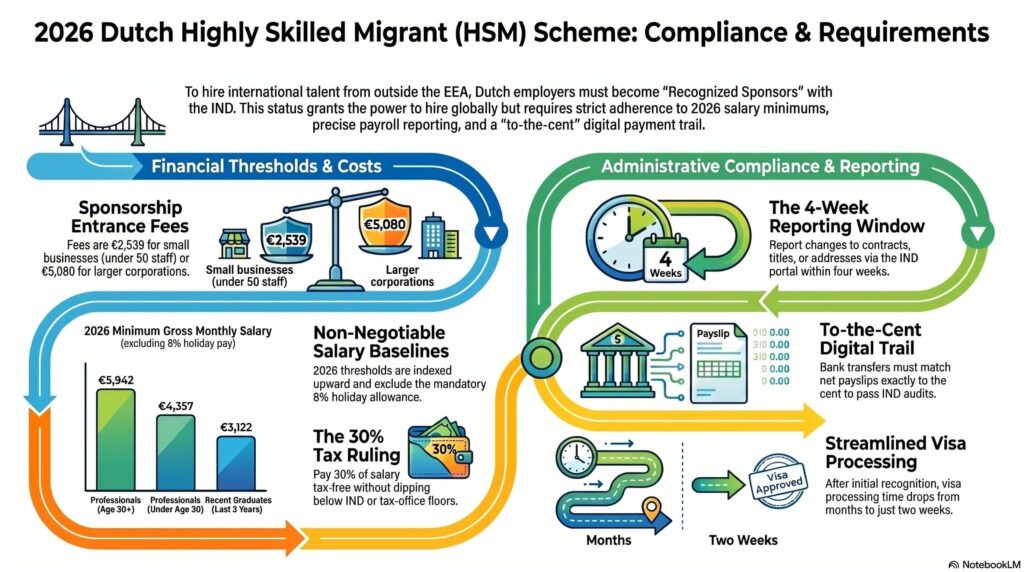
One of the most critical things to get right is the pay scale. The IND sets very specific minimum wage requirements for highly skilled migrants and these numbers are non-negotiable. For 2026, the thresholds have been indexed upward again. If you’re hiring someone who is 30 years or older, you must pay them a gross monthly salary of at least €5,942. If they are under 30, this requirement is slightly lower at €4,357. There’s also a reduced rate of €3,122 for people who have graduated from a top university within the last three years. It’s important to remember that these figures are the bare gross amounts, which means they don't include the mandatory 8% holiday allowance.
Next to that, keep in mind that these numbers aren't just a suggestion; they are hard legal requirements. Thus, if your payroll slips up and pays even a few euros less than the required amount, you risk losing your recognized sponsor status and getting your employee’s visa revoked. So this is where your payroll setup needs to be airtight. It means that you always have to ensure that the social security wage on the payslip always matches or exceeds the amount that you promised the IND in the application. It's actually a very common mistake for new employers to include irrelevant things, like travel allowances or bonuses to reach the threshold, but the IND is very strict about what counts as a fixed salary. This means that you need to keep your 2026 payroll data perfectly aligned with these limits, as it’s the only way to keep your international team and your license safe from issues.
The application process: how does this work?
Becoming a recognized sponsor isn't an easy or quick task. It’s a very formal procedure, that requires a bit of patience and definitely a solid paper trail. In 2026, the process starts with an application to the IND, where you have to prove your company is financially healthy and reliable. For a small business (under 50 employees), the application fee is €2,539, while larger companies pay €5,080. Once you’ve sent in your Dutch Chamber of Commerce (KvK) details and demonstrated that your tax affairs are in order, the IND typically takes anywhere from a few weeks to three months to give you the green light to hire people.
During this waiting period, the IND is essentially inspecting and observing you. They want to see that your business has continuity and isn't just a shell company set up to bypass immigration rules (which some companies actually try, which is why the process is so airtight). Also, if your company is less than 1.5 years old, they might look even more closely at your business plan and your financial backing to ensure you can actually afford the international talent you’re planning to bring in. It’s a good idea to have your latest annual accounts or a solid 2026 budget ready to send in, as any missing documentation can pause the process and stretch the total timeline out even further.
Once the approval letter arrives, your company is officially added to the ‘Public Register of Recognized Sponsors’. This is a big moment, because it radically simplifies all your future hiring. From this point on, you can apply for residence permits for your migrants online, and the processing time drops from months to just about two weeks. It’s a significant upfront investment in both time and money, but it’s the essential foundation for any Dutch business that wants to grow using global talent, rather than being restricted by the local labor supply.
The 30% ruling
When you’re hiring from abroad, the 30% ruling is your best bet to make an offer look attractive. This ruling basically allows you to pay out 30% of a migrant's gross salary completely tax-free. However, for 2026, you have to be very careful with the math if you apply this rule. The IND rules state that the taxable portion of the salary, which is the part left over after you take out that 30%, must still stay above the 30% ruling's own salary norms (which are different from the IND's). For 2026, the general taxable salary must be at least €48,013.
The tricky part is that if your employee is over 30, they also have to hit that IND threshold of €5,942 per month. So, you can't use the 30% ruling to pull their taxable pay below that IND floor. If you do, the IND will see it as a violation of their visa conditions. A smart payroll setup calculates the maximum tax-free allowance possible without ever dipping below those two critical points. It’s a bit of a hassle to do, but when done right, it maximizes your employee’s salary without costing you an extra cent.
Having this managed correctly also shows your new employee that you aren't just a boss, but a professional who understands the Dutch system. It essentially turns a good and stable salary into a great one. In the 2026 market, where every euro of net pay counts, being able to offer this tax-free benefit safely is the difference between a "yes" and a "no" from a top-tier candidate. As such, you can literally see it as an ultimate win-win for a growing company and its international team.
New 2026 administrative duties you should definitely be aware of
One of the biggest changes for 2026 is how the IND factually checks your administration. In the past, they mostly looked at things such as your signed contracts and payslips. But now, as a recognized sponsor, you actually have a new administrative obligation: you must be able to prove that the salaries you supposedly pay are really being transferred to the employee's personal bank account every single month. They essentially want to see a digital paper trail that matches the net amount on the payslip exactly.
This means you can't just be ‘close enough’ with your payments. If your payroll software calculates a net pay of €4,125.60, you must transfer exactly €4,125.60. Any discrepancy, even of a few cents, can be flagged during an IND audit as a potential compliance risk. For a busy business owner, this level of precision can be a headache to deal with, which is why most companies now use automated SEPA payment files. It ensures the bank executes the exact number the payroll system generated, leaving a perfect trail for the inspectors.
Beyond just the bank transfers, your 2026 sponsor file needs to be absolutely correct as well. This includes things like keeping a verified copy of your employee's ID, their current address and their specific job description on file. At all times. The IND's goal is to ensure that the person you said you were hiring is actually the one doing the work and receiving the pay. Keeping these records updated isn't just about good filing; it’s even more about protecting your license to hire from abroad and avoiding the heavy fines that come with administrative mistakes.
Your mandatory reporting obligations
Being a recognized sponsor comes with a very specific ‘to-do list’ regarding the IND. You have a legal duty to Inform them whenever something significant changes in your employee’s life, or work status. In 2026, the window for this is tight: you generally have only four weeks to report a change via the IND's business portal. This includes the obvious stuff like if the employee quits or gets fired, but it also covers things you might not expect, like a change in their job title, a significant pay cut, or even if they move to a new house.
The most common trap for small business owners is forgetting to report a change in the conditions of employment. If your highly skilled migrant decides they want to work four days a week instead of five, that’s a change in their contract that could potentially push their salary below the 2026 thresholds. Even if the employee is happy with the arrangement, the IND will see it as a violation if it wasn't reported. Keeping something similar to a compliance calendar is the only way to stay ahead of these deadlines. You basically need a system that pings you the moment a contract is tweaked so you can update the authorities before that four-week window slams shut.
If you fail to report these changes on time, the consequences aren't just a slap on the wrist. The IND can issue administrative fines that start in the thousands of euros, and if you’re a repeat offender, they can even revoke your sponsor status entirely. This would mean all your international hires would lose their right to work in the Netherlands almost instantly. It sounds intense, but it’s really just about keeping a solid administration. By making reporting a standard part of your monthly routine, you ensure that your business remains a trusted partner in the eyes of the Dutch government.
Payroll and visa rules
In the Netherlands, payroll isn't just about paying people; it’s a formal declaration of compliance to two different government bodies at once. The tax office and the IND share data, so the numbers on your monthly payroll return must perfectly mirror the promises you made in the migrant’s visa application. In 2026, one of the biggest risks for a business owner is wage inconsistency. If your contract says the employee earns the required €5,942, but your payroll reflects a lower taxable wage because of a misclassified deduction, the system will flag a mismatch.
This is why your payroll components have to be set up with extreme care. You need to be certain which parts of the compensation package, like a 13th-month bonus or a fixed allowance, actually count toward the IND salary threshold. For example, if you accidentally categorize a performance bonus as a variable payment, the IND might not count it toward the minimum amount, suddenly making your employee underpaid in the eyes of the law. A specialized payroll setup ensures that every euro you spend is coded correctly from day one, so that your monthly reporting to the tax office automatically satisfies your immigration requirements as well.
Think of your payroll as the source of truth for your company's health. When you have a professional system in place, you aren't just generating payslips; you’re generating protection for yourself and your company against audits. If the IND ever asks for a wage statement ("loonstaat"), you want to be able to hand over a document that is consistent and easy to read. By keeping these two worlds (tax and immigration) in perfect sync, you remove the stress of manual cross-checking and can rest easy knowing that both the Dutch tax authorities and the IND see exactly the same successful and compliant business.
Why payrolling is a solid safety net for you and your employees
When you look at the complexity of the HSM scheme, such as the indexing salaries, the strict reporting windows, and the new 2026 banking requirements, it becomes clear that this is an environment that doesn’t allow you to make any mistakes at all. For you as a foreign entrepreneur, one administrative slip-up isn't just a financial nuisance; it’s a threat to your ability to do business in the Netherlands. Trying to track this on a basic spreadsheet or using a generic, one-size-fits-all payroll app is simply too risky when your sponsor license is on the line. You need a partner who understands that a payslip for a migrant is actually more like a legal document for the IND.
Hiring a specialized Dutch payroll provider isn't just about outsourcing the work, but it’s mainly about hiring a compliance officer for your team. Such experts are the ones who will catch a threshold issue before the payment is even made, ensuring you never accidentally trigger an audit. They provide the SEPA files that guarantee your bank transfers match your records perfectly, and they can often assist with the 30% ruling applications. It’s an investment in your company’s infrastructure that allows you to focus on the person you hired, rather than the paperwork that follows them. Next to that, opting for an EOR is safest, as this takes all responsibility out of your hands, and you can just focus on what you do best, instead of having to do loads by yourself.
In the end, the goal of hiring a highly skilled migrant is to bring fresh energy and expertise into your business. You shouldn't spend that energy worrying about whether you reported a change of address within the four-week window or if your holiday allowance calculation meets the 2026 norms. By putting a professional payroll safety net in place, you’re making sure your international hires feel secure, and your business is seen as healthy by the IND. It’s the best way to make sure that the complicated immigration process turns into a smooth, professional growth strategy for your company and Intercompany Solutions can provide you with exactly that assurance.
IND sponsorship cost and timeline overview
- Small Business Fee (≤50 employees): €2,539 (one-off)
- Corporate Fee (>50 employees): €5,080 (one-off)
- Per-Employee Permit Fee: €423
- Standard Processing Time: 2–3 months (before recognition)
- Streamlined Processing Time: ~2 weeks (after becoming a Recognized Sponsor)
Intercompany Solutions can guide you through all payroll requirements and take this job off your hands
If you are looking for foreign personnel, or want to hire someone specific from a foreign country to work in the Netherlands for you, you’d do well to hire an expert third party that knows how this stuff is handled. At Intercompany Solutions, we don’t only have years of experience and expertise in the establishment of Dutch companies, but we can also take the entire hiring and payroll process off your hands. Our experts know every single important thing there is to know and, as such, you can rest assured that all matters are handled correctly and in line with Dutch laws and legislation. If you would like to simplify the entire hiring process, please feel free to contact us directly for personal advice and, possibly, a clear quote. We are more than happy to help you wherever we can.
Similar Posts:
- Foreign multinational corporations & the Netherlands annual budget
- Tax treaty denounced between the Netherlands and Russia per January the 1st, 2022
- How to set up a business as a young entrepreneur
- Want to innovate in the green energy or clean tech sector? Start your business in the Netherlands
- Significant amendments to the law in Holland in 2019