


Do You Need to Register with the IND to Hire Foreign Employees?
Intercompany Solutions offers a wide variety of services, especially for foreign entrepreneurs who would like to establish a business presence in the Netherlands. You can count on us to take care of the entire incorporation process, but that definitely isn’t where our work for you ends. Next to our core business, we also offer various extra services that are specifically designed to keep your company successful and afloat. One of these services is everything that has to do with hiring employees and payrolling in particular. We offer complete payrolling services and can also act as an EOR for you, which makes it much easier and clearer for you to hire employees without having to deal with the entire administrative side of the matter. If you would like to know what we can do for you, please do not hesitate to contact us directly. We will be more than happy to tell you what we can do for you and your business.
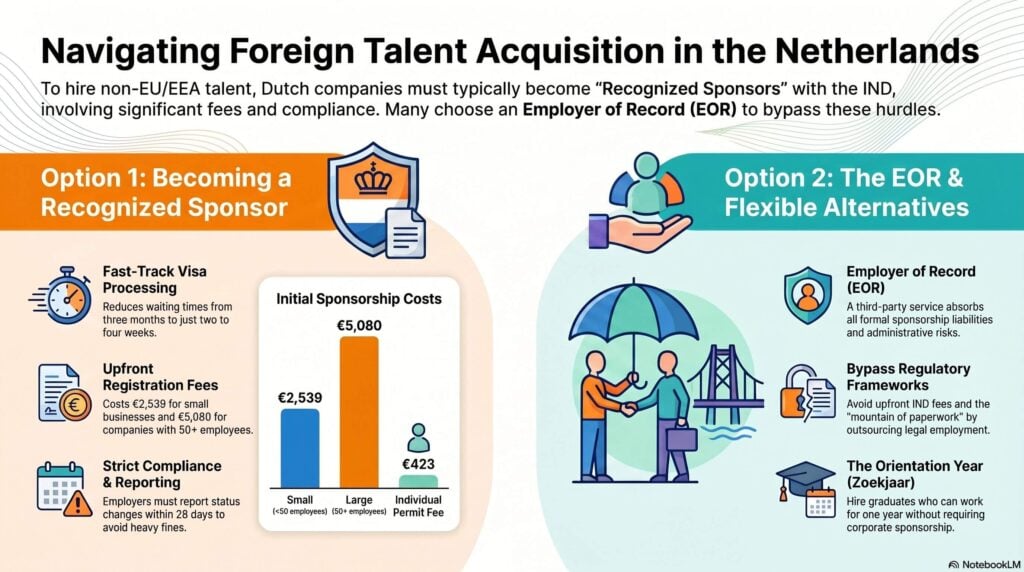
Summary: To hire personnel from outside the EU/EEA, a direct employer must register as a ‘Recognized Sponsor’ with the IND. Otherwise, the immigration authority will refuse to process any work or residence permits. Gaining this status grants access to a fast-track processing window of two to four weeks instead of three months, requiring a one-time application fee of €2,539 for small businesses (under 50 employees) or €5,080 for larger entities, plus €423 per individual permit. Companies can entirely bypass this intense regulatory framework, upfront costs, and strict ongoing reporting duties by using an Employer of Record (EOR) service, which absorbs all formal sponsorship liabilities.
| Question | Short answer |
|---|---|
| Do EU/EEA/Swiss hires need it? | No. They can work without a permit or IND sponsorship |
| Do non-EU/EEA hires need it? | Yes. You must be an IND recognized sponsor (erkend referent) |
| What does sponsorship cost? | €2,539 (under 50 staff) or €5,080, plus €423 per permit |
| What is the benefit? | Fast-track permits in 2-4 weeks instead of up to 3 months |
| Can you avoid it? | Yes, via an EOR, an orientation year (zoekjaar) permit, or EU/EEA hires |
The reality of hiring employees beyond Dutch borders
Finding top talent in the Netherlands did not get any easier in the past few years. Possible candidates are becoming more and more critical about potential jobs and have much more preferences and even demands than in the past. So when you decide to post a job opening for a developer or a data analyst, the stack of resumes is generally either too thin, or missing that specific bit of expertise you really need. That is exactly when you should start looking past the Dutch borders. Bringing in foreign talent expands your reach, but it also brings a whole new set of rules you might not have expected. Think about the situation. You find the perfect candidate from outside the European Union. You are excited, they are excited, and you want to get them on the payroll as soon as possible.
Then someone mentions the IND: the Dutch Immigration and Naturalization Service. Suddenly, the simple act of hiring someone feels like a massively complicated task. So why look abroad at all? Because sometimes the local market just does not have the highly specific skills you require to scale your business. Whether it is an international marketing specialist, an experienced engineer or a product specialist: expanding your search area makes your business competitive.
But when your new hire holds a passport from outside the EU, the Dutch government wants to know who is coming in and why. The IND essentially plays the role of gatekeeper. They make sure the company hiring the individual is legitimate, and the employee actually has a reason to be here. Thus, before you can even apply for a visa or a residence permit, you might need to take a step back and look at your own corporate registration. It is not just about the person; it is about your business's status with the authorities. That’s what we will discuss in this article. If you want more factual information about tax obligations when hiring foreign employees, you should definitely also check out this article.
Understanding the IND and recognized sponsorship
As we mentioned above, to bring in top talent from outside the EU, you will inevitably deal with the Immigration and Naturalization Service, or IND. They act as the main gatekeeper for international labor migration into the Netherlands, ensuring that the company and the individual meet all applicable legal requirements. For most growing businesses, the best approach here is becoming a so-called recognized sponsor (“erkend referent”). But why does this matter?
In essence, being a recognized sponsor gives you a fast pass through the bureaucracy of hiring foreign employees and makes the process much easier and faster. This concretely means that instead of waiting up to three months for visa approvals, applications submitted this way usually take just two to four weeks. To actually gain this status, your business must be registered with the Dutch Chamber of Commerce and demonstrate financial stability. The IND also checks for reliability, which means there should be no major recent bankruptcies, tax debts, or prior immigration infractions. There is a one-time fee to apply for this status, which is €2,539 for businesses with 50 or fewer employees and €5,080 for larger companies.
Once you have the sponsor status, the way you do business and hire people becomes much simpler. For example, the fee for individual residence permit applications drops to €423. You can also manage everything easily through the IND Business Portal. It really turns a massive administrative workload into a predictable and smooth process. However, this status comes with a strict duty of care. You are responsible for keeping proper records, including things like proof that the salary is paid into the employee’s personal bank account each month.
When do you strictly need to register with the IND?
So, when is IND sponsorship actually a mandatory thing? If you are hiring someone who holds an EU, EEA, or Swiss passport, you have no such obligation. These individuals have the right to live and work in the Netherlands without any specific immigration permits. You just need to get them set up in your standard payroll system. But the moment you hire a non-EU/EEA national, the rules change entirely, as you cannot simply put them on your payroll. For starters, they will need a valid residence and work permit. To get that permit for a Highly Skilled Migrant, an Intra-Corporate Transferee, or an EU Blue Card holder, your business must act as the official recognized sponsor.
What happens if you do not register? The IND will simply refuse to process the work or residence permit applications for your candidates. The application must be submitted under your sponsor status for the process to be valid and to receive a decision within the typical two-to-four-week window. Nonetheless, there are also a few edge cases to consider. For instance, if your new hire already holds a general residence permit that grants unrestricted access to the Dutch labor market, you do not need to be a sponsor. Or, if you use an Employer of Record (EOR) service to employ them, the EOR handles the sponsorship. As such, the registration links the work visa directly to your business identity. Without it, your foreign candidate cannot legally start working for you in the Netherlands. Also keep in mind, that trying to bypass this requirement can result in steep fines for non-compliance and also immediate visa rejections, which is something you should avoid at all costs.
The application process for sponsorship
Let’s look at the actual application process. It takes place through the aforementioned IND Business Portal. It is not as scary as it sounds, provided you have your paperwork sorted before you start. First, the IND checks if your business is reliable and stable. They look for recent bankruptcies, large tax debts or any issues labor laws. You will need an active KVK extract and recent financial statements to prove you can actually pay someone a salary. Next, you should definitely consider the costs. Keep in mind that the application fee depends on your company size. We mentioned the fees above, they aren’t very steep, but you should still take these costs into account.
Once you pay the invoice, the IND begins its review. The waiting takes between one and three months if you are completely new. If you already have a network of international staff, you might get approved faster. You will receive a formal decision and access to the online portal. Once your recognition is active, you can apply for the residence permits of individual workers. The fee per permit application is €423 for 2026. Make sure you do not wait until the last minute to gather these documents, though. Having your financial data ready means you can transition into a recognized sponsor without unnecessarily stalling your hiring timeline.
Ongoing obligations and necessary compliance once you are registered with the IND
Once your company achieves recognized sponsorship status, the real work of compliance begins. The IND expects you to act as an attentive and responsible employer. If fail to perform your administrative duties correctly, you risk losing your sponsor status altogether. First, you have a strict duty to inform. If an employee quits, is fired, or stops working for your business, you cannot just let things happen and do nothing: you must actually notify the IND within 28 days. The exact same rule applies if the employee’s salary drops below the required threshold, or if they take extended unpaid leave.
Second, the rules around record-keeping have expanded in the past few years, as we have also discussed in detail in this article. For example, you must now keep actual proof of salary payments in your administration. Compared to the past, when a simple payslip was enough, this means more work. Now, the IND can request to see business bank statements or batch payment overviews showing the money really left your company account and landed in the employee's personal account.
Third, you need to keep their employment details up to date. This includes their current residential address in the Netherlands and a copy of their valid passport or residence permit. You must store these records for at least five years after the employment relationship ends. It sounds like a mountain of paperwork, but it is entirely manageable with the right tools or a good payroll partner like Intercompany Solutions. Think of it as standard procedure to keep your sponsor license active and your relationship with the IND completely sound.
Alternatives to direct sponsorship
Sponsorship is great and makes a lot of things easier, but keep in mind that it is not your only option. If you are just starting out, or you only need to hire one person, the upfront fees and the legal workload might not fit your budget. So, what is the alternative? Many business owners use an Employer of Record, or EOR. Think of it as outsourcing the legal side of employment, since the third-party company takes on all legal responsibility. They become the formal employer on paper, manage the work permit, and run the local payroll. Your new hire works for you every day, but the EOR carries the administrative risk and compliance burden.
Another route is looking for candidates with an orientation year (“zoekjaar”) residence permit. These are usually recent graduates from Dutch or top global universities who have a pass to work in the Netherlands without requiring their employer to be a recognized sponsor. It is a fantastic way to test out a new hire for a year before making a long-term commitment. Of course, you can also hire citizens from the European Economic Area. These employees do not require permits or sponsorship, which completely bypasses the IND system. Using an EOR or hiring individuals with unrestricted work rights lets you build your team without immediately setting up a corporate sponsorship infrastructure. Instead, it lets you focus on growth while someone else handles all the complicated things for you.
Common pitfalls and how to avoid these
Let us wrap things up by looking at the most common mistakes that some employers make when having to deal with the IND. Because even a single oversight can eventually spiral into a formal warning, or even the loss of your sponsor status, so it is wise to be prepared. The most frequent oversight happens when the new year starts. The IND updates salary thresholds every January. If you forget to adjust an employee's salary after the indexation, or fail to notify the IND that they now fall below the threshold, you are instantly out of compliance.
Another common trap is unpaid leave. If a highly skilled migrant takes unpaid leave and their salary drops below the required minimum for that period, you are legally required to report it to the IND within four weeks. Ignoring it simply because it is temporary can result in heavy administrative fines. Then there is the record-keeping requirement we discussed. The IND now demands actual proof of salary payment, not just a monthly payslip. If you only have payslips on file during an audit, you will fail the inspection. Thus, keep those bank transfer statements or payroll batch overviews saved in your folders.
Missing background documents are also a classic pitfall. Always make sure the antecedents certificate is signed before the candidate arrives, and keep a copy of their passport and their current Dutch address on file. What happens if you ignore these rules? First-time offenders usually get a warning, but repeat offenses lead to serious financial penalties ranging from €1,500 up to €4,500 per violation. In extreme cases, the IND will even pull your sponsor license. So make sure to keep your files clean and stay alert to the calendar. A little discipline here keeps your international team working without interruptions.
Intercompany Solutions can assist you with various services aimed at hiring employees
Intercompany Solutions offers extensive payroll services, including extra services that are aimed at making your administration much easier and manageable. We understand that specifically foreign employees might have difficulties with hiring personnel in the Netherlands, especially when you don’t have a Dutch BV in place (we can also assist you with that, by the way, if you ever want to expand your corporate presence to the Netherlands). In short, we make sure all tax duties and administrative obligations are met in a correct manner, which means you can focus solely on your daily business activities and personnel. And since we also offer EOR services, we can take care of all necessary visa procedures for you, so you don’t have to become a recognized sponsor with the IND and can focus on other matters instead. If you would like to know more about what we do and specifically what we can do for you, please feel free to contact us anytime with the questions that might be on your mind.
Similar Posts:
- Foreign multinational corporations & the Netherlands annual budget
- Tax treaty denounced between the Netherlands and Russia per January the 1st, 2022
- How to set up a business as a young entrepreneur
- Want to innovate in the green energy or clean tech sector? Start your business in the Netherlands
- Dutch legislation related to foreign investments