



Salary Requirements for Foreign Employees in the Netherlands: a 2026 Guide
Would you like to hire personnel outside the Netherlands? Many companies opt for this possibility, since there are many highly skilled migrants available that can take care of very specific tasks for you. If you are looking for a specialist, it is quite possible that you sometimes aren’t able to find such a person within Dutch borders. In these cases, we are here to assist you. As we can operate as an Employer of Record (EOR), we can take care of the entire hiring and payroll process for you, as well as take care of all necessary visas and work permits. Hiring someone from abroad can actually be quite complicated, so outsourcing this job is often the most sensible thing you can do, especially if you want to remain compliant with all Dutch laws and regulations. If you would like to know more about this subject, feel free to contact us with any questions you may have.
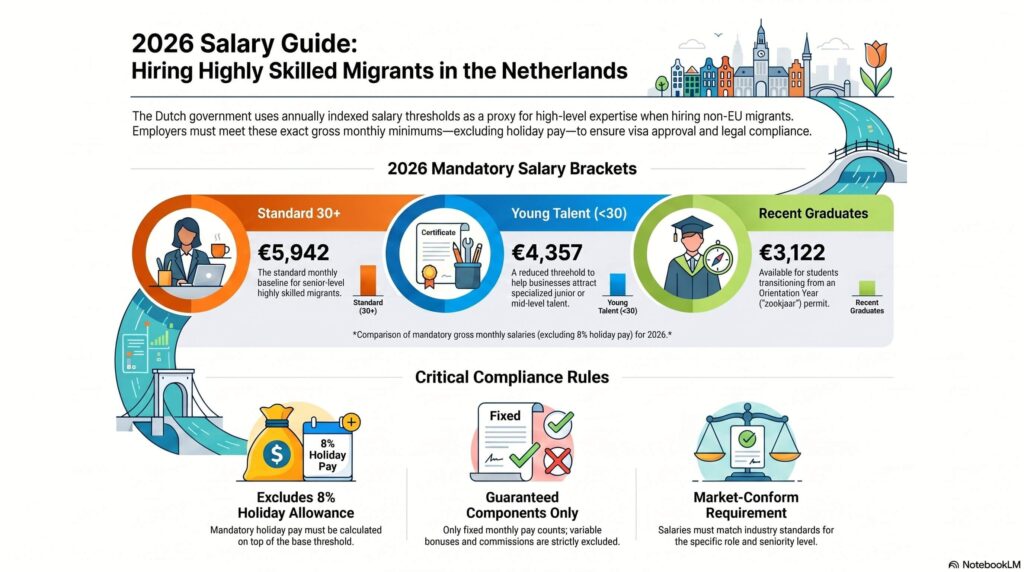
Summary: When hiring non-EU professionals, employers must meet strict, annually indexed IND salary thresholds that serve as a government benchmark for top expertise. In 2026, the mandatory gross monthly minimums (excluding 8% holiday pay) are €5,942 for highly skilled migrants aged 30 and older, €4,357 for those under 30, and a reduced €3,122 for recent graduates transitioning from an orientation year (“zoekjaar”). To maintain visa compliance, employers must ensure these amounts consist strictly of fixed, guaranteed monthly components, are fully market-conform, and are systematically tracked to prevent permit revocations if an employee's hours or pay drop.
| Permit / category | 2026 gross monthly minimum |
|---|---|
| Highly skilled migrant (30 and older) | €5,942 (excl. 8% holiday pay) |
| Highly skilled migrant (under 30) | €4,357 |
| Recent graduate / orientation year | €3,121 |
| European Blue Card | €5,331 |
| Intra-Corporate Transferee (ICT) | No fixed amount; must be market-conform |
Why do salary thresholds exist in the Netherlands?
If you are new to hiring in the Netherlands, the first thing you will notice is that you cannot just pay a foreign worker whatever you both agree on. Unlike hiring a local, where the market and the minimum wage set the floor, hiring from outside the EU involves the government sitting at the negotiating table with you. They essentially use salary thresholds as a filter. The idea is pretty simple: the Dutch government wants to ensure that knowledge migrants are actually bringing high-level value. Instead of checking every single diploma or interviewing every candidate, the authorities use salary as a shortcut. If a company is willing to pay a certain premium, the government automatically assumes the worker has the specific expertise that is scarce in the local market.
This system protects the local labor market from wage competition, but it also ensures the migrant can actually afford to live here. The Netherlands is not a cheap country to live in, especially in the big cities. By setting these floors, the IND makes sure that anyone moving here has a stable financial foundation from day one. As a business owner, you need to view these numbers as a hard baseline. Also take note that they are updated every January 1st to keep up with inflation. If you manage to not reach the base amount by even a few euros, the visa application will be rejected before it even lands on a reviewer's desk. It is the most common beginner’s mistake in international hiring, and it is entirely avoidable if you know the current brackets, which we will discuss below for your convenience.
The 2026 baseline salary for highly skilled migrants
When we talk about the standard highly skilled migrant, we are usually looking at a professional over the age of 30. For 2026, the IND (the Dutch Immigration and Naturalization Service) has set the minimum at €5,942 gross per month. It is important to note that this figure does not include the mandatory 8% holiday allowance. If you are calculating your annual budget, you need to account for that extra amount on top of the monthly baseline. Why such a specific number? The IND indexes these rates every year based on collective labor agreement (“Collectieve Arbeidsovereenkomst”, or “CAO”in Dutch) wage trends. If you hired someone in 2025 on a lower rate, they are generally getting paid this amount as long as they stay with you.
However, the moment someone changes employers or their permit needs an extension in 2026, they must meet this new, higher threshold. For you as the employer, this means your payroll needs to be solid and correct. If you accidentally pay €5,940 instead of €5,942, you have technically breached the conditions of the residence permit. It sounds like nitpicking, but the IND doesn't have a close enough category. Also, keep in mind that this salary must be market conform. You cannot pay a junior assistant €6,000 just to get them a visa if the rest of the industry pays €3,000 for that role. The IND checks to see if the pay matches the position. If you’re paying a premium for a senior role, just ensure the job description and the candidate's CV actually back up that seniority.
What is the ‘Young Talent’ discount?
If you are a smaller company or a fast-growing startup, that nearly €6,000 monthly threshold can be a very high amount for you to pay. This is where the so-called reduced salary criteria come into play. The Dutch government recognizes that a 26-year-old with a Master’s degree is likely a highly skilled migrant in the making, but they haven't yet reached the peak of their earning power. For 2026, if your candidate is under the age of 30, the monthly salary requirement drops to €4,357 (excluding holiday pay again). This is a significant difference that allows you to bring in specialized junior or mid-level talent, without overstretching your current budget.
However, there is a birthday trap you need to watch out for. The day your employee turns 30, the rules do not automatically change for that specific contract. If they were already in the Netherlands on a valid permit under the lower threshold, they can stay on that lower rate even after they turn 30. But, and this is a big but, if they change employers after turning 30, their new employer (you) would have to pay them the full €5,942 rate to get them a new permit. Essentially, the lower rate is tied to the start of the residence permit. It’s a great way to lock in talent early. Just make sure their Master’s degree is from a recognized institution and that you’ve got their passport on file to prove their age. If you accidentally hire a 30-year-old on the junior rate, the application will be dead on arrival.
About the orientation year and recent graduates
If you ever find a candidate who just finished their studies (either in the Netherlands or at a top-ranked university abroad), you might be eligible to apply for the Orientation Year (or “zoekjaar”) permit. This is essentially a one-year free pass from the government. During this year, the graduate doesn't need a specific salary threshold at all. They can even work for you as an intern or a regular employee on minimum wage if that's what you both agree on. The real magic happens when that year is up: if you decide you want to keep them long-term, they qualify for a permanent reduced salary rate. For 2026, that rate is €3,121 per month (again, excluding holiday pay). The best part about this is, that this lower rate stays with them for as long as they work for you, even after they turn 30 or stay for several years.
From a business perspective, this is a massive advantage. You get to test a high-potential graduate for a year with zero IND paperwork, and if they’re a fit, you can hire them permanently at a much lower cost than a standard highly skilled migrant. Just a word of caution: the graduate must apply for this reduced rate status within three years of finishing their degree. If they wait too long, they lose the discount and go back into the under 30 or over 30 salary brackets. Always ask to see their diploma and their current residency card before you draft the contract, so you know exactly which category they fall into.
The European Blue Card and Intra-Corporate Transferees
While the so-called Highly Skilled Migrant permit is the most chosen option for many Dutch companies and international companies based in Holland, you might occasionally run into the European Blue Card or the Intra-Corporate Transferee (ICT) permit. These are based on EU-wide rules rather than just Dutch law, and they come with their own specific amounts. The European Blue Card was designed to make it easier for top-tier professionals to move between different EU countries. Because it’s an EU-standard permit, the salary bar is usually set higher than the Dutch national permits.
For 2026, you are looking at a threshold of €5,331 gross per month (excluding holiday pay). The upside of this option is, that if an employee has held a Blue Card in another EU country for eighteen months, the process to bring them to the Netherlands is much faster. Next to this interesting option, there is also the ICT permit. This is for when you are moving a manager, specialist, or trainee from a branch of your company outside the EU to your Dutch office.
The salary requirements here don't have a fixed amount. Instead, the IND checks if the salary is market conform for the Dutch branch. This means you have to prove that the salary you are paying the transferee is close or identical to what a local Dutch employee would earn in the exact same position. Whether you are using a Blue Card or an ICT permit, the key is consistency. Make sure you know that these aren't budget options, by the way. They are specialized tools for senior leadership and global mobility. If you are a small startup, the standard Highly Skilled Migrant route is almost always the smoother, more cost-effective path to choose instead.
What a Dutch salary actually includes
When you are calculating whether your candidate hits the 2026 threshold, you have to be very careful about what you throw into the equation. You cannot just bundle every perk together to reach the amount that is necessary. The IND only cares about fixed and certain components. In plain English, if the money isn't guaranteed every single month, it doesn't count toward the threshold. Your base gross salary is the main part. Beyond that, things like a fixed structural allowance (for example, a fixed 13th-month payment) can usually be included if they are written into the contract.
However, variable bonuses, commissions, and performance-based tips are strictly excluded. Why? Because there is a chance the employee might not get them. The IND wants to see that even if the employee has a bad month at work, their bank account still receives that legal minimum. Expense reimbursements, like travel costs or a home office allowance, are also not allowed to be incorporated into the threshold calculation. Even the 8% holiday allowance, while mandatory in the Netherlands, is calculated on top of the salary thresholds like we discussed earlier.
The one major exception is the 30% ruling. If your employee has this tax break, the IND looks at their taxable salary plus the tax-free reimbursement. So, basically, as long as the total gross amount you are paying out matches the threshold, you are safe. Just make sure your employment contract clearly separates these items. If you just put a single lump sum on the payslip, a Dutch tax auditor will create a lot of problems for you, and you definitely do not want that. So staying compliant is absolutely of the essence here.
How hiring an Employer of Record (EOR) can help you
Knowing these salary thresholds is one thing, but actually managing them month-to-month is where it can become very complicated for you. In the Netherlands, you need to be meticulous when it comes to the IND and the Dutch tax authorities. If your payroll slips aren't perfect, you aren't just looking at a minor accounting error, but you are risking the legal residency of your employees and your own status as a recognized sponsor (if you choose to be one).
This is why manual tracking in a spreadsheet is usually a recipe for disaster. You need a payroll setup that is aware of these specific 2026 rules. For example, if a highly skilled migrant takes a few weeks of unpaid leave, or if they decide to go part-time, their salary might suddenly dip below the legal threshold. Without an automated check, you might not notice until you get a red-flag notification from the authorities and this is when things can spiral very badly. Thus, it is wise to seek out a professional who can take care of all these matters for you, like Intercompany Solutions.
Because when you integrate these requirements directly into your payroll process, it becomes an early-warning system. It ensures that the mandatory 8% holiday pay is calculated correctly, that the 30% ruling is applied only to the allowed parts of the income, and that your monthly payments are sent from the correct business account. Ultimately, the goal isn't just to pay people, but it's meant to create a paper trail that proves you are actually a reliable employer. Thus, by making the IND's salary requirements a core part of your payroll workflow, you can focus on growing your business while you are being compliant in the background. As such, it turns a potential legal battle into just another smooth outsourced task.
Intercompany Solutions can assist you with our advanced payroll and EOR services
Would you like to hire highly skilled migrants? Or maybe are looking for top-talent amidst people who just graduated? Then it’s very important that you handle all the necessary administrative and tax related duties correctly. We understand that this can be challenging, especially for foreign entrepreneurs that operate here. That is why we offer various interesting services that range from tax advice to handling visa applications and the entire payroll process. This takes an immense amount of work out of your hands, making it possible to focus on your daily business activities and growth of your business in general instead. Would you like to know more about what it is we can do for you? Then take a look at our website, or contact us directly via the contact form. We will generally get back to you within 1 or 2 business days.
Similar Posts:
- Foreign multinational corporations & the Netherlands annual budget
- Tax treaty denounced between the Netherlands and Russia per January the 1st, 2022
- Want to innovate in the green energy or clean tech sector? Start your business in the Netherlands
- Significant amendments to the law in Holland in 2019
- How to set up a business as a young entrepreneur