


Payroll Services in the Netherlands for Your Small Business: How Does This Work?
Do you currently own a small business in your foreign country, and would you like to expand your business activities to the Netherlands? Or do you plan on creating a company, or even starting a business here? In all these cases you will need to take into account that you will have to pay certain taxes and costs when you want to hire personnel for your business. For example, a representative for your company, customer service employees or managers, to name just a few. Intercompany Solutions can make the entire hiring and employment process a lot easier for you, by taking everything out of your hands with our vast range of EOR and payroll services. We make sure you always adhere to all applicable Dutch laws and regulations, that your employees are paid exactly what they should be paid and that you can spend all your time on the progress and growth of your company, instead of mundane tasks such as your administration. If you would like to know more, please do not hesitate to contact us directly for more information.
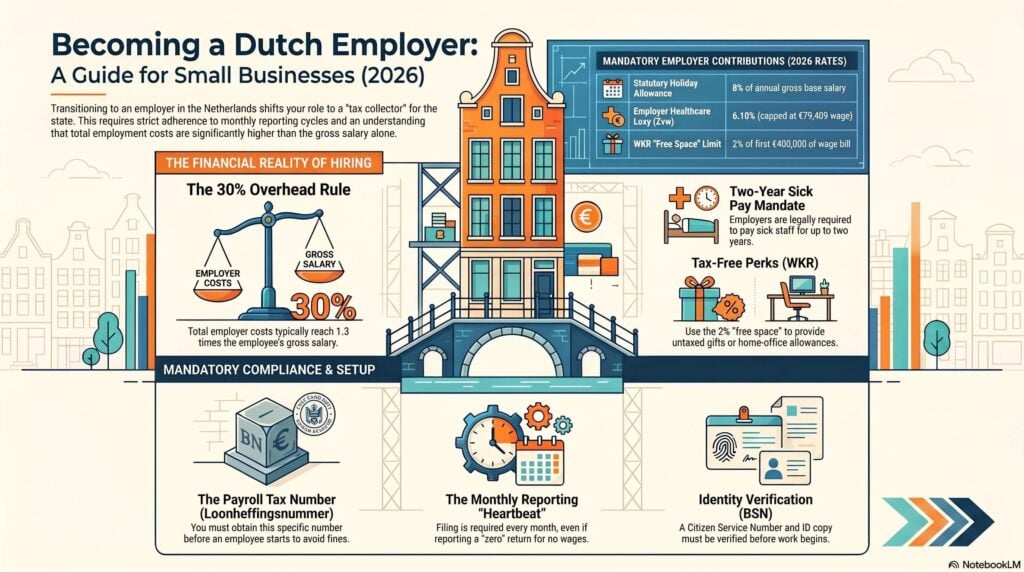
Summary: Transitioning from a solo venture to a small business employer in the Netherlands requires registering for a specific payroll tax number (“loonheffingsnummer”) with the Dutch tax authorities, prior to an employee's start date. Beyond the gross salary, Dutch employers must manage an additional 20% to 30% overhead in mandatory employer costs, which include the statutory 8% holiday allowance (typically paid in May), the 6.10% employer healthcare levy (Zvw), and mandatory social insurance contributions capped at a maximum premium wage of €79,409 in 2026. To protect yourself against liabilities from the strict Dutch two-year statutory sick pay mandate, small businesses are strongly advised to integrate Sickness Absence Insurance (“verzuimverzekering”) directly into their monthly payroll cycles.
| What you pay or do | Detail for 2026 |
|---|---|
| Payroll tax number | Register a loonheffingsnummer with the Dutch tax authorities before day one |
| Gross vs net | Withhold wage tax and social premiums; budget 20-30% on top of the gross salary |
| 8% holiday allowance | Accrue it every month, usually paid out in May |
| Sick pay and insurance | Up to 2 years of statutory sick pay; cover it with a verzuimverzekering and Arbo service |
| Monthly filing | File a payroll tax return every month, even a zero return |
| WKR free space | Around 2% of the wage bill (first €400,000) for tax-free perks; 80% tax over the limit |
The shift to employer status as an entrepreneur
Changing from a one-person company to being a registered employer in the Netherlands is an exciting step, but it’s also the moment the paperwork gets massive and complicated. For many small business owners in Holland, hiring that first employee feels like a giant leap in terms of complexity. You’re no longer just responsible for your own invoices and VAT; you’re now also stepping into the role of a tax collector for the Dutch government. In the Netherlands, the payroll system is essentially built on a foundation of high-level social security and correct reporting.
This basically means, that it isn't as simple as just transferring a sum periodically to your new employees' bank account. Instead, you’re entering a structured environment where every euro must be accounted for and reported to the Dutch tax authorities (“Belastingdienst”). Whether you’re an expat entrepreneur, someone who owns a company abroad or a local starting a boutique agency, understanding that this is a professional partnership with the Dutch state is the first step you will need to take. You aren't just paying a salary anymore; you're really taking on a big social responsibility, and you should definitely be very aware of this fact.
In the Netherlands, this means you're now responsible for things such as your employee’s health coverage, their future pension and even a safety net if they lose their job. It feels like a massive weight when you first look at the rules, but you'll find the way to go about this eventually. It just takes a few months to get used to the Dutch way of doing things. The main requirement is to change how you view payroll in general, because it isn't just a monthly bill or an annoying chore. It’s the administrative necessity that keeps your business on the right side of the law and keeps your team feeling secure at the same time. If you treat it like a vital part of your business from day one, you’ll avoid the issues that hits a lot of first-time employers. It’s about being professional, even if you’re just a team of two to start with.
The payroll tax number and registration with the Dutch tax authorities
Before you can even think about running a payroll, you have to introduce yourself to the aforementioned Dutch tax authorities. This isn't just about your existing business registration, since you specifically need a payroll tax number (“loonheffingsnummer”). You can’t just use your VAT or Chamber of Commerce registration number for this. You have to fill out a form to let the tax office know you're officially becoming an employer. Once you’re in their system, they’ll expect to hear from you every single month, whether you’ve paid someone or not.
The tricky part for small businesses is the timing. You really want to get this sorted a few weeks before your new employee actually starts. Why? Because without that number, you can’t file your monthly tax return, and in the Netherlands, being late with a filing is a surefire way to get a hefty fine you definitely didn't ask for. You’ll also need to make sure you have the employee’s Citizen Service Number (“BSN” in Dutch) and a verified copy of their ID on file before they even do a single hour of work.
It sounds like a lot of boring admin work, but it’s the only way to make sure you follow the whole process correctly. If you’re a foreign business owner, this is usually the moment where you realize that a local payroll provider is worth your money, as the time you save will be substantial. They can handle the registration for you, making sure all the boxes are ticked so you don't start your journey as a Dutch employer with an enormous amount of corrective paperwork.
The difference and calculation between gross vs. net payments
When you sit down with a candidate to talk about money, you’re usually discussing the gross salary. But the number that actually leaves your bank account, and the number that lands in theirs, are two very different things. In the Netherlands, the gap between gross and net is famous for being quite wide. As the employer, you’re responsible for withholding several things such as wage tax and social security contributions right at the beginning. This means you’re essentially acting as the middleman for the Dutch tax authorities.
It gets even more interesting when you add in the mandatory 8% holiday allowance. Most Dutch employees expect this to be paid out in May, but as a business owner, you need to be accruing this every month in your books. If you tell an employee they’ll earn €3,000 a month, you need to remember that your actual cost is that €3,000, plus the holiday pay, plus the employer-paid taxes. It’s a common pitfall for first-time employers to budget only for the gross salary and then get a shock when the total cost of actual employment is 20% to 30% higher.
To keep things clear, you should always provide your new hire with a pro forma payslip before they sign the contract. This document shows exactly what they will take home after the Dutch tax authorities take their cut. It also prevents any awkward conversations on payday and ensures you both know exactly what the deal is. Understanding this puzzle of deductions is the only way to keep your business's cash flow predictable and your employee's expectations managed.
Social security and insurances
One of the biggest hurdles for any new business owner in the Netherlands is the realization, that the salary you have to pay is just the starting point. Because on top of the gross wage and holiday money, you have to pay certain social security contributions. These cover things like state pensions, long-term disability, and unemployment insurance. In 2026, these so-called workforce taxes are a significant chunk of your overhead. You’re essentially paying for the right to have an employee in the Dutch system, and those costs are mandatory from the very first hour they work.
Then there are the insurances. While some are technically optional, most small business owners in the Netherlands quickly realize they are actually essential. The big one is the Sickness Absence Insurance (“verzuimverzekering”). Because you are legally required to pay a sick employee for up to two years, one bad flu or a long-term burnout could genuinely sink a small company. Taking out this insurance is a standard move for any clever employer. It adds a bit more to your monthly bill, but it buys you the peace of mind that you won't go bankrupt if your team member hits a rough patch in their lives and cannot work for an elongated period of time.
You also have to factor in the “Arbo” service fees. Every employer in the Netherlands must have a contract with a certified health and safety service. They act as the independent medical experts who help with reintegration if an employee becomes ill. When you add up the social taxes, the sickness insurance premiums, and the Arbo fees, your total cost of employment is usually about 1.3 times the gross salary, so around 30% more like we already mentioned before. It’s a lot to understand, but getting these hidden costs into your budget early is the only way to grow your business without any nasty financial surprises in the longer run.
Mandatory monthly reporting cycles
Running a small business in the Netherlands means getting used to a very specific monthly heartbeat. Unlike some countries where you might settle up with the tax man once a year, the Dutch tax authorities want to hear from you every single month. Once you’ve paid your employees, you have to file a payroll tax return. The deadline for this is usually the end of the following month. This means, that you will always have to send the returns and payments to the Dutch tax authorities of the salaries you paid the month before. It’s a hard deadline, because there isn't really a grace period and the fines for being even a day late can be surprisingly high.
Also, even if you didn’t actually pay any wages in a particular month (maybe your only employee was on unpaid leave, or you're between hires), you still have to file a ‘zero’ return. You have to tell the system that there’s nothing to report, otherwise, they’ll assume you’ve forgotten and send a reminder that usually comes with a penalty. This monthly cycle can be a lot for a small business owner to handle on their own, especially when you’re also trying to actually run your company. Most owners find that setting up a recurring calendar alert or an automated system is the only way to stay ahead of these responsibilities.
The mandatory reporting rhythm isn't just about the tax authorities, though. It’s also about your employees. In 2026, Dutch workers expect their payslip and their money to arrive at the same time every month, usually between the 20th and the 25th. If you’re late, it’s not just a legal issue: it’s a trust issue. Keeping that monthly cycle predictable is the best way to keep everyone happy, from your new employee to the tax inspector.
The work-related costs scheme (WKR)
Once you’ve got the basics of salary and taxes down, you’ll want to look into the Work-Related Costs Scheme (“Werkkostenregeling” or “WKR”). This is basically a free space that the Dutch government gives you to provide untaxed perks to your team. In 2026, for a small business, this free space is usually 2% of your total taxable wage bill for the first €400,000. Within this budget, you can give your employees things like a Christmas gift, a gym membership, or even a small bonus without anyone having to pay income tax on it.
It’s a great tool, but it’s one you have to watch closely. If you accidentally spend even one euro over your allotted free space, you get hit with an 80% tax rate on the excess. That is a massive penalty, so most small employers keep an eye on this during the year. There are also targeted exemptions that don't count toward your free space at all, like travel allowances (which are €0.23 per kilometer in 2026) or study costs. Knowing what counts as a ‘perk’ as opposed to what counts as a ‘necessary cost’ is the secret to keeping your team happy, without creating issues regarding your budget.
For a new employer, the WKR is often the best way to stand out from the competition. You can offer extra’s and things like a home office allowance of €2.45 per day, or pay for a new laptop, and as long as you categorize it correctly, it’s a tax-free win for everyone. Just make sure your payroll provider is tracking it for you. There’s nothing worse than trying to be a good boss in December, only to realize you’ve triggered a huge tax bill because you didn't keep an eye on the 2% limit earlier in the year.
Why professional assistance is always the best option
Looking at all these moving parts, like the monthly filings, the sickness insurance, and the ever-changing tax percentages for 2026, it’s pretty obvious why most small business owners in the Netherlands don’t do this by themselves for too long. Trying to handle your own payroll might seem like a way to save a few euros, but the risk of a single administrative slip-up is just too high. One forgotten deadline or a small mistake on the social security premiums can lead to fines that far outweigh the cost of an actual payroll service. In the Dutch system, being mostly right just simply isn't enough, as the Dutch tax authorities expect 100% accuracy every single month.
Thus, hiring a local payroll provider isn't just about dumping the paperwork on someone else. It’s about creating more of your own time so you can focus on the reason you actually started your business. These experts know everything there is to know about Dutch labor laws, so they’ll be the ones to tell you when a travel allowance changes, or if you need to tweak your contracts for the new “VBAR” rules. They act like a safety net, making sure your business stays invisible to the tax auditors while your employees get paid on time.
At the end of the day, having a professional at hand that can take care of all these things for you lets you be a better employer. You can spend your energy on your team’s growth instead of getting lost in all kinds of spreadsheets and legal jargon. As you hire those first few people, just remember that you don't need to be a tax expert to run a successful company, you just need to know when to hand the duties to someone who is. It's the smartest investment you can make for your own peace of mind.
Key components of Dutch small business employer costs in 2026
- Statutory Holiday Allowance: 8% of the employee’s annual gross base salary
- Employer Healthcare Levy (Zvw): 6.10% of gross wages (annual ceiling of €79,409)
- Employee Insurance Premiums (AWf/Aof/Whk): Covers unemployment, disability, and regional occupational risk funds
- Mandatory Operational Overheads: Fees for a certified health and safety service (“Arbodienst”) and optional Sickness Absence Insurance (“verzuimverzekering”)
Intercompany Solutions provides entrepreneurs of all sizes with excellent payroll services
It really doesn’t matter whether you want to employ the first person for your company or already have many employees: Intercompany Solutions is your solid business partner when it comes to all matters that are related to hiring and payroll. We can take care of the entire process for you, or only some parts of payrolling. It’s all up to you and your personal preferences. What we can promise, is that you can rest assured that your employees will be paid on time, all tax matters are handled properly, and you will have much more time to focus on your core business activities and employees. Would you like to professionalize your company and hire more people? And would you like someone specialized to handle the administrative side of things for you? Please feel free to contact us at any time, we will gladly explain to you how we will be able to assist you.
Similar Posts:
- Foreign multinational corporations & the Netherlands annual budget
- Tax treaty denounced between the Netherlands and Russia per January the 1st, 2022
- Want to innovate in the green energy or clean tech sector? Start your business in the Netherlands
- How to set up a business as a young entrepreneur
- Significant amendments to the law in Holland in 2019