
What Is Payrolling in the Netherlands? A Guide for Foreign Entrepreneurs
Updated on 3 June 2026
Are you familiar with the concept of payroll companies? If you are a foreign entrepreneur who wants to hire employees in the Netherlands in a flexible way, this can be exactly the solution you are looking for. One of the main advantages of payrolling, is that you don’t even need a physical official business presence in the Netherlands, since the payroll company actually acts as the official employer of the employees. Of course, if you do already have a Dutch BV or branch office (for example), you can still benefit of payrolling. It offers a much easier solution than direct hiring, since you are not responsible for the larger amount of the administrative burden that comes with the hiring of personnel. Intercompany Solutions can take care of the entire payroll process for you, whatever your current situation is right now. Please feel free to contact us for more information, or a personalized quote.
Summary: Payrolling in the Netherlands allows foreign companies to hire employees without becoming the legal employer themselves. A payroll company handles contracts, salaries, taxes and compliance, while you remain in control of all daily business operations. This makes hiring faster, reduces administrative burdens and lowers legal risks, especially when entering the Dutch market. It’s a flexible solution which is often used as a first step before setting up a Dutch entity.
| Topic | Direct hiring | Payrolling | Freelancer (Zzp) |
|---|---|---|---|
| Legal employer | Your company | The payroll provider | The freelancer (self-employed) |
| Dutch entity required | Yes | No | No |
| Contracts and compliance | Your responsibility | Handled by the provider | Service agreement only |
| Salary, tax and social security | You manage and pay | Processed by the provider | The freelancer files own taxes |
| Daily management of work | You stay in charge | You stay in charge | Limited (they work independently) |
| Risk of misclassification | None | None | Yes (gray area in Dutch law) |
| Best fit for | Long-term, stable roles | Flexible market entry | Project-based work |
Starting a company and payrolling in the Netherlands
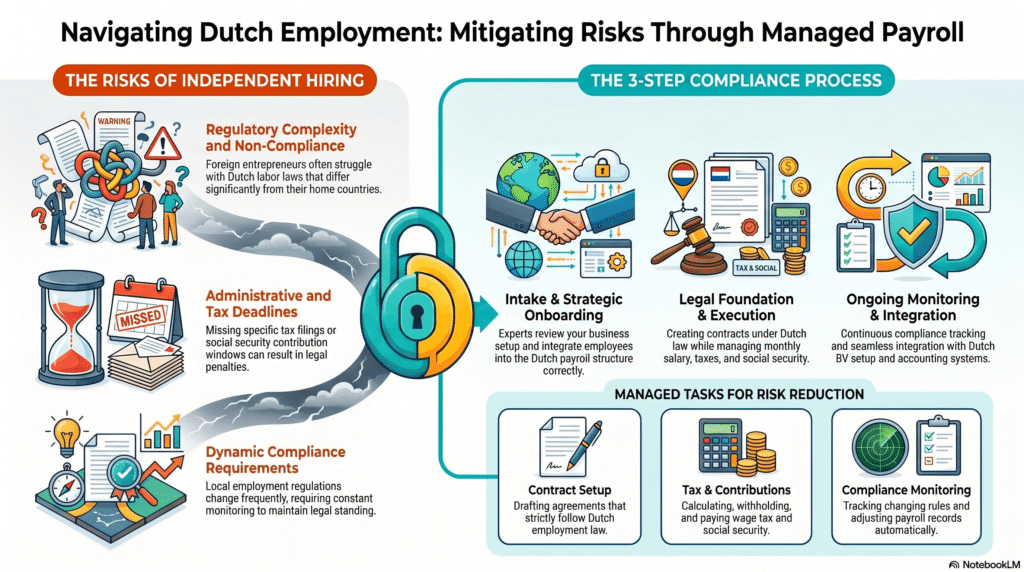
Starting a business in the Netherlands is exciting, that part is usually very clear for many (aspiring) foreign entrepreneurs. The tricky part tends to come a bit later, namely once you move from the idea to actually doing things, especially if you want to hire someone. A lot of foreign entrepreneurs run into that moment where they think: okay, now what? Hiring staff in the Netherlands isn’t just about agreeing on a salary and getting started the next day. There are rules, quite a few, actually. Contracts need to meet local standards, taxes have to be handled correctly, and there are employer responsibilities that don’t really go away once someone starts working for you. Even if it’s just one employee!
If you don’t already have a proper business setup in the Netherlands, it can feel like a lot for what seems like a small step. That’s usually where people start looking for alternatives. One of those is payrolling. It’s not always something entrepreneurs are familiar with right away, and the name alone can be a bit confusing. But the idea itself is quite simple. Instead of becoming the official employer yourself, another company takes on that role. You still work with the employee, manage their tasks, and stay involved in the day-to-day side of things. The difference sits more in the background. In this guide, we’ll go through what payrolling actually means, how it works, and when it might be useful.
So, what is payrolling?
The term payrolling actually sounds way more technical than it really is. In simple terms, it means that another company officially employs your employee(s), instead of you doing that directly. That company is called the payroll provider or company. They essentially handle the formal side of employment. Think of employment contracts, salary payments, tax withholdings, and social security contributions. So, all the things that normally sit with the employer. On paper, the employee works for them. In reality, though, not much changes in how you work together day to day. You still decide what needs to be done, you guide the employee, and they are part of your team.
That’s why people sometimes describe it as splitting the role of the employer into two parts. One part is legal and administrative, the other is practical and operational. The payroll company takes care of the first part, whilst you stay in charge of the second. For many foreign entrepreneurs, that setup makes things a lot more manageable. For example, you don’t have to learn every detail of Dutch employment law before hiring someone. And you don’t need to set up a full company structure just to get started. It’s a way to keep things moving, without ignoring the rules that are already there.
How payrolling works
So how does payrolling actually work in practice? It’s a bit easier than people expect. Usually, it starts with you finding the right person. You go through your normal hiring process, interviews, selection; all of that. Once you’ve decided who you want to work with, the payroll company steps in. They handle the formal onboarding and officially become the employer on paper. This basically means, that they do things such as establish the employment contract, register an employee if necessary, and ensure that all Dutch laws and regulations are followed correctly. They also take care of the whole administrative side after that, like handling things such as payslips and annual statements, withhold and pay taxes and process salary payments.
If there are changes in regulations, they keep track of those as well. So, on your side, not much really changes in how you decide to work with the employee. You still manage the daily tasks, set priorities and stay in contact just like you normally would. And that’s often what surprises people the most. It doesn’t feel very different once things are up and running. The main difference sits in the background, in who carries the legal responsibility. That setup allows you to focus more on the work itself, instead of the surrounding structure. Especially in the beginning, when you’re still figuring things out, that can make a big difference.
The differences between various forms of employment and outsourcing
Payrolling is not the only way to hire or work with people in the Netherlands, and that’s where some confusion can sneak in. It often gets compared to other options that look similar on the surface, but work quite differently once you zoom in a bit. Take hiring someone directly, for example. In that case, your own company becomes the employer. That means you handle everything yourself. Contracts, payroll, taxes, compliance. Full control, but also full responsibility. Payrolling shifts that balance. You still work with the employee in the same way, but the formal side sits with the payroll provider instead. Then there’s the freelancer route, or ‘Zzp’ as it’s called in the Netherlands.
This is where someone works independently and sends you invoices. It can be flexible, yes, but also comes with a gray area. If the working relationship starts to look like regular employment, it may be seen that way legally as well. That’s something Dutch authorities pay close attention to. Payrolling avoids that issue, because the employment status is clear from the start. You may also come across something called umbrella companies, especially if you’re used to other countries. They sound similar, and in some ways they are, but the surrounding rules can differ quite a bit depending on where you are. In the Netherlands, payrolling is actually a very understandable structure with its own legal framework, which makes it much more predictable to work with.
Who is payrolling for?
It’s not always one specific type of company that uses payrolling. You actually see it in quite a mix of situations. A common one is foreign businesses that want to hire someone in the Netherlands, but are not fully set up there yet. They might already have clients, or plans to expand, but setting up a Dutch entity feels like a big step too early. In that case, payrolling becomes a way to still move forward. Then there are smaller companies. Not necessarily startups, but businesses without a full HR setup. Hiring someone properly involves more than people expect at first.
Contracts, payroll and rules that change over time and it adds up. So instead of figuring all of that out themselves, they pass that part on. You also see payrolling used when things are still a bit uncertain. Maybe the Dutch market looks interesting, but it’s not clear yet how things will develop. Or there’s a project that might grow, but could also stay limited. In those cases, flexibility matters more than structure. What’s interesting, is that it’s not always about size or experience. Even companies that could set everything up themselves sometimes choose this route, just to keep things simple in the beginning. It really depends on the situation at that moment, not just on the type of business.
Legal and tax basics of payrolling
When it comes to the legal and tax side of payrolling, this is usually where people expect things to get complicated. And to be fair, Dutch employment law is quite detailed. But the whole point of payrolling is that you don’t have to manage those details yourself, because that is the obligation of the payroll company. For example, they must always ensure that everything complies with local laws and regulations, since they act as the official employer. This basically covers things like employee protection, their working conditions (very important), and the employment contract itself. Keep in mind that employees in the Netherlands have a lot of rights, so it's very important that everything is set up properly from the start and also along the way.
The same concept holds very true for taxes. Salaries are processed through the payroll provider, which means they take care of factors like wage tax and social security contributions. These are deducted and paid to the Dutch authorities as required. For you, that removes a large part of the uncertainty. You’re not figuring out tax rates, deadlines, or reporting obligations on your own. At the same time, it doesn’t mean there are no considerations at all. Depending on how your business is structured, or how active you are in the Netherlands, there could still be broader tax implications to look at. But those are usually separate from the payroll process itself. What payrolling mainly does is make sure that, from an employment point of view, everything is handled properly and in line with Dutch law. That alone tends to take away a lot of hesitation for companies that are new to the system.
The main benefits of payrolling
If you look at why companies choose payrolling, it often comes down to a few practical advantages rather than one big reason. One of the main ones is reducing risk, especially in the early stages. Hiring someone in a new country always comes with a bit of uncertainty. Rules might be different, expectations too. By working with a payroll company, a large part of that risk shifts away from you. They make sure everything is set up correctly from a legal point of view, which already takes away a lot of potential issues. Then there’s the administrative side. Payroll, taxes, contracts, it all needs to be handled properly and on time.
If you’re not familiar with the Dutch system, that can take quite a bit of effort to figure out. With payrolling, that part is largely taken care of. You’re not dealing with the details every month, or trying to keep up with changes in regulations. Another advantage is speed. If you find the right person, you don’t want to lose momentum by spending weeks setting up a structure first. Payrolling makes it easier to move forward without that delay. At the same time, it keeps things flexible. You’re not locked into a setup that may or may not fit long-term. For many companies, that combination is what makes it attractive. Less risk, less administration, and the ability to hire when the opportunity is there, instead of waiting until everything is perfectly in place.
Intercompany Solutions can take care of the administrative side of hiring employees for you
So, what is payrolling in the Netherlands really about? In the end, it’s a way to make hiring simpler, especially if you’re not fully set up in the country yet. Instead of taking on every legal and administrative responsibility yourself, you place that part with a payroll provider. They handle the formal employer side, while you stay focused on the work and the collaboration with your employee. For many foreign entrepreneurs, that alone already makes a big difference. It removes a lot of the friction that can otherwise slow things down.
At the same time, it’s a way for you to not have to overthink. Payrolling doesn’t lock you into one path. Some companies use it briefly, others for a longer period, and some combine it with their own structure. It really depends on how your plans develop. What matters most is that you have a way to get started without needing everything to be perfectly in place from day one. If you’re considering hiring staff in the Netherlands, and you’re still thinking about all your possible options, it can actually help you to look at what stage your business is in, and how much flexibility you want to keep.
At Intercompany Solutions, we always aim to support foreign entrepreneurs with many high-quality services. This includes our standard services such as setting up a Dutch BV, but also exploring practical alternatives like payrolling. If you’re not sure which approach fits your situation best, always feel free to reach out to us. We’re happy to look at your plans and think along with you every single step of the way.
Similar Posts:
- Foreign multinational corporations & the Netherlands annual budget
- Tax treaty denounced between the Netherlands and Russia per January the 1st, 2022
- Want to innovate in the green energy or clean tech sector? Start your business in the Netherlands
- The number of UK companies coming to the Netherlands is steadily rising
- How to set up a business as a young entrepreneur