

Why Use Payroll Services in the Netherlands? Key Benefits for International Businesses
Updated on 3 June 2026
At Intercompany Solutions, we offer many interesting services that are aimed at foreign entrepreneurs who want to establish a successful business presence in the Netherlands. But did you know, that you don’t have to set up a Dutch business right away, if you only want to test the market or hire a few employees at first? In such cases, our payroll services are exactly what you need. Payrolling enables you to hire personnel without actually owning a Dutch business, which can make it easier for you to see whether you can achieve success here. And the best part is, that we can also help you set up a Dutch company if all is going well. And even then, you can still choose payrolling over hiring employees directly via your company. If you would like to know more, please feel free to contact us for personal advice and information. We are always happy to assist you in any way we can.
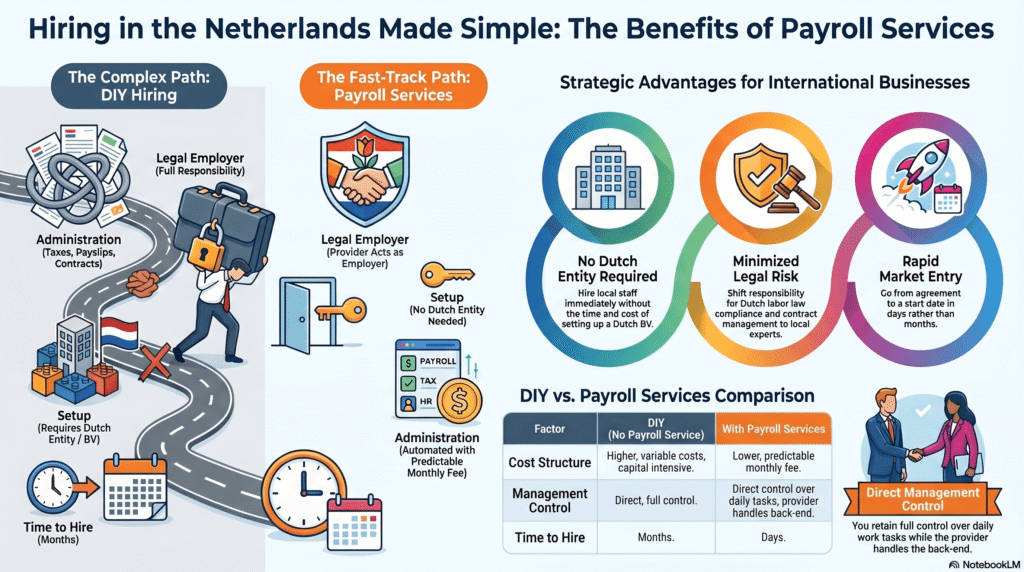
Summary: Hiring employees in the Netherlands can often feel very complex due to factors like local labor laws, tax rules, and administrative requirements. Payroll services offer a practical way to hire employees without setting up a Dutch entity, while shifting legal and administrative responsibilities to a local company. This reduces risk, saves time and provides cost clarity, while still allowing you to manage your team directly. Many international companies use payrolling as a flexible first step before expanding further in the Dutch market.
| Topic | Without payroll services | With payroll services |
|---|---|---|
| Legal employer | You take on full legal responsibility under Dutch law. | The payroll provider acts as the legal employer. |
| Administration | You handle contracts, payslips, tax filings and reports. | All formal HR and payroll tasks are managed for you. |
| Costs | Salary, contributions and unexpected adjustments to track. | One transparent fee covers the main employment costs. |
| Setup | You need a Dutch entity (BV) before hiring. | You can hire staff without a local entity. |
| Flexibility | Adjusting your structure takes time and effort. | You can scale up or down with much less friction. |
| Time to market | Weeks or months before your first hire is on board. | Often just a few days from agreement to start date. |
Hiring employees when having an international business
Hiring employees in another country always sounds straightforward at first, until you get into the details. That’s usually where the uncertainty starts. Different rules, different expectations, and a system you’re not fully familiar with yet. In the Netherlands, that becomes especially clear once you look at employment. Because it’s not just about finding the right person and agreeing on a salary. There are legal obligations, tax rules, and ongoing responsibilities that come with being an employer. Some of those are easy to overlook in the beginning. Others only become visible once you’re already in the process.
For international businesses, that can make hiring feel like a bigger step than expected. There’s often a moment of hesitation. Not because the opportunity isn’t there, but because the surrounding structure feels unclear. That’s where payroll services come into the picture. Payrolling basically offers a way to hire personnel in the Netherlands, without taking on all the accompanying responsibilities yourself. So, instead of having to figure out everything by yourself, you work with a third party that already knows the (legal) system and handles the formal side of employment. You still work with your employee in the same way, but the legal and administrative parts are taken care of behind the scenes. In this article, we’ll look at why companies choose this route, and what the main benefits are when hiring in the Dutch market.
Reduce the legal risks of employment
One of the main reasons companies look into payroll services is to reduce legal risk. Dutch labor law is quite structured, and not always easy to navigate if you’re new to it. There are specific rules around contracts, notice periods, employee protection, and even how you handle things like sick leave. Missing a detail here is not always a small issue. It can have consequences later on, especially if something doesn’t go as expected in the working relationship. That’s where things can feel a bit uncertain for foreign companies. You want to do things properly, but you don’t always know what ‘properly’ means in a local context.
With a payroll provider, that responsibility sits somewhere else. They are the legal employer, which means they need to make sure everything follows Dutch regulations. Contracts are set up correctly, obligations are met and changes in legislation are taken into account. You’re not figuring all of that out on your own while also trying to run your business. At the same time, it doesn’t mean you lose control over how your employee works. The day-to-day side stays the same. What changes is mainly the layer underneath it, where the legal responsibilities sit. For many companies, that shift alone already makes hiring feel a lot less risky, especially in the early stages.
Saving you time and administrative burdens
Another reason companies turn to payroll services is simply to save time. Not in a vague way, but in a very practical, day-to-day sense. Hiring someone in the Netherlands comes with a lot of small tasks that add up quickly. Think of contracts, issuing payslips, tax filings and keeping track of changes in rules. None of it is impossible, but it does take time to understand how it all works. Especially if you’re not familiar with the Dutch system. For many businesses, that’s not where they want to spend their energy. They want to focus on their product, their clients, or growing their team. With payrolling, a large part of that administrative work moves out of your hands.
The payroll provider takes care of the formal side. They prepare contracts, process salaries, and make sure taxes and contributions are handled correctly. You’re not logging into different systems, checking deadlines, or wondering if you missed something important. At the same time, it doesn’t slow you down. Once everything is set up, it tends to run in the background. That’s often what people appreciate most. It’s not just about saving time once, but about not having to think about these things every single month. Over time, that adds up to quite a bit of space to focus on the parts of your business that actually need your attention.
Cost predictability: a huge win
Another aspect that often comes up is cost. Not just how much something costs, but how predictable those costs are over time. When you hire employees directly in a new country, there can be quite a few variables. Salary is one part, but then there are employer contributions, insurance, administrative costs, and sometimes unexpected adjustments if rules change. This means that, if you are not familiar with the system, it’s not always easy to see the full picture ahead of you, which can make planning a bit uncertain. But with payrolling services, the structure of the costs you'll make is usually much more clear from the start.
You agree on a fixed or transparent fee with the payroll provider, which includes the main employment costs. That doesn’t mean everything is completely static, but it does make things easier to estimate. You’re not constantly trying to figure out what something might cost next month or next quarter. For many companies, especially when entering a new market, that kind of clarity is helpful, because it allows you to plan without adding too many unknowns. At the same time, it keeps a lot of things very simple. Instead of dealing with multiple separate costs, you’re working using a more straightforward setup. Thus, over time, this can make budgeting and decision-making much less stressful. Especially if you’re still figuring out how your activities in the Netherlands will develop in the (near) future.
Flexibility in hiring employees
Another reason companies end up using payroll services is flexibility. Not in an immeasurable sense, but rather in how easy it is to adjust when things change. Hiring in a new country often comes with a bit of uncertainty. You don’t always know yet how quickly things will grow, or even in which direction. Maybe you need one person now, maybe more later. Or maybe the role itself changes over time. If you’ve already set up a full structure, it can feel harder to move along with that. With payrolling, that step is a bit lighter. You can bring someone on board without locking everything into place right away.
And if plans shift, you can adjust without having to undo a whole setup first. That’s often what makes it attractive for companies that are still figuring things out. It also works well in situations where the need is temporary, or at least not fully defined yet. Think of projects, short-term expansions, or testing a new market. You’re able to scale up when needed, and scale down again if things don’t go as expected. That doesn’t mean it’s all completely without structure, of course. There are still agreements in place, and employees still have rights. But compared to setting everything up yourself, it gives you a bit more room to move. And for many businesses, especially early on, that’s exactly what they need.
No direct need for a local entity
One of the more practical advantages of payrolling is that you don’t always need to set up a local entity right away. For foreign companies, that can make quite a difference. Setting up a Dutch BV is not necessarily difficult, but it does take time and comes with certain obligations. If you’re still in an early stage, or just exploring the market, that step can feel a bit too big. Especially if you only want to hire one person to start with. In that situation, payrolling offers another way. Because the payroll provider is already established in the Netherlands, they can act as the legal employer.
That means you can work with someone locally, without having your own Dutch company in place from day one. For many businesses, that lowers the threshold to get started. You don’t have to commit to a structure before you know if it makes sense long-term. At the same time, it doesn’t mean this applies in every situation. Depending on your activities, or how your business is set up, there can still be reasons why a local entity is needed at some point. So it’s not a universal shortcut. But in many cases, especially in the beginning, it creates a bit more breathing room. You can take that first step, see how things develop, and decide later how you want to structure your presence in the Netherlands.
Employee security and benefits
It’s easy to focus on the company side of payrolling, but for employees it matters just as much how things are set up. In the Netherlands, people generally expect a certain level of security when they take on a job. That’s not just about salary. It’s also about contracts, what happens if they get sick, how holidays are handled and whether things are properly arranged behind the scenes. If those parts are unclear, it can create doubt quite quickly. With payrolling, that structure is usually already in place. The payroll company handles the formal employer role, so they make sure the contract follows Dutch standards and that required contributions are taken care of.
From the employee’s point of view, that often feels more solid than something informal or loosely arranged. They know where they stand. At the same time, the daily work doesn’t really feel different. They still work with you, talk to you, and are part of your team. That combination is what makes it work in practice. On one side, there is a clear legal setup. On the other, there is a normal working relationship. For companies, that can also make a difference. If everything is properly arranged from the start, it’s easier to build trust. Especially if you’re hiring in a country where people don’t know your business yet. It removes a layer of uncertainty, for both sides.
Real-world example scenario
Let’s make the scenario a bit more concrete. Say you run a company in the United States, and you’ve been looking at the Dutch market for a while. At some point, you find someone who could really help you get started locally. Maybe they know the market, or maybe they already have valuable contacts. You’d like to hire them, but then the practical questions come up: you don’t have a Dutch entity yet, and setting one up for a single hire feels like a big move. So you hesitate. Not because you don’t want to move forward, but because the surrounding structure isn’t clear yet. This is exactly the kind of situation where payrolling gets used.
Instead of putting everything on hold, you work with a payroll provider in the Netherlands. They take care of the formal side: the employee signs a contract with them, salary runs through them, and taxes are handled as required. On your side, things stay quite normal. You bring the person into your team, talk to them daily, and start building your presence in the market. It doesn’t feel very different once it’s up and running. The main difference is in how it’s arranged behind the scenes. Then, over time, you see how things develop. If it grows, you can still set up your own Dutch company later. If not, you haven’t taken a bigger step than needed. That’s really the idea behind it.
Intercompany Solutions can assist you with all your payroll needs
So, why do companies use payroll services in the Netherlands? In the end, it often comes down to making things simpler in a situation that can otherwise feel quite complex. Hiring in another country brings a lot of moving parts. Rules, taxes, responsibilities and things you don’t always see right away. Payrolling takes a big part of that weight off your shoulders. Instead of trying to figure everything out at once, you work with a setup that already exists. The formal employer side is handled, while you focus on building your team and your activities. For many international businesses, that makes it easier to take the first step. At the same time, it’s not something you need to overcommit to. Some companies use it briefly, others for longer, and some mix it with their own structure.
In general, it very much depends on what you’re trying to achieve, and how your plans will develop over time. What actually matters most is that you don’t have to wait until everything is perfectly in place before moving forward, and that's a huge win. So, if you’re looking into hiring staff in the Netherlands, and you’re not sure which approach fits your situation in the best way possible, it can help you a lot to explore your options first. At Intercompany Solutions, we offer various interesting services. First and foremost, we support foreign entrepreneurs with setting up Dutch companies. But we also offer practical solutions, like payrolling. If you’d like to understand what works best in your case, feel free to reach out. We’re happy to think along with you and help you get started.
Similar Posts:
- Foreign multinational corporations & the Netherlands annual budget
- Tax treaty denounced between the Netherlands and Russia per January the 1st, 2022
- Want to innovate in the green energy or clean tech sector? Start your business in the Netherlands
- How to set up a business as a young entrepreneur
- The challenges of starting entrepreneurs