


Payroll for Remote Teams in the Netherlands: What Are Your Options?
If you currently own a foreign company and would like to expand your presence abroad, then the Netherlands is a great place to consider. The country consistently scores very high in many international business listings and is extremely welcoming to foreigners. But, most importantly: it has one of the world’s greatest bilingual talent pools. Which is why we help foreign companies with hiring qualified personnel, by offering tailor-made payroll services that take the entire administrative burden off your hands. Dutch labor laws can be quite complicated, especially if you don’t speak the Dutch language. If you would like to know more about what we can do for you, please feel free to contact us anytime for personal and professional advice. In this article, we will explain how you can manage remote teams in the Netherlands and how payrolling works exactly.
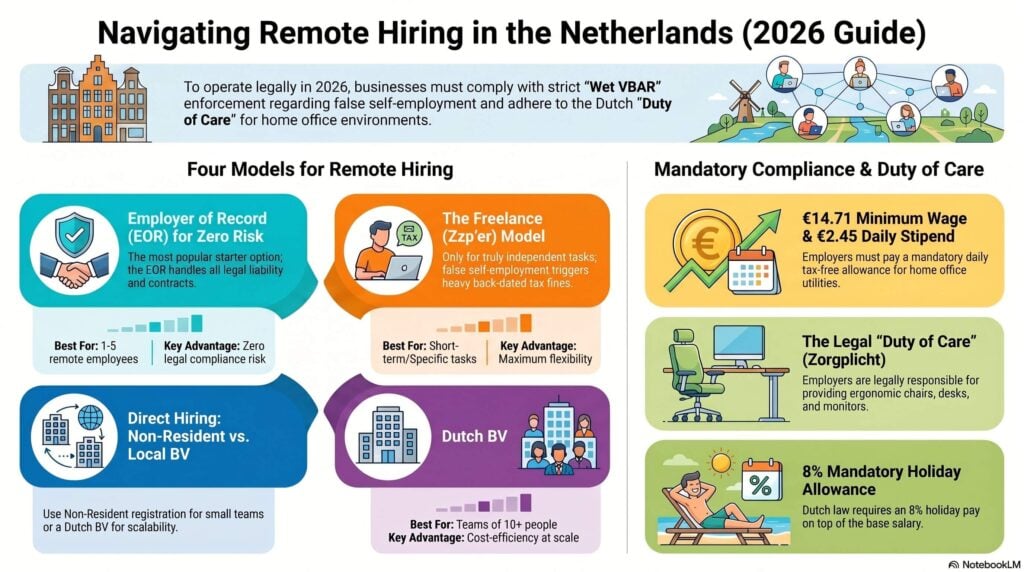
Summary: Foreign companies expanding into the Netherlands cannot simply wire international bank transfers to pay remote workers. Instead, they must comply with strict Dutch labor laws, mandatory social security contributions and a statutory minimum wage of €14.71 per hour. Businesses have four primary remote hiring models: hiring independent freelancers, partnering with an Employer of Record (EOR) to offload all compliance risks, registering as a Non-Resident Employer directly with the Dutch tax authorities, or incorporating a local Dutch BV for scalable cost-efficiency. Additionally, remote employers must honor a strict Duty of Care (“zorgplicht”), which includes providing things like ergonomic home office setups and a tax-free work-from-home stipend of €2.45 per day.
Remote working: Dutch laws and regulations
By 2026, the being able to work from anywhere dream has hit a bit of a reality check in the Netherlands. While Dutch employees value their home-office days more than ever, the government has sharpened its regulations to ensure that remote work doesn't become a loophole for avoiding taxes or labor protections. If you are a foreign company looking to hire people in the Netherlands, you have to realize that Dutch labor laws mostly protect the employee and not the employer (a bit akin to people who rent from landlords).
If your team member is sitting at a desk in Amsterdam or Rotterdam, they are protected by Dutch dismissal laws, they are entitled to the Dutch minimum wage (which hit €14.71 per hour this year), and they must be covered by Dutch social security, to name just a few examples. Next to that, keep in mind that you can't just send a wire transfer from a bank in London or New York and call it a day to pay your staff. The Dutch tax authorities (“Belastingdienst”) expect a formal structure when you hire people and that means adhering to Dutch labor and tax laws.
As such, whether you use a local partner or register yourself, you need a way to withhold wage taxes and pay into the national insurance schemes. In 2026, "I didn't know" is no longer a valid excuse for the Dutch authorities. They have also resumed full enforcement against things such as false self-employment, meaning that if hire a freelancer and he or she looks and acts like an employee, you can basically count on back taxes and significant fines. So makes sure you follow all the rules, preferably by hiring a trusted third party such as Intercompany Solutions. Below we will list some of the most used ways to hire people in Holland if you own a foreign company.
Option 1: The freelance (Zzp’er) model
For many remote teams, the simplest move seems to be hiring Dutch talent as freelancers. There’s no payroll to run, no social security to calculate, and you just pay an invoice whenever someone works for you, or periodically (you can freely decide this with any freelancer, which makes it a very flexible option). Unfortunately enough, in the past this was a massive gray area that companies exploited. Which is why in 2026 the rules have tightened significantly under the enforcement of the law balancing assessment of employment relationships (“Wet VBAR”).
The Dutch tax authorities are now very aggressive about false self-employment. If your freelancer works exclusively for you, uses your company laptop, attends your weekly stand-ups, and doesn't have (many) other clients, the law views them as an employee, regardless of what your contract says. Thus, if the Dutch tax authorities decide they are actually an employee, you will be hit with years of back-dated social security contributions and heavy fines as well, which can be a very significant amount that might even bankrupt you. So you should be very cautious when you hire someone this way and make sure your contract doesn’t fall under any of the false self-employment criteria.
So, the freelance model only works if the person is truly independent. They should set their own hours, use their own equipment, and have a clear entrepreneurial risk. If you want them to be a core part of your team, treat them like a colleague and have them represent your company, the freelance route is definitely not the best deal for you. It’s a great option for a short-term project or a specific task, like creating a website or handling your tax returns, but for a permanent remote team member, it's often more trouble than it’s worth.
Option 2: The Employer of Record (EOR)
For a foreign company with no local office, the EOR option is often the most popular choice for remote hiring in 2026, especially if you are new on the market or just want to hire people as soon as possible. It’s also a handy option when you want to hire skilled migrants instead of Dutch personnel. As we describe in this article, the EOR acts as the legal employer on your behalf. They handle the Dutch employment contract, ensure the salary meets the current thresholds, and manage specific Dutch details, like the mandatory holiday allowance and the tax-free home office stipend.
The nice thing about the EOR for remote teams is that it completely bypasses the need for you to understand Dutch social security. If your remote employee gets sick, the EOR handles the reintegration process required by Dutch law. If the employee wants to apply for the 30% tax ruling, the EOR’s tax experts handle the application. You simply receive one monthly invoice that covers the salary, taxes, and a service fee.
The downside? It can be an expensive way to scale, depending on the company you choose to work for you. If you only have one or two remote workers, that’s a fair price for zero legal risk. But if you’re planning to hire a team of twenty or more, you’re looking at a massive annual overhead just for the privilege of not having your own entity. It’s the perfect starter option, but many companies eventually outgrow it. Nonetheless, it’s the only option that literally covers all responsibilities and risks, so if you want to be safe, this is essentially the choice for you.
Option 3: The non-resident employer registration
What if you want to be the direct employer, but you aren't ready to set up a full Dutch BV? There is actually a middle ground called the Non-Resident Employer Registration. This allows your foreign company (say, based in the US or UK) to register directly with the Dutch tax authorities (“Belastingdienst”) as an employer. In this setup, you are the legal employer on the contract, but you are registered in the Netherlands specifically for payroll taxes. You’ll get a Dutch payroll tax number, which allows you to withhold wage tax and social security contributions for your remote employee. It’s a very clean way to operate because it shows the authorities you are taking your responsibilities seriously without the overhead of a local corporation.
However, there is a catch: you have to handle the administrative side yourself or hire a specialized Dutch payroll partner. You’ll still need to ensure the contract complies with Dutch labor laws, meaning you can’t just use your standard employment contract from your home country, but you will need to do everything according to Dutch labor and tax laws. You’ll also be responsible for things like managing (long-term) sickness and disability insurance. It is a fantastic option for companies that have outgrown the EOR model, but aren't ready to commit to a legal entity yet. In this scenario, hiring someone to pick up all payroll matters for you is the wisest option if you want to make sure you adhere to all laws and regulations.
Option 4: Setting up a local Dutch BV
If your remote team is growing beyond a few people, the most sustainable long-term move is to incorporate a Dutch “Besloten Vennootschap” (BV). Think of the BV as your company’s Dutch citizenship. It’s a separate legal entity that gives you the highest level of credibility with local banks, the IND, and, most importantly, the employees you are trying to hire. The process has become significantly more streamlined by 2026. You can now handle almost the entire incorporation through a digital notarial deed or by power of attorney, so no more flying to Holland just to sign a piece of paper. You’ll need a minimum capital of just €0.01, a registered Dutch business address, and a visit to the Chamber of Commerce (KVK). Once the BV is operating, you aren't just a foreign company anymore; you are a local employer with your own VAT number and payroll tax registration.
The major benefit here is cost efficiency at scale. You stop paying the high monthly service fees that come with an EOR. You also gain total control over your benefit packages, pension schemes, and company culture. Plus, if you ever want to apply for a sponsorship license to bring in talent from outside the EU, having a BV is the essential first step. It’s a bit of an administrative hurdle at the start, but for a team of 10 or more, the math almost always tilts in favor of the BV. It transforms your remote setup from a project into a permanent Dutch operation. Still, we strongly advise hiring a third party for all payroll related matters, especially if you don’t know much about hiring people in the Netherlands. Next to that, you will have to pay yourself a salary as the director. If you let someone else take care of all these things, you will have more time to expand and grow your newly incorporated Dutch BV.
The safety requirements you need to take into consideration
In the Netherlands, the employer’s Duty of Care (“zorgplicht”) doesn't stop at the office. If your team is working remotely, you need to take into account that you are legally responsible for ensuring their home workspace is ergonomically sound and safe in every way possible. This isn't just about being a nice employer: it’s a health and safety requirement. If a remote employee develops chronic back pain or carpal tunnel because they were working from a kitchen stool, you could technically be held liable for the occupational injury and this can be very costly and daunting.
To manage this, most Dutch employers provide a budget or a direct reimbursement for a proper desk, an ergonomic chair and high-quality monitors. In 2026, the tax-free home office allowance is a main item in basically every Dutch contract. For this year, you can pay your employees €2.45 per day tax-free to cover the costs of extra electricity, heating, and even the coffee they drink while working for you.
Beyond the physical things, you also need to consider the so-called right to disconnect. While not yet a hard law in the same way as in some other EU countries, Dutch courts are increasingly siding with employees who claim burnout from digital tethering. As a remote employer, setting clear boundaries in your employee handbook about communication hours and off-time is a very important part of your compliance. It keeps your team healthy and keeps the Dutch labor inspectors happy and that is very important.
So how to harmonize remote payroll?
As you can see, there is a lot to think about when you want to hire people in the Netherlands. At the end of the day, you didn't start your company to become an expert on Dutch tax codes or ergonomic chair regulations. Whether you decide to go with the safety of an EOR or the long-term freedom of your own Dutch BV, you just want your team to be happy and your legal bases covered. The real secret isn't just picking a model; it's making sure your payroll isn't a mess.
In 2026, the Dutch authorities are very strict with laws like the Wet VBAR, or those daily home office stipends. As such, you will need a setup where all necessary actions happen automatically. Imagine a situation where the €2.45 daily allowance, the 8% holiday pay, and the complex social security all happens without you needing to touch a spreadsheet or software program. Sounds nice, doesn’t it? That’s essentially what a solid payroll partner brings to the table: they’re the ones keeping the boring and complicated stuff like back-taxes and IND audits far away from your attention.
By getting your remote payroll right, you’re not just staying compliant, but you are actually showing your Dutch team that you really value them. You get to offer the professional, localized experience they expect, while you stay focused on the big picture. So, if you're actually ready to stop worrying about Dutch paperwork and start scaling your team, you should definitely consider an EOR or payroll services as an option. It'll make hiring in the Netherlands one of the easier part of your global expansion.
Intercompany Solutions can help you answer all your questions about hiring employees in the Netherlands
Whether you want to expand or already hired employees, but want to simplify your daily activities: you have come to the right place. Intercompany Solutions offers various payroll options, that are specifically tailored to suit your company’s needs. If you want to outsource everything, then using our EOR option is the best fit for you. You can also choose to handle some of the responsibilities yourself and simply hire us to take care of the payroll process for you. If you aren’t sure about the best solution for you, please always feel free to contact us with any questions you might have. We are always happy to provide you with professional advice and help you out wherever and whenever necessary.
Similar Posts:
- Foreign multinational corporations & the Netherlands annual budget
- Want to innovate in the green energy or clean tech sector? Start your business in the Netherlands
- Tax treaty denounced between the Netherlands and Russia per January the 1st, 2022
- Directives to counter tax avoidance in Holland
- Stricter tax demands for multinationals in the Netherlands