


How to Hire Your First Employee in the Netherlands Without Making Mistakes
Updated on 20 July 2026
If you would like to hire employees in the Netherlands with a foreign company, there are a few different paths to choose from. Next to that, there are also plenty of laws and regulations to take into consideration. To make this entire process much more understandable for you, Intercompany Solutions offers extensive payroll services to help you out from day one. We can take care of the entire administration, all the tax returns and things that are related to hiring personnel in Holland. This ensures that you are compliant with Dutch labor laws at all times. Our specialized team of experts can tell you exactly what you will need to do and how to go about it. Would you like more information about hiring your first employee in the Netherlands? Then obviously feel free to contact us directly with any questions you might have about the topic.
Summary: Hiring a first employee in the Netherlands requires choosing a compliant entity framework: incorporating a local Dutch BV, utilizing a licensed Non-Resident Employer payroll track, or using an Employer of Record (EOR) to lessen employment liability. Because foreign labor structures do not exist under Dutch law, contracts must include precise statutory terms, such as a strict one-month probation maximum for fixed-term agreements and adherence to the 36-month temporary contract limit (“ketenregeling”). Also, employers must adhere to the Duty of Care (“zorgplicht”) which is governed by the Gatekeeper Improvement Act. This dictates mandatory occupational health partnerships (“Arbodienst”) and carries a liability to fund two years of salary payments during sick leave.
| Key step | What you must get right |
|---|---|
| Choose a legal employer | Pick a Dutch BV, Non-Resident Employer registration or an EOR before you hire |
| Use a compliant contract | Respect the 1-month probation max, 8% holiday pay and the 36-month chain rule (ketenregeling) |
| Cover the Duty of Care | Arrange an Arbodienst and sickness insurance for the 2-year (104 weeks) sick pay |
| Check CAO and pension | Verify your SBI code for a binding CAO and any mandatory industry pension fund |
| Sort tax, IND and 30% ruling | Get a payroll tax number, apply for the 30% ruling within 4 months and arrange IND sponsorship |
How are you going to hire someone in the first place?
Before you even start interviewing candidates, you need to ask yourself a very important question first: who will be the legal employer on paper? This is actually the number one mistake for international companies, who often assume they can simply hire someone in the Netherlands using a contract from their home country. In reality, the Dutch tax authorities (“Belastingdienst”) and labor laws require a local way of hiring people to ensure taxes and social security are handled correctly. You essentially have three strategic paths to take here.
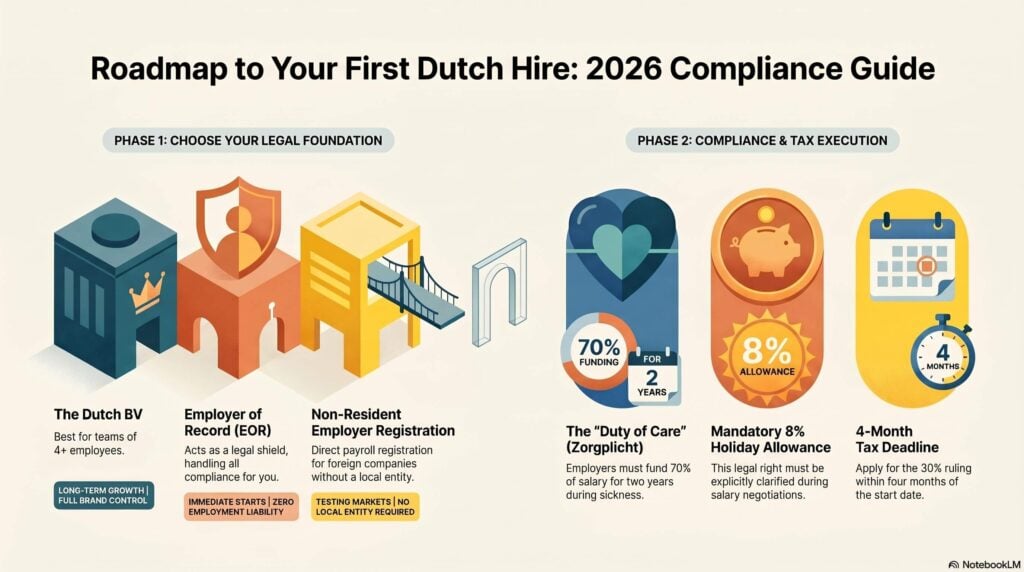
The first is setting up a Dutch BV, a local limited liability company. This is the standard if you plan to hire a team and want full control over your brand. The second path is using an Employer of Record (EOR). The EOR is a Dutch company that hires the person for you, effectively acting as a legal shield. They handle all the compliance stuff, while you manage the employee’s daily work. The third option is Non-Resident Employer Registration, where your foreign company registers directly for Dutch payroll taxes without forming a local BV.
Think of this choice as the foundation of your entire Dutch venture. If you don’t have a Dutch entity yet but your favorite potential employee needs to start immediately, the EOR is your only realistic option to stay legal from day one. However, once you reach three or four employees, the monthly service fees for an EOR can quickly exceed the cost of maintaining your own BV. Many companies start with an EOR to test the market and then flip the employees over to their own BV later, but continue using payroll services anyway to lessen the administrative burden. Making this decision early saves you from a lot of hassle, as switching models often requires drafting entirely new contracts. As such, make sure to always look at your two-year growth plan before signing that first contract, as the cheapest option today might be the most expensive one eighteen months from now.
Mandatory Dutch contract clauses
Once you’ve settled on your legal entity, the next hurdle is the actual contract. This is where a lot of foreign HR teams get confused, because the concept of "at-will" employment simply doesn't exist in the Netherlands. You can’t just copy-paste a contract from home and think it will be sufficient. Take the mandatory probation period, for instance. If you’re offering a fixed-term contract between six months and two years, the law says you get exactly one month to decide if they're a fit. If you try to sneak in a two-month probation, the whole clause gets tossed out by a judge, leaving you with zero trial period at all. Then there’s the 8% holiday allowance. This isn't some nice bonus; it’s a legal right. You need to be crystal clear during negotiations whether the salary you're offering includes or excludes this 8% amount, otherwise, you might end up paying thousands more than you planned come May (since this is the month in which you will have to pay this amount of money).
You also need to keep an eye on the chain rule. In 2026, this rule states that you can only give three temporary contracts over a three-year span. On that fourth contract, or if you hit the 36-month mark, that employee is legally permanent. So there are no "ifs" or "buts." Even non-compete clauses have become trickier; you now have to prove a "compelling business interest" in writing for it to hold in a fixed-term deal. It’s these little details that generally tend to trip up the first-time hire. As such, Instead of trying to make your existing documents look like they’re Dutch, it’s much safer to start with a local template that already respects these mandatory things. It keeps the relationship professional and your business protected.
The so-called Duty of Care (“Zorgplicht”)
In the Netherlands, you don't just hire an employee; you also need to take serious care of their well-being. This is known as the “Zorgplicht”, or Duty of Care. One of the biggest surprises for first-time Dutch employers is the two-year sickness rule. This rule states that, if your employee falls ill, you are legally required to pay at least 70% of their salary for up to 104 weeks. You can’t simply terminate the contract because they aren't working.
To manage this massive financial risk, almost every sane employer takes out a Sickness Absence Insurance (“Verzuimverzekering”). This insurance covers the salary payments, but it usually requires you to follow a very strict protocol for reintegration under the so-called Gatekeeper Improvement Act. To stay compliant with these rules, you must also contract an occupational health service (“Arbo Service”). Think of them as the medical referees. When your employee calls in sick, the Arbo doctor basically determines for you what they can and cannot do.
Keep in mind that you aren't allowed to ask the employee what their medical diagnosis is, because that’s a huge GDPR and privacy violation in the NL. You only get to know how long they’ll be absent from work and what type of adjusted work they might be able to handle. On top of that, you’ll need to perform a Risk Inventory and Evaluation (RI&E) to ensure their workspace, even if it’s a home office, is safe. It sounds like a lot of bureaucracy, but setting these insurances and services up before the first day of work is the only way to make sure all goes well. If you skip this, one long-term illness could easily bankrupt your small business.
The pension and collective labor agreements (CAO)
One of the most frequent mistakes foreign employers can make, is to assume they can simply offer a salary and be done with it. In the Netherlands, though, many industries are governed by a Collective Labor Agreement (“CAO”). These are sector-wide agreements negotiated between unions and employer organizations that dictate everything from minimum wages to overtime rates. If your business activities fall under a specific CAO, like retail, IT, or metalworking, you are legally bound by its terms, even if you never signed anything.
So, before you hire your first employee, you must check your SBI code (your business category at the Chamber of Commerce) to see if a mandatory CAO applies to you. If it does, your employment contract cannot offer anything less favorable than what is written in that agreement. Then there is the pension. Unlike many other countries, the Netherlands has a complex, multi-pillar pension system. While there is no universal law forcing every employer to provide a pension, about 70% of companies are required to do so because of their CAO or a mandatory industry-wide pension fund. If you are in a sector like construction or healthcare, you’ll likely have no choice but to enroll your first employee in a specific fund and pay the required premiums.
Next to that, even if no CAO applies, it is very common in 2026 for Dutch employees to expect a pension contribution as a standard benefit. If you skip this, you might find it impossible to attract top talent. So we strongly advise to always consult with a payroll expert like Intercompany Solutions to verify your CAO status before you start negotiating salary, or you might find yourself receiving back-dated pension invoices that can total thousands of euros per employee.
The IND and the 30% ruling
If you are hiring a specialist from abroad, or even someone who already lives in the Netherlands that meets specific criteria, you need to talk about the 30% ruling. This is basically a tax advantage where you can provide 30% of the employee’s gross salary tax-free to cover extraterritorial costs. In 2026, the rules have become even more specific regarding salary thresholds and the scaling down of the benefit over time. The biggest mistake here is missing the deadline.
You must apply for this ruling within four months of the employee’s start date. If you miss that window, the tax break isn't retroactive to the start date, and you’ve essentially cost your new hire a massive amount of their take-home pay. Furthermore, if your first hire isn't an EU citizen, you’ll need to deal with the IND (Immigration and Naturalisation Service). To sponsor a highly skilled migrant, your company needs to become a ‘Recognized Sponsor’. This process involves a vetting phase where the IND looks at your company's financial stability and registration. You cannot simply promise a visa; you need to have the legal status to back it up.
If you don't want to go through the hassle of becoming a sponsor yourself for just one person, this is where using an EOR becomes incredibly valuable again, as they already have the sponsorship license. Navigating the 30% ruling and IND requirements requires precision, as a single error in the application can result in a rejection that takes months to appeal, often causing your new employee to look for a more tax-efficient employer elsewhere.
Payroll setup and the Dutch tax authorities
Once you have a signed contract, you need to turn the legal hire into a financial reality, so to speak. This starts with registering as an employer with the Dutch tax authorities. Even if you are a foreign company without a local office, you must obtain a Dutch payroll tax number (“loonheffingennummer”) before your new employee’s first day at work. You also need to verify your employee’s identity by checking their original passport or ID card and keeping a secure copy in your records, since missing this step can lead to the ‘anonymous rate’ being applied, which is a massive 52% tax hit that neither you nor your employee wants.
In 2026, the administration side is largely digital, but it’s not exactly something you just set up once and don’t deal with anymore afterwards. You’ll need to set up a monthly payroll system that accounts for things like wage tax, national insurance and employee insurance premiums. One specific thing that catches foreign business owners off guard is the Work-Related Costs Scheme (“Werkkostenregeling”, or “WKR”). This is a tax-free pot (usually around 1.92% of your total wage bill) that you can use to give your team perks like gym memberships, flowers, or a company bike without paying extra tax. If you go over this budget, however, you get an 80% tax rate on the excess. Because the Dutch payroll system is so distinct, most first-time employers find it’s much cheaper to hire a local payroll provider than to try and configure their home-country software to handle the important details of Dutch social security.
A handy ‘first hire’ checklist
To wrap this all up, think of your first Dutch employee as a sequence of milestones rather than just a simple signature on a document. You really can't afford to mess this up, so your roadmap starts with picking your employment model. Try to decide early on if you're going with a BV, an EOR, or a non-resident registration. Once that’s settled, you need to draft a Dutch-Compliant Contract. This isn't just about the salary; it’s about adhering to necessary things like the one-month probation and explicitly stating how that 8% holiday pay is handled. Before your new employee even opens their laptop, make sure your sickness insurance and Arbo service contracts are up and running. Skipping this is easily the biggest gamble you can take, as you’re essentially betting against the possibility of a two-year sick leave.
The final stretch is all about the Dutch tax authorities. You'll need that payroll tax number ready and a verified copy of the employee’s ID in your files to avoid the dreaded anonymous tax rate. If you’re relocating talent, get the 30% ruling and IND sponsorship, because missing those windows is a mistake that hits your employee’s wallet directly. Finally, get a payroll system in place that can actually track your WKR budget for those tax-free perks. By following this sequence, you turn a potential legal battlefield into a professional experience. You won't just be staying compliant; you'll be building the kind of solid foundation that makes your first Dutch employee feel like they’ve joined a company that truly knows what it’s doing.
Step-by-step checklist for hiring employees in Holland
- Select the Employment Infrastructure: Decide between a local Dutch BV, a Non-Resident Employer payroll setup, or an Employer of Record (EOR)
- Verify CAO and Pension Mandatory Status: Audit your business Chamber of Commerce (KvK) SBI code to check for sector-wide collective labor agreements and mandatory industry funds
- Secure Compliance Insurances: Get a certified occupational health contract (“Arbodienst”) and Sickness Absence Insurance (“verzuimverzekering”) to cover the two-year sick pay mandate
- Register with the Dutch tax authorities: Secure your dedicated payroll tax number (“loonheffingsnummer”) prior to day one
- Execute Identity and Visa Audits: Retain a verified passport copy to eliminate the 52% anonymous tax rate penalty, and submit 30% ruling files within the 4-month boundary.
Intercompany Solutions will help you hire qualified people in no time
Are you looking for local experts, but you don’t know where to start? No need to worry: we are here to assist you during this process. It might seem daunting at the very beginning, but if you set everything up correctly, you will see that hiring people in the Netherlands is actually very doable. We make sure that every single necessity is met, and you adhere to all laws and regulations that cover hiring personnel in Holland. We can also provide you with expert advice, make sure you hire the right people and help you out in times of need. Hiring someone in a foreign country can look scary, but in time, you will see that it’s actually a solid investment that can help your company grow in the future. Feel free to contact us for support or any questions you might have.
For more information on payrolling matters you can visit the ICS Payroll website on www.icspayroll.com.
Similar Posts:
- Foreign multinational corporations & the Netherlands annual budget
- Directives to counter tax avoidance in Holland
- Tax treaty denounced between the Netherlands and Russia per January the 1st, 2022
- Want to innovate in the green energy or clean tech sector? Start your business in the Netherlands
- How to set up a business as a young entrepreneur