

Hiring Employees in the Netherlands Without a Local Entity: Is Payrolling the Solution?
Updated on 3 June 2026
Payrolling is a very innovative solution, if you would like to hire personnel in the Netherlands without committing completely to all necessary obligations and restrictions following from Dutch laws and regulations. Since hiring employees can actually be quite difficult to understand for foreign entrepreneurs, Intercompany Solutions can assist you by offering extensive and specialized payroll services, that are specifically aimed at foreigners who would like to start a business in the Netherlands, or otherwise hire staff here. We provide end-to-end payroll administration for companies (from startups to international organizations). It doesn’t really matter whether you employ local staff, a local company director (DGA) or skilled migrants: we will always make sure to simplify the entire process for you so you can focus solely on your business growth.
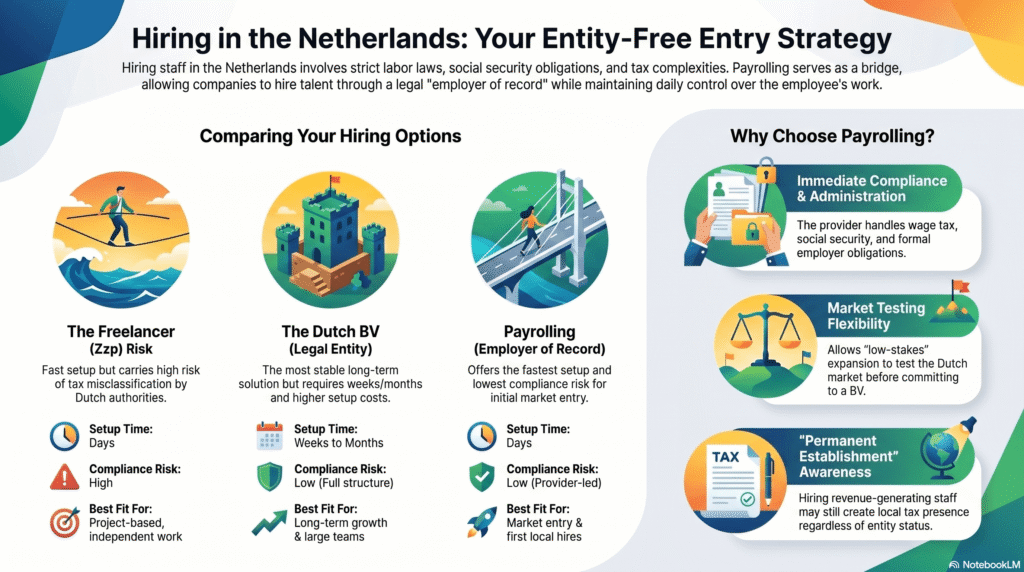
Summary: Foreign companies can often hire employees in the Netherlands through payrolling without setting up a Dutch entity first. A payroll company then becomes their legal employer and handles things like contracts, salary processing, tax withholdings and compliance, while you keep control over the employee’s daily work. This can be a practical first step for market testing, small teams, or short-term expansion. As your Dutch activities grow, you can later switch to a Dutch BV or combine your BV with payroll services.
| Option | Setup time | Effort and cost | Compliance risk | Best fit for |
|---|---|---|---|---|
| Dutch BV | Weeks to months | Higher (notary, registrations, ongoing fees) | Low (full structure) | Long-term plans, growing teams |
| Freelancer (Zzp) | Days | Low | Higher (misclassification by Dutch authorities) | Independent, project-based work |
| Payrolling | Days | Low (transparent fee) | Low (provider handles it) | Market entry, first hires, flexibility |
Do you need to set up a Dutch local entity?
If you want to hire employees in the Netherlands, one of the first questions that comes up is surprisingly simple: do you actually need to set up a Dutch company first? For many foreign entrepreneurs, that question quickly turns into a bit of a headache. For example, you may have found a great candidate already, or you want to expand fast, but then you run into legal structures, tax rules, and registration requirements that slow everything down. Next to that, it can take some time and preparation to set up a Dutch BV and not every company is prepared for that stage immediately.
However, it is not as simple as it might appear to hire someone locally without having a legal organization in the Netherlands. Dutch employment law is quite strict, and you can’t simply “hire and see how it goes” without the proper setup. That’s where alternative solutions start to become interesting. One of the most practical options is payrolling, which allows you to hire employees in the Netherlands without immediately establishing your own Dutch company. However, how does that really work? And when is this really the best course of action? In this article, we will go over the difficulties, the options you actually have and how payrolling can be a handy and flexible approach to get into the Dutch market when hiring personnel.
The challenges of hiring staff without a Dutch legal entity
Trying to hire someone in the Netherlands without having a Dutch company in place can get complicated pretty quickly. On paper, it may look doable, but once you look closer, there are a few things that tend to block you. The first one is legal responsibility. In the Netherlands, an employer has to meet quite a number of local rules. Think of proper employment contracts, employee insurance, and social security contributions. These are not optional, and they are not easy to arrange from abroad without some kind of local setup.
Then there's the tax side of things and this is where things often become a bit complicated. Because, even if your business is located somewhere else, hiring a Dutch worker might establish a local tax presence. This means that you might have to deal with payroll taxes and reporting requirements in the Netherlands all of a sudden. Not something most entrepreneurs plan for when they just want to hire one person. There is also the practical side of things. Running payroll in another country, keeping up with changing regulations and making sure everything is compliant can take quite a bit of time. Especially if the Netherlands is not your main market yet, because then this can start to feel like a heavy step for a relatively small move.
So how does this work in practice?
Since you don’t always need a Dutch branch or entity to hire someone via payroll in the Netherlands as a foreign company, you might think it’s very easy to just put people on payroll and proverbially roll with it. But there are a few catches! As we already discussed, with payrolling, the payroll provider is the legal employer in the Netherlands. So from a legal and administrative perspective:
- The employment contract is with the payroll company
- They handle wage tax, social security, compliance
- They carry the formal employer obligations
Because of that, you don’t need your own Dutch entity or branch just to hire someone. But there are a few things to keep in mind:
Substance and presence
Even without an official Dutch entity, hiring someone in the Netherlands can create a form of local presence which is sometimes called a “permanent establishment”, depending on what that employee does.
Type(s) of activities
If the employee is generating revenue, signing contracts, or representing your company in a significant way, tax authorities might still see that as business activities in the Netherlands.
Long-term plans
Many companies start with payroll without a branch, but then later still set up a Dutch BV, or register a branch office or subsidiary if business operations grow. So in reality, it’s not required to have a Dutch business presence, but it can become relevant later on depending on scale and activity.
Possible solutions for such issues
So what are your options if you want to hire in the Netherlands, but you don’t have a Dutch company set up yet? Most people end up looking at three directions. The first one is starting your own Dutch BV. It’s the most complete solution, because you have your own legal entity and everything runs through that. But it’s also the biggest and a costly step. You need a notary, you have to register the company and there are ongoing obligations you can’t really ignore. If you’re only hiring one person to begin with, that can feel like a lot.
Then there’s the freelancer route. At first, this often looks easier. You agree on a contract, pay invoices, and you’re done. But in the Netherlands, this comes with a catch. If someone works like an employee, with fixed hours and instructions, authorities may not see them as a freelancer at all but as an employee instead. That situation can get messy later on, especially if it turns out taxes or contributions should have been paid differently. The third option is payrolling. This is where another company officially employs your worker, while you still work with them on a daily basis. It sounds a bit unusual at first, but in practice it can take away a lot of the pressure. You don’t have to arrange everything yourself from day one, and you’re not forced into setting up a full structure before you’re ready.
How payrolling can help you and your business
So where does payrolling fit into all of this? Basically, it shifts the formal employer role to another party. A payroll company hires the employee on paper, and takes care of everything that comes with this responsibility. Think things like contracts, salary payments, tax deductions, social security and all the rest of it. So you don’t have to arrange those parts yourself, which is usually where things get complicated when you’re operating from abroad. At the same time, the day-to-day situation doesn’t really change that much. The employee still works with you, follows your instructions and is part of your team. That’s why people sometimes find the concept a bit strange at first, because legally, and practically, it feels like two different layers.
Still, it works, and it’s quite common in the Netherlands. What it really does is remove the need to set up a Dutch entity right away. You’re not dealing with local registrations, you’re not figuring out payroll taxes on your own, and you’re not trying to keep up with rules you might not be familiar with yet. The payroll provider already has that structure in place. For a lot of companies, that takes away much unnecessary hesitation. You can just get started, see how things go and build from there without locking yourself into something permanent too early.
The advantages of payrolling
Once you start looking into payrolling a bit more the advantages become pretty clear, especially if you compare it to setting everything up yourself from scratch. One of the biggest advantages is speed. You don’t have to go through the full process of establishing a Dutch company first, which can take time and some planning. With payrolling, things can often move much faster. That makes it easier to respond when you find the right person and don’t want to lose momentum. There’s also the cost side of things. Keep in mind, that setting up and maintaining a BV comes with certain fixed expenses, even if your activities are limited right now. Payrolling, on the other hand, is usually much more flexible. In essence, you pay for what you use, without immediately needing to have a full structure in place.
This can actually feel a lot safer, especially in the early stages of a business. Another advantage of payrolling is reducing overall complexity. Things like Dutch employment law, payroll taxes and compliance can be quite detailed, and are definitely not always easy to navigate when leading a company from abroad. By working with a payroll company, a large part of that responsibility shifts away from you. They handle the administration, keep track of changing rules, and make sure everything is done correctly. That doesn’t mean you’re completely hands-off, but it does take away a lot of the pressure. For many businesses, that combination of speed, lower upfront costs and less complexity is exactly what makes payrolling such a practical option when entering the Dutch market.
Limitations of payrolling and other considerations you should keep in mind
Payrolling works well in a lot of situations, but it’s not something you automatically stick with forever. At some point, you may start to notice the downsides a bit more. One of those is the simple fact that the employee is not officially on your own company’s payroll. In daily practice that’s usually fine, people just work together as normal, but it can feel slightly indirect. Especially if you’re building a core team and want everything under one roof. Then there’s the cost side. In the beginning, payrolling often feels lighter because you avoid setup costs and a lot of admin.
But over time, those monthly fees are still there. If your team grows, or if you plan to stay active in the Netherlands long-term, it can start to make less sense financially. Another thing is that it really depends on how your business operates. Some structures fit well with payrolling, whilst others not so much. It’s not always something you can decide in a small amount of time, generally it becomes more clear the longer you are active as a business owner. And sometimes, you simply outgrow payrolling. What started as a practical shortcut becomes a bit of a workaround you no longer need. That doesn’t mean it’s a bad option, not at all. It just means it’s often part of a phase. Useful at the start, or when you want flexibility, but not always the final setup.
Best use cases and practices
So, when does payrolling make the most sense, then? Usually in circumstances where you want to proceed, but aren't quite ready to fully commit to a business presence overseas. Market testing is an excellent way to start. Perhaps you would want to investigate the Dutch market, determine whether there is a need, or have a local expert on the ground? In that situation, starting a full-fledged business right away may seem like a significant move, so instead you can start modestly with payrolling. You can hire someone, get things moving and figure things out as you go. It’s also useful when working with remote or distributed teams. If your company is based abroad, but you want to add a Dutch employee, payrolling can bridge that gap without forcing you into a local structure immediately.
Another situation where it comes up quite often is short-term expansion. Think of projects, temporary roles, or situations where you’re not sure yet how long you’ll need someone. Instead of committing to a full company setup, you keep things much more manageable and flexible at the same time. That said, it still helps to be clear about expectations from the start. Even if the structure is more flexible, the working relationship itself should feel stable and clear for the employee. In general, payrolling tends to work best when you treat it as a practical step in between and not necessarily as the end goal.
When should you consider transitioning to a Dutch BV?
At some point, the question usually comes up almost by itself. Do you keep using payrolling, or is it time to set up your own Dutch BV? There’s no exact moment where that switch has to happen, but there are a few signs people tend to notice. For example, if your activities in the Netherlands are no longer temporary. Maybe you started out just testing the market, but things are actually working? You’re getting clients, possibly even thinking about growing a small team. That’s often where payrolling starts to feel a bit like a middle step rather than the final setup. Cost can also play a role, although not always right away.
In the beginning, flexibility is usually more important than saving on structure. But over time, those ongoing payroll fees are still there. If you’re planning to stay and expand, having your own entity can start to make more sense financially. There’s also something about having everything under your own company. Contracts, employees, daily operations; it just lines up more naturally. That doesn’t mean you have to rush into it. Some businesses move quickly, whilst others take a bit longer before making that decision. It really depends on how sure you are about your plans in the Netherlands. In most cases, the switch happens when it no longer feels like a big step, but more like the obvious next one.
Next to that, you can also choose the proverbial best of both worlds: having a Dutch BV and combine this with our payrolling services. There are some situations imaginable, where companies with a BV still choose payrolling:
- When you are hiring your first employee, and you want to avoid setting up your own administration right away
- For temporary roles or projects where flexibility matters more than structure
- If you want to outsource HR and compliance, even though you technically could do it yourself (which can actually save you a lot of time to focus on more important matters)
- During growth phases, when things are moving fast and internal processes aren’t fully in place yet
So even with a BV, payrolling can take some serious work off your plate. The main difference is that you could hire directly, but you choose not to, at least for certain roles or periods. Over time, many companies do bring employees onto their own payroll once things stabilize. But mixing both is completely normal too. Some employees on your BV payroll, others via a payroll provider: no issues there.
Intercompany Solutions can assist you in many ways
Hiring employees in the Netherlands without having a local entity can feel like a bit of a puzzle at first. There are rules to consider, tax implications, and practical things that don’t always show up until you’re already in the process. For many foreign companies, that makes it harder to move quickly, especially if you just want to get started with one hire. Payrolling offers a way around that. It gives you the option to hire someone locally, without immediately setting up a Dutch BV, and without having to figure out every detail on your own from day one. At the same time, it’s not something you have to stick with forever.
Some businesses use it as a starting point, others keep using it alongside their own structure. It really depends on what fits your situation. The main thing is that you have options, and you don’t have to solve everything at once before taking a first step. If you’re considering hiring in the Netherlands, and you’re not sure which route makes the most sense, it can help to look at your plans, your timeline, and how flexible you want to be in the beginning. At Intercompany Solutions, we continually assist foreign entrepreneurs with entering the Dutch market, whether that involves setting up a Dutch BV or exploring alternatives like payrolling. If you would like to understand what works best in your specific situation, feel free to reach out. We’re always happy to think along with you.
Similar Posts:
- Foreign multinational corporations & the Netherlands annual budget
- How to set up a business as a young entrepreneur
- Tax treaty denounced between the Netherlands and Russia per January the 1st, 2022
- Want to innovate in the green energy or clean tech sector? Start your business in the Netherlands
- The challenges of starting entrepreneurs