


Employer of Record (EOR) vs. Payrolling in the Netherlands: What’s the Difference?
Updated on 20 July 2026
Are you looking at possibilities to hire Dutch personnel, even if you currently only have a foreign company? Even though this sounds complicated, it actually isn’t. There are multiple options to choose from and hiring someone for payroll services is one of these options. We can provide you with all the necessary services to hire someone and meet all criteria according to Dutch law. Next to that, we can also handle all related things like tax returns, hire people from abroad and make sure they get everything you promise. Payroll is simply outsourcing the entire administrative burden that comes with hiring personnel, and it’s generally worth the money you invest, as it leaves you with much more time and space to simply focus on your company and your ambitions. Please contact us if you would like more information immediately, we will happily help you out.
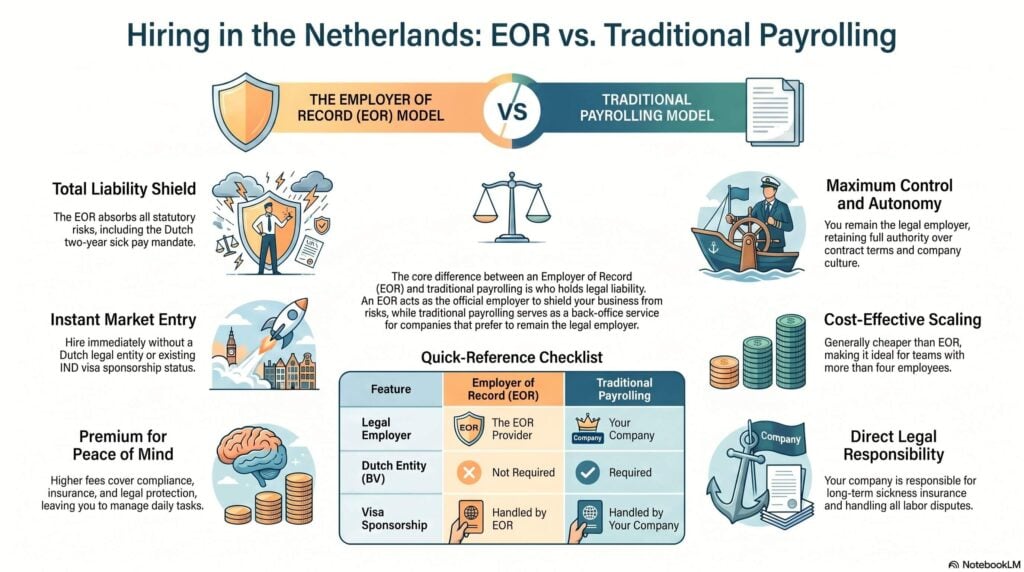
Summary: The core difference between an Employer of Record (EOR) and traditional payrolling centers entirely on who holds the legal employer liability on paper. An Employer of Record (EOR) acts as the official legal entity for your staff, absorbing all local statutory risks, managing IND visa sponsorship, and shielding your business from liabilities like the Dutch two-year sick pay mandate. Conversely, traditional payrolling acts strictly as an outsourced back-office processing service, since your business remains the legal employer on the contract, retaining complete autonomy over contract terms while assuming all long-term insurance and operational liabilities.
| Model | Legal employer & main liabilities | Best suited for |
|---|---|---|
| Employer of Record (EOR) | Provider is the legal employer and absorbs sick pay, IND sponsorship and Dutch labour-law risk | Companies without a Dutch BV that want to hire fast and offload risk |
| Traditional payrolling | You stay the legal employer; the provider only runs the payroll administration | Companies with a Dutch entity that want full control and lower fees |
Why these two terms get mixed up and why it matters
When you’re looking to hire someone in the Netherlands, you’ll quickly run into a lot of jargon that might be very difficult to understand as a foreign business owner. Two of these main terms are Employer of Record (“EOR”) and payrolling. On the surface, they look like the same thing: you pay a company and they make sure your employee gets their salary. But if you treat them as identical, you might find yourself in a legal tangle with the Dutch authorities that you really don’t want to be in. We often tell clients to think of it like the difference between renting a car and hiring a private driver. In both cases, you’re getting from A to B. But with one, you’re behind the wheel and responsible for the insurance, the petrol, and the traffic fines. With the other, someone else takes the wheel while you sit in the back and focus on your business.
The confusion usually stems from the fact that both services handle the administrative stuff, like tax filings, payslips and pension contributions. However, the Dutch legal system looks at these two models very differently. One keeps you as the legal employer, while the other completely removes that burden from your shoulders. Understanding which one you need depends entirely on how much risk you want to carry and whether you have a local Dutch entity set up yet. In a world where remote work and international hiring are the norm, getting this distinction right from day one is very important. It’s essentially the difference between a smooth operation and a massive administrative burden that could stall your growth in the Dutch market.
What is an Employer of Record (EOR)?
When you think of an Employer of Record (EOR), you can basically see it as your legal presence in the Netherlands which isn’t actually you or your company, but a third party. So, when you use an EOR, your company isn't actually the employer of your Dutch staff when interpreted by Dutch laws and regulations. Instead, the EOR service provider takes that role. They sign the employment contract, they register with the tax authorities, and they take on all the legal liability that comes with Dutch labor laws. For many international founders, this is the ultimate way to hire personnel easily.
If you don’t have a Dutch legal entity (a BV) yet, but you’ve found a great developer or project manager you want to hire tomorrow at the latest, an EOR is how you do it. You pay the EOR a flat fee plus the employee's salary and taxes, and they handle everything else. They are the ones who have to worry about sickness pay, pension regulations, and those notoriously strict Dutch dismissal laws. The beauty of this setup is speed and precision. You can essentially hire someone in the Netherlands within a few days because the EOR already has the infrastructure, the tax numbers and the IND sponsorship status ready to go.
You still manage the employee's daily tasks, set their goals and decide their raises, but on paper, they are an employee of the EOR. It’s a bit more expensive than doing it yourself, but you’re paying for the peace of mind. You don't have to learn the ins and outs of Dutch social security or hire a local HR expert just to manage one person. It’s the best move for companies trying out the Dutch market before diving in without thinking.
What is traditional payrolling?
If you already have a Dutch BV set up, or you’ve registered your foreign company with the Dutch tax office, you might not need a legal shield to hire people. In this case, traditional payrolling is likely what you are looking for. Unlike an EOR, where the provider is the employer on paper, with payrolling, you are the legal employer. You hold the contract, you have the direct relationship with the employee, and you carry the ultimate legal risk. So, what does the payroll company actually do? Think of them as your highly specialized back-office. They handle the administration and math that keeps you compliant with the Dutch tax authorities.
They also calculate things like social security contributions, ensure the 8% holiday pay is accrued correctly, and generate those official monthly payslips. They make sure the right amount of tax is withheld and paid on time, so you don't end up with a surprise audit. The big difference here is control and responsibility. Because you are the employer of record in this scenario, you are the one responsible if an employee falls ill for a long period (which, in the Netherlands, can mean paying their salary for up to two years). You also manage the pension registrations and the insurance policies yourself.
In short, payrolling is for companies that want to be rooted in the Netherlands somehow, but also don't want to spend their free time calculating Dutch tax brackets. You keep the authority, and the company doing the payrolling is keeping your books clean. It’s generally cheaper than an EOR because you’re doing the heavy lifting of being the legal employer yourself, and still takes a lot of work off your shoulders at the same time. In general, payroll services are highly sought after due to this flexibility and cheaper rate.
The legal responsibility split
This is the section where you really see the divide between these two models. In the Netherlands, the law is very protective of the employee, and someone has to be responsible if things go wrong. In an EOR setup, that party is the provider. Since they are the legal employer, they are the ones who must show up in court if there is a dispute, and they are the ones liable for ensuring the workplace meets Dutch safety standards. With traditional payrolling, however, the responsibility is yours. For example, if you have a disagreement with an employee about their contract, or if they claim they were treated unfairly, you are the one who has to deal with the legal proceedings. The payroll provider will make sure the numbers on the payslip were correct, but they won't defend you in a labor dispute because they aren't the party signed to the contract. In some cases, a payroll provider can advise you though. Intercompany Solutions can definitely help you out with assistance should such disputes or problems arise.
The most significant risk in the Netherlands is long-term sickness. Dutch law requires an employer to pay at least 70% of a sick employee's salary for up to 104 weeks (two years). If you use an EOR, the EOR provider manages this risk (usually through their own insurance). If you use a payroll service, you are responsible for that two-year commitment yourself. You’ll need to take out your own sickness absence insurance (“verzuimverzekering”) to cover that potential cost. Understanding this split is vital for your risk management strategy. One model offers total insulation from Dutch labor law complexities, while the other requires you to be fully insured up and ready to handle the duties of being a local employer. It’s basically a trade-off between paying a premium for protection or taking on the risk to save on service fees.
What if you want to hire foreigners?
If your new employee needs a visa, the choice between EOR and payrolling is often very clear. To bring a highly skilled migrant to the Netherlands, the employer must be a so-called Recognized Sponsor with the IND. If your company is based in Dubai or Los Angeles (to name just some examples) and doesn't have a Dutch entity yet, you cannot be a sponsor. You simply don't exist in the eyes of the Dutch immigration system. This is where the EOR becomes a great option. Because the EOR is a Dutch company with its own sponsorship license, they can host the visa for you.
They handle the entire IND application, ensure the salary meets the 2026 thresholds and take care of the residency paperwork. Your employee gets their permit, and you get your talent, all without you having to touch a single immigration form. With traditional payrolling, you are the sponsor. This means you must go through the process of applying for recognition with the IND yourself. You’ll have to pay the registration fees and prove your company's financial stability. If you already have this status, a payroll provider is great for maintaining the records, but they cannot lend you their sponsorship.
In short: if you need a visa now, and you don't have a Dutch BV, the EOR is your only realistic path. If you have a long-term plan to hire dozens of people and want to build your own corporate identity in the Netherlands, it’s worth getting your own sponsorship and using a payroll partner to manage the monthly data. It’s a choice between a quick start with a partner or a long-term build on your own. Aside from that, we actually encourage foreign company owners to make use of the Dutch labor force. The talent pool is enormous and most employees are bilingual, or even trilingual. There are many people to choose from, so hiring someone from abroad is not always necessary.
Cost vs. control: what fits you best?
When deciding between an EOR and a payroll provider, you are essentially balancing your budget against your desired level of authority. An Employer of Record is almost always the more expensive option, but also by far the safest. Because the EOR takes on all the legal and financial risks, like the two-year sickness pay we mentioned, they generally charge a significant fee. This is usually either a flat monthly fee per employee, or a percentage of the total gross salary. You are basically paying for a package deal that includes compliance, insurance, and legal protection. On the flip side, traditional payrolling is cheaper, but you have to handle much more by yourself.
With payrolling, you are paying for a service that processes data, not a partner that shares your risk. Since you are the one holding the insurance and the legal liability, the payroll provider’s fees are generally just a fraction of what an EOR would charge. For a company that wants to start hiring people in Holland, this is almost always the more cost-effective way to scale. However, the control aspect is where things get interesting. In an EOR setup, while you manage the person’s daily work, the EOR technically has the final say on the contract terms.
They have to ensure the contract doesn't violate their own corporate policies or Dutch law. If you want to offer a very creative or non-standard bonus structure, the EOR might say "no" to protect themselves. With payrolling, you have total autonomy. Since you are the legal employer, you can draft the contract exactly how you want (within the limits of Dutch law, of course). You decide the perks, the notice periods and the specific clauses without needing a middleman’s approval. It’s the difference between following someone else's rules or writing your own, and we often see that most company owners prefer the latter option due to its flexibility.
How do you make the best decision?
Deciding between an EOR and a payroll provider isn't about which service is better, but it's rather about which stage your business is currently in. If you are a small startup or an international firm testing the Dutch talent pool for the first time, the EOR is almost always the winner. It allows you to hire instantly, bypass the IND paperwork, and offload the risk of Dutch labor laws for a predictable monthly fee. It’s the easiest (but also most costly) entry into the Netherlands.
However, as your team grows, the situation starts to change. Once you have more than three or four employees, the cumulative fees of an EOR can become significantly higher than the cost of maintaining your own Dutch BV and hiring a payroll partner. At that point, bringing the legal employer status in-house gives you more control over your company culture, your contracts, and your long-term costs. So, how do you decide? Ask yourself some questions like these:
- Do I know much about Dutch labor laws? If no, choose EOR.
- Do I have a Dutch legal entity (BV)? If no, go for EOR just to be safe.
- Do I need an IND visa for this person immediately? If yes (and you aren't a sponsor yet), go EOR.
- Am I ready to handle the 2-year sickness risk myself? If yes, traditional payrolling will save you money.
No matter which path you choose, the actual thing that keeps you safe is your payroll integration. Even with an EOR, you need clear visibility into how your staff is being paid. But if you go the payroll route, that integration becomes your primary defense. A solid payroll system doesn't just print slips; it ensures that every tax contribution, pension deduction, and 30% ruling application is handled with exact precision. As such, by treating your payroll as a core part of your compliance strategy (rather than just an administrative chore), you ensure that your expansion into the Netherlands is built on a foundation of total legal and financial clarity.
Intercompany Solutions can assist you with all matters regarding hiring employees in the Netherlands
Since we also offer Dutch business establishment services, we often see foreign companies in need for Dutch employees. In such cases, it’s wise to outsource the entire hiring process because Dutch rules and laws can be very complicated and unyielding for someone who doesn’t know these well. And even though an EOR might seem costly, our fees are actually very acceptable within the market. Doing everything yourself and potentially making mistakes is what can make hiring personnel extremely costly. So both EOR and payrolling are basically very solid options to choose. We will always assist you with any choices you make and can provide you with advice regarding your responsibilities as an employer. Just give us a call, and we will gladly explain how the process works, so you can grow your company steadily.
For more information on EOR services and other Payroll matters in the Netherlands you can visit our dedicated website for ICS Payroll.
Similar Posts:
- Foreign multinational corporations & the Netherlands annual budget
- Tax treaty denounced between the Netherlands and Russia per January the 1st, 2022
- Want to innovate in the green energy or clean tech sector? Start your business in the Netherlands
- Stricter tax demands for multinationals in the Netherlands
- How to set up a business as a young entrepreneur