



By Melvin van Esch, Co-founder, Intercompany Solutions
Published Jul 06, 2026 · Last reviewed 20 July 2026
All blog posts are reviewed and fact checked by our labour law lawyer Zishan Hussain and our director.Editorial standards
If you want to hire personnel in the Netherlands for your (Dutch or foreign) company, you need to take into account that there are many rules and regulations that you will need to follow strictly. If you make any mistakes, this can result in huge problems, hefty fines and even worse scenarios. Which is why we offer professional payrolling services to a wide variety of clients: to make sure everything is in order and done by the book. Payrolling also takes a very large amount of time and effort out of your hands, since you don’t have to deal with the entire administrative burden. For example, in this article, we will explain a bit more about payroll taxes, which will provide you with a broader overview of some of the things you will have to deal with. If you would like to know more about what it is exactly that we can offer you, please feel free to contact us for a personal consultation. We will look at your specific situation together and decide which services will fit you and your company best.
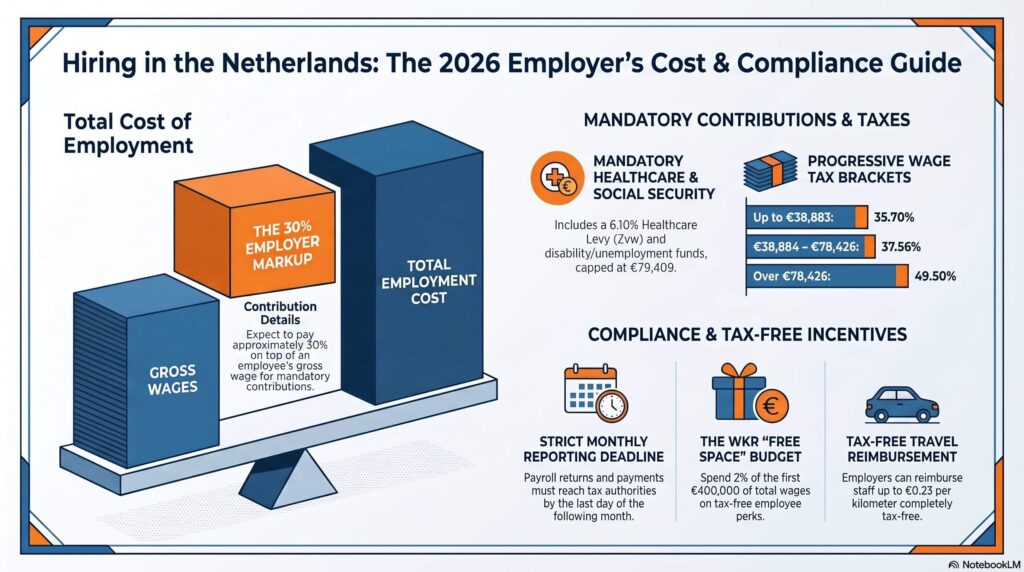
Summary: Hiring in the Netherlands requires budgeting for a total cost of employment that averages 30% on top of an employee's gross wage, due to mandatory social security contributions, the 6.10% healthcare levy (Zvw), and progressive wage taxes (ranging from 35.70% up to 49.50%). Employers can use tax-planning tools like the Work-Related Expenses Scheme (“WKR”), which provides a tax-free free space budget of 2% on the first €400,000 of total wages for company perks, alongside exemptions like tax-free mileage reimbursements (€0.23 per km). To remain fully compliant, businesses must submit a monthly payroll tax return (“loonaangifte”) and clear all payments with the Dutch tax authorities by the strict deadline of the following month’s last day.
| Payroll cost component | 2026 figure |
|---|---|
| Total employer cost | Around 30% on top of the gross salary |
| Wage tax brackets | 35.70% up to €38,883, 37.56% up to €78,426, 49.50% above |
| Healthcare levy (Zvw) | 6.10% of gross wage, capped at €79,409 |
| Social security cap | Premiums apply only on salary up to €79,409 |
| WKR free space | 2% of the first €400,000 in wages; 80% tax over the limit |
| Monthly filing | File and pay the loonaangifte by the last day of the next month |
The employer cost reality: what many people don’t expect
When you’re budgeting for a new hire in the Netherlands, the biggest surprise for most foreign employers is that the gross salary you will have to pay them is only the starting point of the entire deal. In the current 2026 market, you can basically expect to pay an amount of 30% on top of an employee's gross wage in mandatory taxes and contributions. This covers everything from unemployment insurance to the healthcare levy. While this might seem steep compared to some other jurisdictions, it’s the way that keeps the high level of social stability and infrastructure stable in the Netherlands. Understanding this ‘total cost of employment’ early on is the key to preventing a nasty surprise in your first monthly bank statement.
It’s also important to distinguish between the taxes you pay and the taxes you withhold. As an employer, you’re essentially acting as a tax collector for the Dutch tax authorities. You take the ‘Wage Tax’ out of the employee’s paycheck and send it to the government, but the social security premiums are an additional cost that comes directly out of your company’s pocket. In 2026, the administrative burden of calculating these costs meticulously has increased, but once you see the full picture you can actually plan your hiring strategy with much more confidence. It turns hiring staff from a guessing game into a predictable financial task.
Wage tax brackets in 2026
The basis of the Dutch system is the progressive wage tax. In 2026, the tax office uses a three-bracket system to ensure that higher earners contribute a larger percentage. The first bracket covers income up to €38,883 at a combined rate of 35.70% (which includes national insurance). The second bracket is for all sums between that and €78,426, at a rate of 37.56%. Anything earned above that mark hits the top bracket of 49.50%. While these rates look high on paper, almost every employee is also entitled to certain tax credits (‘heffingskortingen’) which significantly lower the actual amount you end up withholding.
As the boss/business owner, you don't necessarily have to explain these brackets to your staff, but you do need to understand how they impact their actual pay. For 2026, the thresholds have been indexed upward to account for inflation, which means your employees get to keep a little more of their raise than they would have in previous years. It’s a very logical system, but it can be confusing for international hires who are used to flat-tax systems. For example, being able to explain that the high 49.5% rate only applies to the top slice of their income, not the whole thing, is a great way to put a new employee’s mind at ease during the salary negotiation phase. So you don’t have to know everything inside out, but it’s really handy if you are acquainted with at least the basics.
Everything about social security contributions
It is also important to note that a substantial part of your payroll budget goes to employee insurance contributions, on top of the base salary. As an employer in the Netherlands, you are always required to pay into a collective safety net that protects your staff against unemployment and long-term disability, amongst other things. In 2026, these premiums include the s-called Unemployment Fund (‘AWf’), which is generally lower for employees on permanent contracts, and the Disability Fund (‘Aof’), which is a little cheaper for smaller businesses. It’s best to think of these not as a tax, but as a mandatory insurance policy that ensures your team is supported if they ever lose their job or become unable to work.
What’s really important for your 2026 planning, though, is the maximum contribution wage which is currently capped at €79,409. This means you only pay these social security percentages on the portion of an employee's salary that falls below this amount. If you’re hiring a senior manager or a highly skilled migrant that earns well over that amount, your extra employer costs actually stop once they hit that cap. This makes hiring senior talent slightly more cost-effective regarding their salary, than entry-level staff.
Managing these different funds is the most complex part of Dutch payroll. Since the rates for disability insurance can actually change depending on your specific industry and your company's history, it’s not an easy and straightforward calculation. You need to stay on top of these shifts to make sure you aren't overpaying or, even worse, underfunding your employees' protection. By keeping these contributions synchronized with your monthly payments, you're fulfilling a major social obligation whilst ensuring your business stays in the clear with all authorities.
The healthcare contribution (Zvw)
On top of the standard social security taxes, every Dutch employer must pay a specific tax under what's called the Healthcare Insurance Act (‘Zorgverzekeringswet’ or ‘Zvw’). In 2026, this contribution is set at 6.10% of the employee's gross wage. It’s very important to understand that this isn’t the employee's private health insurance: they still have to pay for their own monthly policy separately. Instead, this is a mandatory employer tax that helps fund the broader Dutch medical system. For you as a business owner, it’s another non-negotiable add-on that you need to factor into your total labor costs from day one.
Just like the other social premiums, the Zvw contribution is capped at a maximum wage. For 2026, this threshold is €79,409. Once an employee's annual salary crosses this line, you no longer pay that 6.10% on the remaining amount. This cap is a vital detail for your 2026 financial planning, because it means that for high-earning staff, the relative cost of the Zvw actually decreases as their salary goes up. It’s a bit of a quirk in the Dutch system, but it ensures that the health tax doesn't become prohibitively expensive for companies hiring solid and experienced talent.
Managing this correctly is vital because the Zvw contribution is often the first thing the Dutch tax authorities look at during a check-up. Since the rate and the cap change every year, you need a payroll setup that automatically adjusts for these shifts. Getting it wrong, even by a few euros, can create a mess of retroactive corrections that are a headache for both you and your staff. By making sure this healthcare levy is always paid correctly payments, you're making things much easier for yourself and your staff and also will avoid any nasty issues.
The work-related expenses (WKR)
One of the most useful tools in your Dutch payroll kit is the Work-Related Expenses Scheme (‘WKR’). Basically, the Dutch government gives you a ‘free space’ budget every year to treat your team without the tax office taking a cut. For 2026, this budget is set at 2% of your first €400,000 in total wages. It’s perfect for those little extras that build a good culture: think Christmas parties, office snacks or even a small birthday bonus. Since the employee receives these perks 100% tax-free, it’s often way more appreciated than a small gross raise that just gets eaten up by the Dutch tax authorities.
The secret to using the WKR well is knowing what doesn't have to come out of that 2% budget. There are targeted exemptions for things like study costs or travel. Speaking of travel, in 2026, you can actually reimburse your staff up to €0.23 per kilometer completely tax-free. If you stay within these specific categories, your 2% free space stays untouched, which eventually leads to leaving you more room for the fun stuff. Just keep a close eye on the total, because if you accidentally spend more than your allocated budget on these perks, the company has to pay a very high 80% levy on the difference, and it’s best you try to avoid that, of course.
Thus, for a foreign employer, the WKR is really about flexibility. It allows you to tailor your benefits to what your team actually cares about without constantly checking the tax tables. The only real must is good and proper record-keeping. You need to track what you're spending throughout the year so you don't get a surprise bill in January. If you manage it right, it’s a total win-win: your employees feel valued with high-value perks, and you keep your overall tax burden as light as possible.
Monthly reporting and paying
Once your payroll is set up, you enter a monthly rhythm that the Dutch tax office takes very seriously. Every month (or every four weeks, depending on your choice), you have to file a payroll tax return (‘loonaangifte’). This isn’t a once a year thing like personal income tax; it’s a constant obligation for your business. You report exactly what you paid your staff, the taxes you withheld and the social premiums the company owes. The deadline is strict: both the filing and the actual payment must be received by the Dutch tax authorities by the last day of the month following the one you’re reporting for. So if you’re paying for May, the money and the paperwork need to be there by June 30th.
Missing these deadlines is one of the quickest ways to get on the tax office's radar and that’s not something you want or need. In 2026, the penalties for late filing or late payment are automated and can add up fast. Even if you didn’t have any employees working that month, but your company is still registered as an employer, you still have to file what’s called a zero-return (‘nihilaangifte’). It’s basically their way of knowing that you haven’t forgotten them. For a foreign employer, this constant cycle can feel a bit relentless, especially if you’re used to more relaxed reporting schedules in other countries.
The good news is that this cycle is highly predictable. Most modern payroll systems handle the filing part with a single click, sending the data directly to the tax office's servers. Your main job as the owner of the company is simply ensuring the funds are in the right account at the right time. Because the Dutch system is so digitalized, once you get into the groove of the monthly heartbeat, it actually becomes more of a background task rather than a source of stress. It’s all about consistency: keeping your records clean and your payments punctual ensures that your business remains a low-risk entity in the eyes of the government.
Making it all manageable with professional payroll services
At the end of the day, when you're looking at all these rules and percentages (like the 35.7% income tax, the 6.1% healthcare levy and those social security caps), it’s very easy to feel like you’re drowning in numbers. But here’s the thing: in the 2026 landscape, the Dutch system is actually incredibly predictable once you stop trying to do everything yourself (especially if you have a foreign company). The most successful foreign employers aren't the ones who memorized every tax bracket; they’re the ones who just factored that 30% rule-of-thumb into their hiring budget and moved on to actually building their company.
The real secret to staying in line with Dutch payroll is treating it like a background utility rather than a daily task. By setting up an automated, professional system from the start, you’re essentially hiring a compliance officer who lives in your software. They handle the tricky stuff, like indexing the new 2026 thresholds or managing the WKR budget, so you don't have to. It turns what feels like a mountain of paperwork into a simple, monthly task.
Paying these taxes is really just the entry fee for accessing one of the most productive and stable workforces in the world. When your payroll is clean and automated, you aren't just following rules; you’re building a foundation that lets your team feel secure. That peace of mind is what allows you to scale up anywhere in the Netherlands without looking over your shoulder for the tax office. Once that's in place, you’re finally free to focus on the work that actually makes your business grow. And we can help you with everything when it comes to payroll.
Intercompany Solutions can handle all payrolling matters for you and your company
Our highly specialized team knows every single law, rule and regulation that is important when hiring personnel. Next to that, we can also offer legal and tax advice, making it easier for you to understand how everything works in the Netherlands. Setting up a branch office here, or even starting a Dutch company to hire employees can seem very daunting if you don’t know the exact rules you will have to follow. Which is why we are here to assist you during every step of the way. If you would like to know more about our services, please feel free to contact us anytime for personal advice or a clear quote.
We have a dedicated payroll website www.icspayroll.com with more information on payrolling.
Similar Posts:
- Foreign multinational corporations & the Netherlands annual budget
- Tax treaty denounced between the Netherlands and Russia per January the 1st, 2022
- How Developed Countries Collect Taxes on Bitcoin
- Stricter tax demands for multinationals in the Netherlands
- Want to innovate in the green energy or clean tech sector? Start your business in the Netherlands

Sources
- Business.gov.nl - employing staff in the Netherlands
- UWV - Dutch employee insurance and labour information
- Wet op de vennootschapsbelasting 1969 (wetten.overheid.nl)
- SVB - Dutch social insurance and A1 certificates
- PwC Netherlands - tax insights and publications
- Hoge Raad 2025, dissolution of an employment contract (ECLI:NL:HR:2025:1171)
- Hoge Raad 2022, dismissal on economic grounds (ECLI:NL:HR:2022:276)
- Burgerlijk Wetboek Boek 7, employment law (wetten.overheid.nl)
- Loyens & Loeff - legal and tax insights
- Court of Justice EU, CCOO on recording working time (C-55/18)
- Belastingdienst - calculating payroll taxes
Need more information on the Dutch BV company?
Contact an expertReady to start your company in the Netherlands?
| Formation time | Dutch BV formation completed in 3 to 5 business days |
|---|---|
| Process | Fully remote setup with step-by-step guidance |
| Compliance | Expert support for registration, VAT and compliance |
| Aftercare | Accounting, tax and legal support included |
| One partner | All of the above through one trusted formation partner |