

In Which Cases Should You Establish a Dutch BV for Hiring Employees in the Netherlands?
Intercompany Solutions has assisted thousands of foreign entrepreneurs in the past with a very wide variety of services, ranging from Dutch company establishment to tax advice, EOR and payroll services. We have a highly specialized team in place that knows all the relevant ‘ins and outs’ of hiring personnel in the Netherlands; Dutch employees or foreign talent alike. This means that we can assist you during every part of the hiring process and beyond, making it much easier for you to acquire high-quality personnel that can elevate your business to a higher level. We make sure all mandatory requirements are met, and you adhere to Dutch laws and regulations at all times, making it possible for you to focus on your core business and more important matters than your administration. If you would like to know what we can do for you, please do not hesitate to contact us directly. We can offer you personalized and expert advice, specifically tailored to your situation and needs.
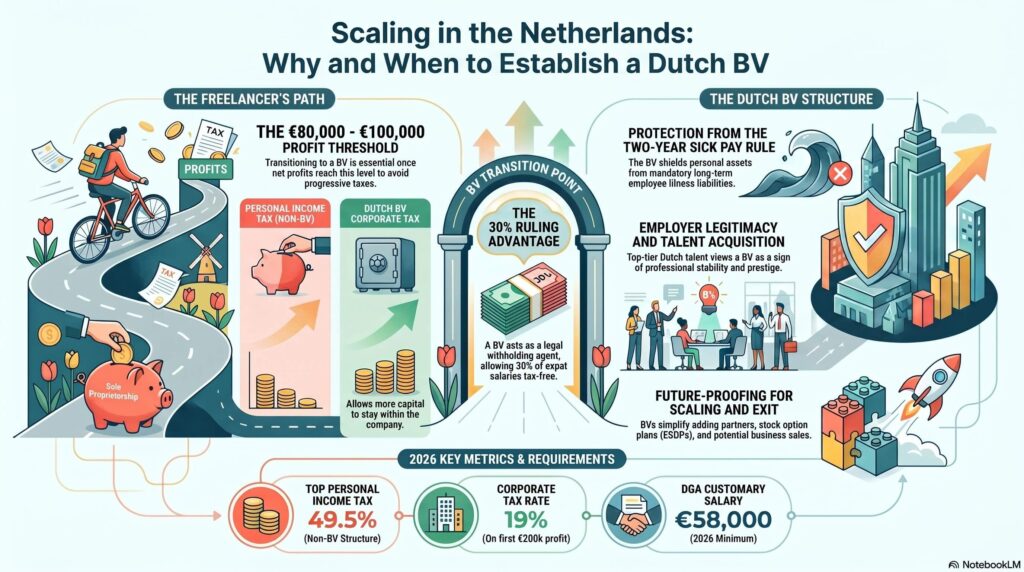
Summary: Incorporating a Dutch BV (private limited liability company) becomes essential once business net profits climb toward €80,000 to €100,000, effectively shielding entrepreneurs from progressive personal income tax brackets capping at 49.50%. The BV functions as a separate legal entity, protecting personal assets from severe corporate operational risks, such as the mandatory two-year Dutch sick-pay liability, while acting as the required legal withholding agent to issue the 30% ruling. Under the 2026 Director-Major Shareholder (DGA) framework, owners must run a structured monthly payroll processing a mandatory minimum customary salary (“gebruikelijk loon”) of €58,000.
| Reason to set up a Dutch BV | What it gives you |
|---|---|
| Profit tipping point | From €80,000-€100,000 profit a BV beats the 49.5% income tax (corporate tax 19% / 25.8%) |
| Liability protection | Your personal assets stay separate from business debts and the 2-year sick pay risk |
| 30% ruling access | As a DGA you and your hires can use the 30% ruling; the BV acts as withholding agent |
| Scaling your team | Clean employer status for contracts, CAO, pensions, ESOPs and new partners |
| DGA payroll | Run a customary salary (gebruikelijk loon) of around €58,000 via monthly payroll |
The professional threshold to think about starting a Dutch BV
For many foreign entrepreneurs, the journey into the Netherlands starts with a simple choice: stay as a freelancer or go big immediately with a Dutch BV. While a sole proprietorship (“Eenmanszaak”) is easier to set up, the BV (which is comparable to a private limited liability company) is the real signal that you’re building a long-term presence. In the eyes of the Dutch government and potential employees, a BV carries a certain level of prestige and stability. If you’re planning to hire top-tier talent in the Netherlands, those candidates will often look at your business structure to see how real and stable the company is. Owning a BV shows that you’ve invested in the local legal framework and that you’re prepared adhere to the professional rules of the 2026 labor market.
It's not just about your image, though. Many Dutch corporate clients actually prefer, or even require, that their partners is a BV for compliance reasons. By establishing a Dutch entity, you’re actively removing the foreign barrier that can sometimes make local hires or partners a bit nervous. It basically simplifies everything: from getting a Dutch business bank account to signing an office lease. If your goal is to grow a team in the Netherlands and become a recognized player in the Dutch economy, starting with a BV is often the most strategic move you can make.
Liability protection: one of the main benefits of a Dutch BV
The biggest selling point for a Dutch BV is usually the limited liability it provides. When you start hiring employees, your risk profile changes instantly. You aren't just responsible for your own work anymore; you’re responsible for the actions, safety, and long-term pay of another human being. In a sole proprietorship, if the business gets sued or falls into debt, your personal house, car, and savings are all at risk to pay debts made with the company. But with a Dutch BV, the company is its own legal person, or legal entity as it is formally named. This means that as long as you’re managing things in a correct way and are also not being fraudulent, your personal assets always stay separated from the liabilities of your business.
Next to that, this protection is especially important in the Netherlands because of the strict 'two-year sick pay' rule. If your business isn't a BV and you run into a situation where you can't cover the costs of a long-term illness or a legal dispute with a (former) staff member, you could find yourself personally bankrupt. By establishing a BV, you’re essentially buying a massive insurance policy for your personal life. It allows you to take the necessary risks to grow your team and scale your operations without the constant fear that a single business mistake will ruin your family’s financial future.
Furthermore, it makes you a much more attractive employer. High-level talent in the Dutch tech or service sectors understands the difference between a freelance setup and a registered limited liability company. They always want to know whether the company they are possibly joining is a stable, professional entity, with its own capital and structure. For business owners, this shield isn't just about safety, but it's mainly about creating a solid foundation that can withstand the pressures of the 2026 labor market, while at the same time protecting the life you’ve built outside of work.
The 30% ruling advantage
If you’re a foreign entrepreneur moving to the Netherlands, the 30% ruling is probably already on your radar, or it should be. Essentially, it’s a massive tax break that allows you to give an employee 30% of their salary tax-free to cover the costs of relocating. You might ask yourself what the catch is? You generally need to be an employee of a Dutch company to get it. By setting up a Dutch BV, you can actually become an employee of your own company (the "Director-Major Shareholder", or “DGA” in Dutch). This lets you qualify for that tax break yourself, which can save you thousands of euros every year.
It’s also a nifty tool for hiring. If you’re trying to convince a brilliant developer from abroad to move to the Netherlands, being able to offer them the 30% ruling is a total game-changer. It makes their net take-home pay much higher without it costing you a cent more in gross salary. But here’s the thing: you can’t easily do this as a sole trader. You need the formal structure of a BV to act as the withholding agent for this specific tax benefit. In 2026, the rules around this are tighter than they used to be, but for the right high-skilled talent, it’s still the biggest benefit in the Dutch market.
Having this setup ready to go shows that you aren't just pretending to be successful and thriving, on the contrary. It actually shows that you’re using the Dutch tax system to its full advantage for both yourself and your future team. It turns the expensive Dutch labor market into something much more manageable. When you factor in the massive savings over five years, the cost of setting up the BV usually pays for itself in just a few months. It’s easily the most profitable move a foreign business owner can make if they qualify for the legal criteria.
Tax efficiency and when to switch your business type
Deciding when to switch from a sole proprietorship to a BV usually comes down to one thing: the tipping point in your profits. In the Netherlands, a sole trader (“Eenmanszaak”) gets some great tax breaks early on, like the private business ownership allowance. But there's a limit. Once your profit starts climbing toward that €80,000 to €100,000 mark, the progressive income tax, which can hit a staggering 49.5% in 2026, starts to eat at your profits. This is when the BV structure becomes your best option.
In a BV, your business profit is hit with corporate tax first, which is a much lower 19% for the first €200,000 and 25.8% above that amount. Even after you pay yourself a salary and deal with dividend tax, the money that’s left over stays in the company at that lower rate. This allows you to reinvest in your team or your tech much more efficiently. It’s like having a tax-efficient bucket where you can store your cash rather than handing half of it over to the Dutch tax authorities immediately.
For a foreign entrepreneur, this isn't just about saving money; it’s about cash flow. When you have employees to pay, every euro is important. The Dutch BV structure allows you to manage your personal income separately from the company's growth funds. By keeping your personal customary salary at the required 2026 level (around €58,000) and leaving the rest of the profit in the BV, you’re playing it safe and keeping reserves at an interesting rate. It gives you the financial breathing room to hire that second or third person much sooner than you could as a solo entrepreneur.
Are you planning on scaling your team?
Once you decide to move beyond a team of one, the BV structure really starts to show its value. Scaling a company in the Netherlands requires a level of administrative clarity that other business models just can't match. When you hire multiple people under a Dutch BV, the legal relationship is clean: they are employees of the company, not of you personally. This makes it much simpler to handle things like employment contracts, collective labor agreements (CAO) and even pension schemes as you grow.
A BV also makes you look a lot more stable to recruiters and HR partners. If you’re trying to build a culture and a brand, having that "B.V." after your company name acts as a badge of legitimacy. It’s easier to set up standardized perks, like employee stock option plans (ESOPs), which are very important if you want to attract high-level talent without having a lot of money. In the 2026 market, where everyone is fighting for the same skilled workers, having these corporate-style benefits can be the deciding factor for a new hire.
It also simplifies the exit or the entry of new partners. If your business takes off, and you want to bring in a co-founder or sell a piece of the company to an investor to fund more hiring, doing that with a BV is a standard procedure. Trying to do that as a sole trader is an absolutely horrid task that includes tons of legal paperwork and tax complications. As such, by starting with a BV, you’re basically future-proofing your growth. You’re building a presence that is designed to hold more than just one person, allowing you to scale up as fast as your specific market allows.
Payroll integration for the DGA (director-shareholder)
When you transition to a BV, you’re no longer just the owner of your company; you officially become an employee as well, known as a ‘DGA’ as we mentioned briefly above. This comes with a unique set of rules called the customary salary (“gebruikelijk loon”). The Dutch tax authorities want to make sure you aren't paying yourself a tiny salary just to avoid income tax, while taking all your money out as lower-taxed dividends. For 2026, the benchmark for this salary is around €58,000, though it can be a bit lower if you can prove your business is still in the startup phase.
This is exactly where a professional payroll setup becomes a must for you and your company, if you want to do everything right. You have to run your own monthly payslip alongside your employees’, making sure all the social contributions and wage taxes are withheld correctly. It’s a bit of a balancing act, because while you want to satisfy the Dutch tax authorities, you also need to manage the company's cash flow to ensure there's enough left over to pay your actual team. A good payroll provider like Intercompany Solutions will help you document your salary choices so you don't end up in a dispute with a tax inspector later on.
Integrating your own salary into the same system as your hires makes everything much clearer. It ensures that your insurance coverage, pension accrual, and tax filings are all happening in one synchronized way. For foreign entrepreneurs, this is often the most confusing part of the BV model, but once it’s set up, it’s a powerful way to manage your personal wealth while building a real corporate entity. It basically turns the complex DGA rules into a simple, automated monthly task that protects the company and your personal standing with the tax authorities.
What’s the best choice for you?
Deciding whether to start a Dutch BV is rarely about a single thought or moment. Instead, it’s usually a realization that your business has outgrown itself. If you have a solid business plan, a clear path to hiring your first two or three employees, and your projected profits are starting to make the 49.5% income tax bracket look intimidating, then the BV is no longer a luxury, but it’s an actual necessity. It’s the move that transforms you from a person with a small company into a company with a future. In the 2026 landscape, where clarity and legal protection are more valuable than ever, it’s the most stable platform you can build on.
For foreign entrepreneurs specifically, the Dutch BV is also your best way to the local culture. It says you are here to stay, you’re hiring locally, and you’re contributing to the Dutch social system. While the initial setup costs and the slightly higher administrative burden can feel like a hurdle, the tax efficiency and the 30% ruling benefits almost always tip the scales in your favor. When you combine that with a professional payroll partner who handles the DGA rules and the employee filings, the complexity of the BV mostly disappears, leaving you with a streamlined, growable and safe business structure.
Ultimately, if you’re serious about making yourself available the Dutch market, you shouldn't let the paperwork intimidate you. The BV is built to propel you forward, not to hold you back. Establishing a Dutch BV in an early stage gives your business the space to grow and expand. It goes way beyond tax savings, since it’s also about things like the assurance to recruit top talent, secure major clients and create something that can stand the test of time. With that foundation in place, there’s really no limit to what your team can accomplish in the Netherlands.
Intercompany Solutions can help you with the best setup for your company
Even though we can offer you all necessary payroll services, keep in mind we also are experts in Dutch business establishment. You can easily hire personnel without a Dutch BV, that’s a fact. But depending on your specific situation, the growth of your presence in the Netherlands and the amount of people you want to hire, a Dutch BV can become increasingly more attractive. If you could use some professional advice regarding this subject, please always feel free to contact our expert team directly. We can assist you with any questions you might have, ranging from company establishment to tax advice and payroll services. In any case, with or without a BV, we are here to make sure any employees you hire are paid correctly. We are always ready to help you in any way we can, so you can focus on building and expanding your company in the best way possible.
Similar Posts:
- Foreign multinational corporations & the Netherlands annual budget
- Tax treaty denounced between the Netherlands and Russia per January the 1st, 2022
- How to set up a business as a young entrepreneur
- Want to innovate in the green energy or clean tech sector? Start your business in the Netherlands
- The challenges of starting entrepreneurs