



VAT Returns Netherlands: Your 2026 Compliance Guide
What you need to know about Dutch VAT returns
Every entrepreneur operating in the Netherlands must file a VAT return, known in Dutch as a btw aangifte, with the Netherlands Tax Administration (Belastingdienst). This applies regardless of your business size, legal structure, or country of residence. The Dutch VAT system runs on three main rates: a standard rate covering most goods and services, a reduced rate for items like food and medicine, and a zero rate for specific categories such as solar panels. Certain sectors, including education, healthcare, childcare, insurance, and banking, are fully exempt.
Filing frequency is assigned by the Tax Administration, not chosen by you. Most businesses file quarterly, though monthly and annual schedules exist for businesses with higher or lower tax liabilities. Every return must be submitted digitally, and you must file even when you had zero transactions during the period.
Key obligations at a glance:
- VAT rates: 21% standard, 9% reduced, 0% for specific goods, and full exemptions for qualifying sectors
- Filing frequency: monthly, quarterly, or annual, as assigned by the Tax Administration
- Submission method: digital only, via Mijn Belastingdienst Zakelijk or Standard Business Reporting (SBR) software
- Zero returns: mandatory even with no turnover or VAT activity
- Calculation responsibility: you calculate what you owe or are owed; the Tax Administration issues no pre-filled assessments
How to prepare and file your Dutch VAT return
The process is more straightforward than it looks, but the sequencing matters. Here is how to move from setup to submission without errors.
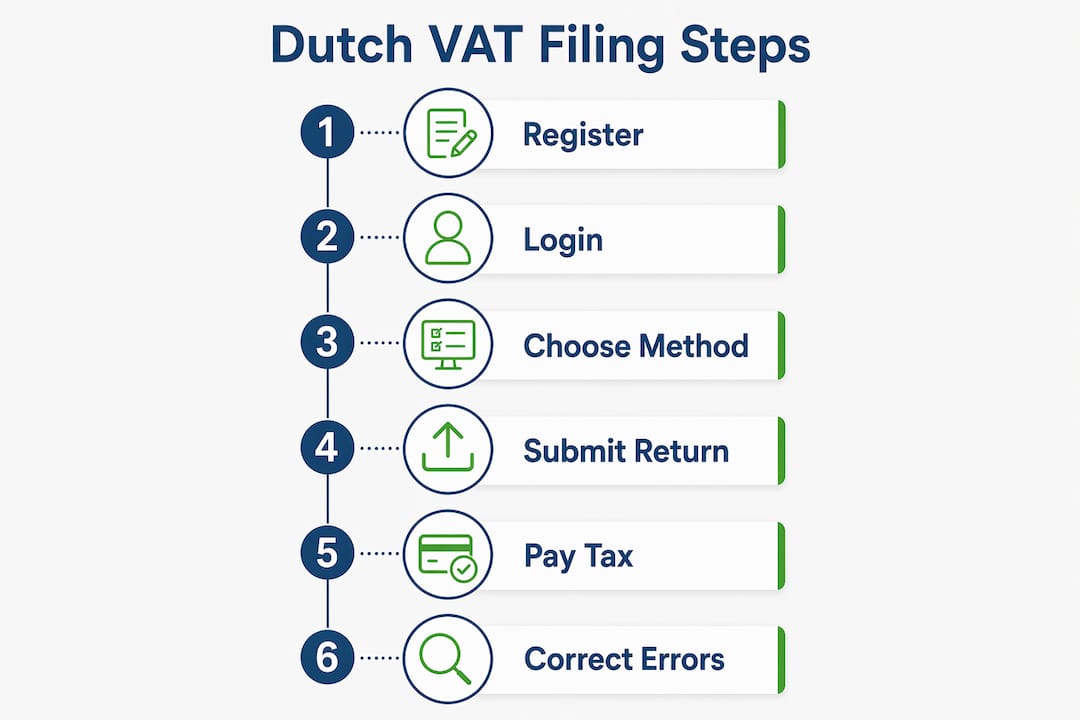
Step 1: Get your login credentials. After registering your business with the Dutch Chamber of Commerce (KVK), your details pass automatically to the Tax Administration. You will receive a letter confirming your VAT number and filing schedule, plus login credentials for the digital portal.

Step 2: Choose your filing method. The standard route is Mijn Belastingdienst Zakelijk, accessed via DigiD (for individuals), eHerkenning (for legal entities like a BV), or a European approved digital identity. Alternatively, accounting software compatible with Standard Business Reporting (SBR) can submit directly on your behalf.
Step 3: Calculate your VAT position. Declare the VAT you charged customers during the period, then deduct the input VAT your suppliers charged you. The difference is what you pay or reclaim. The Tax Administration does not generate an assessment for you; the calculation is entirely your responsibility.
Step 4: Account for special transactions.
- Intra-Community acquisitions: if you purchased goods from another EU country, you report the VAT under the reverse-charge mechanism, declaring it as both charged and deducted in the same return
- Reverse-charge on subcontracting: in sectors like construction and shipbuilding, you pay the subcontractor’s VAT instead of them
- Crypto payments: convert the value to euros, typically at the invoice date, and include it in your turnover
Step 5: Handle zero returns. If you had no activity, log in and file a nil return anyway. Skipping it triggers a penalty just as missing a positive return would.
Step 6: Pay before the deadline. Payment must clear the Tax Administration’s account by the due date, not just be initiated. If you are owed a refund, the Tax Administration processes it after reviewing your return.

Step 7: Correct errors promptly. If the discrepancy between what you filed and what you owed is less than €1,000, correct it in your next return. Above €1,000, you must file a Suppletie-aangifte (supplementary return) through the Mijn Belastingdienst Zakelijk portal.
Important details and special cases that affect your return
VAT exemptions and input tax deductions
If your business only carries out VAT-exempt activities, such as healthcare or education services, you generally do not file returns at all. The Tax Administration will confirm this in writing. The catch: you also cannot deduct any input VAT on your business expenses, so your cost structure looks different from a standard VAT-registered business.
Mixed businesses, those that carry out both taxable and exempt activities, must apportion their input VAT deductions. Only the share relating to taxable turnover is deductible.
The Small Businesses Scheme (KOR)
Businesses with annual turnover below a defined threshold can apply for the KOR (kleineondernemersregeling). Under KOR, you charge no VAT to customers and file no returns, which cuts administrative burden significantly. The trade-off is real: you also lose the right to deduct input VAT on any business purchases or investments. For a business with high operating costs, that forfeiture often outweighs the paperwork savings. Think carefully before enrolling.
Documentation you must keep
Dutch VAT law requires you to retain invoices, receipts, and accounting records for a legally mandated period. Every invoice supporting a VAT deduction must show the supplier’s VAT number, the VAT amount, and a description of the goods or services. Digital records are acceptable, but they must be accessible and readable if the Tax Administration requests an audit.
Common mistakes to avoid
- Deducting input VAT on expenses not used for taxable business activities
- Missing the filing deadline because you assumed a zero-activity period required no action
- Failing to apply the reverse-charge mechanism on qualifying intra-Community purchases
- Using the wrong accounting method: invoice accounting (factuurstelsel) applies when your customers are primarily businesses; cash accounting (kasstelsel) applies when they are primarily consumers
Pro Tip: Keep a simple monthly log of all invoices issued and received, tagged by VAT rate. When the quarterly deadline arrives, the numbers are already organized and the return takes minutes rather than hours.
VAT refunds
If your input VAT exceeds your output VAT in a period, you are entitled to a refund. The Tax Administration processes refunds after reviewing the return. Refunds are not automatic on submission; the timeline varies, but straightforward cases typically resolve within a few weeks. You can also offset a VAT refund against payroll taxes you owe in some circumstances.
Deadlines, penalties, and how to stay compliant
Resident businesses must file and pay within a standard regulatory period after the reporting period ends. Non-resident businesses have an extended period to file and pay after the reporting period. That extra month matters, but it is not a grace period; it is the actual deadline, and missing it carries the same consequences as missing the one-month window for residents.
Miss a deadline and you receive an naheffingsaanslag, an additional tax assessment that includes the unpaid VAT plus a fine. Repeat offenses escalate the penalty. The Tax Administration publishes its full deadline calendar for 2026 on the Belastingdienst website, and you are responsible for tracking those dates yourself.
Practical compliance tips:
- Set calendar reminders at least two weeks before each filing deadline to allow time for any last-minute corrections
- Authorize a tax representative or accountant to file on your behalf if you cannot manage submissions personally
- Confirm that your payment clears the Tax Administration’s bank account before the deadline, not just that you initiated the transfer
- Keep all supporting documentation organized and accessible for at least seven years in case of an audit
For entrepreneurs managing broader Dutch tax compliance, VAT deadlines are just one piece of the picture. Corporate income tax and payroll obligations run on separate schedules.
What US-based and non-resident entrepreneurs must know
Non-resident entrepreneurs face a few hurdles that Dutch residents do not. Getting these right from the start prevents penalties that are entirely avoidable.
VAT registration comes first. Before filing a single return, non-resident businesses must register specifically with the Tax and Customs Administration in Heerlen. Chamber of Commerce registration alone does not satisfy this requirement. You need a separate VAT registration, and you cannot file or claim refunds until it is in place.
eHerkenning access takes time. Legal entities, including foreign-owned Dutch BVs, need eHerkenning to log into the filing portal. Obtaining eHerkenning as a non-resident company involves identity verification steps that can take weeks. Foreign entrepreneurs consistently underestimate this timeline. Start the process well before your first filing deadline.
No pre-filled returns, ever. The Dutch system places full self-assessment responsibility on you. The Tax Administration will not send you a bill or a pre-calculated return. You determine what you owe, file the return, and transfer the payment, all before the deadline.
Zero-transaction periods still require action. Even if your Dutch entity had no sales or purchases in a quarter, you must file a nil return on time. Penalties apply regardless of whether any VAT was actually due.
Pro Tip: If you are a US entrepreneur running a Dutch BV remotely, appoint a local tax representative with filing authorization before your company becomes VAT-active. This sidesteps the eHerkenning barrier entirely and keeps every deadline covered.
For non-residents navigating the full scope of Dutch VAT obligations, the VAT OSS system is worth understanding alongside standard return requirements, particularly if you sell to consumers across multiple EU countries.
Intercompanysolutions helps international entrepreneurs handle VAT registration, filing setup, and ongoing compliance as part of its Dutch company formation services, covering everything from your first btw aangifte to ongoing bookkeeping support.
Key Takeaways
Filing Dutch VAT returns correctly requires self-assessed calculations, digital submission, and strict deadline adherence, with non-residents facing distinct registration and access requirements before they can file at all.
| Point | Details |
|---|---|
| Three VAT rates apply | Standard 21%, reduced 9%, and 0% for specific goods; some sectors are fully exempt. |
| Filing is always mandatory | Zero-activity periods still require a nil return; skipping one triggers a penalty. |
| Non-resident deadline is two months | Resident businesses have one month; non-residents get two months after the reporting period. |
| €20,000 | Businesses below this annual turnover threshold can opt out of VAT filing via KOR but lose input VAT deductions. |
| Error correction threshold is €1,000 | Discrepancies below a set monetary threshold can be fixed in the next return; above that, a supplementary return is mandatory. |