How to Declare VAT as a Foreign Entrepreneur with the One Stop Shop (OSS) System
Paying and receiving VAT is often an integral part of doing business anywhere in the world, since every country on the planet has its own VAT system. Whether you do business nationally or internationally, at some point you will always be confronted with VAT. We understand that this might seem complicated or even daunting for foreign entrepreneurs, especially if you aren’t very well acquainted with Dutch corporate and tax law. Thankfully, our specialists at Intercompany Solutions have many years of extensive experience when it comes to Dutch business establishment, legal compliance, and paying taxes in every way possible.
For example, we will not just establish your Dutch company, but afterwards we can also assist you with all tax-related matters. That means handling your periodical and yearly tax returns, offering you personalized tax advice, and helping you to figure out the best suitable business form for your endeavors. If you would like to know more about our services and whether we are in a position to help you with anything, please contact us directly. We will happily answer all your questions or provide you with a direct and clear quote for the services you might need.
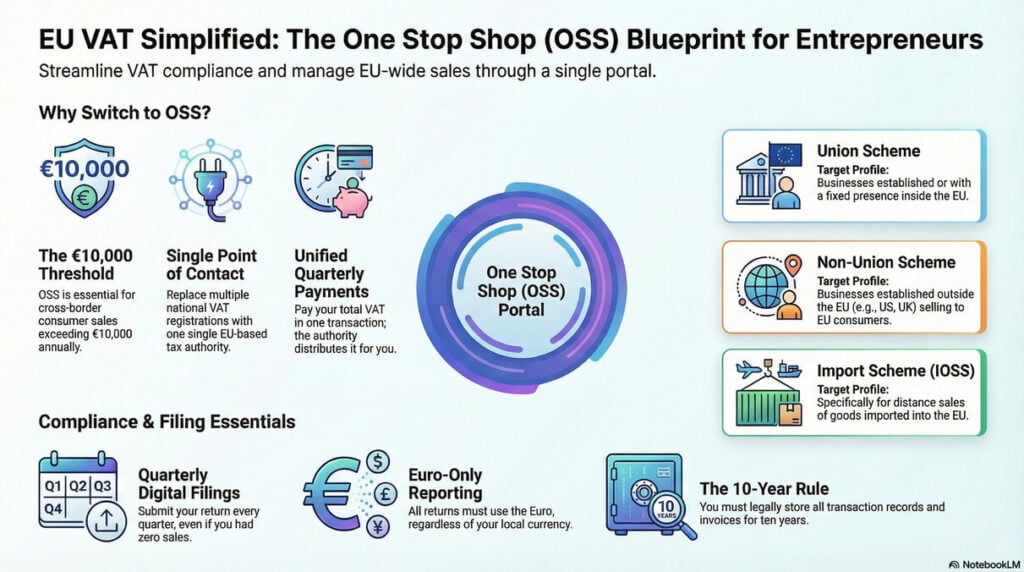
Summary: The One Stop Shop (OSS) system is a revolutionary EU tax scheme designed to eliminate the administrative burden of registering for VAT in every individual member state. For foreign entrepreneurs selling goods or digital services to EU consumers (B2C), the OSS allows for a single quarterly VAT return and one consolidated payment to a chosen tax authority, such as the Netherlands. Once you exceed the €10,000 EU-wide cross-border threshold, the OSS becomes the most efficient tool for maintaining compliance, managing diverse VAT rates, and scaling your e-commerce business across all 27 member states.
| OSS Scheme | Target Audience | Key Use Case |
| Union Scheme | Businesses established inside the EU | Cross-border B2C sales within Europe |
| Non-Union Scheme | Businesses based outside the EU (e.g., US/UK) | Selling services to EU private consumers |
| Import Scheme (IOSS) | Global sellers importing into the EU | Low-value goods (under €150) distance sales |
Paying taxes in the Netherlands as a foreign entrepreneur
Starting or running a business in a country that is not your own can feel exciting, but it can also raise many questions. This is often especially true when it comes to taxes, since taxes in themselves are complicated enough (even in your native country). Nonetheless, know that the Netherlands is actually well-known for being a very business-friendly country, and many international entrepreneurs choose to establish a presence here because of its many strong points. Think of things like a very welcoming atmosphere towards foreign entrepreneurs, its exceptionally strong logistics network, the stable economy and political situation, and a very straightforward company formation process. However, even if you don’t physically live in the Netherlands, there is a good chance that you may still have to deal with Dutch tax obligations, depending on where your customers are located and how you sell your products or services.
So, it’s important to understand how things work early on, especially when it comes to VAT, because mistakes can easily lead to extra costs, penalties, or unnecessary stress later. For foreign entrepreneurs, taxation can look a bit different for Dutch residents, but the system is still clear once you understand the basics. If you sell products or certain digital services to customers inside the European Union, VAT rules may apply, and you must report and pay VAT correctly. Even if your company is registered abroad. This is because VAT is based on where the customer is located, not just where your company sits. The European Union wants to make sure that VAT is collected in the right country fairly and that businesses from different countries follow the same rules. That’s why the EU created a useful tool called the One Stop Shop (OSS) system, which is especially helpful for foreign entrepreneurs, but more on that in a moment.
Understanding VAT for foreign entrepreneurs in the Netherlands
VAT, also known as value-added tax, is a type of consumption tax that is added to most products and services sold within the European Union. In the Netherlands, it is called BTW (Belasting Toegevoegde Waarde). VAT may sound complicated at first, but in simple words, it is a tax that customers pay on top of the price, and businesses are responsible for collecting it and passing it on to the tax authorities. If you sell goods or certain digital services to customers inside the EU (even if your company is not physically based in the Netherlands), you may still be required to charge VAT based on where your customers live. This is especially important for online shops, e-commerce platforms, and digital service providers who sell across borders.
In the Netherlands there are several different VAT rates. This entails the standard VAT rate of 21%, which is basically used for most products and services. Then there is a reduced rate of 9% for some goods like food and medicines. And you even have a 0% rate for certain specific international transactions and some special goods and services. This means that, as a foreign entrepreneur, the rate you use will mainly depend on what you sell and where your customer is located. Additionally, keep in mind that VAT rules in the EU are designed to create equal competition. The meaning of this is that all businesses must follow similar rules, regardless of where they are based at any given moment. This way, a seller from another country does not gain an unfair advantage over a seller from the Netherlands when selling goods or services to Dutch customers.
Being able to actually understand VAT rules well is therefore especially important when you sell in multiple EU countries or are planning to expand your business internationally that way, because managing different national VAT rates, invoices, and filing systems can quickly become challenging. Thus, in order to solve this problem, the EU introduced the previously mentioned so-called One Stop Shop (OSS) system. This is a very handy and efficient solution, which allows entrepreneurs to report and pay VAT on a single platform instead of having to deal with multiple countries individually.
What is the OSS system and who can use it?
The One Stop Shop (OSS) is essentially a very simplified VAT reporting scheme. It was, as we mentioned above, introduced by the European Commission to help businesses selling across EU borders avoid having to register for VAT in every single member state, which is undeniably a very tedious process. So, instead of juggling separate VAT registrations and filings in multiple countries, you can now choose to declare all your eligible EU business-to-consumer (B2C) transactions via one EU-based tax authority. In general, there are three main OSS ‘schemes,’ depending on your business setup and where your company is established:
- The Union scheme is for businesses that have a place of establishment or fixed establishment inside the EU.
- The Non-Union scheme is for businesses established outside the EU, for example, a webshop in the UK or the US that is selling to EU consumers. They can still register for OSS.
- The Import Scheme (sometimes referred to as IOSS) handles goods imported into the EU for distance sales to consumers.
So who should use it? If you are a foreign entrepreneur (whether inside the EU or outside) and you sell goods or certain services directly to private individuals in EU countries, the OSS could greatly simplify your VAT obligations. For instance, distance sales of goods from your webshop in one EU country to consumers in other EU countries, or digital services provided to consumers in the EU. If you exceed certain thresholds (like the EU-wide threshold of €10,000 for sales to consumers outside your country of establishment), OSS becomes especially relevant. In short, OSS is an optional but powerful tool, and if you fit the criteria, it can reduce paperwork dramatically. But you must also abide by its rules across all eligible transactions.
When and why a foreign entrepreneur should register for OSS in the Netherlands
Registering for the OSS system is not mandatory, but it can make your business life much easier if you sell to consumers in multiple EU countries. You should definitely consider registering for OSS in cases when you are selling physical goods or certain digital services directly to private customers (B2C) within the EU. And also, if your sales are above the previously mentioned EU-wide threshold of €10,000 per year for cross-border consumer sales. Because once you cross this threshold, you are actually required to charge VAT based on the laws and regulations in the customer’s country, not your own. This means that without OSS, you’d have to register for VAT separately in each country where your customers live, which can seriously become a time-consuming and costly process. Therefore, even if you haven’t reached the threshold yet, you might still choose OSS early because it prepares you for growth and helps you avoid sudden administrative changes later.
Furthermore, OSS can also be used by entrepreneurs outside the EU who sell to EU consumers, as long as they meet the previously mentioned eligibility and registration requirements. In those cases, you choose one EU country where you register, and that tax authority becomes your main point of contact for VAT reporting. Choosing the Netherlands as your OSS registration country can be beneficial if you already work with Dutch suppliers, use Dutch fulfillment centers, have a company established there, or simply prefer the clarity and reliability of Dutch government systems. Many entrepreneurs also choose the Netherlands because English-language guidance is widely available and because the Dutch tax authorities are known for having clear digital filing systems. So, make sure to register for OSS when you want to make cross-border VAT reporting easier, avoid multiple VAT registrations, and create a smooth, predictable tax process for your growing online business.
Step-by-step guide: how to register for OSS and declare VAT via the Dutch system
We will provide a summarized overview of the necessary steps and actions to register for the One Stop Shop System below so you know what you are supposed to do and how everything works. If you still have any questions whatsoever, please always feel free to contact one of the team members of Intercompany Solutions for helpful advice; we are always ready to help you in any possible way we can.
- The basics of registering for OSS
Registering for the OSS system may sound technical, but the actual process is quite manageable once you understand the steps. The first thing you need to know is that OSS registration is done online through the tax authority of the EU country you choose, for example, the Dutch tax authorities if you register in the Netherlands. Before starting, make sure your business details are complete and correct, including your legal business name, registration number, contact information, and the countries where you plan to sell. If you are based outside the EU, you may need to appoint an EU-based intermediary for the process, depending on the type of OSS scheme you use. To register, you log into the online portal of the selected tax authority and fill out the OSS registration form.
Once accepted, you will receive confirmation, and from that moment on, you must use OSS for all qualifying cross-border business-to-consumer sales in the EU. This means that if you choose OSS, you cannot mix OSS filings with normal local VAT filings for those same sales anymore. When it is time to file, you submit an OSS VAT return, which is usually done once per quarter, via the same online portal. In that return, you enter your total sales per country, specify the correct VAT rate per country, and calculate the VAT owed. After submitting, you pay the VAT amount in one single payment to the tax authority you registered with. What happens then is that they will distribute the correct VAT amounts to each EU country automatically instead of you having to do this. Basically, this saves you much time because you can avoid multiple payments and separate national tax conversations, which is exactly why OSS exists. Just always make sure the amounts you report are accurate and backed by proper records, because you are obligated to do this by law. That part remains your responsibility.
- Submitting the OSS VAT return: what to include and what not to do
As we mentioned before, once you are registered for the OSS scheme, you will need to submit a VAT return every quarter. Even if you had no sales during that period. This is important, because forgetting to file or filing late can lead to reminders, penalties, or even removal from the OSS system, which would send you back into multiple country registrations, which is definitely something no entrepreneur wants. In your OSS return, you don’t list individual invoices; instead, you report the total value of your cross-border B2C sales per EU country, including the correct VAT rate for each country. Since the VAT rates are not the same in every European country, it’s always important to check and apply the correct rate for every sale. This means that when you are preparing your tax return, make sure that you correctly separate EU cross-border consumer sales from other sales, such as domestic sales, B2B transactions, or non-EU exports.
This is due to the fact that these other categories are not reported through OSS and must be handled separately, according to local laws and regulations. Another important detail is the currency conversion. Your OSS return must be completed using the euro, even if your business normally invoices in dollars, pounds, or another currency. The European Central Bank (ECB) reference rate can usually be used for conversion. Some common mistakes include mixing B2B and B2C sales in the OSS return, applying the wrong VAT rate, forgetting corrections from previous quarters, or failing to keep supporting transaction records. Tax authorities may request documentation for up to 10 years, so make sure you store invoices, order confirmations, payment details, and delivery proofs safely. By staying organized and working with reliable bookkeeping tools or a specialized form like ours, you can avoid errors while keeping the process smooth and stress-free.
- What happens after filing OSS?
Once you have actually submitted your OSS VAT return, the next step is to make sure that the VAT payment is completed correctly and timely. The good news is that the payment process via OSS is so much simpler than managing multiple country-specific payments! You only need to pay one total amount to the main tax authority in the country where you registered for OSS. For example, the Dutch tax authorities if your business is registered in the Netherlands. They will then divide the payment and transfer the correct VAT part to each EU country that is involved in the transactions. It is important to note that your return must match your payment exactly, as differences in the tax return can lead to annoying situations like delays, correction notices, or even temporary access issues to the OSS platform. Therefore, always double-check your totals before sending both the return and the payment.
Next to that, record-keeping is another important part of staying compliant. Even though OSS seriously reduces all the administrative paperwork across countries, it certainly does not remove your obligation to keep detailed transaction records. Think of information and data such as invoices, payment confirmations, shipping details, customer locations, and VAT rate documentation. These records must be kept for at least 10 years according to law, because any EU country you sold to has the legal right to request proof in the case of an audit or clarification. They may not ask this often, but when they do, being prepared can save you a lot of time and stress. You should also be aware of the fact that OSS returns may need corrections if you discover mistakes later. Fortunately, the OSS system allows adjustments in future returns rather than reopening older ones, but it’s still best to solve issues as soon as you detect them. Using digital bookkeeping, automated invoicing tools, or professional support can help you stay compliant, organized, and confident that you are handling the process correctly.

Using OSS vs. traditional VAT registration in the Netherlands: pros and cons
Choosing between the OSS system and traditional VAT registration can feel confusing at first, but understanding the main differences will help you make the right decision for your business. In a traditional setup, if you sell to customers in several EU countries, you normally need to register for VAT in each individual country where your customers are located. That means separate tax numbers, separate VAT filings, and separate deadlines, which can quickly turn into a lot of administration. Especially for e-commerce businesses offering products or services across the EU. But even though traditional registration may still be required in some cases, such as when you store goods in another EU country, or when you make local sales there, you can rest assured that for most cross-border online sales to private customers, OSS is an available and much more efficient option.
So, summarized: with the OSS system, you can handle all EU consumer VAT declarations in one single return through one chosen tax authority, which is usually where your company is based in the EU if you do business from the EU. This saves you lots of time, reduces plenty of paperwork, avoids irritating language barriers, and makes payments far less complicated in general. However, do note that OSS comes with certain rules. Once you join, you must use OSS all the time for all eligible cross-border B2C sales, and you must make sure that you always apply the correct VAT rates for the countries where you sell goods or services. Also be informed about the fact that OSS also does not cover everything, such as B2B sales, non-EU exports, or domestic transactions, like we already mentioned before. All of these still follow regular VAT reporting rules.
So, which option is actually better? This mainly depends on what you do in practice. If you run a business that occasionally sells across borders, traditional registration might still work fine. You don’t have many transactions with many countries, so the administration isn’t too complicated and large, which means you won’t spend much time handling this on your own. But if you do things like operate an online shop, subscription-based service, or digital platform with customers across several EU countries, OSS is usually the smarter and more scalable choice. It provides clarity, saves you much time, and prevents a long list of separate VAT registrations.
Some practical tips for foreign entrepreneurs
Handling VAT and OSS does not need to be stressful, but it does require good organization and clear routines. One of the most helpful pieces of advice we can offer is to invest in reliable bookkeeping or e-commerce software that can automatically track data such as the customer’s country, the applicable VAT rate, and sales totals. Some of the most popular online platforms, such as Shopify, WooCommerce, and Amazon, often allow VAT automation plugins, which can avoid mistakes and save you valuable time. It can also help to create a simple internal checklist that you follow every quarter: check your total EU consumer sales, verify VAT rates, review transactions per country, and prepare your OSS return before the filing deadline. This type of structure keeps your administration calm instead of chaotic.
Next, you need to consistently make sure that you stay informed about VAT rate changes. This is because these can differ from country to country and sometimes even suddenly change during the year. Setting a digital reminder, or subscribing to tax updates, can prevent annoying and even costly surprises. Another useful tip is to always keep clear digital records. Storing documents in the cloud, such as invoices, order confirmations, proofs of payment, and shipping details, ensures that you can easily retrieve them if/when needed. Remember that you need to be able to show all these for 10 years after the initial transaction. Finally, do not hesitate to ask for professional support, especially if you sell to multiple EU countries, work with complex logistics, or expect rapid growth. A short consultation with a tax expert can prevent very expensive mistakes, and it can also give you much-needed peace of mind when you know that everything is handled correctly. So, the key idea is this: once you set up a simple and repeatable system, OSS becomes a practical tool that supports your business instead of slowing it down. With the right approach, VAT can be just another administrative task instead of a source of stress or confusion.
Why using the OSS can help your company
Managing VAT as a foreign entrepreneur can feel like learning a new language. At first it seems overly complicated, but once you understand the basic pattern, everything starts to make sense. The One Stop Shop (OSS) system was specifically designed to simplify the European VAT laws and rules and provide international sellers with a smoother and more organized way to meet their tax obligations. This means that, instead of signing up for VAT in several different EU countries and dealing with multiple systems, you can report everything in one central place and focus more on running and growing your business. Whether you sell digital services, physical products, subscriptions, or downloadable content, OSS can save you time, reduce paperwork, and help prevent expensive mistakes.
However, even though OSS makes things easier, it still requires you to file correct returns, keep records for a long period of time, and be aware of VAT rules in different EU countries. Many entrepreneurs feel unsure whether OSS is required in their situation. And also about things like how to register, how to correctly submit a quarterly return, or what to do when something changes. And that’s perfectly normal, because cross-border e-commerce is fast-moving and the rules are often complicated and very detailed. The good news is that you don’t have to figure it out on your own. Our team doesn’t just help foreign entrepreneurs establish Dutch companies, but we also provide professional tax guidance, VAT and OSS assistance, and full support with tax returns. Whether you’re just starting out or already selling internationally, we can guide you step-by-step so everything is done correctly, clearly, and on time. Always feel free to reach out if you want personal advice, support with OSS registration, or full VAT administration handled for you. We’re happy to help your business grow smoothly and confidently.
The many services Intercompany Solutions can offer you
Intercompany Solutions has assisted hundreds of foreign entrepreneurs from over 50 different nationalities. Our clients range from small one-person startups to multinational corporations and everything in between. Our processes are aimed at foreign entrepreneurs, and, as such, we know the most practical ways to assist with your company registration. We can assist with the full package of company registration in the Netherlands, either ourselves or via trusted and professional partners we work closely with:
- Company establishment in the Netherlands
- Application for a VAT or EORI number
- Application for foreign VAT numbers
- Startup assistance
- Accounting services
- Administrative services
- Secretarial services
- Legal assistance
- Payroll administration
- Tax services
- OSS returns
- Intra-Community transactions declarations (ICP)
- Acquiring an Article 23 license
- Obtaining E-herkenning for your company
- Acquiring or closing G-accounts
- Transfer of shares
- Dutch company closures
- General business advice
We are constantly improving our quality standards to continually deliver impeccable services.
How Intercompany Solutions can assist you with several tax-related matters
Doing business in a different country is already complicated enough as it is. You need to learn a completely different business culture, become acquainted with rules and regulations in a certain country, and might also have to take care of things like obtaining permits or visas, hiring staff, and handling payroll and taxes. Therefore, we are here for you if you have serious aspirations about starting a Dutch business. If you have a good business idea, you just need to provide us with a power of attorney and some necessary documents, and we can generally establish a Dutch BV for you in just a few business days. Once that is sorted, we can also periodically assist you with everything tax-related, which will provide you with much more time to actually focus on your business. Would you like to learn more about the possibilities for you and your (future) Dutch company? Then please feel free to contact us directly for personalized advice. We are here to help you in every way we can.