

Remote Netherlands Business Registration Process: The 2026 Comprehensive Guide
Updated on 7 August 2026
Establishing a Dutch BV no longer requires a flight to Schiphol or a physical appointment at a notary's office. While the Netherlands business registration process once demanded a physical presence, current legal frameworks allow for a fully remote setup through a legalized Power of Attorney. Many international entrepreneurs experience uncertainty regarding the strict UBO register requirements or feel concerned about administrative delays at the Chamber of Commerce (KVK). We recognize that you need a predictable, efficient timeline and clear procedural steps to launch your European operations without the burden of international travel.
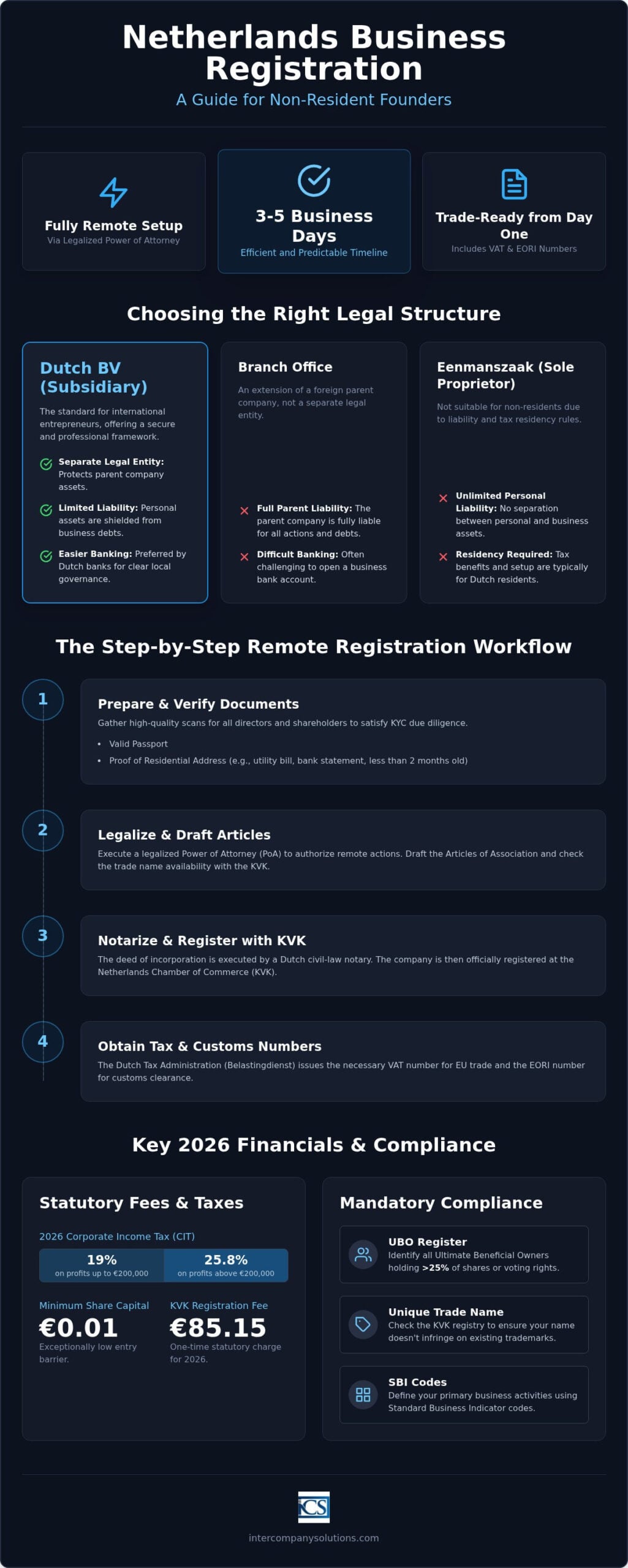
This comprehensive guide provides the exact workflow to register your Dutch business remotely in as little as 3 to 5 business days. You'll learn how to manage the €0.01 minimum capital requirement, handle the €85.15 KVK registration fee, and secure necessary VAT and EORI numbers for immediate trading. We'll outline the specific steps for non-resident founders to achieve full compliance with 2026 Dutch corporate laws, including the transition to Rabobank as the Belastingdienst house bank, while maintaining a transparent view of annual maintenance costs. This approach ensures your company's foundation is trade-ready and legally sound from day one.
Last reviewed: August 2026
Key Takeaways
- Complete the Netherlands business registration process remotely in 3 to 5 business days using the legalized Power of Attorney method.
- Utilize the Dutch BV structure to facilitate international trade with a minimum share capital requirement of only €0.01.
- Prepare the necessary identification and residency documents to satisfy 2026 UBO register thresholds and mandatory KYC due diligence.
- Secure your VAT and EORI numbers through the Belastingdienst to ensure compliance with EU customs and tax regulations from day one.
- Account for essential 2026 statutory fees, such as the €85.15 KVK registration charge and applicable corporate income tax rates.
Choosing the Right Legal Structure for Your Dutch Business
Selecting a legal structure is the first and most critical decision in the Netherlands business registration process. For international entrepreneurs, the Dutch legal system offers several corporate forms, but the Besloten Vennootschap (BV) is the standard for private limited companies. A BV is a separate legal entity with its own rights and obligations, which protects the personal assets of its directors and shareholders from business liabilities. All Dutch companies must be registered with the Netherlands Chamber of Commerce (KVK) to obtain a unique registration number, which is essential for tax and banking purposes.
While local residents often consider the eenmanszaak (sole proprietorship) due to its simple setup, it's rarely suitable for non-residents. The sole proprietorship doesn't offer limited liability; the owner is personally responsible for all debts. Additionally, the Dutch Tax Administration (Belastingdienst) typically requires the owner to be a Dutch resident or have a valid work permit to qualify for specific tax benefits. For those operating from abroad, the BV provides a much safer and more professional framework for international trade and holding structures.
The Dutch BV: Advantages for Foreign Entrepreneurs
The primary benefit of a BV is its limited liability. Shareholders are only liable for the amount they've invested in the company's shares. Since the 2012 Flex-BV legislation, the minimum share capital is only €0.01, making the entry barrier exceptionally low. This structure is highly respected by European clients and international investors, as it signals a commitment to transparency and compliance. Intercompany Solutions handles the drafting of the articles of association to ensure the company's internal regulations meet both statutory requirements and the founder's specific operational needs.
Branch Office vs. Subsidiary: Which Fits Your Expansion?
When expanding an existing foreign business, you must choose between a branch office and a subsidiary. A branch office is not a separate legal entity; it's an extension of the parent company. This means the parent company bears full legal and financial liability for the branch's actions in the Netherlands. Furthermore, opening a business bank account for a branch is often difficult because Dutch banks prefer local entities with a clear local governance structure.
A subsidiary, established as a standalone Dutch BV owned by the parent company, is generally the more efficient choice. It separates the parent's assets from Dutch risks and simplifies tax reporting. While a branch is taxed as part of the parent company, a subsidiary pays Dutch corporate income tax on its own profits. For 2026, the CIT rate is 19% on profits up to €200,000 and 25.8% on any amount exceeding that threshold. This clear separation often makes the subsidiary more attractive for long-term growth and regulatory adherence.
Essential Requirements for the Netherlands Business Registration Process
To begin the Netherlands business registration process, founders must prepare specific documentation to satisfy both the Chamber of Commerce (KVK) and the Dutch Tax Administration. Unlike the standard in-person registration mentioned on many public portals, international founders can utilize a legalized Power of Attorney (PoA). This legal instrument allows a representative to act on your behalf, eliminating the requirement for a physical visit to a Dutch notary. You'll need high-quality scans of valid passports and recent proof of residential address, such as a utility bill or bank statement not older than two months, for all directors and shareholders.
Selecting a unique trade name is equally critical. You must check the KVK registry to ensure your chosen name doesn't infringe on existing trademarks or lead to consumer confusion. Once the name is cleared, you'll need to define your business activities using Standard Business Indicator (SBI) codes. These codes categorize your company's operations for the official registry and influence your insurance requirements and tax obligations. Correctly identifying these details is a vital step in the Netherlands business registration process to avoid future administrative corrections.
The UBO Register: Transparency and Compliance
The Dutch government requires all BVs to identify their Ultimate Beneficial Owners (UBOs) in a centralized register. A UBO is any individual who holds more than 25% of the shares, voting rights, or ownership interest in the company. You must provide the UBO's full name, month and year of birth, nationality, country of residence, and the specific nature of their interest. Any changes to UBO information must be reported within 7 days to remain compliant. While the register is mandatory, access to certain personal details is restricted to authorized entities to balance public transparency with individual privacy.
Registered Office and Local Substance
A valid Dutch business address is a statutory requirement for incorporation. While some founders consider virtual offices, these are often insufficient for obtaining a VAT number from the Belastingdienst. The tax authorities require "substance," meaning the company must have a physical presence where management decisions are made or business is conducted. To satisfy these requirements without a long-term lease, founders often opt for managed office solutions that provide a dedicated workspace and administrative support. For those unsure about meeting these criteria, Dutch BV company formation services can provide guidance on compliant address solutions that meet both KVK and tax authority standards. The one-time KVK registration fee for 2026 is €85.15, which is typically paid during the finalization of the registration. Before committing to a structure, reviewing a detailed Netherlands company formation cost breakdown for 2026 can help founders budget accurately for both mandatory fees and professional service rates.
The Step-by-Step Remote Registration Workflow
The remote Netherlands business registration process follows a synchronized legal workflow designed to bridge the gap between international founders and Dutch statutory requirements. Because non-resident founders cannot always visit a Dutch notary in person, the process utilizes a legalized Power of Attorney (PoA). This method ensures all signatures are verified and legally binding under Dutch law without requiring travel. The workflow is divided into four distinct phases to ensure accuracy and compliance at every stage.
The first phase involves rigorous Know Your Customer (KYC) due diligence. This requires the collection and verification of identification documents and proof of address for all directors and shareholders. Once the initial check is complete, the second phase begins with drafting the Deed of Incorporation and the PoA. These documents outline the company's internal regulations and grant the representative authority to sign the final deed in the Netherlands. Accuracy during drafting is essential to avoid delays during the final execution.
In the third phase, you must legalize the PoA in your country of residence. This involves a local notary witnessing your signature and, in most cases, obtaining an Apostille or consular legalization to confirm the document's international validity. Finally, in phase four, the Dutch civil law notary executes the deed using the legalized PoA. The notary then files the company details with the Chamber of Commerce to finalize the registration. Our team manages this entire Dutch BV company formation sequence to ensure no procedural steps are missed.
Accelerated Timeline: From Zero to Registered in 3-5 Days
Efficiency is a hallmark of the Dutch administrative system. On Day 1, the focus is on trade name verification and finalizing the KYC file. Days 2 and 3 are dedicated to drafting the notarial documents and coordinating the remote signature legalization in the founder's home country. By Day 4 or 5, the Dutch notary executes the deed and submits the filing to the KVK. You typically receive your registration number and RSIN (Legal Entities and Partnerships Identification Number) within hours of the filing being processed.
The Role of the Dutch Civil Law Notary
A Dutch civil law notary is a public official who plays a mandatory role in the formation of every BV. They're legally responsible for verifying the identity of the founders and ensuring the articles of association comply with Dutch corporate law. Before the final registration is processed, a company may operate as a "BV i.o." (in formation); however, directors remain personally liable for all actions taken during this period. The notary's execution of the deed transitions the entity into a fully registered BV. This transition is when the limited liability protection for shareholders officially takes effect. Non-resident founders who want a thorough understanding of each procedural step can benefit from reviewing a professional guide to Dutch BV formation for remote setup in 2026, which covers the notary coordination process, UBO register thresholds, and corporate tax compliance in detail.
Last reviewed: August 2026
Post-Registration: VAT, EORI, and Ongoing Compliance
Once the Netherlands business registration process at the Chamber of Commerce is complete, the company receives an RSIN number. This is a legal entity identifier, but it's not a tax number. To trade, you must activate the BV with the Dutch Tax Administration (Belastingdienst). While the KVK automatically notifies the tax office of new registrations, foreign-owned entities often require a manual VAT application. This involves proving that the company is a "tax entrepreneur" with actual business activities in the Netherlands.
Completing the Netherlands business registration process is only the first step toward operational readiness. If your business involves importing or exporting goods across EU borders, you'll also need an EORI number. This registration is free and typically links to your KVK number. For companies registered in the Netherlands, the EORI is often activated quickly once the VAT number is issued. Establishing a compliant bookkeeping framework from the start is necessary to manage these registrations and prepare for future filings; to ensure broader compliance across the EU or UK, you can check out CiDATax SRL for professional tax guidance.
Navigating the Dutch VAT Application
The Belastingdienst evaluates several factors to determine if a BV qualifies for a VAT number. They look for "substance," which includes a physical business address and local management decisions. Non-resident directors often face delays if they cannot demonstrate active business operations or intended Dutch turnover. Providing signed contracts with suppliers or clients can significantly speed up this phase. It's also vital to distinguish between providing goods and services, as this affects your VAT filing frequency and reporting obligations.
Annual Reporting and CIT Filings
Every Dutch BV must file annual accounts with the KVK within 12 months of the financial year-end. Additionally, Corporate Income Tax (CIT) returns are mandatory. For 2026, the CIT rates are 19% on the first €200,000 of taxable profit and 25.8% on any profit above that threshold. You must also adhere to a 7-year record retention period for all corporate administration; this increases to 10 years for records related to immovable property.
Compliance requires precision, especially regarding the Belastingdienst's updated payment protocols. As of May 2026, the tax authority utilizes Rabobank as its primary house bank for corporate collections. To ensure all statutory deadlines are met and tax numbers are secured efficiently, entrepreneurs often utilize professional Accounting & Tax Services to manage their ongoing Dutch obligations. Professional bookkeeping prevents administrative penalties and ensures the BV remains in good standing with both the KVK and the tax office. Any changes to the company structure or UBO status must be reported to the KVK within 7 days to maintain regulatory adherence.
Strategic Advantages of Remote Setup with Intercompany Solutions
Utilizing a remote model for the Netherlands business registration process removes the logistical burden and travel costs associated with international expansion. Founders can establish their presence in the Dutch market without leaving their home country, relying instead on the legalized Power of Attorney route. While this remote setup is highly efficient, entrepreneurs who eventually plan to visit their new headquarters or explore the region can benefit from custom Europe travel itineraries to maximize their time abroad. This approach is particularly beneficial for non-EU residents who may face complex visa requirements or travel restrictions. By centralizing the formation, VAT activation, and initial bookkeeping, entrepreneurs ensure that their statutory foundations are compliant with Dutch law from the moment of incorporation.
Managing the UBO register and KYC requirements requires a meticulous approach to documentation. With experience across over 2,000 successful incorporations, we understand the specific scrutiny non-resident shareholders face from the Chamber of Commerce and tax authorities. We provide the necessary bridge between global business goals and the local regulatory environment, ensuring that every detail, from the €0.01 minimum capital to the €85.15 KVK fee, is handled with precision. Founders who want full visibility into every expense before committing can consult our 2026 Netherlands company formation cost guide for a transparent breakdown of notary fees, professional service rates, and recurring compliance costs. Our firm acts as a long-term compliance partner, moving beyond simple registration to provide ongoing Dutch BV company formation support and secretarial services.
Remote Formation Specialists for Global Entrepreneurs
Our role involves more than just filing paperwork; we facilitate the entire entry into the Eurozone. We proactively address tax compliance by ensuring your business structure meets the "substance" requirements necessary for VAT and EORI numbers. This includes guidance on statutory obligations like the 7-year record retention period and the reporting of UBO changes within 7 days. We're committed to completing the remote formation process within a standard 3 to 5 business day timeline as a market-leading standard for international founders.
Getting Started: Your Path to a Dutch Entity
The process begins with an initial consultation where we define your business goals and match your activities to the correct SBI codes. Transparent communication is maintained throughout the 5-day registration window, providing updates as the notary executes the deed and the KVK issues your RSIN. Once registered, we assist with the transition to local banking and tax activation, accounting for the Belastingdienst's use of Rabobank for corporate collections as of May 2026. Start your Netherlands business registration process with Intercompany Solutions today.
Last reviewed: August 2026
Launching Your Dutch Operations from Abroad
The Netherlands business registration process is a streamlined legal workflow that allows you to establish a European presence without the need for international travel. By utilizing the legalized Power of Attorney method, you can secure a fully operational Dutch BV while adhering to all statutory UBO and KYC requirements. Success depends on maintaining clear communication with the KVK and the tax authorities, especially regarding the activation of your VAT and EORI numbers for immediate trade. Our team has supported more than 2,000 global entrepreneurs in establishing their Dutch entities, providing specialized expertise in remote formation for non-residents. We offer a comprehensive approach that includes full-service accounting and tax support to ensure your company meets every regulatory deadline. You can register your Dutch BV remotely in 3-5 days with Intercompany Solutions to start your expansion with confidence. We're ready to facilitate your entry into the Dutch market and help you build a stable, compliant foundation for your professional interests.
Last reviewed: August 2026
Frequently Asked Questions
Can I register a Dutch company without visiting the Netherlands?
Utilizing a legalized Power of Attorney (PoA) is the standard method to complete the Netherlands business registration process without visiting the country. This legal instrument allows a representative in the Netherlands to sign the deed of incorporation before a Dutch notary on your behalf. You must have your signature legalized by a local notary in your country of residence and obtain an Apostille or consular legalization. This method removes the requirement for a physical visit during the incorporation phase.
How long does the Netherlands business registration process take for foreigners?
The Netherlands business registration process typically takes between 3 and 5 business days once all legalized documents are received by the notary. This timeline includes the execution of the notarial deed and the subsequent filing with the Chamber of Commerce (KVK). While the registration itself is fast, founders should allow additional time for the initial document collection and the international legalization of the Power of Attorney in their home country.
Do I need a Dutch citizen as a director to start a BV?
There is no legal requirement for a Dutch citizen or resident to serve as a director or shareholder of a BV. International founders can hold 100% of the company's shares and manage the entity from abroad. However, the Dutch Tax Administration (Belastingdienst) evaluates "substance" when issuing a VAT number. This means the company often needs local management presence or a physical workspace to prove it's genuinely operating within the Dutch jurisdiction.
What is the minimum share capital required for a Dutch BV in 2026?
The minimum share capital for a Dutch BV in 2026 is €0.01. You can choose to issue a higher amount of capital, but the statutory minimum is designed to keep the entry barrier low for new enterprises. This capital doesn't need to be deposited into a bank account before incorporation; it can be paid into the company's treasury after the registration is finalized at the KVK. The capital can be divided into shares of any nominal value.
What is the difference between an RSIN number and a VAT number?
The RSIN (Legal Entities and Partnerships Identification Number) is a generic identification number used by Dutch government bodies, while the VAT number is specifically for tax reporting. The KVK issues the RSIN immediately upon registration. The VAT number is issued later by the Belastingdienst after they've verified your business activities and substance. You'll need both to operate legally, as the RSIN is required for all interactions with the tax office and other authorities.
Is a physical office address mandatory for KVK registration?
A registered business address within the Netherlands is a mandatory requirement for KVK registration. While you don't need to own the property, you must have a valid contract allowing you to use the address for your business. It's important to choose an address that provides "substance," as the tax authorities rarely issue VAT numbers to companies using addresses that function only as postal forwarding services without dedicated workspace or local management.
Can a foreign company be the sole shareholder of a Dutch BV?
A foreign legal entity can be the sole shareholder of a Dutch BV. This structure is common for international groups setting up a Dutch subsidiary for European operations. In this case, the foreign company's directors must provide the necessary corporate documents, such as an extract from their local commercial register and the articles of association. These documents must be legalized for use in the Netherlands to satisfy the notary's KYC and UBO register requirements.
Similar Posts:
- Foreign multinational corporations & the Netherlands annual budget
- Tax treaty denounced between the Netherlands and Russia per January the 1st, 2022
- Want to innovate in the green energy or clean tech sector? Start your business in the Netherlands
- 5 Best EU Countries for Corporate Tax
- How to set up a business as a young entrepreneur