


Netherlands Company Formation Cost: 2026 Professional Fee Breakdown
Establishing a Dutch BV involves more than just a single notary visit; it requires a clear understanding of the total Netherlands company formation cost to avoid unexpected fiscal overhead. For 2026, the mandatory one-time registration fee at the Chamber of Commerce (KVK) is fixed at €85.15. Many international founders focus exclusively on this initial setup, only to be surprised by the recurring costs necessary to maintain legal and tax compliance throughout the first year of operations.
You're likely seeking transparency regarding the total investment needed for your business. This analysis provides a precise breakdown of professional service rates, including notary fees for remote incorporation via legalized Power of Attorney and mandatory UBO registration procedures. We also outline the essential tax thresholds, such as the 19% corporate income tax rate on profits up to €200,000, so you can build a reliable budget. This guide details exactly which expenses are mandatory and which are optional, moving you from initial curiosity to a state of informed confidence for your Dutch expansion.
Key Takeaways
- Identify the fixed statutory fees for 2026, including the €85.15 Chamber of Commerce (KVK) registration and mandatory notary involvement for the Deed of Incorporation.
- Leverage the Flex-BV legislation to establish your company with a minimum share capital as low as €0.01, significantly reducing initial capital requirements for new founders.
- Determine the total Netherlands company formation cost by separating one-time setup expenses from recurring annual compliance fees for VAT and corporate tax filings.
- Plan for the Dutch corporate income tax system, which applies a 19% rate on the first €200,000 of taxable profit and 25.8% on earnings exceeding this threshold.
- Understand the procedural requirements for remote incorporation via legalized Power of Attorney, ensuring legal adherence for non-resident and international entrepreneurs.
One-Time Mandatory Incorporation Costs in the Netherlands
Initial setup costs are primarily driven by statutory requirements and notarial oversight. The Dutch economic landscape maintains a rigid distinction between legal forms that require a notarial deed and those that don't. While simpler structures like a sole proprietorship can be registered directly with the authorities, capital-based entities must undergo a formal incorporation process involving a civil-law notary. This distinction is the first factor that determines your total Netherlands company formation cost.
To assist in your structural planning, the following table outlines the notary requirements and registration fees for the most common legal forms in 2026:
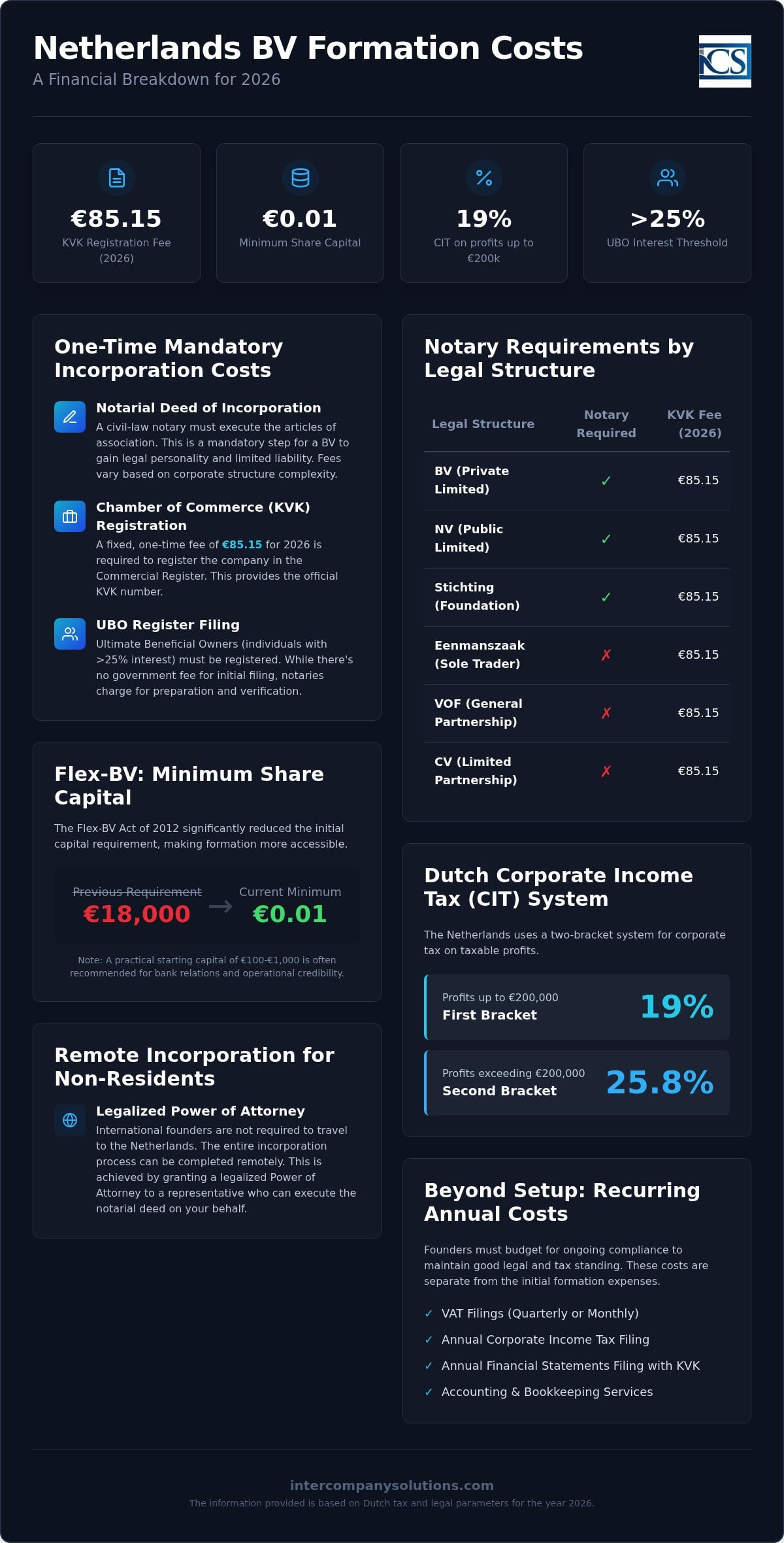
| Legal Structure | Notary Required | KVK Registration Fee (2026) |
|---|---|---|
| BV (Private Limited Company) | Yes | €85.15 |
| NV (Public Limited Company) | Yes | €85.15 |
| Stichting (Foundation) | Yes | €85.15 |
| Eenmanszaak (Sole Trader) | No | €85.15 |
| VOF (General Partnership) | No | €85.15 |
| CV (Limited Partnership) | No | €85.15 |
Notarial Fees and Legal Documentation
Under Dutch law, a BV can't be established without a notarial deed of incorporation. This document contains the articles of association and must be executed by a civil-law notary to be legally valid. The notary's role is to verify the identity of the founders, check the company name's availability, and ensure the entity's structure complies with the Dutch Civil Code. This process gives the BV its legal personality and limited liability status.
The complexity of your corporate structure directly influences notarial pricing. If you're establishing a standard BV with one director and one shareholder, the documentation is straightforward. However, if you have multiple shareholders with different classes of shares or complex transfer restrictions, the notary will spend more time drafting and reviewing the articles. For non-resident founders, the notary facilitates the process through a legalized Power of Attorney, which avoids the need for a physical visit to the Netherlands. You'll also need to budget for translation and legalization fees if the founding documents originate from foreign corporate shareholders.
Statutory Registration with the KVK and UBO
After the deed is signed, the entity must be registered in the Commercial Register of the Kamer van Koophandel (KVK). For the 2026 fiscal year, the KVK registration fee is fixed at €85.15. This is a mandatory one-time payment for all new entities, regardless of their legal form. Once the fee is processed, you'll receive your KVK number, which is necessary for tax registration and opening a corporate bank account. This is a fundamental step in starting a business in the Netherlands.
Simultaneously, the company must register its Ultimate Beneficial Owners (UBOs) in the UBO register. Any individual holding an interest of more than 25% in the company is considered a UBO. While the KVK doesn't charge an additional government fee for the initial UBO filing during formation, notaries often charge an administrative fee for preparing the filing and performing the required identity verifications. Ensuring accuracy in this register is vital, as non-compliance can lead to significant administrative penalties and delays in bank account approvals.
Minimum Share Capital and Statutory Requirements
The transition to the "Flex-BV" system in 2012 eliminated the previous requirement of €18,000 in starting capital. This change significantly lowered the entry barrier for international entrepreneurs. Today, the legal minimum share capital for a Dutch BV is just €0.01, though most founders choose to issue a round number like €100 or €1,000 divided into shares of €1 each. This flexibility is a core component of the total Netherlands company formation cost, as it allows you to allocate capital toward operations rather than locking it in a statutory reserve.
The Flex-BV Capital Structure
While the law allows for a nominal capital of one cent, practical business considerations often dictate a higher amount. Commercial banks in the Netherlands frequently view a BV with only €1 in capital as a higher risk during the Know Your Customer (KYC) process. Depositing €1,000 or more can improve your standing when applying for a corporate account. Unlike the private limited company (BV), a public limited company (NV) still requires a minimum paid-up capital of €45,000. It's also relevant that the Netherlands abolished capital tax in 2006, meaning there are no additional government levies on the value of the shares you issue at incorporation. Data from the World Bank Doing Business report highlights that these streamlined capital requirements place the Netherlands among the most efficient jurisdictions for starting a business.
Remote Formation via Power of Attorney (POA)
For non-EU founders, traveling to the Netherlands for a notary appointment isn't always feasible. The Dutch legal system accommodates this through the legalized Power of Attorney (POA) route. You can sign the necessary incorporation documents in your home country before a local notary. These documents then require an apostille or legalization by the Dutch embassy to be valid in the Netherlands. While this adds external legalization and courier costs to your overall Netherlands company formation cost, it saves the significant expense of international travel and accommodation.
The timeline for this remote process typically spans 3 to 5 business days once all legalized documents arrive in the Netherlands. If you're managing a complex structure with multiple foreign corporate shareholders, the notarization requirements become more stringent. Each layer of ownership must be documented to satisfy UBO transparency rules. International entrepreneurs seeking a complete overview of this process can consult our professional guide to Dutch BV formation and remote setup in 2026 for step-by-step procedural guidance. If you have questions about the specific documentation required for your residency status, you can reach out to our specialists for a detailed assessment.
Recurring Compliance and Accounting Maintenance Fees
Managing a Dutch BV involves shifting your focus from the initial setup to long-term fiscal maintenance. While the upfront Netherlands company formation cost covers your entry into the market, you must budget for recurring compliance obligations to remain in good standing with the Tax Administration (Belastingdienst) and the Chamber of Commerce (KVK). Failure to meet these deadlines often results in administrative fines that can quickly exceed your initial incorporation budget. Accurate budgeting for the first year should always include professional support for statutory filings.
A critical statutory requirement often overlooked is the mandatory record retention period. Dutch law requires you to maintain all corporate and financial records for a minimum of 7 years. If your BV owns immovable property, this requirement extends to 10 years. These records must be accessible for inspection and should include everything from invoices and bank statements to contracts and correspondence. Professional Accounting & Tax Services ensure these documents are organized according to Dutch GAAP or IFRS standards, which is necessary for the mandatory filing of annual accounts with the KVK.
Corporate Income Tax (CIT) Thresholds
The Netherlands uses a two-bracket system for Corporate Income Tax. For the 2026 fiscal year, a rate of 19% applies to the first €200,000 of taxable profit. Any profit exceeding this €200,000 threshold is taxed at 25.8%. It's your responsibility to file a CIT return annually, even if the company hasn't generated a profit or remained dormant. Professional fees for CIT compliance typically cover the preparation of the annual report, the calculation of taxable income, and the submission of the return via the secure Digipoort system. Consistent monitoring of these thresholds ensures you don't face unexpected tax liabilities as your Dutch operations grow, and firms like AccouConsult offer similar strategic tax and business advisory for international entrepreneurs.
VAT Registration and Reporting
Most active Dutch BVs must register for Value Added Tax (BTW). The standard rate is 21%, though a reduced rate of 9% applies to specific goods and services, such as food products and certain labor-intensive services. Once registered, you'll generally file VAT returns on a quarterly basis. These filings must be accurate and submitted within one month of the quarter's end. If your business engages in international trade outside the EU, you'll also need an EORI number, which involves a separate administrative application. Integrating these reporting costs into your total Netherlands company formation cost assessment ensures a transparent view of the capital required for year one.
Variable Operational Costs: Office, Payroll, and Support
Beyond the fixed statutory fees, the total Netherlands company formation cost depends heavily on your specific operational requirements. While notarial and registration fees are predictable, the expenses related to your physical presence and workforce vary based on your business model. These variable costs are often what differentiate a dormant holding company from an active trading entity. Budgeting for these items early ensures that your BV remains compliant with local substance requirements, which is a prerequisite for most corporate banking and VAT applications.
Registered Address and Virtual Office Costs
To register with the KVK, every Dutch BV must have a local business address. It's a legal requirement that this address is a physical location where the company's records are kept and where management can be reached. For many international founders, a registered address service provides a compliant solution without the immediate need for a long-term commercial lease. However, it's vital to distinguish between a basic registration address and a physical office space. While a registered address satisfies the Chamber of Commerce, the Tax Administration (Belastingdienst) and Dutch banks often require proof of "substance." This means demonstrating that real business activities occur in the Netherlands. If you're a non-resident director, choosing an address that offers dedicated desk space or meeting rooms can significantly improve your chances of bank account and VAT approval.
Payroll and Employee-Related Costs
If you intend to hire staff, you'll need to account for the ongoing expense of payroll services in the Netherlands. This administration involves monthly payslip generation, social security calculations, and wage tax filings. For companies looking to attract international talent, the 30% tax reimbursement ruling is a powerful tool. This allows you to pay 30% of a highly skilled employee's salary tax-free, provided they meet specific income and residency criteria. The application process for this ruling requires precise documentation and involves administrative fees that should be factored into your staffing budget.
If your BV acts as a sponsor for foreign workers from outside the EU, you must apply for recognized sponsor status with the IND (Immigration and Naturalisation Service). This Highly Skilled Migrant (HSM) sponsorship involves a one-time application fee and recurring costs for each visa issued. For rapid market entry, some entrepreneurs utilize Employer of Record (EOR) services to hire local staff before their own payroll system is fully established. Additionally, secretarial services can provide essential support for managing correspondence with the bank and tax authorities, ensuring that your administrative obligations don't fall behind as you scale.
Strategic Cost Management with Professional Formation Services
Managing the total Netherlands company formation cost effectively requires a choice between a la carte service selection and all-inclusive packages. While a la carte pricing might appear lower at first glance, the cumulative cost of separate filings for VAT, EORI numbers, and UBO registrations often exceeds the price of a bundled service. Professional packages provide a predictable budget by consolidating these essential steps into a single fee structure. This approach eliminates the risk of "scope creep," where additional administrative needs arise during the incorporation process and lead to unexpected invoices.
For international entrepreneurs, the 10-hour premium secretarial support package offers significant value during the first year. This support is particularly useful when dealing with Dutch banks, as it covers the preparation of the extensive documentation required for KYC procedures. Because we prioritize efficiency, our process includes a 24-hour response time for all inquiries and a 100% satisfaction guarantee. This ensures that your professional interests are handled with the meticulous attention to detail required in the Dutch regulatory environment.
Full-Service Incorporation Packages
A professional Dutch BV formation package typically covers everything from the initial name check to the final delivery of the corporate box. These packages clearly distinguish between professional service fees and government disbursements, such as the €85.15 KVK registration fee for 2026. By choosing a full-service route, you gain access to experts who handle the legalized Power of Attorney process, which is essential for remote formation. This setup avoids the hidden costs of DIY registration, where non-residents often struggle with the specific Dutch-language requirements of the Chamber of Commerce or the Tax Administration.
Avoiding Delays and Administrative Penalties
Incorrect filings are one of the most common causes of budget overruns. For example, the UBO register requires precise data on individuals with an interest of more than 25%. Fines for incorrect or late UBO filings can be as high as €21,750, making professional oversight a necessary safeguard rather than an optional luxury. Our specialists ensure that all submissions comply with the latest 2026 regulations, maintaining a strict 3-5 day timeline for incorporation. If you're ready to establish your entity without the risk of administrative delays, you can contact Intercompany Solutions for a detailed professional fee breakdown.
Last reviewed: August 2026
Establishing Your Dutch Entity with Fiscal Precision
Establishing a commercial presence in the Netherlands requires a structured approach to budgeting. You've identified that the Netherlands company formation cost includes fixed statutory fees like the €85.15 KVK registration and variable operational expenses such as payroll administration and substance-compliant office solutions. Maintaining your BV involves adhering to the 19% corporate tax bracket for profits under €200,000 and fulfilling quarterly VAT obligations within the strictly mandated timelines.
Our specialists have assisted over 1,000 foreign entrepreneurs in launching their Dutch ventures with a focus on remote accessibility and legal integrity. We prioritize procedural clarity and offer a 24-hour response time to ensure your incorporation stays on schedule. Every engagement is backed by a 100% satisfaction guarantee to provide the reliability your international business requires.
We look forward to facilitating your entry into the Dutch market with the precision and expertise your professional interests deserve.
For entrepreneurs also considering expansion into the South African market, you can learn more about Express Shelf Company to assist with local registration and compliance requirements.
Last reviewed: August 2026
Frequently Asked Questions
How much is the Chamber of Commerce (KVK) registration fee in 2026?
The Chamber of Commerce (KVK) registration fee for 2026 is fixed at €85.15. This is a one-time statutory payment required at the moment of registration. It's separate from notarial or professional service fees and must be paid to obtain your unique KVK number. This number is a prerequisite for opening a Dutch corporate bank account and signing any legal or commercial agreements within the jurisdiction.
Does a Dutch BV require a minimum share capital to be paid upfront?
A Dutch BV doesn't require a large minimum share capital; the legal requirement is only €0.01. This flexibility was introduced with the Flex-BV legislation to lower the entry barrier for entrepreneurs. While the capital doesn't need to be high, it must be officially issued in the Articles of Association. Most founders choose to issue €100 or €1,000 to maintain better standing with financial institutions during the bank's onboarding process.
What are the typical notary fees for incorporating a BV remotely?
Notary fees for a standard BV formation typically range between €500 and €1,500 depending on the complexity of the share structure. When incorporating remotely, you must factor in additional costs for the legalization and apostille of identification documents in your home country. These expenses contribute to the total Netherlands company formation cost but allow non-residents to establish an entity without traveling to the Netherlands for a physical appointment.
What is the corporate income tax rate for small businesses in the Netherlands?
For small businesses and startups, the corporate income tax (CIT) rate is 19% on taxable profits up to €200,000. Any profit generated above this €200,000 threshold is taxed at 25.8%. These rates apply to all BVs regardless of the founders' residency status. Founders must monitor these thresholds annually as they are subject to adjustment by the Dutch Ministry of Finance based on the current national budget.
Are there ongoing costs if my Dutch company is inactive?
Inactive companies still incur mandatory maintenance costs to remain compliant with Dutch law. You must file annual accounts with the KVK and submit yearly corporate income tax returns to the Belastingdienst, even if the balance sheet shows no activity. Additionally, you must maintain a registered business address and adhere to the seven year record retention period for all corporate documentation to avoid administrative fines from the tax authorities.
How much does it cost to apply for a Dutch VAT number?
The Dutch Tax Administration doesn't charge a government fee for issuing a VAT number. However, professional costs are incurred when hiring a specialist to prepare the application and ensure the company meets the necessary substance requirements. These requirements are essential for the Belastingdienst to verify that the BV is an active participant in the Dutch economic system rather than a dormant letterbox entity.
Is a local director required to keep formation costs low?
Dutch law doesn't strictly require a local director to form a BV. However, appointing a resident director or demonstrating local substance is often necessary for practical reasons, such as securing a Dutch bank account or obtaining a VAT number for international trade. For non-resident founders, using professional secretarial services can help manage these administrative nuances without the immediate expense of hiring local management or renting physical office space.
What are the costs associated with the 30% ruling for employees?
Costs for the 30% ruling include the professional fees for the application and ongoing payroll administration. The ruling allows employers to provide 30% of an employee's gross salary tax free, provided specific income and residency requirements are met. Correctly managing these applications is a key factor in the overall Netherlands company formation cost for businesses planning to relocate highly skilled talent to their Dutch headquarters.