



Hiring Your First Employee in the Netherlands: A Founder's Guide
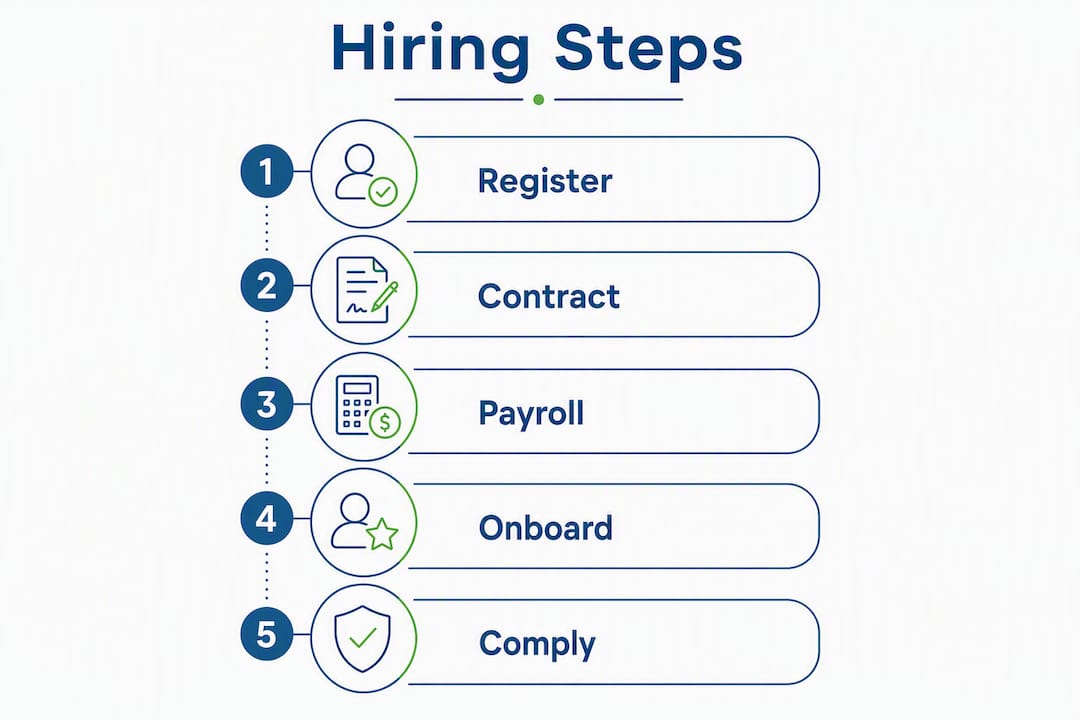
To legally hire your first employee in the Netherlands as a non-resident BV founder, you must register as an employer with the Belastingdienst (to obtain a loonheffingennummer), update your Kamer van Koophandel (KvK) record, set up payroll, and meet your AVG (Autoriteit Persoonsgegevens) and Arbo obligations before day one.
Before you post a single job ad: confirm you have at least three months of total labour costs sitting in your business account. That buffer covers gross salary, employer premiums, holiday pay, and any sick-pay exposure from week one. Skipping this step is the most common reason a first hire becomes a financial crisis within 90 days.
Your immediate must-do checklist:
- Register as employer with Belastingdienst and receive your loonheffingennummer (allow 1–2 weeks)
- Update your KvK registration to reflect employer status
- Verify the employee’s identity and BSN (citizen service number) before the start date
- Draft a compliant employment contract with correct salary, hours, and probation terms
- Set up payroll software or engage a payroll provider
- Complete a Risk Inventory and Evaluation (RI&E) and appoint a preventiemedewerker
- Open a personnel file that meets AVG requirements from the moment you receive the first resume
- Confirm you hold ≥3 months of total labour costs in reserve
Table of Contents
- What are the first steps to hiring your first employee in the Netherlands?
- How does payroll work in the Netherlands, and what will your first hire actually cost?
- What must your employment contract include?
- How do you handle AVG, personnel files, and health and safety requirements?
- How do you recruit and onboard your first employee effectively?
- What does the timeline and total cost look like from decision to first payroll?
- What mistakes do founders most often make when hiring their first employee?
- Key Takeaways
- What non-resident founders consistently get wrong about hiring in the Netherlands
- How Intercompanysolutions helps you hire your first employee without the compliance risk
- Useful sources and official references
What are the first steps to hiring your first employee in the Netherlands?
The registration order matters. Do these in sequence, and the rest of the process follows logically.
- Register as employer with Belastingdienst. Apply for your loonheffingennummer online. Processing takes 1–2 weeks, so start before you make an offer.
- Update your KvK record. Notify the Kamer van Koophandel that your company now has employees. This is a simple mutation, but it is legally required.
- Notify UWV if applicable. Certain situations (e.g., hiring someone with a distance to the labor market) require UWV notification. Check whether your hire triggers this.
- Choose your payroll setup. Decide between payroll software, an administratiekantoor, or full payrolling before the contract is signed.
- Assemble your document package: company details, a contract template, an identity-check procedure, and a personnel file template that complies with AVG rules.
Documents to gather before recruitment starts:
- Company registration number (KvK) and loonheffingennummer
- Employment contract template (fixed-term or indefinite)
- Identity verification procedure and BSN collection process
- Personnel file template with data-retention periods
- RI&E documentation and preventiemedewerker appointment record
Delegation note for non-resident founders: registration with Belastingdienst and KvK can be handled remotely or through a local representative. RI&E, arbo-service contracts, and payroll admin are best delegated to a Dutch provider from day one. Intercompanysolutions handles all of these as part of its payroll and hiring support for BV founders.
How does payroll work in the Netherlands, and what will your first hire actually cost?
Payroll in the Netherlands runs on loonheffingen: a combined withholding that covers wage tax and national insurance contributions. You withhold this from the employee’s gross salary each month and remit it to Belastingdienst on a fixed schedule.

On top of the gross salary, you carry employer-side premiums for unemployment insurance (WW), disability insurance (WIA), sick-pay coverage (Ziektewet), and the health insurance surcharge (Zvw). Industry guidance puts total employer on-costs at roughly 35–40% above gross salary, depending on your sector CAO and pension obligations.
| Cost component | Approximate rate |
|---|---|
| Gross salary | 100% (base) |
| Vacation pay (vakantiegeld) | +8% of gross |
| WW (unemployment) premium | ~2–5% of gross (sector-dependent) |
| WIA/WAO (disability) premium | ~6–7% of gross |
| Zvw (health surcharge) | ~6% of gross |
| Pension contribution (if CAO applies) | Varies by sector |
| Estimated total employer cost | ~135% of gross |
Rates are illustrative and change annually. Verify current figures with Belastingdienst before your first payroll run.
For a concrete example: a €3,000 gross monthly salary becomes roughly €4,050–€4,200 in total monthly employer cost before pension. Multiply by three for your minimum cash buffer: roughly €12,150–€12,600 before making an offer.
Three payroll setup options for non-resident founders:
- Payroll software (self-managed): cost-effective but requires you to stay current on Dutch payroll rules.
- Administratiekantoor (outsourced bookkeeper): typically costs €25–€75 per month per employee and removes most administrative burden.
- Payrolling (legal employer transfer): shifts employer risk entirely but carries a markup of roughly 20–35% on top of salary costs.
Pro Tip: The two most expensive payroll mistakes are timing holiday pay incorrectly and missing CAO-triggered pension obligations. Both are hard to unwind retroactively. If you are managing your BV remotely, outsourcing payroll from day one is almost always cheaper than correcting errors later.
What must your employment contract include?
Every Dutch employment contract must cover these elements:
- Full job description and role title
- Gross salary and pay date
- Working hours per week
- Start date and contract duration (fixed-term or indefinite)
- Probation period: maximum one month for contracts under two years; two months for indefinite contracts
- Notice periods (statutory minimum: one month for employee; one to four months for employer, depending on tenure)
- Work location, including any home-office arrangement
- Confidentiality and IP clauses
- Pro-rata leave entitlement (minimum 20 days for full-time; four times weekly hours)
- Statutory holiday pay (8% of gross annual salary, typically paid in May)
Check current minimum wage figures on Rijksoverheid before finalizing salary. The statutory minimum wage is updated twice yearly.
CAO applicability is the clause most founders miss. If a collective labor agreement covers your sector, it overrides your contract on salary floors, working hours, and pension contributions. Search the Rijksoverheid CAO register before drafting anything. If a CAO applies, your pension obligation is automatic, not optional.
How do you handle AVG, personnel files, and health and safety requirements?
AVG obligations begin the moment you receive the first resume, not after hiring. The Autoriteit Persoonsgegevens is explicit: recruitment data must have a lawful basis, be limited to what is necessary, and be deleted when no longer needed.
AVG checklist for hiring:
- Document the lawful basis for processing each data category
- Limit personnel file contents to what is legally required
- Set retention periods: most employment data must be deleted within two years of employment ending
- Store files securely (encrypted, access-controlled)
- Inform candidates what data you collect and why
RI&E and Arbo obligations kick in from the first employee. Dutch law requires a Risk Inventory and Evaluation and a designated preventiemedewerker. For companies with 25 or fewer employees, the employer can serve as the preventiemedewerker, but the documentation must exist and be current.
Insurance basics non-resident founders often overlook:
- Employer liability (aansprakelijkheidsverzekering): covers employee injury claims
- Verzuim (sick-pay) insurance: Dutch law requires you to continue paying a sick employee for up to two years; verzuim insurance caps your exposure
- Consider whether payrolling shifts this risk more cost-effectively for your situation
For remote founders, the practical path is to contract a certified arbo service, arrange verzuim insurance through a Dutch insurer, and use Intercompanysolutions’s compliance management to keep documentation current without being physically present.
How do you recruit and onboard your first employee effectively?
Recruitment workflow:
- Write a specific role brief with measurable success criteria, not just a list of duties.
- Define selection criteria before reviewing any applications.
- Run two to three structured interview stages.
- Verify identity documents and collect the BSN before the start date; store a readable copy for inspection purposes.
- Issue a written offer with probation terms clearly stated.
Day-1 checklist (delegatable to a local contact):
- Workstation and system access ready
- Contract signed and filed
- BSN and identity copy on file
- First-week objectives agreed in writing
- Introduction to any local contacts or team members
90-day onboarding plan with structured checkpoints:
- Week 2: Role clarity check. Does the employee understand priorities? Are there blockers?
- Week 4: Performance and culture fit review. Document observations in writing.
- Weeks 10–12: Formal probation evaluation. Decide to confirm, extend support, or exit. A structured 90-day plan with these three review points significantly reduces wrong-hire risk and improves retention.
Use the probation period actively. A documented conversation at week four costs nothing; a dismissal process after month six costs significantly more.
What does the timeline and total cost look like from decision to first payroll?
Sample timeline (Month -3 to Month 0):
- Month -3: Validate your financial buffer (≥3 months total labour costs). Check CAO applicability and pension obligations.
- Month -2: Register as employer with Belastingdienst (allow 1–2 weeks). Begin recruitment. Complete RI&E.
- Month -1: Finalize payroll setup. Sign arbo-service contract. Draft employment contract. Make offer.
- Month 0: Employee starts. First payroll run. Personnel file complete.
Illustrative cost blocks:
| Cost item | Approximate amount |
|---|---|
| Contract drafting / HR admin setup | €600 (one-off) |
| RI&E completion | €500 (one-off) |
| First-month payroll + employer premiums | ~135% of gross salary |
| Monthly payroll outsourcing | €25–€75/month |
| Verzuim insurance | Varies by salary and sector |
For pre-revenue or early-stage financial planning, build these one-off costs into your hiring budget before you start recruitment, not after.
What mistakes do founders most often make when hiring their first employee?
- Underestimating sick-pay exposure. You are legally required to pay a sick employee for up to two years. Without verzuim insurance, one long-term absence can destabilize a small operation.
- Missing holiday-pay accrual. Vakantiegeld accrues monthly. Founders who treat it as an annual surprise payment create cash-flow problems every May.
- Ignoring CAO obligations. Assuming no CAO applies without checking is a compliance risk that surfaces during audits.
- Skipping identity and BSN checks. The Nederlandse Arbeidsinspectie checks these. Missing documentation carries fines.
- Vague job descriptions. A role without measurable outcomes makes probation evaluations subjective and legally risky.
- Rushing the contract. A contract signed under time pressure often lacks IP clauses, correct probation terms, or the right notice period.
Pro Tip: If your commercial runway is under three months, wait before hiring. The cost of a wrong first hire, including the two-year sick-pay obligation and the time lost to a poor fit, almost always exceeds the cost of a short capacity gap. Hire when the buffer is real, not projected.
Early issues during probation are best handled with documented performance conversations, not informal feedback. If the fit is wrong, use the probation period to exit cleanly with proper notice. Seek local legal or payroll support before any dismissal conversation.
Key Takeaways
Hiring your first employee in the Netherlands requires employer registration with Belastingdienst, a minimum three-month labour-cost buffer, and a structured 90-day onboarding plan to reduce compliance risk and improve retention.
| Point | Details |
|---|---|
| Register as employer first | Apply for your loonheffingennummer at Belastingdienst; allow 1–2 weeks before your target start date. |
| Budget additional costs above gross salary to cover vacation pay, WW, WIA, Zvw, and potential pension contributions. | |
| Hold a 3-month labour-cost buffer | Keep at least three months of total labour costs in reserve before making any offer. |
| Use a 90-day onboarding plan | Schedule reviews at weeks 2, 4, and 10–12 to catch fit and performance issues early. |
| Intercompanysolutions supports the full process | From KvK and Belastingdienst registration to payroll setup and compliance management, all handled remotely. |
What non-resident founders consistently get wrong about hiring in the Netherlands
The founders who struggle most with their first Dutch hire are not the ones who get the contract wrong. They are the ones who treat hiring as a commercial decision and forget it is also a legal transition. The moment you sign that employment contract, you become a legal employer under Dutch law, with obligations that run for years, not months.
The 3-month buffer rule is not conservative advice. It is the minimum. Sick-pay exposure alone, two years of continued salary for an ill employee, can wipe out a small BV’s reserves if there is no verzuim insurance in place. Most founders discover this after the fact.
The 90-day onboarding plan matters for a different reason than most people assume. It is not primarily about productivity. It is about documentation. If a hire is not working out, you need written records of conversations, objectives set, and feedback given. Without that paper trail, exiting someone during or after probation becomes legally complicated and expensive.
Remote founders have one structural advantage: they are forced to delegate. That delegation, done well through a local payroll provider and a compliance partner, often produces better outcomes than a founder who tries to manage Dutch HR administration from abroad without local expertise.
How Intercompanysolutions helps you hire your first employee without the compliance risk
Non-resident founders who have already formed their Dutch BV through Intercompanysolutions can extend that same single-point-of-contact model to their first hire. The practical gap between “I have a BV” and “I have a compliant payroll running” is exactly where most remote founders lose time and money.
Intercompanysolutions covers the full employer setup: KvK and Belastingdienst registration, loonheffingennummer application, payroll configuration, RI&E coordination, and AVG-compliant personnel file setup. You get a compliant payroll run from day one, a clear onboarding checklist, and a single Dutch contact for ongoing administration. With over 2,000 successful formations and a guaranteed 24-hour response time, the team handles the local complexity so you can focus on the hire itself.
Ready to move from BV formation to your first employee? Review the full corporate services Intercompanysolutions offers for non-resident founders, or contact the team directly for a personalized quote and a remote onboarding call.
Useful sources and official references
- Ondernemersplein: Stappenplan voor het eerst personeel aannemen — registration order, timing, and employer setup checklist
- Belastingdienst — loonheffingen rates, payroll tax forms, and employer registration
- Autoriteit Persoonsgegevens: Uw eerste werknemer aannemen — AVG obligations from recruitment through employment
- UWV — employee insurance registration, WW and WIA premium information
- Rijksoverheid — current minimum wage figures, CAO register, and statutory working-conditions rules
- KvK (Kamer van Koophandel) — employer registration mutation and business registration guidance
This article provides general information for non-resident founders and does not constitute legal, tax, or employment advice. Verify current rates, thresholds, and obligations with the official sources above or a qualified Dutch employment law advisor before making hiring decisions.
Recommended
Similar Posts:
- Foreign multinational corporations & the Netherlands annual budget
- Significant amendments to the law in Holland in 2019
- Want to innovate in the green energy or clean tech sector? Start your business in the Netherlands
- Tax treaty denounced between the Netherlands and Russia per January the 1st, 2022
- Netherlands measures for additional CO2 reduction