


Netherlands Holding Company Tax: 2026 Investor Guide
The Netherlands maintains a network of over 90 double taxation treaties, a figure that underscores its position as a primary jurisdiction for international corporate structures. Many entrepreneurs recognize the strategic value of a Dutch entity but feel uncertain about the specific substance requirements needed to access these treaties. It's often difficult to manage the technicalities of Netherlands holding company tax rules while ensuring that a structure remains compliant with the 2026 statutory thresholds.
This guide provides a technical overview of the Dutch tax framework for 2026, focusing on the 19% corporate tax rate for profits up to €200,000 and the 25.8% rate applied to earnings above that limit. We'll clarify the mechanics of the participation exemption and the 15% standard dividend withholding tax. You'll also find a clear roadmap for remote BV incorporation via the legalized Power of Attorney route, which allows for setup without physical travel. By following this progression, you'll gain a full understanding of the regulatory environment and the necessary steps to maintain a compliant holding structure in the current fiscal year.
Key Takeaways
- Learn how the Dutch participation exemption eliminates corporate tax on dividends and capital gains for qualifying shareholdings of 5% or more.
- Understand the two-tier Netherlands holding company tax structure, featuring a 19% rate for profits up to €200,000 and 25.8% for higher brackets.
- Identify the conditions for applying the 15% standard dividend withholding tax or qualifying for exemptions under EU/EEA directives.
- Review the mandatory substance requirements, including the resident director threshold, necessary to maintain treaty benefits and avoid anti-abuse measures.
- Follow the procedural steps for remote BV incorporation using a legalized Power of Attorney to establish your holding structure without visiting the Netherlands.
The Dutch Participation Exemption (De Deelnemingsvrijstelling)
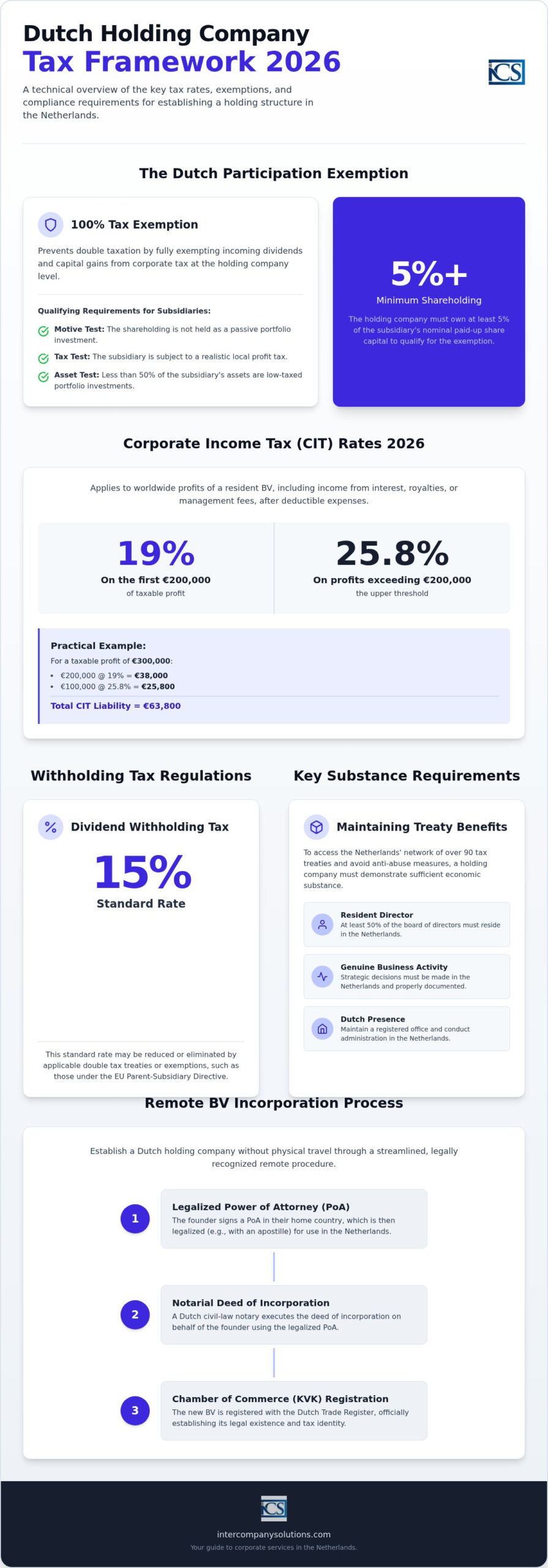
The Dutch participation exemption, known locally as deelnemingsvrijstelling, serves as the primary mechanism to prevent double taxation within corporate groups. It ensures that profits already taxed at the subsidiary level aren't taxed again when they reach the parent company. Under this regime, 100% of dividends and capital gains are exempt from corporate income tax at the holding level. This rule applies regardless of whether the subsidiary is located in the Netherlands or abroad, provided specific conditions are met.
The foundational requirement for this exemption is a minimum 5% shareholding in the nominal paid-up share capital of the subsidiary. This threshold is relatively low compared to many other European jurisdictions, which helps businesses manage their Netherlands holding company tax liabilities while maintaining a transparent link to the Dutch corporate tax system. By centralizing profits in a Dutch entity, groups can reinvest capital without the friction of multiple tax layers.
Qualifying Requirements for Subsidiaries
To benefit from the exemption, the subsidiary must meet at least one of three specific statutory tests. The motive test requires that the parent company doesn't hold the shares as a mere portfolio investment. If the subsidiary is subject to a local profit tax that results in a realistic tax burden, known as the tax test, the exemption generally applies. Finally, the asset test ensures the subsidiary's assets don't consist of more than 50% low-taxed portfolio investments. These requirements ensure the structure supports genuine business activities rather than passive asset holding. Intercompany Solutions offers Accounting & Tax Services to help international groups document these compliance tests and maintain the exemption's validity.
Benefits for International Group Structures
International groups use the Dutch holding structure to eliminate tax leakage during the repatriation of profits. When a subsidiary distributes dividends, the Dutch holding receives them tax-free, allowing for immediate reinvestment into other group projects or operational costs. This flexibility is a significant advantage for regional headquarters, as it allows for the consolidation of cash flows from multiple jurisdictions without incurring additional corporate tax at the holding level.
The exemption also applies to capital gains realized when selling a subsidiary. This allows a group to exit an investment and retain the full proceeds for future acquisitions or debt restructuring. For entities managing intellectual property or centralized services, this stability provides a predictable framework for long-term financial planning. It allows for global expansion while ensuring that the core capital remains protected from recurring tax triggers within the group structure.
Corporate Income Tax (CIT) Rates and Thresholds for 2026
The Dutch tax system operates on a two-tier corporate income tax (CIT) structure that applies to the worldwide profits of a resident BV. While the participation exemption typically covers dividends and capital gains from subsidiaries, other income sources-such as interest, royalties, or management fees-are subject to standard CIT rates. You must calculate the taxable base by subtracting deductible business expenses and available tax losses from the gross annual income.
For the 2026 fiscal year, the Dutch Tax and Customs Administration applies a 19% rate on the first €200,000 of taxable profit. Any profit exceeding this €200,000 threshold is taxed at a flat rate of 25.8%. This progressive structure provides a strategic advantage for smaller holding entities or those in the early stages of growth, as the effective tax rate remains lower until the business scales beyond the initial bracket.
2026 Corporate Tax Bracket Overview
The €200,000 threshold serves as the primary tax pivot point for all Dutch corporate entities in 2026. For a holding company with a taxable profit of exactly €200,000, the CIT liability is €38,000. If the profit reaches €300,000, the first €200,000 is taxed at 19%, and the remaining €100,000 is taxed at 25.8%, resulting in a total tax of €63,800.
When managing multiple Dutch entities, you might consider forming a fiscal unity (fiscale eenheid). This arrangement allows the group to offset the losses of one company against the profits of another, simplifying the overall tax position. However, a fiscal unity is treated as a single taxpayer. This means the group only accesses the 19% tax bracket once, rather than each individual company having its own €200,000 threshold. Choosing the right structure is essential for optimizing your Netherlands holding company tax position.
Annual Tax Filing and CIT Deadlines
Compliance with the Belastingdienst requires precise timing and accurate record-keeping. You're required to file your CIT return within five months after the end of the fiscal year. For companies using the calendar year, the deadline is June 1st of the following year. If you need more time to prepare the financial statements, you can request a filing extension through a registered tax intermediary.
Late filings or inaccurate reporting can lead to administrative fines and interest charges. The Dutch authorities prioritize transparency, so ensuring your bookkeeping aligns with statutory requirements is vital. If you're unsure about the specific deductions available for your structure, you can reach out to our tax specialists for a review of your 2026 compliance strategy.
Dividend, Interest, and Royalty Withholding Tax Regulations
The Netherlands applies a standard dividend withholding tax rate of 15% on distributions made by Dutch resident companies. However, this rate is frequently reduced or eliminated through domestic legislation and an extensive network of over 100 double taxation treaties. For dividends paid to qualifying parent companies within the EU or EEA, a 0% rate typically applies under the Parent-Subsidiary Directive, provided the parent entity holds at least 5% of the shares. This exemption ensures that capital moves freely within the European market without tax friction.
While the Netherlands generally doesn't levy withholding tax on interest and royalty payments, a conditional withholding tax of 25.8% applies in 2026 for payments made to affiliated entities in low-tax jurisdictions or in cases involving tax abuse. This measure targets jurisdictions with a statutory corporate tax rate of less than 9% or those appearing on the EU list of non-cooperative jurisdictions. Understanding these nuances is a critical part of managing Netherlands holding company tax obligations for global enterprises with complex cross-border flows.
For enterprises managing diverse portfolios that extend to the US-Israel investment corridor, coordinating Dutch tax benefits with other regional legal requirements is essential. The Israel Cross Border Law Firm provides specialized expertise in facilitating business and investment between those jurisdictions.
Applying Tax Treaty Benefits
To access reduced withholding rates, a company must demonstrate that the recipient is the beneficial owner of the income. This means the recipient has the right to use and enjoy the dividend or interest without being bound by a legal or contractual obligation to pass the payment to another entity. Documentation, such as a certificate of residence from the foreign tax authority, is required by the Belastingdienst to validate treaty claims. The 100+ treaties currently in force allow for rates as low as 0% or 5% for substantial holdings, facilitating global capital flow by ensuring profits aren't eroded by excessive taxation when moving across borders.
Anti-Abuse Provisions and Substance
Dutch authorities and EU directives, such as the Anti-Tax Avoidance Directive (ATAD), have introduced stringent measures to prevent treaty shopping. An entity that exists solely to funnel payments to a third country without performing genuine economic activities won't qualify for tax benefits. To combat this, the Netherlands enforces minimum substance requirements. A holding company must show economic reality by meeting several criteria, including having at least half of the statutory directors residing in the Netherlands and making key management decisions within Dutch borders. Intercompany Solutions provides Accounting & Tax Services to help companies document their economic presence and maintain compliance with these evolving anti-abuse standards.
Failure to meet these substance standards can lead to the denial of treaty benefits and increased scrutiny from both Dutch and foreign tax administrations. The entity must also maintain a local bank account, conduct its bookkeeping in the Netherlands, and have sufficient equity to bear the risks associated with its assets. Ensuring your structure is robust against these anti-abuse provisions is essential for long-term fiscal stability and the successful repatriation of group profits.
Substance Requirements and Statutory Compliance
Substance refers to the physical and economic presence a company maintains in the Netherlands. For a holding structure, this presence isn't merely a formality; it's a prerequisite for accessing treaty benefits and the participation exemption. Tax authorities evaluate whether an entity has genuine ties to the Dutch jurisdiction or if it's a passive vehicle. Demonstrating substance is vital for managing your Netherlands holding company tax position effectively.
Board members are subject to residency criteria to satisfy local laws. At least 50% of the statutory directors must reside in the Netherlands. Beyond residency, these directors must have the professional capacity to make significant management decisions. These decisions must be documented and executed within Dutch borders. You must also maintain a local registered office address. A simple PO Box won't suffice. The address must be a physical location where the company's records are accessible.
Retain all corporate and financial records for at least 7 years. If the company owns immovable property, this retention period increases to 10 years. These records must be readily available for inspection by the Belastingdienst if they're requested. Maintaining accurate records is essential for substantiating your Netherlands holding company tax position during a routine audit.
Chamber of Commerce (KVK) Obligations
Registration with the Handelsregister is mandatory upon formation. For 2026, the KVK registration fee is €85.15. This is a one-time cost. Each year, the holding company must file its financial statements with the KVK. The level of detail required in these filings depends on the size of the company. You are also required to register all Ultimate Beneficial Owners (UBOs) who hold more than 25% of the shares. Intercompany Solutions provides Secretarial Services to assist with these mandatory filings and UBO updates.
Accounting and VAT Compliance
VAT obligations vary depending on the entity's activities. A 'pure' holding company, which only holds shares and receives dividends, is generally not considered a VAT entrepreneur. It cannot charge VAT or deduct input tax. However, an 'active' holding company that provides management services or administrative support to its subsidiaries must register for VAT. These services are typically subject to the standard 21% VAT rate. You can find more details on accounting for Dutch BV to ensure your quarterly and annual filings meet all legal standards.
For active holdings that need to manage complex payroll or pension records, you can visit Datasupport VA for specialized software solutions that simplify these administrative requirements.
Incorporating a Dutch Holding BV Remotely
International entrepreneurs don't need to visit the Netherlands to establish a corporate presence. The Dutch legal system allows for the remote formation of a Besloten Vennootschap (BV), which is the standard legal form for holding structures. This accessibility is a key reason why global investors choose this jurisdiction. While the incorporation is handled from abroad, the entity remains a Dutch tax resident, which is essential for managing Netherlands holding company tax liabilities effectively.
The procedural path for non-resident founders relies on a legalized Power of Attorney (PoA). You'll receive a draft PoA from a Dutch civil law notary or your incorporation agent. You must sign this document in the presence of a notary in your home country. Depending on your location, the document may also require an apostille or further legalization from a Dutch consulate. Once the physical documents reach the Netherlands, the civil law notary can execute the Deed of Incorporation on your behalf.
The timeline for formation is efficient. It typically takes 3 to 5 business days to finalize the process once the notary receives the legalized paperwork. Unlike some other jurisdictions, the Netherlands doesn't demand significant upfront capital. The minimum share capital requirement is only €1, though founders often choose a higher amount to reflect their initial investment or group structure requirements.
Step-by-Step Formation Process
The process begins with the submission of identification documents, such as a valid passport and proof of residential address. Once these are verified, the Dutch notary drafts the Deed of Incorporation. This deed contains the company's articles of association, which define the holding's purpose and internal governance rules. After the notary executes the deed, the company is registered with the Chamber of Commerce (KVK). The KVK then issues a unique RSIN number, which serves as the entity's legal identification for tax and administrative purposes. The company is also registered with the Belastingdienst for a VAT number if it performs active management tasks.
Professional Support for International Founders
Managing the interface between a foreign notary and the Dutch Handelsregister requires technical precision. An incorporation agent acts as a bridge, ensuring that all legalization steps meet Dutch statutory standards. This support is vital for non-EU founders who may face more complex documentation requirements. We provide comprehensive assistance with starting a business in the Netherlands entirely from your home office.
Setting up a holding isn't just about the initial registration. It involves aligning the structure with your long-term goals for profit repatriation and asset protection. If you require expert guidance on the administrative and legal aspects of your 2026 setup, you can contact Intercompany Solutions for a consultation. Our team ensures that your Netherlands holding company tax strategy is supported by a robust and compliant legal foundation from day one.
Last reviewed: August 2026
Securing Your Dutch Corporate Future
The 2026 fiscal landscape offers significant advantages for investors who correctly structure their operations. By leveraging the participation exemption, you can ensure that dividends and capital gains remain 100% tax-free at the holding level. Maintaining a clear understanding of Netherlands holding company tax rates, specifically the 19% bracket for profits up to €200,000, is essential for accurate financial forecasting. It's also vital to monitor the 25.8% rate for higher profit tiers and stay updated on conditional withholding tax rules for low-tax jurisdictions.
Success depends on meeting strict substance requirements and managing annual KVK compliance. With over nine years of Dutch corporate law expertise, we facilitate a 100% remote incorporation process via the Power of Attorney route. Our team provides a 24-hour response time guarantee for all inquiries, ensuring your global expansion moves forward without delay. You'll find that having a dedicated partner simplifies the complexities of Dutch tax administration and bookkeeping.
We look forward to supporting your business growth and helping you establish a stable corporate presence in the Netherlands.
Last reviewed: August 2026
Frequently Asked Questions
What is the corporate tax rate for a Dutch holding company in 2026?
The corporate tax rate for a Dutch entity in 2026 is 19% for taxable profits up to €200,000. Any profit exceeding this threshold is subject to a rate of 25.8%. These rates apply to all non-exempt income, such as management fees, interest, or royalties. Proper planning of your Netherlands holding company tax position ensures that your structure maximizes the benefit of the lower initial tax bracket.
Does a Dutch holding company pay tax on dividends received from subsidiaries?
A Dutch holding company generally does not pay tax on dividends received from subsidiaries due to the participation exemption. This requires the holding to own at least 5% of the subsidiary's shares and meet specific motive or tax tests. When these criteria are satisfied, 100% of dividends and capital gains are exempt from corporate tax. This mechanism effectively prevents double taxation within international corporate groups.
Can I register a Netherlands holding company remotely as a non-EU resident?
Yes, you can register a Netherlands holding company remotely as a non-EU resident. The process is conducted via a legalized Power of Attorney (PoA), which allows a Dutch notary to execute the Deed of Incorporation on your behalf. You must have your identification documents and the PoA legalized in your home country. This route ensures you can establish your business without the need for international travel.
What are the minimum substance requirements for a Dutch holding entity?
Minimum substance requirements include having at least 50% of your statutory directors residing in the Netherlands. Key management decisions must be made within Dutch borders, and the company must maintain its primary bank account and bookkeeping in the country. These requirements are essential for demonstrating economic reality to the Belastingdienst. Satisfying these criteria is a prerequisite for accessing the benefits of the extensive Dutch tax treaty network.
How much is the KVK registration fee in 2026?
The KVK registration fee in 2026 is €85.15. This is a one-time administrative fee paid to the Chamber of Commerce when you first register your BV in the Handelsregister. While the registration fee is fixed, you should also account for notary fees and the costs associated with legalizing documents. Annual filing of financial statements is mandatory, though these recurring filings do not incur the same registration fee.
Is there a withholding tax on interest or royalties paid by a Dutch company?
There is generally no withholding tax on interest or royalties paid by a Dutch company to foreign entities. However, a conditional withholding tax of 25.8% applies to payments made to affiliated companies located in low-tax jurisdictions. This measure targets jurisdictions with a statutory tax rate below 9% or those on the EU non-cooperative list. For most standard structures involving treaty countries, these payments remain free of Dutch withholding tax.
What is the minimum share capital required to start a Dutch BV?
The minimum share capital required to start a Dutch BV is €1. This capital must be divided into shares with a par value defined in the company's articles of association. While the legal minimum is very low, many entrepreneurs choose to start with a higher amount to provide initial working capital. The capital can be paid in cash or through the contribution of other assets, known as a contribution in kind.