


How to Set Up a Dutch Holding Company: A 2026 Procedural Guide
Establishing a Dutch holding structure is the most effective method for international founders to ring-fence assets and optimize European tax liabilities without setting foot in the Netherlands. If you're researching how to set up a Dutch holding company, you've likely encountered the perceived complexity of Dutch corporate law and the logistical hurdles of remote registration for non-EU residents. It's understandable to feel uncertain about the procedural nuances required to maintain compliance while seeking a scalable corporate structure for expansion.
This guide provides a technical roadmap for the incorporation process in 2026. You'll learn the exact legal requirements for the 2-BV model, the specific tax advantages such as the 5% participation exemption, and the legalized Power of Attorney route used for remote registration. We also cover current financial parameters, including the €85.15 KVK registration fee and the 2026 corporate income tax rates of 19% on profits up to €200,000 and 25.8% above. This overview ensures you have a clear path toward asset protection and tax-efficient dividend distribution through a professional Dutch structure.
Key Takeaways
- Understand the 2-BV structure to effectively separate operational liabilities from valuable assets like intellectual property and real estate.
- Identify the tax benefits of the Dutch Participation Exemption, which facilitates tax-free dividend and capital gain transfers between entities.
- Learn the specific steps for how to set up a Dutch holding company remotely using the legalized Power of Attorney (POA) route for international founders.
- Verify current 2026 financial parameters, including the €85.15 KVK registration fee and the tiered corporate income tax rates of 19% and 25.8%.
- Prepare for essential post-incorporation compliance, such as VAT registration and the requirement for a registered Dutch business address.
Understanding the Dutch Holding Structure: The 2-BV Model
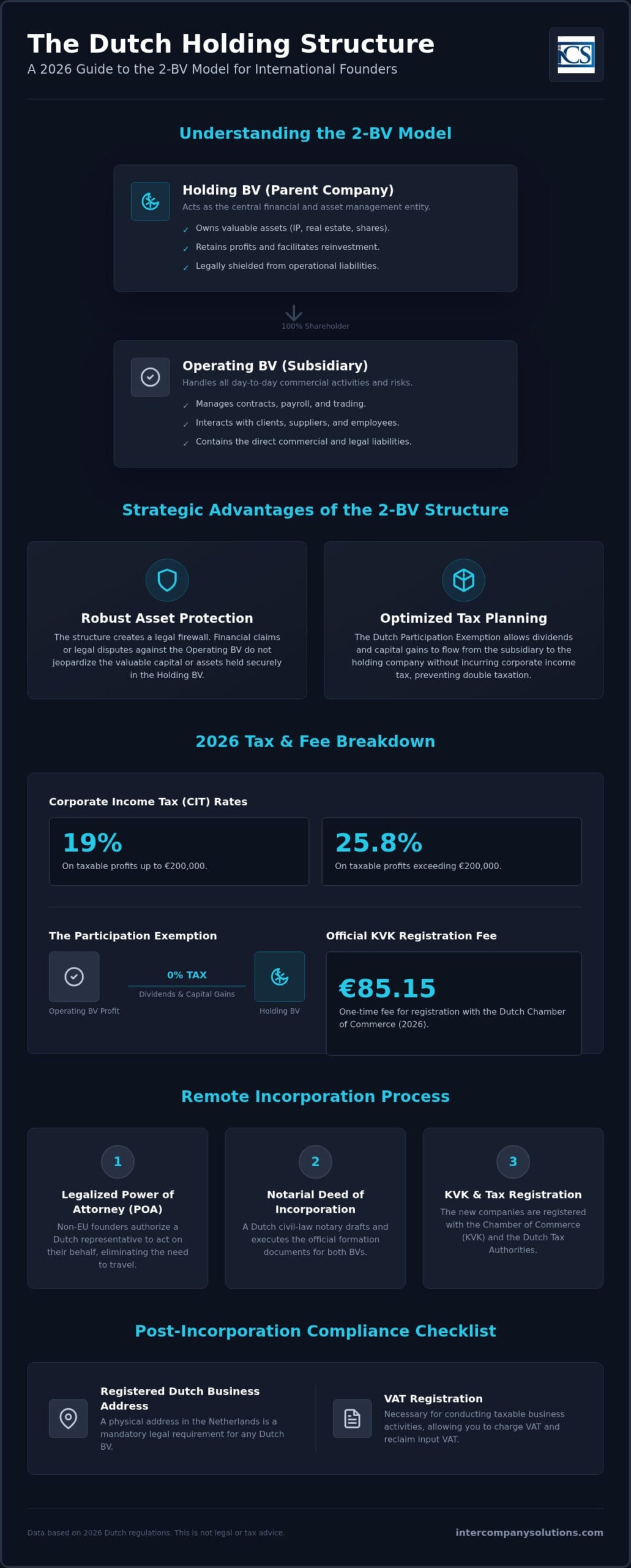
The Dutch holding structure is a configuration of at least two distinct legal entities known as the Besloten Vennootschap (BV). This setup, commonly called the 2-BV model, is the standard choice for foreign investors entering the Dutch market. It creates a clear division between the ownership of assets and the execution of business activities. The Holding BV sits at the top of the hierarchy, acting as the parent company that manages shares, retains profits, and holds valuable intellectual property or real estate. It typically doesn't engage in daily commercial trade or hire staff, which keeps its balance sheet clean from operational liabilities.
Conversely, the Operating BV serves as the subsidiary where the actual business occurs. It signs contracts, manages payroll, and assumes the commercial risks associated with the industry. For those looking into how to set up a Dutch holding company, understanding this separation is vital. By isolating the trading activities in a separate legal entity, you ensure that any financial claims or legal disputes against the subsidiary don't automatically jeopardize the capital or assets held by the parent company. You can begin the Netherlands company formation process remotely to establish both entities simultaneously, providing a secure foundation from day one.
The Relationship Between Parent and Subsidiary
In this structure, the Holding BV acts as the sole shareholder of the Operating BV. This relationship provides a robust layer of protection. If the operating company faces bankruptcy, the assets stored in the holding company, such as accumulated dividends or brand rights, remain legally shielded from the subsidiary's creditors. Entrepreneurs often expand by establishing multiple operating companies under a single holding umbrella. This modularity allows you to test new markets or products through different subsidiaries while centralizing financial control at the top level.
Common Use Cases for International Entrepreneurs
International investors utilize this model to streamline their European operations. It's an efficient vehicle for managing intellectual property rights (IP), as the Holding BV can license these rights to subsidiaries across the EU. This structure also simplifies the consolidation of profits from various global sources. When it's time to exit a business venture, selling shares in an Operating BV is often more straightforward than selling the entire group. Because the Dutch participation exemption often applies, the capital gains from such a sale can frequently be transferred to the Holding BV without immediate taxation. This allows for the efficient reinvestment of capital into new projects without eroding the principal through multiple tax layers. When researching how to set up a Dutch holding company, entrepreneurs find that this flexibility supports long-term growth and global mobility.
Legal and Tax Foundations: Participation Exemption and 2026 CIT
The Dutch tax system remains a primary driver for investors learning how to set up a Dutch holding company. For the 2026 fiscal year, the corporate income tax (CIT) rates are set at 19% for taxable profits up to €200,000 and 25.8% for profits exceeding this amount. These rates apply to the net profit generated by your operating company. However, the Netherlands offers an extensive network of over 100 double-tax-avoidance treaties. This network prevents international income from being taxed twice, making the Netherlands a strategic hub for global trade and investment.
The cornerstone of this structure is the Participation Exemption (deelnemingsvrijstelling). Under this rule, dividends and capital gains received from a qualifying subsidiary are exempt from corporate tax at the holding level. This mechanism prevents the "cascade" effect where profits are taxed multiple times as they move up through a corporate group. By utilizing this exemption, you can centralize capital from various subsidiaries into a single parent entity without eroding the principal through additional tax layers.
Tax Efficiency Within the Holding Structure
A significant benefit of the 2-BV model is the ability to reinvest profits from the operating subsidiary into the holding company without immediate tax friction. If both companies meet specific requirements, they can apply for a 'Fiscal Unity' (fiscale eenheid). This allows the group to file a single, consolidated tax return, effectively offsetting the losses of one entity against the profits of another. The Dutch participation exemption ensures that dividends and capital gains are tax-free at the holding level provided the parent company owns at least 5% of the subsidiary's shares. If you're unsure if your business qualifies for this arrangement, you can speak with our tax specialists for a detailed assessment.
Withholding Tax and International Distributions
The standard Dutch dividend withholding tax rate is 15%, but many international structures qualify for lower rates or full exemptions under various tax treaties or the EU Parent-Subsidiary Directive. Unlike many other jurisdictions, the Netherlands hasn't levied capital tax on the issuance of shares since 2006, which reduces the cost of initial capitalization. For international founders relocating to manage their entities, the 30% tax reimbursement ruling can provide a substantial benefit. This ruling allows 30% of a qualifying employee's gross salary to be paid tax-free, provided they meet specific income and expertise thresholds established by the tax authorities.
Strategic Advantages for International Entrepreneurs and Investors
The Dutch holding structure offers more than just tax efficiency; it provides a strategic framework for global expansion. By establishing a Dutch entity, founders gain immediate access to the EU Single Market and its 450 million consumers. The Dutch BV is internationally recognized for its stability and legal certainty, which enhances your credibility when negotiating with European suppliers or clients. This reputation for professionalism is a significant asset when positioning a brand for international growth.
Using a holding structure also allows for a clean and efficient exit strategy. If you decide to divest a specific business line, you can sell the shares of the operating subsidiary while the holding company retains the capital gains. Because the participation exemption usually applies, these gains can be reinvested into new ventures without immediate corporate tax erosion. This process keeps the parent entity intact, allowing it to serve as a long-term vehicle for wealth management and future investment cycles.
For those looking to diversify their global footprint beyond Europe, you can learn more about Supreme Services for specialized consultancy on establishing and operating businesses within the UAE's dynamic markets.
Asset Protection and Liability Limitation
A primary motivation for those learning how to set up a Dutch holding company is the isolation of operational risks. You can house retained earnings, surplus cash, and pension reserves within the holding BV, keeping them out of reach from creditors of the operating subsidiary. Intellectual property (IP) and real estate should also be registered under the holding company to protect these high-value assets from claims arising from daily trading activities. This legal separation ensures that the personal assets of the director-major shareholder (DGA) remain distinct from corporate liabilities, provided the management adheres to Dutch corporate governance standards.
Enhanced Funding and Investment Opportunities
The 2-BV model is the preferred structure for venture capital and private equity firms because it allows for investment at the holding level. This setup provides investors with a clear overview of the entire group's performance while maintaining a transparent and scalable governance model. The Netherlands' sophisticated financial infrastructure supports international financing, making it easier to manage cross-border capital flows and secure credit lines for expansion. If you're considering starting a business in the Netherlands, having this structure in place from the beginning is essential for attracting institutional backing. It signals to global partners that your enterprise is built on a reliable legal foundation designed for professional scale.
Step-by-Step Procedure for Remote Holding Company Incorporation
Establishing your structure begins with Phase 1: selecting a unique company name and determining the share capital. While the legal minimum for a BV is €0.01, founders often opt for a round figure like €1 or €100 for administrative simplicity. If you're researching how to set up a Dutch holding company without traveling, the process relies on a structured sequence involving a Dutch civil-law notary and the Chamber of Commerce (KVK). This remote path ensures that your professional interests are managed efficiently without the need for a physical presence in the Netherlands during the formation stage.
The incorporation process moves through several distinct phases. After the name and capital are set, the notary prepares the draft deed of incorporation and the necessary Power of Attorney documents. Once these are executed and legalized, the notary performs the final execution of the deed. Following this, the company is registered in the KVK Business Register, and the mandatory UBO filing is completed. Each step is designed to meet strict Dutch regulatory standards while facilitating ease of entry for global entrepreneurs.
The Legalized Power of Attorney Route
For international founders, the Power of Attorney (POA) route is the standard method for remote Netherlands company formation. You'll need to provide legalized identification documents to verify your identity. EU residents can typically provide a legalized copy of their passport, while non-EU residents may require an apostille or additional legalization through a local Dutch consulate. Once the POA is legalized in your home country and received in the Netherlands, a Dutch notary executes the deed of incorporation on your behalf. This streamlined approach allows for full registration within 3 to 5 business days from the moment all legalized documents are in our hands.
UBO Register and Transparency Compliance
Transparency is a core requirement of the Dutch corporate landscape. Every BV must identify its Ultimate Beneficial Owners (UBOs) in the UBO register, which is maintained by the KVK. A UBO is defined as any natural person who holds more than 25% of the shares, voting rights, or ownership interest in the company. This registration occurs simultaneously with the company's entry into the KVK Business Register. You'll also need to pay the one-time KVK registration fee, which is €85.15 for the 2026 period. Maintaining an accurate UBO record is a mandatory compliance step that ensures your holding structure remains in good standing with Dutch financial and tax authorities. Understanding how to set up a Dutch holding company correctly involves preparing these transparency disclosures accurately from the start.
Post-Incorporation Compliance and Administrative Obligations
Once you've finalized the steps for how to set up a Dutch holding company, the focus shifts to maintaining its legal and financial standing. The immediate requirement after notary execution is the payment of the Chamber of Commerce (KVK) registration fee, which is €85.15 for the 2026 period. This is a one-time administrative cost. Beyond this, you must adhere to strict Dutch record-keeping laws. All corporate and financial records must be retained for a minimum of 7 years. If your holding company owns immovable property, such as Dutch real estate, this retention period extends to 10 years to comply with tax authority requirements.
Compliance is an annual cycle. You're required to file financial statements with the KVK every year. The complexity of these statements depends on the size of your company, categorized as micro, small, medium, or large. Additionally, a corporate income tax (CIT) return must be submitted to the Belastingdienst. For companies following the calendar year, the standard deadline is June 1 of the following year. Failure to meet these deadlines can lead to administrative fines and may affect the director's liability protection, so it's vital to maintain a methodical approach to these administrative obligations.
VAT and EORI Registration for Trade
While a holding company might not always require VAT registration if it only holds shares, most structures involving an operating subsidiary will need a VAT (BTW) number. You apply for this through the Belastingdienst. If your group is involved in the international movement of goods, an EORI number is also mandatory. This identifier is essential for all customs procedures within the European Union. Utilizing professional accounting services can facilitate these applications alongside your ongoing bookkeeping to ensure your VAT returns are filed correctly every quarter, preventing issues with the tax office.
Substance and Management Requirements
To benefit from the Dutch tax treaty network and the participation exemption, your holding company must demonstrate economic substance. This begins with maintaining a registered business address in the Netherlands. Tax authorities increasingly scrutinize companies that lack a local presence. This means that significant management decisions should be made within the Netherlands, and at least half of the statutory directors should ideally be Dutch residents. If you need to hire local personnel to meet these requirements or manage operations, Dutch payroll and staffing services ensure you remain compliant with local labor laws and social security contributions. This proactive approach to substance ensures your holding structure remains a valid tax resident of the Netherlands.
Last reviewed: August 2026
Establishing Your Dutch Corporate Foundation
Implementing a 2-BV structure provides a robust legal framework for international expansion while ensuring high-value assets remain protected from operational risks. By following the 2026 procedural guidelines, you can leverage the participation exemption to facilitate tax-free dividend transfers and benefit from the competitive corporate income tax rates of 19% and 25.8%. Understanding how to set up a Dutch holding company through the legalized Power of Attorney route allows you to secure these advantages without the need for international travel.
The transition from incorporation to active compliance requires attention to detail regarding Chamber of Commerce filings and VAT registration. Our team has assisted over 2,000 founders worldwide, offering a turnaround time of 3 to 5 business days for full registration. We provide specialized support for non-EU entrepreneurs, ensuring that every administrative requirement is met with precision and transparency. This professional approach allows you to focus on growth while we manage the complexities of Dutch corporate governance.
We look forward to facilitating your entry into the Dutch market and supporting your long-term business objectives in Europe.
Last reviewed: August 2026
Frequently Asked Questions
What is the minimum share capital required for a Dutch holding company?
The minimum share capital for a Dutch BV is €0.01. While this low threshold offers flexibility, many entrepreneurs choose a nominal amount like €100 for easier share division. You don't need to provide a bank statement for the capital deposit during the formation stage. This makes the initial capitalization process straightforward for international investors who want to establish a professional presence without significant upfront capital requirements.
Can a non-resident set up a Dutch holding company remotely?
Yes, non-residents can complete the process remotely through a legalized Power of Attorney (POA). This route allows a Dutch notary to execute the deed of incorporation on your behalf. You'll need to provide legalized identification documents from your home country. This is the standard method for those researching how to set up a Dutch holding company from abroad without visiting the Netherlands in person during the administrative phase.
How long does it take to register a holding structure in the Netherlands?
Registering a holding structure typically takes between 3 and 5 business days once the legalized documents arrive in the Netherlands. The primary timeline variable is the legalization of the Power of Attorney in your home country. After the notary executes the deed, KVK registration is usually completed within 24 hours. We ensure all administrative steps are handled with speed and precision to facilitate a fast market entry for global entrepreneurs.
What are the corporate tax rates for a Dutch BV in 2026?
For the 2026 fiscal year, the corporate income tax rates are 19% on taxable profits up to €200,000 and 25.8% on any profit exceeding this threshold. These rates apply to the net taxable income of the company. It's important to calculate these based on the consolidated results if you've established a fiscal unity between your holding and operating companies. These rates remain consistent with the 2025 tax parameters for business owners.
What is the Dutch participation exemption and how does it work?
The participation exemption allows a Dutch holding company to receive dividends and capital gains from a subsidiary tax-free. To qualify, the parent company must hold at least 5% of the nominal paid-up share capital of the subsidiary. This mechanism prevents double taxation within a corporate group. It's a key reason why international investors choose this specific structure for managing European and global assets while maintaining tax efficiency at the parent level.
Is a Dutch bank account required for a holding company?
A Dutch bank account isn't a legal requirement for the initial incorporation of a BV. However, you'll need a functional business account to conduct trade, pay the mandatory DGA salary of €58,000 for 2026, and handle VAT transactions. Foreign entrepreneurs often face longer timelines for account opening due to strict KYC protocols. We provide secretarial support to assist with the documentation and coordination required by various financial institutions.
What documents are needed for the UBO register in the Netherlands?
To register in the UBO register, you must provide a legalized copy of the passport and proof of the ownership structure for all individuals holding more than 25% interest. This includes direct or indirect shares and voting rights. The Chamber of Commerce (KVK) maintains this register to ensure corporate transparency. Accurate UBO registration is mandatory and must be completed during the initial company formation process to remain in good legal standing.
Do I need a local director for my Dutch holding company?
Dutch law doesn't strictly require a local director for the incorporation of a BV. Foreign founders can serve as the sole director of their entities. However, having a local director or local management is often necessary to establish tax residency and meet substance requirements. This ensures your company can fully access the benefits of the Dutch tax treaty network and avoid being taxed in other jurisdictions through effective management and control.
Similar Posts:
- Foreign multinational corporations & the Netherlands annual budget
- Tax treaty denounced between the Netherlands and Russia per January the 1st, 2022
- How to set up a business as a young entrepreneur
- 5 Best EU Countries for Corporate Tax
- Want to innovate in the green energy or clean tech sector? Start your business in the Netherlands