

Payroll or Hiring Employees Directly in the Netherlands: What’s the Best Choice for Your Company?
Updated on 3 June 2026
It can be quite a feat to choose what to do when your company starts growing (internationally), and you need more capable hands to help you out with daily business activities. If you would like to expand your company to the Netherlands, you don’t always need a business presence immediately in order to be able to hire employees. You can also choose to hire a third party who will take care of all administrative duties and act as the employer of the employee: this is called payrolling. At Intercompany Solutions, we offer extensive payroll services that help foreign entrepreneurs especially to hire people in the Netherlands, even without owning a legal entity (although it is also highly possible to hire people via payroll when you already own a Dutch company, you can read more about that in this article). If you would like more information about the distinction between payrolling and hiring employees directly, then please read on, or contact us directly for personalized information or a clear quote.
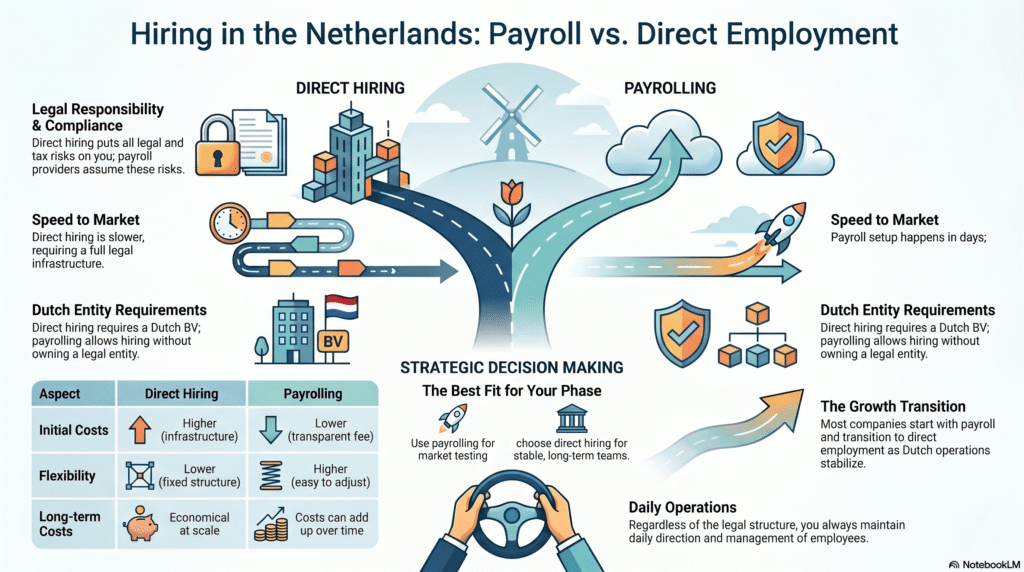
Summary: When hiring employees in the Netherlands, companies can choose between direct employment or payrolling. Each has its own very specific trade-offs. Direct hiring offers full control, but requires handling all legal, tax and administrative responsibilities yourself. Payrolling shifts those responsibilities to a provider, making it easier to hire quickly and stay flexible, especially in the early stages of a business. Many companies start with payrolling and transition to direct employment as their presence in the Netherlands grows.
| Aspect | Direct hiring | Payrolling |
|---|---|---|
| Legal employer | Your company | The payroll provider |
| Dutch entity required | Yes | No |
| Admin and compliance | Your full responsibility | Handled by the provider |
| Setup speed | Slower, full setup needed | Faster, often within days |
| Initial costs | Higher (infrastructure, support) | Lower (transparent fee) |
| Long-term costs | Often more economical at scale | Can add up over time |
| Flexibility | Lower (fixed structure) | Higher (easy to adjust) |
| Risk responsibility | You carry the full risk | Provider handles a large part |
| Best fit for | Stable, growing teams | Market entry and testing phase |
What to do when you need employees in the Netherlands?
Hiring someone is never just a tiny decision you make overnight. It affects costs, how much responsibility you take on, and how flexible your business can be moving forward. That’s true in any country, but when you’re dealing with the Netherlands as a foreign company, a few extra layers come into play. It’s not only about finding the right person. It’s also about how you structure that working relationship. Do you hire someone directly under your own company, or do you use a setup like payrolling instead? At first, it might seem like a technical choice. Something you decide based on preference. But in practice, it can have a real impact on how easily you can hire, how much time you spend on administration, and what kind of risks you’re taking on.
The distinction sits more in how things are arranged behind the scenes. Who is the legal employer, who carries responsibility, and who handles the administrative side? Those are the parts that influence how much control you have, but also how much you need to manage yourself. Some companies prefer full control from the start, whilst others would rather keep things a bit easier, especially when they’re still figuring out how their activities in the Netherlands will develop. Keep in mind, that neither option is automatically better. It really depends on your situation. That’s why it helps to look at both approaches side by side, instead of focusing on just one. In this article, we’ll walk through how direct employment works, how payrolling compares to that, and in which situations one might make more sense than the other.
Direct employment explained
If you hire someone directly in the Netherlands, it basically means they become your employee, on your own company’s payroll. That part is simple enough. You agree on terms, sign a contract, and start working together. But once you look a bit closer, there’s more sitting underneath that setup. You’re not just the one giving direction, you’re also the official employer in the legal sense. Being an employer in the Netherlands involves quite a few rules, and not all of them are easy to pick up straight away. It also brings a number of responsibilities with it. Some of them are obvious, like paying salary and keeping records.
Others are less visible at first. Think of how contracts are written, rules around sick leave, notice periods, and ongoing obligations that don’t really go away once someone is hired. Then there’s the payroll side. Taxes need to be calculated correctly, contributions need to be paid, and everything has to be reported in the right way. If you already have a Dutch presence, this is usually part of your normal setup. You either handle it internally or have support in place. But if you’re new to the country, it can take some time to get comfortable with how it all works. And it’s not a one-time thing either. It continues month after month. That doesn’t mean direct employment is complicated in a negative sense. It just means it’s a more complete setup from the start. You take full control, but also full responsibility.
Using payroll services instead
So what is it actually like, when you use payrolling instead of hiring employees yourself as a company? The main idea is rather simple: you still hire someone to work for you, but you’re not their official employer on paper, because that part is handled by a payroll company. They sign the contract with the employee and take care of the formal side. From a legal point of view, the employee works for them. In daily work, though, it doesn’t feel that different. You still talk to the employee, give direction, and decide what needs to be done. They are part of your team, just like any other colleague. That’s usually what people notice first. The setup sounds different, but the day-to-day work feels familiar. The bigger difference sits in the background.
The payroll company handles things such as salary payments, taxes and social contributions. They also make sure everything follows all relevant Dutch employment rules and laws, which can be quite detailed and even complicated if you’re not used to them. For companies that are new to the Netherlands, that takes away a lot of guesswork. You don’t have to figure out every step yourself before getting started. It also means you don’t need to set up a full Dutch company right away just to hire someone. At the same time, it’s not something that runs completely on its own. It does mean, that you still manage the working relationship between you and the person who works for you, and that means you always stay involved in how this role develops. It’s more that the formal responsibilities are placed with someone else, so you can focus on the work and daily activities themselves, without getting stuck in the administrative burdens and setup.
Side-by-side comparison of both options
If you place direct employment and payrolling next to each other, the differences become clearer quite quickly. Not in a very obvious way, but more in how responsibilities are divided. With direct employment, your company carries everything. You are the legal employer, which means contracts, payroll, taxes, and compliance all sit with you. That gives you full control, but also means you need to handle every part of it. With payrolling, that responsibility is split. The payroll company becomes the official employer, while you stay in charge of the daily work.
So the employee works with you, but the formal side is handled elsewhere. That already changes quite a bit in practice. Then there’s the administrative side. If you hire directly, you need to set up payroll, keep track of regulations, and make sure everything is done correctly each month. With payrolling, a large part of that moves out of your hands. These aspects are handled by the supplier, which can save time, particularly if you are unfamiliar with the Dutch system. Costs also have an impact, though not necessarily in a straightforward manner.
In the long term, direct employment may be more economical, particularly if your team is larger. Payrolling, on the other hand, usually involves less initial setup and is easier to forecast. Another distinction is flexibility. While direct employment comes with greater structure from the beginning, payrolling typically allows you to move a little faster and modify more quickly. And lastly, there are certain risks. With direct hiring, you carry these yourself. With payrolling, part of these risks are managed by the payroll company.
Pros & cons of direct employment and payrolling
If you look at both options more closely, you’ll notice that neither is simply better than the other. It really depends on what you need at that moment exactly. Direct employment definitely has some clear advantages. You have full control, everything sits within your own company, and it often feels more straightforward once it’s up and running. Especially if you already have a presence in the Netherlands, it can fit naturally into your existing structure. At the same time, that control comes with responsibility. You need to handle contracts, payroll, compliance, and keep track of changing rules. That part doesn’t disappear once someone is hired.
Payrolling approaches it from a different angle. It takes away a large part of those responsibilities by placing them with a payroll company instead. That can simplify things, especially at the start of your business endeavor, or when you're still learning, since it gives you more opportunities for you to concentrate more on the task at hand rather than the (administrative) setup. But it’s not without downsides either. Over time, the costs can add up, and some companies prefer to have everything directly under their own control. There’s also a slightly different dynamic, since the employee is formally employed by another party. In daily work that usually doesn’t matter much, but it’s still something to be aware of. In the end, it’s less about which option is ‘better’ and more about which one fits your situation. What works well at one stage of your business might not be the best choice later on, so it greatly depends on the phase you are in now with your company as well. It’s always wise to ask advice from a professional, if you are unsure about this particular fact.
So what should you choose at this moment?
So when does direct hiring really make sense? It’s usually not the very first step companies take when entering the Netherlands. More often, it comes a bit later, once things are already moving. For example, if you’ve been active in the market for a while, and it’s no longer just an experiment. You have clients, work is coming in, and you start thinking about building something more stable. That’s often where direct employment starts to feel more logical. Instead of working around a structure, you create one that fully sits within your own company.
It also becomes more relevant once you have a Dutch BV in place. At that point, you already have the foundation, so handling employment directly is a more natural next step. You don’t have to rely on another party for the formal side, and everything stays under your own control. That doesn’t mean it suddenly becomes simple, but it does fit better with how your business is set up. Another thing that plays a huge role is the actual size of your team. If you’re only hiring one person, the difference might not feel that big. But if you’re planning to grow a team, direct employment can start to make more sense over time.
The effort you put into setting things up spreads out, instead of repeating the same external structure for each hire. Still, it’s not only about numbers. Some companies just prefer having everything in one place. Contracts, payroll, daily operations, all under their own roof. It gives a certain clarity, even if it comes with more responsibility. In most cases, direct hiring fits best when you’re no longer testing, but actually building something that’s meant to last. And payrolling is the best option if you are starting a business, want to stay flexible, or don’t want to hire many employees at once.
Intercompany Solutions can help you decide which option suits your company best
So what’s the best choice for your company: payroll or hiring personnel directly? In most cases, it’s not about picking a single ‘right’ option, but about timing. Where are you right now, and what do you actually need at this stage? If you’re just entering the Dutch market, or still figuring things out, payrolling can make that first step a lot easier. This is due to several factors, Firstly, it allows you to hire someone without having to set up everything at once. You can move forward, test a lot and see how things develop before committing to a full structure.
After that, if and once your activities in the Netherlands are becoming more stable (or you’re simply planning to grow a team), direct employment often starts to make much more sense. It then gives you a setup that fully sits within your own company and aligns better with possible long-term plans. But what you often see in practice is a combination of both. Companies like to start with payrolling, and then switch to direct hiring once they feel ready and steady enough to do so. Meaning it’s not a strict choice, but much more a step-by-step kind of process that follows the growth of your business along the way.
That’s also where it helps to look at the bigger picture, not just the hiring method itself. At Intercompany Solutions, we regularly support foreign entrepreneurs with both sides of this process. That includes setting up a Dutch BV, handling registrations, and making sure the legal structure is in place, but also advising on practical solutions like payrolling when that fits better in the early stages. If you’re not sure which route is right for you, or when to make the switch, it can be useful to look at your plans in a bit more detail. If you’re considering hiring in the Netherlands and want to understand your options, feel free to reach out. We’re happy to think along with you and help you choose an approach that fits your situation now, and later on as well.
Similar Posts:
- Foreign multinational corporations & the Netherlands annual budget
- Tax treaty denounced between the Netherlands and Russia per January the 1st, 2022
- Want to innovate in the green energy or clean tech sector? Start your business in the Netherlands
- How to set up a business as a young entrepreneur
- The challenges of starting entrepreneurs