
Dutch BV Registration Requirements: Statutory Rules for 2026
Establishing a private limited company in the Netherlands requires a minimum share capital of only €0.01, yet the procedural accuracy required to meet Dutch BV registration requirements remains uncompromising. Many international entrepreneurs recognize the strategic value of a Dutch foundation but feel stalled by the perceived complexity of local regulations and the language barrier with authorities like the Belastingdienst. It's a common concern that remote incorporation might be unreliable or that hidden administrative hurdles will lead to non-compliance for foreign founders who cannot visit the country in person.
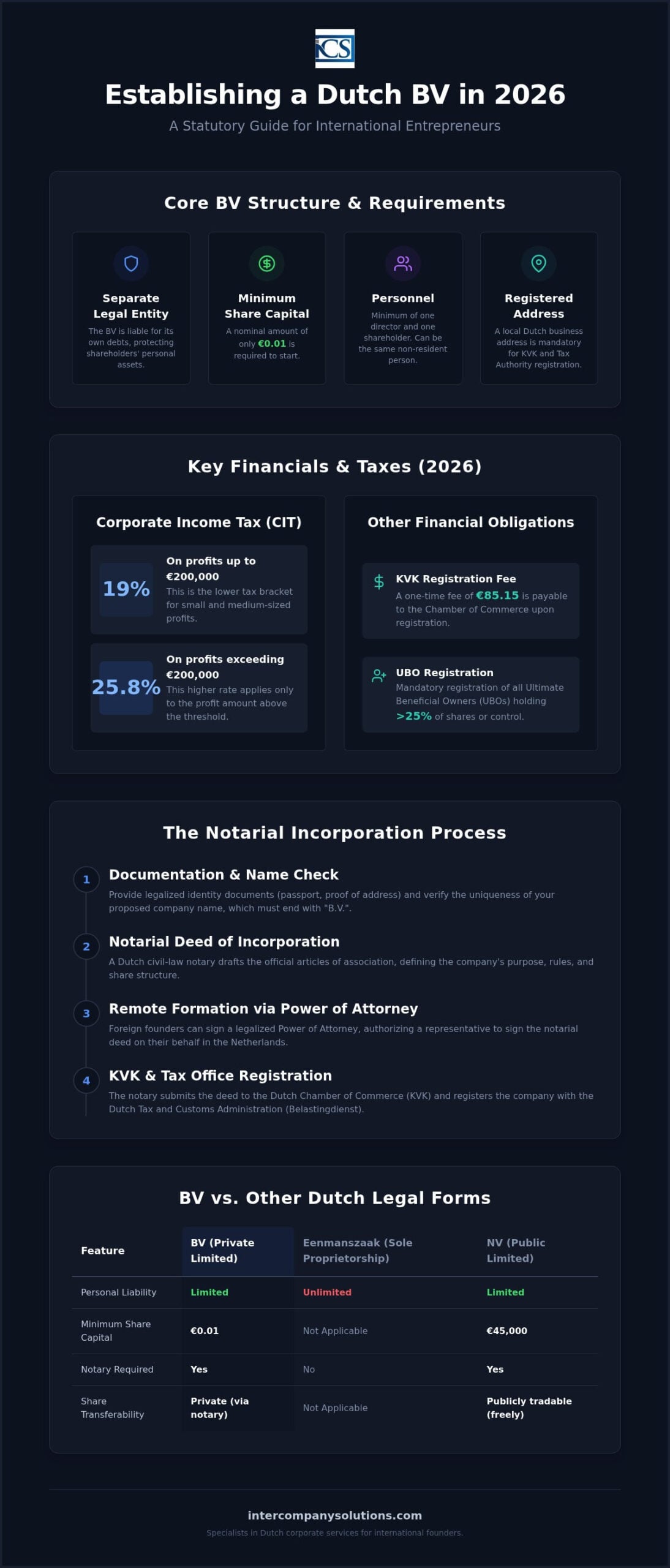
We understand these challenges and have designed this guide to provide a definitive overview of the statutory rules for 2026. You'll gain a clear understanding of the legal, financial, and administrative steps necessary to incorporate your business successfully from abroad. We'll outline the mandatory involvement of a civil-law notary, the specific documentation required for remote setup via a legalized Power of Attorney, and the €85.15 KVK registration fee. We also detail the 2026 corporate tax brackets of 19% on profits up to €200,000 and the mandatory UBO registration for anyone holding more than 25% of shares. This overview ensures you have the technical knowledge to establish your company with professional confidence.
Key Takeaways
- Understand the legal personality of the Besloten Vennootschap and the statutory minimum share capital requirement of €0.01.
- Identify the specific steps to satisfy Dutch BV registration requirements, including the mandatory involvement of a Dutch civil-law notary.
- Learn the 2026 Chamber of Commerce (KVK) registration procedures and the associated administrative fee of €85.15.
- Clarify your fiscal obligations, including the two-bracket Corporate Income Tax rates of 19% and 25.8% and the mandatory UBO registration for interests above 25%.
- Discover how foreign entrepreneurs can complete the entire incorporation process remotely using a legalized Power of Attorney.
Understanding the Dutch BV Structure and Legal Personality
The Besloten Vennootschap, or BV, is the standard private limited company structure in the Netherlands. It functions as a separate legal entity, which means the company itself holds rights and obligations independent of its founders. For entrepreneurs evaluating Understanding the Dutch BV, this distinction is fundamental. The business owns its assets, enters into contracts, and is responsible for its own liabilities. This legal separation ensures that shareholders are generally only liable for the amount they've invested in the company's share capital. It protects personal assets like your home or savings from being seized to pay business debts.
Within this structure, roles are clearly divided between ownership and management. Shareholders act as the owners, while directors manage daily operations. In many startups, one person holds both positions. This flexibility is a key aspect of meeting Dutch BV registration requirements. The law requires at least one director and one shareholder, but there's no requirement for these individuals to be Dutch residents. This makes the BV an accessible vehicle for international business growth and remote management.
Advantages of the BV for International Founders
Establishing a BV provides immediate professional credibility with European banks and partners. The structure is highly flexible regarding share classes. Since the 2012 Flex-BV law, founders can issue shares with profit rights but no voting rights. This is helpful when bringing on silent partners or investors who don't need a say in daily management. Shares are also easily transferable through a notarial deed. This makes the BV much more scalable than other forms, allowing for smooth transitions during future funding rounds or an eventual exit.
Structural Comparison with Other Legal Forms
The primary reason to choose a BV over a sole proprietorship (eenmanszaak) is the protection of personal assets. In a sole proprietorship, your personal and business finances are legally one and the same. If the business fails, you're personally responsible for all debts. The BV creates a shield, which is why understanding the Dutch BV registration requirements is the first step for most foreign investors. Compared to the NV (public limited company), the BV is simpler and cheaper to maintain. An NV requires a minimum capital of €45,000, whereas a BV can be started with just €0.01.
Every BV must be incorporated through a Dutch civil-law notary who drafts the articles of association. This document defines the company's internal rules and purpose. If you're seeking professional Dutch BV company formation, our specialists handle the coordination with the notary to ensure full compliance with Dutch law. This process ensures your company is correctly registered in the Trade Register (KVK) from the start, providing a solid legal foundation for your European operations.
Statutory Requirements for Dutch BV Registration in 2026
The Dutch legal framework provides a streamlined path for incorporation. Since the 2012 Flex-BV legislation, the minimum share capital requirement is just €0.01. This low barrier allows founders to allocate capital toward operational costs rather than locking it in a bank account. If your business model requires a company vehicle, you can check out MijnBedrijfsWagenLease to find financial leasing solutions that preserve your working capital. A BV must have at least one shareholder and one director. These roles often overlap in small enterprises. To fulfill Dutch BV registration requirements, you must also provide a local Dutch business address. This address is recorded at the Chamber of Commerce (KVK) and serves as the official point of contact for the Dutch Tax and Customs Administration (Belastingdienst). Choosing a unique company name is equally vital. The KVK will reject names that are too similar to existing businesses or those that are misleading to the public. The name must also end with "B.V." to clearly signal the company's limited liability status.
Shareholder and Director Criteria for Foreigners
Founders from both EU and non-EU countries can register a BV. While the process is similar, non-EU founders often face additional scrutiny during bank account applications. You'll need to provide a valid passport and a recent proof of address, such as a utility bill or bank statement. If a foreign legal entity acts as the shareholder, you must submit a legalized extract from the local trade register where that parent company is based. This documentation confirms the entity's legal existence and identifies its authorized representatives. Starting a business in the Netherlands as a foreigner often involves remote formation via a legalized Power of Attorney. This allows a representative to sign the deed of incorporation before the notary on your behalf. You can discuss your specific corporate structure with our team to ensure your documents meet Dutch standards.
The Ultimate Beneficial Owner (UBO) Register
Transparency is a cornerstone of Dutch corporate law. Meeting Dutch BV registration requirements also involves identifying the Ultimate Beneficial Owners in the KVK UBO register. A UBO is defined as any natural person who holds more than 25% of the shares, voting rights, or ownership interest in the company. As outlined in the official Dutch government guide, this registration is mandatory during the incorporation process. Failing to maintain accurate UBO data can lead to significant administrative fines. While certain details like the UBO's name and the nature of their interest are accessible to specific authorized organizations, private information like home addresses and social security numbers remains shielded from the general public. This balance between transparency and privacy is designed to prevent financial crimes while protecting individual founders.
The Notarial Incorporation and KVK Registration Process
The execution phase of your business setup centers on the involvement of a Dutch civil-law notary. This official is legally required to draft and witness the deed of incorporation. This document includes the articles of association (statuten), which define the company’s name, registered office, and corporate purpose. In most cases, the entire process, from the initial draft to the final registration, is completed within 3 to 5 business days. This speed is a hallmark of the Dutch administrative system, provided all documentation is prepared with precision to meet Dutch BV registration requirements. The notary's role is to ensure the company is formed in accordance with the Dutch Civil Code, protecting the interests of both the founders and future creditors.
Remote Incorporation via Legalised Power of Attorney
Foreign entrepreneurs can manage this entire process without stepping foot in the Netherlands. We coordinate remote formation through a legalized Power of Attorney. You'll need to sign this document in the presence of a notary in your own country to verify your identity. If you're based outside the EU, your local notary's signature must be verified with an Apostille or through a legalization chain at a Dutch embassy. This process confirms the authority of the local notary and the authenticity of your signature. Once we receive these physical documents, the Dutch notary proceeds with the incorporation as if you were present in person. This route is the standard procedure for our Dutch BV company formation services, ensuring a secure and compliant entry into the market.
Registration with the Chamber of Commerce (KVK)
Once the notary executes the deed, they immediately submit the company's details to the Chamber of Commerce (KVK) via a digital portal. For 2026, the KVK registration fee is €85.15. The Chamber of Commerce sends an invoice for this amount to your registered business address shortly after registration. Upon successful entry into the Trade Register, the KVK issues a unique eight-digit identification number. You'll then receive an official extract (uittreksel), which is necessary for opening corporate bank accounts and signing commercial contracts. The KVK automatically shares this new registration data with the Dutch Tax and Customs Administration (Belastingdienst). This triggers the internal process for assigning your VAT and corporate tax numbers, often saving you from having to initiate a separate registration for basic tax obligations. It's a streamlined handover that allows you to focus on operational readiness while the authorities finalize your fiscal profile.
Corporate Tax and Financial Reporting Obligations
Successful incorporation is only the beginning of your company's life in the Netherlands. Maintaining a compliant status requires strict adherence to Dutch tax laws and financial reporting standards. One of the most critical Dutch BV registration requirements involves the statutory record retention period. Dutch law requires you to store all business records, including invoices, bank statements, and contracts, for a minimum of 7 years. If your BV owns immovable property, this period extends to 10 years. These records must remain accessible to the Tax and Customs Administration (Belastingdienst) to verify your tax filings during potential audits.
CIT Rates and Profit Thresholds in 2026
The Dutch corporate tax system uses a two-bracket structure based on your company's taxable profit. For the 2026 fiscal year, a rate of 19% applies to the first €200,000 of profit. Any profit exceeding this €200,000 threshold is taxed at a rate of 25.8%. This structure provides a competitive environment for small and medium-sized enterprises. If your BV functions as a holding company, you may qualify for the participation exemption. This rule allows for 100% tax-free receipt of dividends and capital gains from subsidiaries, provided you hold at least 5% of the shares and meet specific activity requirements. It's a primary reason why many international groups choose the Dutch BV for their European headquarters.
VAT Registration and EORI Numbers
Most BVs engaged in commercial activities must register for Value Added Tax (VAT), known locally as BTW. The Belastingdienst typically issues your VAT number shortly after the KVK registration is finalized. You'll generally be required to file VAT returns on a quarterly basis, although monthly filings are sometimes mandatory for high-turnover businesses. The standard Dutch VAT rate is 21%, while a reduced rate of 9% applies to specific goods and services like food and certain medical supplies. If your business imports or exports goods to countries outside the European Union, you also need an Economic Operators Registration and Identification (EORI) number. This number is mandatory for all customs declarations and ensures your shipments move efficiently through Dutch ports.
Your company must also file annual financial statements with the Chamber of Commerce (KVK). The management board is responsible for preparing these statements within 5 months after the end of the financial year. Shareholders can grant an extension of up to 5 additional months. Once the shareholders adopt the accounts, you must file them with the KVK within 8 days. The absolute deadline for filing is 12 months after the financial year ends. Failing to meet these deadlines can result in personal liability for directors and significant administrative fines. Our payroll and accounting services can help you manage these recurring deadlines to ensure your company remains in good standing.
Professional Assistance for Remote Company Formation
Managing the full spectrum of Dutch BV registration requirements requires a coordinated approach between legal, fiscal, and administrative experts. Intercompany Solutions serves as a proactive facilitator for international founders, handling the entire incorporation process remotely. We manage the coordination with the Dutch civil-law notary, the submission of documents to the Chamber of Commerce, and the initial setup of your company's statutory records. Professional Dutch BV company formation ensures that every detail, from the articles of association to the UBO registration, aligns with current Dutch law. This meticulous attention to detail minimizes the risk of administrative delays and ensures your business starts on a compliant foundation.
Expedited VAT and Bank Account Support
Securing a VAT number and a business bank account are often the most time-consuming steps for foreign entrepreneurs. We provide direct assistance with the Belastingdienst VAT application, ensuring your company's activity description and substance requirements are clearly presented. Our team also offers guidance on selecting and applying for Dutch or European business bank accounts that suit your operational needs. For complex administrative tasks, our secretarial services provide the necessary support to maintain your company's standing with local authorities, or you can explore HR outsourcing and consulting to manage your personnel requirements, allowing you to focus on growth rather than paperwork.
Next Steps for Starting Your Business
If you're ready to proceed, we recommend reviewing our comprehensive guide to starting a business in the Netherlands. This resource provides deeper context on market entry and operational strategy. Once you have a clear vision, an initial consultation allows us to tailor the BV structure to your specific commercial goals. We then finalize the 2026 incorporation checklist, which includes verifying your unique company name, preparing the legalized Power of Attorney, and confirming the €85.15 KVK registration fee.
Beyond the initial setup, we provide ongoing support to manage your fiscal obligations. This includes corporate tax filings at the 19% and 25.8% rates and ensuring annual accounts are filed with the KVK within the 12-month deadline. If your business plan involves hiring staff, integrating payroll services in the Netherlands is essential. We handle the registration as an employer with the tax authorities, draft compliant employment contracts, and manage monthly salary slips. This end-to-end support system is designed to reassure international owners that their professional interests are managed with efficiency and reliability.
Last reviewed: August 2026
Establishing Your European Presence in 2026
The Dutch BV remains a highly effective vehicle for international expansion due to its minimal capital entry and the robust legal protection it offers shareholders. Successfully meeting Dutch BV registration requirements provides your business with immediate access to the European market and a transparent fiscal framework. Our Rotterdam-based team coordinates the entire process, from the initial notarial deed to the final KVK extract, ensuring your company is ready for operation without requiring your physical presence in the Netherlands.
We provide a guaranteed 3 to 5 day incorporation timeline and a 100% remote process through a legalized Power of Attorney. This structured approach allows you to establish your company with confidence and precision. We're ready to assist you in meeting the 2026 statutory rules and securing your business's position in the Dutch market.
Last reviewed: August 2026
Frequently Asked Questions
What is the minimum share capital for a Dutch BV in 2026?
The minimum share capital for a Dutch BV in 2026 is €0.01. This requirement hasn't changed since the introduction of the Flex-BV legislation in 2012. Founders can choose to issue more capital if they wish, but the statutory minimum is designed to lower barriers for new enterprises. It's often practical to issue a slightly higher amount, such as €100, to simplify share division.
Can a non-resident register a Dutch BV remotely?
Yes, non-residents can register a Dutch BV remotely without visiting the Netherlands. This is achieved through a legalized Power of Attorney, which allows a representative to sign the deed of incorporation before a Dutch notary on your behalf. This method effectively satisfies all Dutch BV registration requirements for foreign founders who can't travel. You'll need to sign the documents in your home country before a local notary.
What are the corporate tax rates for a Dutch company in 2026?
For the 2026 fiscal year, the corporate income tax rates are 19% on profits up to €200,000 and 25.8% on any amount exceeding that threshold. These rates apply to the company's taxable profit after deducting eligible business expenses. You should also be aware of the 15% dividend withholding tax rate that typically applies when distributing profits to shareholders.
How long does it take to register a BV with the Chamber of Commerce?
The standard timeline to register a BV with the Chamber of Commerce (KVK) is 3 to 5 business days. This period covers the drafting of the articles of association by a notary and the digital submission to the Trade Register. Once the notary signs the deed, the KVK usually processes the registration within 24 hours, providing you with your unique KVK identification number.
Is a local Dutch director required for BV registration?
A local Dutch director isn't a statutory requirement for BV registration. You can appoint directors of any nationality or residency. While a local presence can assist with opening certain bank accounts or meeting specific tax substance rules, the legal formation of the company doesn't depend on having a resident director. One person can also serve as both the sole director and shareholder.
What documents are needed for Dutch BV incorporation as a foreigner?
Foreigners need to provide a valid passport and a recent proof of residential address, such as a utility bill or bank statement less than two months old. If you're incorporating remotely, you'll also need a legalized Power of Attorney. Corporate shareholders must provide an official, legalized extract from their local trade register to prove the entity's existence and authorized signatories.
What is the KVK registration fee for a new company in 2026?
The KVK registration fee for a new company in 2026 is €85.15. The Chamber of Commerce sends an invoice for this one-time fee to your registered business address shortly after your company is entered into the Trade Register. You don't pay this fee to the notary; it's a separate administrative cost billed directly by the government authority.
What are the UBO registration requirements in the Netherlands?
All BVs must register their Ultimate Beneficial Owners (UBOs) in the KVK UBO register. A UBO is any natural person who owns or controls more than 25% of the shares or voting rights. This mandatory disclosure is a key part of Dutch BV registration requirements and must be completed during the initial incorporation process to ensure your company remains compliant with transparency laws.