



Benefits of a Dutch Holding Structure for International Entrepreneurs
Protecting corporate wealth requires a structural separation between active trading and accumulated capital. International entrepreneurs often face unnecessary exposure when using a single-entity model, where a single legal dispute can threaten years of retained earnings or intellectual property. It's a common frustration to see profits diminished by dividend withholding taxes or to risk the entire business portfolio due to operational volatility. Understanding the benefits of a Dutch holding structure is essential for anyone looking to secure their financial future in the Netherlands.
This technical analysis explains how a dual-BV setup optimizes tax liability and safeguards corporate assets under current 2026 regulations. We'll examine the participation exemption for tax-free exits, the requirements for a fiscal unity, and the procedural steps for remote setup via a legalized Power of Attorney. By the end of this guide, you'll understand how to isolate operational risks from your surplus capital while maintaining compliance with the mandatory 2026 DGA salary of €58,000 and the 19% corporate income tax rate on profits up to €200,000.
Key Takeaways
- Learn how the dual-BV model separates accumulated capital from operational risks to create a secure corporate framework.
- Understand the benefits of a Dutch holding structure, specifically how the participation exemption allows for the tax-free transfer of dividends and capital gains.
- Discover methods for isolating intellectual property and retained earnings from the liabilities of active business operations.
- Identify how to facilitate tax-free exits and reinvest proceeds into new ventures without immediate corporate income tax leakage.
- Review the procedural steps for remote incorporation via a legalized Power of Attorney, ensuring compliance with 2026 Dutch regulatory standards.
Defining the Dutch Holding Structure: The Two-BV Model
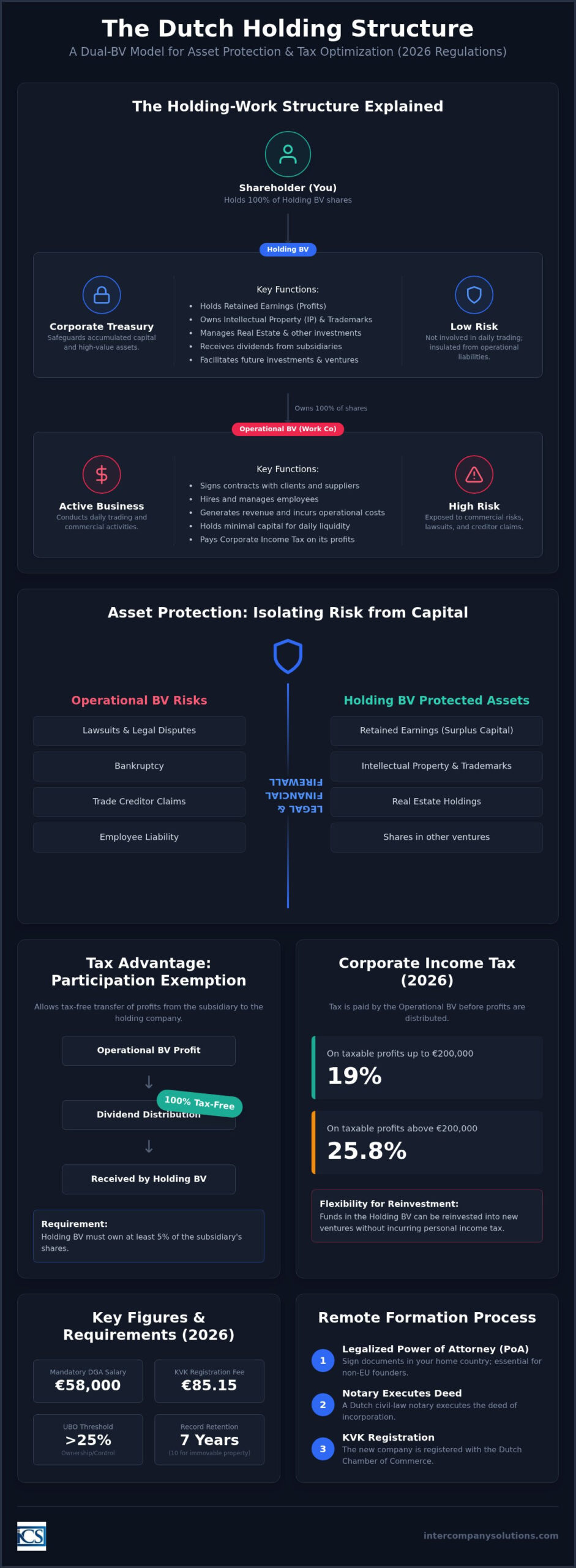
The foundation of a professional Dutch business setup usually involves two distinct private limited companies. While many entrepreneurs consider starting with a single entity to save on initial costs, the long-term benefits of a Dutch holding structure far outweigh the setup expenses. This arrangement, often called the "holding-work" structure, consists of a Holding BV at the top and an Operational BV as its subsidiary. Starting with this dual-layered model from day one is more efficient than restructuring later, as transferring shares or assets after a company has grown can trigger unnecessary tax events.
In this model, you hold the shares of the Holding BV personally. The Holding BV then owns 100% of the shares in the Operational BV. This hierarchy creates a legal and financial buffer. If the operational company faces a lawsuit or bankruptcy, the assets held within the holding company remain protected from the subsidiary's creditors. It's a standard risk-management strategy that separates your "working" capital from your "safe" capital.
The Role of the Holding BV
The Holding BV functions as your corporate treasury. Its primary purpose isn't to trade or provide services, but to manage and safeguard assets. This entity holds your accumulated profits, high-value intellectual property, trademarks, and real estate. By keeping these assets outside the active trading company, you ensure they aren't exposed to the risks of daily business activities. It acts as a personal piggy bank where you can retain earnings for future use.
Earnings from the subsidiary can be moved up to the holding company via the Dutch participation exemption. This mechanism allows dividends to be transferred 100% tax-free, provided the holding company owns at least 5% of the subsidiary's shares and meets specific criteria. This setup facilitates efficient reinvestment. Instead of paying personal income tax on a dividend distribution, you can use the holding's funds to launch a second subsidiary or invest in other ventures without immediate tax leakage.
The Role of the Operational BV
The Operational BV is the active part of your business. It signs commercial contracts, hires employees, and interacts with clients. Because this entity is the one "doing the work," it naturally attracts the most risk. If a client disputes a contract or an employee makes a legal claim, the liability is limited to the assets within this specific subsidiary. The operational company typically holds only the minimum capital required for daily liquidity, though maintaining this liquidity often requires the timely collection of outstanding invoices; for specialized support with international commercial debt recovery, check out Whole King Company Limited.
For international founders, establishing this structure involves a clear procedural path. You can complete the Netherlands company formation process remotely through a legalized Power of Attorney. This is particularly useful for non-EU entrepreneurs who need a robust structure without immediate physical relocation. The Operational BV pays corporate income tax on its profits (19% on the first €200,000 and 25.8% above that) before distributing the remainder to the holding company. This ensures that only the operational entity's balance sheet is exposed to trade creditors.
Last reviewed: August 2026
Tax Advantages: Participation Exemption and Fiscal Unity
One of the primary benefits of a Dutch holding structure is the access to a tax-efficient environment for profit distribution. The Dutch corporate tax system follows a two-bracket structure for 2026; a rate of 19% applies to the first €200,000 of taxable profit, while 25.8% applies to any amount above this threshold. Once the operational subsidiary fulfills its tax obligations, the residual profit is available for transfer to the holding entity without further corporate tax impact. This mechanism prevents the double taxation of the same earnings within a corporate group.
Requirements for Participation Exemption
The Dutch participation exemption ensures that dividends and capital gains received by a parent company from its subsidiary are 100% exempt from corporate tax. Under a Dutch holding company structure, you qualify for this exemption if the parent owns at least 5% of the nominal paid-up share capital of the subsidiary. The subsidiary must also be an active business entity rather than a passive portfolio investment. This exemption applies to both EU and non-EU subsidiaries, provided the ownership criteria are met.
Benefits of a Fiscal Unity (Fiscale Eenheid)
A fiscal unity allows the parent and its subsidiaries to be treated as a single taxpayer for corporate income tax purposes. This arrangement enables you to offset the losses of one BV against the profits of another, reducing the total taxable base of the group. It also eliminates the requirement for intercompany VAT billing between the entities. The group files one consolidated tax return, which streamlines the filing process for entrepreneurs managing multiple business lines.
Applying these specific thresholds requires a clear understanding of your group's projected cash flow. You can request a professional tax review to determine if your current setup qualifies for these exemptions under 2026 regulations.
Last reviewed: August 2026
Asset Protection and Risk Management
Asset protection is a primary driver for international entrepreneurs choosing a dual-layered corporate setup. One of the fundamental benefits of a Dutch holding structure is the creation of a legal firewall between your active trade and your accumulated wealth. By isolating the operational risks within a subsidiary, you ensure that a single commercial dispute or bankruptcy at the subsidiary level doesn't automatically grant creditors access to the assets held in the parent company. This separation is achieved because each BV is a distinct legal entity with its own balance sheet and liabilities.
Protecting Retained Earnings
Financial stability depends on the consistent transfer of surplus capital from the operational entity to the holding company. When the operational BV generates profit, those funds are vulnerable to litigation or debt claims as long as they remain on its books. Moving these funds to the Holding BV as dividends effectively places them out of reach of operational creditors. Dutch law requires you to maintain all corporate records for a 7-year retention period, which includes the documentation for these intercompany transfers. This strategy ensures that your working capital is just enough to cover daily operations, while your surplus capital is safely stored in the holding entity.
Intellectual Property and Licensing
Technology and software firms frequently use this structure to safeguard their most valuable intangible assets. This arrangement is one of the key benefits of a Dutch holding structure for firms entering the European market. Instead of housing patents, trademarks, or software code within the trading company, these assets are owned by the Holding BV. The operational entity then pays a market-conform license fee to use the intellectual property. This setup serves two purposes: it protects the IP from operational failure and naturally shifts profits from the high-risk trading entity to the low-risk holding entity.
If the subsidiary faces a legal challenge, the core technology remains secure and owned by the parent company. This proactive approach is a standard part of the Netherlands company formation process for international startups. A robust holding balance sheet also facilitates easier access to financing. Banks and financial institutions often view a holding company with significant assets and no operational debt as a more reliable borrower. You can use the holding's assets as collateral for loans intended for new business ventures. This provides a level of financial flexibility that a single-entity structure cannot offer, as the parent company can act as a guarantor for the subsidiary's credit lines without exposing its entire asset base to the lender.
Last reviewed: August 2026
Exit Strategies and Reinvestment Flexibility
Planning for an eventual exit is a critical component of a successful business strategy. One of the most significant benefits of a Dutch holding structure is the flexibility it provides during the sale of a business unit. When you hold shares in an operational company through a holding entity, the transaction is treated as a share deal. This distinction is vital for preserving the value of the transaction. It ensures that the majority of the proceeds remain available for future operations or reinvestment rather than being diminished by immediate tax claims. Most entrepreneurs don't consider the exit when starting a business in the Netherlands, yet the structure's design is specifically built for this transition.
Tax-Free Share Sales
Under the Dutch participation exemption, any capital gains realized from the sale of shares in a qualifying subsidiary are 100% exempt from corporate income tax. If your subsidiary has grown in value, the holding company can sell those shares and receive the full purchase price without paying the 19% or 25.8% CIT on the profit. This provides a substantial advantage for serial entrepreneurs and venture capitalists who build and sell companies. If you owned those shares personally, the sale would trigger immediate personal income tax. By using a holding structure, you defer that personal tax liability until you decide to distribute a dividend from the holding company to yourself.
Dividing Business Lines
A holding structure allows you to maintain a modular business environment. You can operate multiple subsidiaries under a single parent company, each dedicated to a specific service or product line. This modularity is one of the practical benefits of a Dutch holding structure. If one business line becomes highly successful, you can sell that specific subsidiary to an outside investor or a competitor without disrupting the operations of your other companies. The holding company retains the proceeds tax-free, which you can then use to fund the growth of your remaining subsidiaries or launch entirely new projects.
This setup also simplifies the process of bringing in new partners or investors. An investor can buy a percentage of shares in a specific operational BV while your holding company retains the majority. This keeps your personal assets and other business interests completely separate from the new partnership. It provides a clean, professional framework that is highly attractive to venture capital firms and strategic buyers who prefer clear boundaries between different corporate activities. The holding company can even provide intercompany loans to new ventures using the capital gained from a previous sale, acting as an internal bank for your business group.
Last reviewed: August 2026
Formation Requirements and Remote Setup Procedures
Establishing a corporate presence in the Netherlands does not require your physical presence in the country. For international entrepreneurs, one of the practical benefits of a Dutch holding structure is the ability to manage the entire incorporation process through a legalized Power of Attorney (PoA). This remote route is the standard procedure for non-EU founders who wish to secure their assets under Dutch law without immediate relocation. While the legal minimum share capital for a Dutch BV is only €1, many founders choose to deposit a higher amount, such as €100 or €1,000, to demonstrate financial substance to future banking partners and creditors. For the 2026 fiscal year, the Chamber of Commerce (KVK) charges a one-time registration fee of €85.15 for each entity within your structure.
Transparency is a core requirement of the Dutch regulatory environment. Any Ultimate Beneficial Owner (UBO) who holds more than 25% of the shares, voting rights, or ownership interest in the holding company must be registered in the Dutch UBO register. This registration is a mandatory part of the formation process and is handled alongside the initial KVK filing. Maintaining clear records of these interests is essential for ongoing compliance and for opening corporate accounts with financial institutions.
The Remote Incorporation Process
The setup begins with the submission of high-quality identification documents and a legalized PoA to a Dutch civil-law notary. This notary is responsible for drafting and executing the deeds of incorporation for both the Holding BV and the Operational BV. Standard structures are typically finalized within 3 to 5 business days once all legalized documents are received in the Netherlands. You can find detailed technical steps in our Netherlands company formation guide. This timeline ensures that your business can begin trading or holding assets with minimal delay, provided the initial documentation meets the notary's specific requirements.
Compliance and Administrative Obligations
Operating a dual-BV structure involves specific recurring responsibilities to maintain good standing with the Dutch authorities. Every entity must have a local registered business address in the Netherlands, which serves as the official point of contact for the Belastingdienst and the KVK. You are also required to file annual accounts with the Chamber of Commerce within strict statutory deadlines to avoid administrative penalties. After the notary completes the incorporation, the next immediate steps involve applying for a VAT registration number and, if you intend to trade goods outside the EU, an EORI number. These identifiers are linked to the Operational BV, while the Holding BV typically maintains a more passive administrative profile. Adhering to these procedural steps ensures you continue to enjoy the long-term benefits of a Dutch holding structure without facing regulatory interruptions.
Last reviewed: August 2026
Strategic Asset Management with a Dutch Holding Structure
Implementing a dual-BV model provides the necessary framework to protect your accumulated capital while maintaining a flexible exit strategy. By understanding the benefits of a Dutch holding structure, you can effectively isolate operational liabilities and utilize the participation exemption to reinvest profits without immediate tax leakage. This setup ensures that your intellectual property and retained earnings remain secure regardless of the challenges faced by your trading entity.
Our team specializes in non-EU founder compliance and facilitates the entire remote incorporation process in just 3 to 5 business days. We're committed to providing a 100% satisfaction guarantee to ensure your professional interests are managed with the highest level of accuracy and reliability. We handle the technical details of the 2026 KVK and UBO requirements so you can focus on your commercial growth.
Establishing a corporate structure in the Netherlands is a significant step toward global mobility. We look forward to guiding you through every procedural detail to ensure your international venture is built on a stable and compliant foundation.
Last reviewed: August 2026
Frequently Asked Questions
Is a Dutch holding structure beneficial for small businesses?
Yes, small businesses benefit from the immediate separation of trade risks and accumulated capital. Even with lower turnover, isolating intellectual property and retained earnings from daily trading liabilities is a sound risk management strategy. The benefits of a Dutch holding structure include protecting your private assets from business debts from the start. It's also more cost-effective to implement this dual-BV model during initial formation than to restructure your business after it has grown.
Can I set up a Dutch holding structure remotely as a non-EU resident?
Non-EU residents can incorporate a Dutch structure without traveling to the Netherlands. This is achieved through the legalized Power of Attorney route. You sign the necessary formation documents and have them legalized in your home country before sending them to a Dutch civil-law notary. This remote process typically takes 3 to 5 business days once the notary receives the physical, legalized documents. Our team specializes in managing these requirements for international founders.
How much is the minimum share capital for a Dutch BV in 2026?
The statutory minimum share capital for a Dutch private limited company is €0.01. While this low threshold was introduced to facilitate entrepreneurship, most international founders choose to issue shares with a total value of €1, €100, or €1,000. This choice is usually based on the desired share division between multiple founders and the level of professional credibility you wish to present to future banking partners and creditors during the setup process.
What are the corporate tax rates for a Dutch holding company in 2026?
For the 2026 fiscal year, the corporate income tax (CIT) is 19% on the first €200,000 of taxable profit. Any taxable profit exceeding this €200,000 threshold is taxed at a rate of 25.8%. These rates apply to the net profit of the entity after all deductible business expenses have been subtracted. Holding companies that qualify for the participation exemption may receive certain types of income, such as dividends, entirely tax-free.
How does the participation exemption work for dividends?
The participation exemption allows a parent company to receive dividends and capital gains from a subsidiary 100% tax-free. To qualify for this exemption, your holding BV must own at least 5% of the nominal paid-up share capital of the subsidiary. This mechanism is one of the primary benefits of a Dutch holding structure, as it prevents the double taxation of corporate earnings as they move from the operational level to the holding level.
Do I need a local director for my Dutch holding company?
There is no legal requirement to appoint a Dutch resident as a director of a BV. Foreign individuals or foreign legal entities are permitted to serve as directors. However, to satisfy economic substance requirements for certain tax benefits and to facilitate the opening of a local corporate bank account, you must maintain a registered business address in the Netherlands. Most international entrepreneurs manage their Dutch companies successfully from abroad while meeting these local standards.
Can a Dutch holding company own subsidiaries in other countries?
A Dutch holding company can act as the parent entity for subsidiaries located in any global jurisdiction. The Netherlands maintains one of the world's most extensive networks of double tax treaties, which helps to reduce or eliminate withholding taxes on international distributions. This makes the Dutch holding an efficient central hub for entrepreneurs who manage diverse business lines or multiple international projects under a single, stable corporate umbrella.