


Accounting for Dutch BV: Compliance and Tax Obligations in 2026
Directors of a Dutch BV face personal liability for company debts if they fail to file annual accounts with the Chamber of Commerce (KVK) within the 12-month statutory deadline. While the Dutch legal system supports international growth, the requirements for accounting for Dutch BV are precise and leave little room for error. You likely recognize the difficulty of managing statutory bookkeeping and tax filing remotely while deciphering complex terms like BTW and VPB.
It's a common concern for foreign entrepreneurs who want to ensure their operations remain fully compliant with the Belastingdienst without being physically present. This guide provides a clear framework for your 2026 obligations, including corporate tax filings and annual reporting standards. You'll learn how to optimize your tax position through participation exemptions and meet the specific 19% corporate tax threshold for profits up to €200,000. We'll also detail the mandatory digital filing procedures and the €85.15 KVK registration fee to keep your financial records accurate and secure.
Key Takeaways
- Maintain statutory financial records for a minimum of seven years to comply with Dutch civil and tax law requirements.
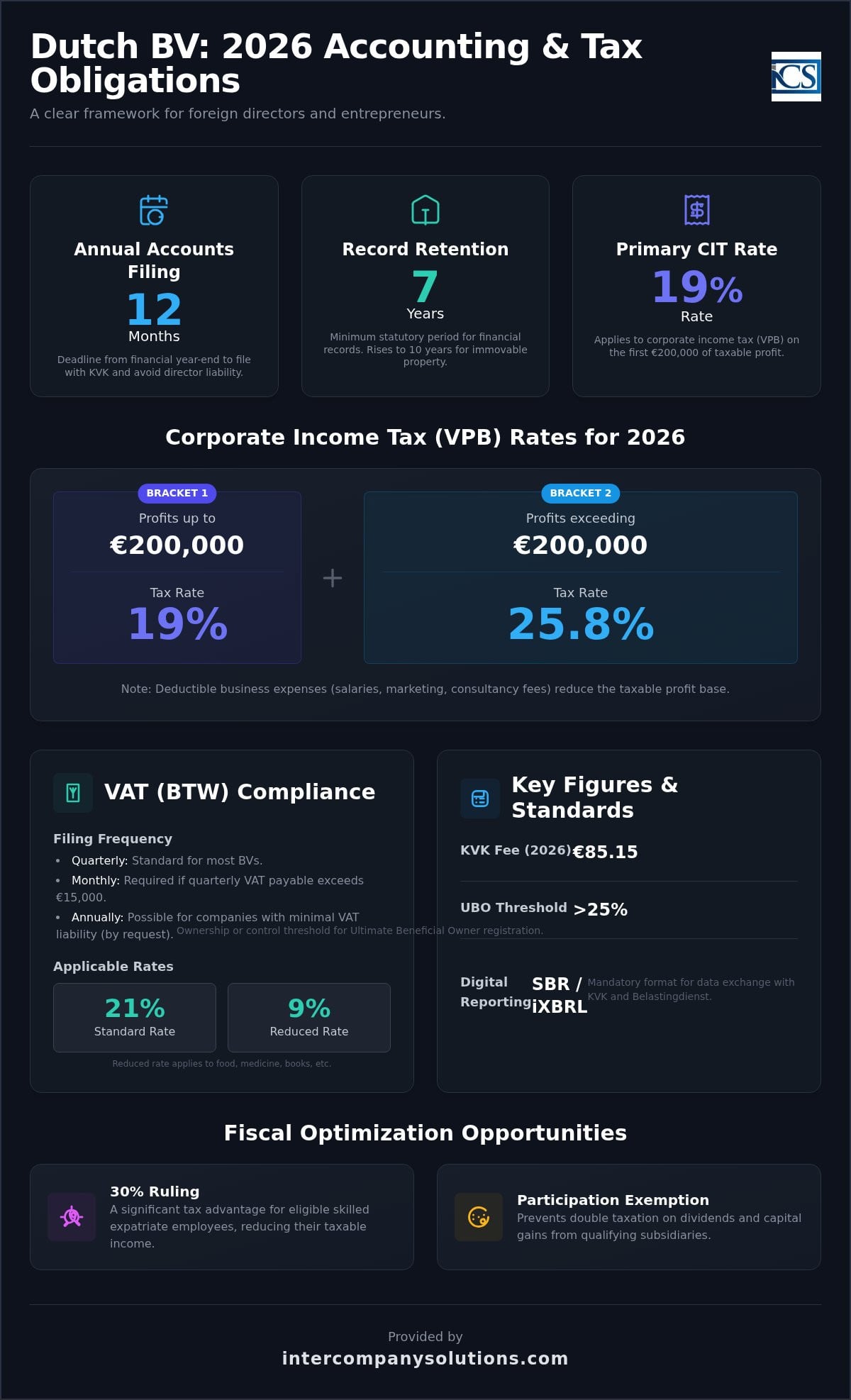
- Apply the 19% corporate income tax rate on taxable profits up to €200,000, with a 25.8% rate applicable to profits exceeding this threshold.
- Submit annual accounts to the Chamber of Commerce within 12 months of the financial year-end to avoid director liability and administrative penalties.
- Streamline the remote management of accounting for Dutch BV by utilizing the legalized Power of Attorney route for VAT and bank applications.
- Verify eligibility for the 30% ruling and participation exemptions to optimize the fiscal position of your international corporate structure.
Statutory Bookkeeping and Record-Keeping Obligations
Every Besloten vennootschap (BV) incorporated in the Netherlands is legally required to maintain a comprehensive and accurate administration. This isn't just a best practice; it's a statutory obligation under Book 2 of the Dutch Civil Code. Your administration must reflect the company's true financial position at any given time. If you manage your accounting for Dutch BV correctly, your records will provide a clear trail of all rights and obligations. This data serves as the legal foundation for both your annual accounts and your tax returns. Accurate records also protect directors from personal liability in the event of a bankruptcy audit.
The standard retention period for all digital and physical business records is seven years. This includes everything from ledger accounts to internal emails that impact the financial position. However, if your BV owns or deals with immovable property, the law extends this retention period to ten years. For those managing such assets, investing in high-quality building components can be a sound fiscal decision; you can learn more about Intura and their premium daylight solutions for Dutch properties. These records must be stored in a way that remains legible and accessible throughout the entire period. If the Dutch Tax Office (Belastingdienst) requests an audit, you must be able to produce these documents within a reasonable timeframe. Failure to provide a complete administration can lead to a reversal of the burden of proof in tax disputes, placing the company in a precarious legal position.
Primary Record Requirements for 2026
To meet the standards for 2026, your administration must include specific primary documents that verify every transaction. Sales and purchase ledgers must be supported by detailed invoices that comply with Dutch VAT (BTW) formatting rules. You must also retain all bank statements and records of electronic payments. Contracts, employment agreements, and business correspondence are equally vital. For entrepreneurs starting a business in the Netherlands, keeping these records organized from day one prevents administrative backlog and potential fines. The Belastingdienst expects these records to be "audit-proof," meaning an external auditor can verify the source of every entry in your books without ambiguity.
Digital Administration and Software Standards
The Netherlands is transitioning toward fully digital reporting for all corporate entities. Most Dutch companies are now required to maintain digital records that are compatible with Standard Business Reporting (SBR). This system uses the iXBRL format to ensure that financial data is exchanged efficiently between businesses and government agencies like the KVK and Belastingdienst. Your software should allow for real-time reconciliation of bank accounts to ensure that the data you report matches your actual cash flow. Using SBR-compatible software reduces the risk of manual entry errors and ensures your filings meet the latest technical specifications required for the 2026 fiscal year. Professional accounting for Dutch BV is best handled through these digital platforms to facilitate remote oversight for foreign directors. For international firms needing robust systems to manage these digital requirements, you can learn more about NaviWorld (Thailand) Co., Ltd. and their expertise in Microsoft Dynamics 365 for finance and procurement.
Periodic Tax Filings: VAT and Corporate Income Tax
Managing the periodic tax cycle is a critical component of accounting for Dutch BV. Most companies operate on a standard calendar year, but new incorporations often utilize a broken fiscal year. This option allows your first financial year to run from the date of incorporation until December 31 of the following year, which simplifies your initial reporting. VAT (BTW) filings are typically submitted on a quarterly basis. If your quarterly VAT payable consistently exceeds €15,000, the Belastingdienst will require monthly filings. Conversely, companies with minimal annual VAT liability may request an annual filing cycle to reduce administrative pressure.
CIT Thresholds and Rates for 2026
Your Corporate Income Tax obligations (VPB) depend on the net taxable profit of the BV. For the 2026 fiscal year, the tax brackets are strictly defined. You pay a 19% rate on the first €200,000 of taxable profit. Any profit exceeding this €200,000 threshold is taxed at 25.8%. Proper accounting for Dutch BV ensures that you maximize deductible business expenses to lower this taxable base. Deductible items include staff salaries, marketing costs, and professional consultancy fees, provided they're incurred for business purposes. It's vital to reconcile these figures accurately before the filing deadline, which is usually June 1 for the previous calendar year.
VAT Registration and Compliance
Most commercial activities in the Netherlands are subject to the standard VAT rate of 21%. A reduced rate of 9% applies specifically to sectors such as food, medicine, and certain books or newspapers. As of 2026, hotel stays and short-term accommodations have transitioned to the 21% rate. If your BV engages in trade with other EU member states, you must manage intra-community transactions. This involves reporting the supply of goods or services to EU-based businesses via an ICP declaration. You must submit both the VAT return and the payment within one month after the period ends to avoid automatic administrative fines.
Penalties for late filings are non-negotiable and apply automatically. For VAT, a late filing results in a €68 fine, while late payment incurs a penalty of 3% of the unpaid amount. Corporate tax penalties are considerably higher, often starting at €385 for a first-time delay. If you're managing your business from abroad, our team can provide tailored accounting support to ensure all deadlines are met without manual intervention.
Annual Reporting and the Chamber of Commerce (KVK)
Filing annual accounts with the Chamber of Commerce (KVK) is a mandatory transparency requirement for every Dutch legal entity. This process is distinct from your tax filings and ensures that the company's financial status is available for public record. For the 2026 fiscal year, the KVK registration fee remains €85.15. The management board is responsible for preparing these statements, which the shareholders must then formally adopt. This approval process is a critical safeguard, as it signifies that the owners agree with the financial representation of the business for the preceding year.
The depth of information you must disclose depends on the company's size. Most international entrepreneurs starting out will fall into the "Micro" or "Small" categories, which benefit from significantly reduced reporting burdens. While large corporations must provide detailed cash flow statements and extensive notes, small BVs typically only need to submit an abbreviated balance sheet and a limited set of explanatory notes. Accurate accounting for Dutch BV ensures that your classification is reviewed annually so you don't over-report or miss mandatory audit triggers.
Classification of the Dutch BV
The Netherlands uses specific financial thresholds to determine your reporting obligations. A company is classified as "Small" if it meets at least two of the following three criteria for two consecutive years: total assets do not exceed €7.5 million, net turnover is below €15 million, and the average number of employees is under 50. If your BV stays below these limits, you're exempt from the requirement of a full statutory audit. Medium and large companies that exceed these thresholds must appoint a certified Dutch auditor to verify their financial statements before they can be filed with the KVK.
Deadlines for Financial Statement Filing
The statutory timeline for annual reporting is strict. You're required to prepare the financial statements within five months after the end of the financial year. For a standard calendar year ending on December 31, this means the draft should be ready by May 31. However, shareholders can grant an extension of up to five additional months if there are valid reasons for the delay. This moves the preparation deadline to October 31.
Once the shareholders adopt the accounts, you must file them with the KVK within eight days. Regardless of extensions or delays in adoption, the absolute maximum deadline for publication is 12 months after the end of the financial year. Missing this final deadline is considered a specialized economic offense and can lead to significant administrative fines or director liability in the event of insolvency. Maintaining a consistent rhythm in your accounting for Dutch BV is the most effective way to manage these overlapping deadlines.
Payroll Accounting and the 30% Ruling
If your Dutch BV employs staff or has an active director-shareholder (DGA), you're required to maintain a formal payroll administration. Dutch labor law mandates a written employment contract for every individual on the payroll. This document must clearly define the salary, working hours, and secondary benefits. For a DGA, the customary salary (gebruikelijk loon) for 2026 is set at €58,000. This is the minimum taxable wage the tax authorities expect you to pay yourself to prevent the circumvention of wage taxes through dividend payments.
Monthly obligations involve filing wage tax returns and paying social security contributions. These payments fund national insurances, such as the state pension (AOW) and long-term care (Wlz). Because the Dutch system is highly regulated, many international founders integrate specialized payroll services to ensure calculations are accurate. These services manage payslip distribution and the reporting of employee benefits, which are essential parts of robust accounting for Dutch BV.
The 30% Tax Reimbursement Ruling
The 30% ruling is a major fiscal incentive for BVs that recruit highly skilled migrants from abroad. For the 2026 fiscal year, eligible employees can receive 30% of their gross salary as a tax-free allowance to cover extraterritorial costs. To qualify, the employee must be recruited from more than 150 kilometers from the Dutch border for at least 16 out of 24 months prior to their first working day. The minimum taxable salary for the general 30% ruling in 2026 is €48,013. For employees under 30 with a qualifying master's degree, the threshold is €36,497.
Applying this ruling reduces the effective tax rate for the employee and can lower the employer's total cost of employment. It's a strategic tool for attracting global talent. You should be aware that as of January 1, 2025, new applicants can no longer opt for "partial non-resident taxpayer status." This change means they're taxed on their worldwide assets in Box 3. A transitional rule allows those who held the ruling before 2024 to retain this specific benefit until the end of 2026.
Employer Obligations and Insurances
As an employer, you're responsible for mandatory contributions toward disability and pension schemes. Dutch law requires you to pay at least 70% of an employee's salary for up to two years if they're unable to work due to illness. You must also maintain a contract with an occupational health service (Arbodienst) to manage sick leave. If your BV operates without a physical office in the Netherlands, using an Employer of Record can help manage these local liabilities, ensuring your payroll remains a compliant part of your accounting for Dutch BV.
Professional Accounting Support for Foreign Founders
Managing the financial administration of a company from another country requires a structured approach to ensure no statutory deadlines are missed. For international entrepreneurs, the most efficient method of handling accounting for Dutch BV is through a remote partnership. We utilize a legalized Power of Attorney (PoA) route, which is particularly vital for non-EU directors. This legal instrument allows us to represent your interests at the notary and with the tax authorities without requiring your physical presence in the Netherlands. It's a proven process that maintains legal integrity while providing the speed necessary for modern global trade.
The onboarding process begins with immediate VAT registration and assistance with bank account applications. Since the Belastingdienst and the KVK communicate almost exclusively in Dutch, having a local partner to manage this correspondence is a practical necessity. We monitor your compliance status against the 2026 standards in real time, ensuring that your periodic filings and annual reports are submitted well before the final deadlines discussed in previous sections. This proactive monitoring acts as a risk-mitigation tool for foreign directors who may not be familiar with the nuances of local administrative law.
Remote BV Management and Secretarial Support
Our premium secretarial services extend beyond basic bookkeeping. We provide a bridge between your international operations and the Dutch regulatory environment. This includes a 24-hour response time for urgent regulatory inquiries and the professional handling of all official mail. When the tax office sends a request for information or a preliminary assessment, we process the documentation and advise you on the necessary steps. This level of support ensures that your focus remains on business growth while we manage the meticulous details of corporate compliance and record-keeping. To further enhance your scaling strategy, you may want to check out Full Potential for specialized entrepreneurial training and consulting.
Selecting a Corporate Service Provider
There's a significant operational advantage to combining Dutch BV formation with recurring accounting services. When the same team that incorporated the company also manages the books, the transition to active trading is seamless. We understand the initial share capital structure and the specific fiscal choices made during incorporation, such as the application for a broken fiscal year. This continuity prevents data gaps that often occur when shifting between different service providers.
We operate on fixed-fee models for bookkeeping and tax retainers, providing you with predictable administrative costs. These packages typically cover VAT returns, corporate income tax filings, and the publication of annual accounts at the KVK. For complex international structures, we offer a free initial consultation to outline the most efficient accounting framework for your specific needs. This ensures your Dutch entity remains a stable and compliant vehicle for your global professional interests.
For entrepreneurs whose business interests extend beyond the Netherlands into the United Kingdom, you may also wish to visit Fair View Accounting Services for specialized chartered accounting support in the UK.
Last reviewed: August 2026
Securing Your Corporate Compliance for 2026
Establishing a Dutch BV provides a robust platform for international trade, provided you maintain strict adherence to local statutory requirements. Protecting your company from administrative fines and director liability requires a meticulous approach to the 7-year record retention rule and the 12-month KVK filing deadline. By effectively utilizing the 19% corporate tax bracket and the 30% ruling for skilled migrants, you can significantly optimize your firm's fiscal performance in 2026. These steps ensure your business remains in good standing with both the Belastingdienst and the Chamber of Commerce.
Ensuring your accounting for Dutch BV is handled by experienced specialists allows you to scale your business with confidence while we manage the administrative details. For directors whose expansion involves travel to Southeast Asia, you can find out more about the costs for urgent entry documentation to Vietnam.
Your international venture deserves a stable foundation built on legal integrity and professional precision. We look forward to facilitating your growth in the Dutch market with efficiency and reliability.
Last reviewed: August 2026
Frequently Asked Questions
What is the corporate tax rate for a Dutch BV in 2026?
The corporate income tax rate for a Dutch BV in 2026 is 19% on taxable profits up to €200,000. Profits exceeding this threshold are taxed at a rate of 25.8%. These rates apply to both resident and non-resident companies operating through a Dutch legal structure. Accurate accounting for Dutch BV ensures you correctly categorize expenses to determine your final taxable base within these specific brackets.
How long must I keep the financial records of my Dutch company?
You must retain your company's financial records for a minimum of seven years. This statutory period applies to all digital and physical administration, including ledger accounts, invoices, and business correspondence. If your company owns immovable property in the Netherlands, the mandatory retention period increases to ten years. These records must remain accessible for audit by the Belastingdienst throughout the entire duration.
Is a Dutch BV required to have a local accountant?
While Dutch law doesn't strictly mandate hiring a local accountant for micro and small BVs, it's a practical requirement for foreign founders. Filing tax returns and annual accounts requires access to the Standard Business Reporting (SBR) system and a deep understanding of Dutch tax terminology. Most international directors find that professional support is the only way to ensure full compliance with the local regulatory landscape.
What is the deadline for filing annual accounts with the KVK?
The standard deadline for preparing financial statements is five months after the end of the financial year. For a calendar year ending December 31, this means the draft should be ready by May 31. Shareholders can grant a five-month extension, but the absolute maximum deadline for filing with the KVK is 12 months after the financial year ends. Missing this final date is a serious economic offense.
Can I manage my Dutch BV accounting remotely from abroad?
You can manage your accounting for Dutch BV entirely from abroad through digital portals and a legalized Power of Attorney. This route allows a corporate service provider to handle VAT applications, bank correspondence, and statutory filings on your behalf. Modern accounting software compatible with Dutch standards ensures you have real-time oversight of your financial position without needing a physical office or local residency in the Netherlands.
What are the penalties for late tax filings in the Netherlands?
Penalties for late tax filings are applied automatically by the Belastingdienst. For VAT returns, a late filing results in a €68 fine, while late payments incur a penalty of 3% of the unpaid amount. Corporate income tax penalties are significantly higher, starting at €385 for a first-time delay. Consistent delays can lead to increased scrutiny and higher fines, making timely administration a priority for directors.
Do I need an audit for my small Dutch BV?
A small Dutch BV is generally exempt from the requirement of a full statutory audit. You only need an audit if your company meets at least two of the following three criteria for two consecutive years: total assets exceeding €7.5 million, net turnover over €15 million, or an average of 50 or more employees. Most SMEs fall below these thresholds and only need to file abbreviated annual accounts with the KVK.
How does the 30% ruling affect my company’s payroll accounting?
The 30% ruling allows you to pay eligible foreign employees a tax-free allowance of 30% of their gross salary. This requires specialized payroll administration to calculate the correct tax-free amount and ensure the employee meets the 2026 salary threshold of €48,013. Implementing this ruling correctly reduces the BV's social security burden and helps in attracting highly skilled migrants by increasing their net take-home pay.