
How to Gain Capital for Your Dutch Business: A Complete List of Options
Intercompany Solutions has assisted literally thousands of foreign entrepreneurs with the establishment of Dutch companies. We specialize in providing you a very fast and efficient establishment and incorporation process, making it essentially possible for you to start doing business in just a few days, depending on the nature of your request and the type of company you would like to start in the Netherlands. We can offer you this service because we have a vast network of professionals in place who make it possible for us to take care of all matters very swiftly.
Next to Dutch company establishment, we also offer a very wide variety of extra services that can help your company grow fast and flourish, next to also assisting you in remaining compliant with all Dutch laws and regulations governing companies. You can count on us for tax advice, legal advice, and many special services that allow you to expand and manage your business well. We always offer our services for a fixed price that is decided upon beforehand, so you always know what you can expect from us. Would you like to know more about what we can offer you and your (future) Dutch company? Then feel free to contact us with any questions you may have; we will happily answer all of these for you.
Summary: Raising capital in the Netherlands has evolved from traditional bank loans to a multi-layered approach involving private investors, government grants, and digital crowdfunding. While many entrepreneurs start with personal savings (Bootstrapping), the Dutch government actively supports innovation through non-repayable subsidies. For rapid growth, Venture Capital and Angel Investors provide the necessary fuel in exchange for equity. The "smart" approach often involves combining different sources to maintain cash flow while minimizing personal risk.
| Funding Source | Best For... | Key Requirement |
| Microcredit (Qredits) | Small startups & freelancers | Solid business plan (loans up to €250k) |
| Angel Investors | Early-stage innovative startups | High growth potential & equity share |
| WBSO / Subsidies | Tech & R&D projects | Proof of innovation or sustainability |
| Crowdfunding | B2C products with a story | High-impact marketing & community engagement |
| Venture Capital | Scaling proven business models | Rapid growth targets & professional reporting |
Why start a business in the Netherlands?
Starting a business in the Netherlands gives you a strong foundation and presence in one of the most stable and international economies in the world. Many foreign entrepreneurs choose the Netherlands because it offers direct access to the entire European Union’s Single Market, which gives you direct access to more than 440 million consumers. If you want to sell goods or services across Europe, a Dutch company can make that process much easier and more efficient. The Netherlands is mainly known for innovation, good infrastructure, and, of course, the excellent geographical location. The ports of Rotterdam and Schiphol Airport connect Europe with the entirety of the world. Many different business types, such as technology companies, logistics providers, creative studios, and food businesses all thrive here. It’s also a very English-friendly country, which makes communication much simpler for international business owners.
Another great benefit is that Dutch business rules are very clear and transparent. You always know what to expect from banks, the tax authorities, and any other possible government institutions. This automatically gives your business credibility and trust, which is definitely something customers and partners really care about. Furthermore, you don’t have to do everything alone either. Many service providers, like our company, help with stuff like company formation, tax filings, payroll, legal support and general business guidance. This means you can focus more on growing your ideas, while experts help with all the necessary formalities. So, if you are ready to enter the European market, a Dutch business can seriously be the ideal start. It opens doors for you, builds trust, and gives you access to opportunities across the entire EU. With the right support, launching a business in the Netherlands can be simple, fast, and exciting all at the same time.
Why entrepreneurs need capital
Every great business idea needs a little bit of help to kickstart the actual business. That ‘help’ is very often capital, which is the money you use to get started and to grow. Even if you begin small, there are always a few early costs you will need to take care of. For example, you might need a website, tools or equipment, a bit of marketing, product samples, or even just time to work before your first customers arrive. Capital gives you the breathing space to build your business step by step, and it also helps you stay flexible. In the beginning, you may need to test different products or services, improve your offer, or make changes based on what customers want. When you have some financial support, you can make smarter decisions instead of rushing out of stress. Many entrepreneurs underestimate how long it takes before a steady income begins, and this is completely normal. So in such cases, capital keeps you going until your business becomes profitable.
There is another important point to be made about capital: trust. When banks, suppliers, or investors see that you have resources to back up your plan, they are more confident in working with you. Even a small financial buffer shows that you are serious and prepared for real growth. The good news? You do not need to be rich to start. Capital can come from many places, sometimes even from people or organizations that simply believe in your idea. In the Netherlands, there are many different options available, from local microcredit to global investors and EU programs. With the right support and guidance, raising the money you need is absolutely possible, even if you are a brand-new entrepreneur.
Full overview of capital options in the Netherlands
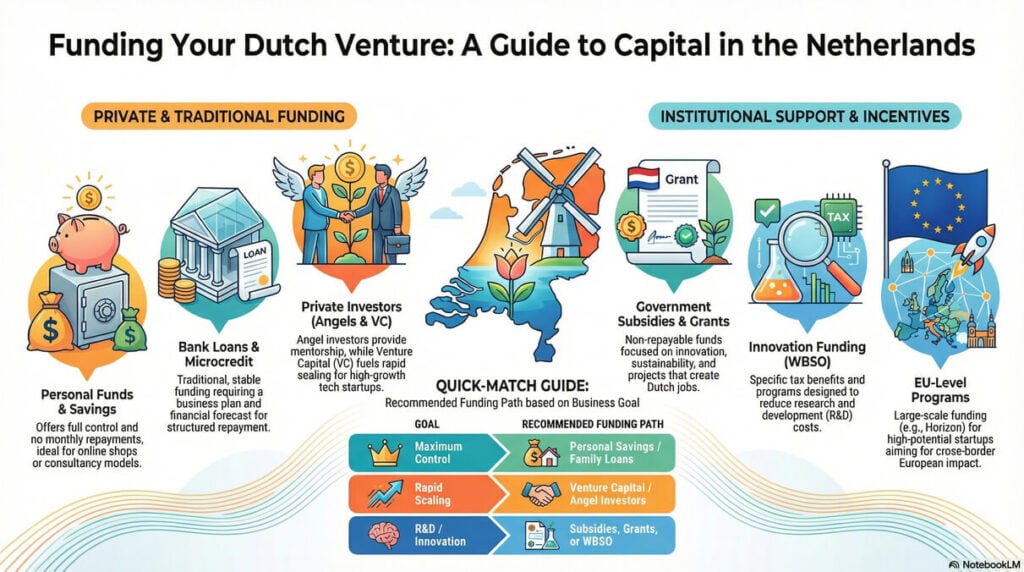
When you start a business, it’s important to know that there is never just one way to find money. In the Netherlands, entrepreneurs can choose from many different options to gain capital. These depend on factors such as their budget, business type, and generally how fast they want the company to grow. Some entrepreneurs start with their own savings if accessible, whilst others work with banks or investors, and many combine multiple sources of capital to build a strong financial foundation to feel and look stable. Below, you will find a small list of the most common funding options available for Dutch companies nowadays:
- Own savings or general personal funds
- Bank loans (including microcredit)
- Crowdfunding
- Angel investors
- Venture capital (VC)
- Subsidies and grants
- Innovation funding programs
- Leasing and supplier credit
- Friends & family loans
- EU-level funding programs
- Partnerships and strategic investors
- Startup incubators & accelerators (often combined with funding)
Some of these options are very accessible, even for small startups and first-time entrepreneurs. Others are more advanced and more suitable for fast-growing startups that want to scale quickly. What matters most for you, is choosing a type of capital that matches your business plan. So this doesn’t just entail the amount of money you need, but also other factors such as how much control you want to keep in your company. In the next part of this article, we will explain each option in simple language. You can read about how all options work, which one is best for whom, and how you can get started. This will help you understand which funding path fits your goals, your business idea, and your personal situation. With the right knowledge, gaining capital becomes much easier and less stressful this way.

Step-by-step: how each funding option works
If you want to know exactly what your options are, we strongly advise you to read about all possible funding options in general. In the past, the bank was probably your best bet. But since the internet and digitalization, the number of options has grown substantially, providing you with many more funding options than ever before. So for your convenience, we have included the most sought-after options below. This will make it possible for you to choose one or more options that fit your company type and ambitions in general.
- Personal funds or savings
In general, we always advise keeping loans to a minimum and rather using what you already have, since this will always save you from possible payment issues later on. So, using your own money is the easiest and fastest way to finance your business. There are no banks, no investors, no long paperwork trail, but just you taking the first step. Many Dutch businesses begin this way, even if it is only a small amount at first. It shows that you believe in your idea and are willing to invest in yourself. The benefit of this option is full control: you do not give away shares or need to make monthly repayments. Every euro you earn basically stays in your own company. This makes personal funding a great option for simple business models like online shops, consultancy, creative services, and small production.
The risk is that your savings are generally limited. This means that you must always be careful not to put yourself in financial danger. A good rule is to invest only what you can afford to lose in the beginning. Keep in mind that it is completely fine to start small and then eventually grow step by step. If you want, you can also later combine your personal funds with other forms of capital. One main advantage of starting with your own money is that it makes it easier to convince others to support you, because you have already shown discipline, initiative, and commitment.
- Bank loans and microcredit
Bank loans are one of the most traditional ways to fund a business and have existed for a long time. Dutch banks offer different products, mostly depending on what your company needs. For example, a larger business may ask for a regular company loan, while small entrepreneurs often start with something named a microcredit, which is a smaller loan that is specifically designed for new or growing companies. The main advantage of a bank loan is stability. You receive a clear amount of money up front and then pay it back each month with a certain amount of interest. This helps you with planning and budgeting well. You do need to realize that banks usually want to see a business plan, a financial forecast, and sometimes even a form of guarantee or collateral. This is because they just want to make sure your business can repay the loan.
For foreign entrepreneurs, it may take a bit more time to open a business bank account or show any kind of financial history. But with a strong plan and possibly also professional guidance, it is definitely a viable option. By the way, many entrepreneurs often combine a bank loan with other options such as leasing or subsidies to reduce risks. If you want to explore such options, it is smart to speak with an advisor who knows the Dutch banking system well, like Intercompany Solutions. We can help you choose the type of loan that fits your company’s stage and goals.
- Crowdfunding platforms
Crowdfunding is a modern and also very fun and democratic way to raise money. Instead of going to one bank or investor, you ask many people to support your business with small amounts. This generally happens online through special crowdfunding platforms. Supporters often can receive something like a reward, product, interest, or sometimes even shares in your company. Crowdfunding works especially well for businesses with a story, a creative idea, or a product that people get very enthusiastic about since this tends to pull people towards your idea. Furthermore, it is also a great way to test the market. Because if many people want to support your idea before it even exists, you know you are on the right path.
Keep in mind that with crowdfunding, the main challenge is marketing. You need to promote your campaign well, create a clear presentation, and obviously show why your project matters. Things like good photos, videos, and social media activity can make a big difference here. The big benefit? You not only receive money, but you also build a first group of fans and customers. They, in turn, help you spread the word and increase your credibility. Crowdfunding is easier when you already have a network, but even new entrepreneurs have succeeded by simply being creative and showing energy and passion.
- Angel investors
Another type of investor is the so-called angel investor. Angel investors are generally experienced businesspeople who use their own money to support promising startups. They mostly invest early on, when the business idea is still growing and therefore banks and other institutions are not ready to help yet. Angel investors can provide capital, but also other things like valuable knowledge, contacts, and mentorship. That support can save you time and help you avoid beginner mistakes. In return, angel investors usually receive shares in the company. This means they become part-owners and share in the success, once and if the business grows. Mainly for that reason, they want to see potential for strong growth within a few years. Angel investors often like innovative ideas, digital businesses, or otherwise unique products that can develop quickly.
To attract an angel investor, you will definitely need a clear pitch. This needs to contain elements such as what your company does, why it is special, and how it can make a profit. Note that a simple business plan and realistic strategy go a long way. Joining networking events, startup competitions, and online investor networks can help you meet the right person. Some entrepreneurs worry about losing control when they sell shares, but a good angel investor supports your vision, since they succeed only when you do. If the relationship feels like teamwork, it can be a great starting point and accelerator for your business.
- Venture capital (VC)
Venture capital is a type of capital that is most suitable for companies that already show strong potential and want to grow fast. VC funds typically invest larger amounts than angel investors, which can sometimes be hundreds of thousands or even millions of euros. This type of funding is quite common in sectors such as technology, life sciences, and other interesting innovative solutions that could become big in the European or global market. In exchange for the investment, VC funds generally take a certain percentage of the shares of the company and may also ask for involvement in decision-making. They want to help push the company toward rapid growth, which can be very exciting, but also very demanding. So, to achieve that, the business must grow quickly to meet expectations.
To work with a VC, you will definitely need more than a good idea. Factors such as a clear product or prototype, a defined market, and early customers are often required. You also need confidence and a strong pitch, because VC investors compare many opportunities at once. While venture capital is not for every company, it can also bring opportunities that would be impossible otherwise. With this type of major financial fuel, a business can expand its team, enter new markets, and become a serious player in the EU and beyond.
- Government subsidies & grants
The Dutch government actively encourages both national and foreign entrepreneurship, especially in areas like innovation, sustainability, energy efficiency, and sectors that create jobs. In order to support these goals, there are many interesting subsidies and grants available. The great part about this is that these funds do not have to be paid back, as they are considered financial support to help your business grow and not a loan in general. Some programs are available for very small companies, while others support larger projects. You might receive funding for developing a new product, buying cleaner equipment, hiring staff, or entering new markets. It all depends on your business activity and future goals.
It’s important to know that applying for such subsidies does require paperwork, sometimes a lot. You need to clearly explain your project and show how it benefits society or the economy to be able to have a chance. Many entrepreneurs, therefore, work with consultants or accountants who understand these rules and can assist with applications. This significantly increases your chance of success. Subsidies are a fantastic way to reduce risks in your business. They help you experiment and innovate without carrying the full financial burden. If your idea has a positive impact, there is a good chance the Dutch government, or even the EU, will want to support it.
- Innovation funding
The Netherlands is known for innovation, and the government actively supports companies developing new technologies or smarter ways of working. Innovation funding programs are designed to help reduce research and development costs. A well-known example is the WBSO, which offers tax benefits for companies working on technical innovation or software development. There are also national and regional programs that support sustainability, digital transformation and other modern business fields. The advantage is that these programs can give you more financial space to experiment and develop products before they even reach the market.
To apply, you generally need a clear description of what you are creating or building and why it is new or improved. It doesn’t have to be complicated, just mainly specific. Many foreign entrepreneurs are surprised by how supportive the Dutch system is when your idea actually brings innovation to the country. Keep in mind that innovation funding does not usually cover all your costs, but it can lower them enough to make your idea actually realistic. It’s a great option for tech startups and companies with long(er) development timelines.
- Leasing and supplier finance
Not every business needs money in the bank, because sometimes what you really need is access to things like equipment or materials. The option of leasing allows you to use tools, machines, or vehicles and pay for them over time instead of buying them all at once. The main benefit of leasing is that it keeps your capital free for other needs like marketing or hiring. Supplier credit works in a similar way. A supplier delivers goods now, and you then pay later once your customers have paid you. This can be very helpful for companies that need stock or raw materials to get going, since it reduces financial pressure in the first months of trading.
Note that both of these methods highly depend on trust. Suppliers or leasing companies always want to see that your business is reliable. So, owning a Dutch company and having a proper administration already helps build that trust. With good agreements, leasing or supplier credit can be a smart and flexible path to growth, especially for small businesses.
- Friends, family, and community loans
Sometimes the best support comes from the people who already believe in you, who are generally amongst friends and family. For example, a small loan from someone you trust can help you get started quickly without any issues such as complex applications or high interest rates. This is actually a very common first step for new entrepreneurs around the world. The most important rule? Keep everything clear and written down from the start to avoid misunderstandings later on. Make sure to agree on the amount, the repayment terms, and what happens if things don’t go exactly as planned. A simple contract avoids problems and protects your relationships at the same time.
This kind of funding works best when the amount needed is small and the business will start earning money soon. Do note that, even if the loan is small and informal, showing professionalism makes everyone feel comfortable and confident. If you make sure this happens, then your friends’ or family’s trust can be the spark that gets your Dutch business moving.
- EU-level funds
The European Union offers several funding programs to help businesses grow, especially those that bring innovation, sustainability, or cross-border cooperation. This is similar to innovation funds provided by the Netherlands. These funds are designed to strengthen the European economy as a whole, so companies in the Netherlands can benefit greatly from them. Some well-known examples include programs like Horizon, which is mainly for research and innovation, and the EIC Accelerator, which is for high-potential startups specifically. EU funding can actually be quite powerful, sometimes covering large development costs or helping a business enter new European markets faster than you’d have thought.
However, the application process can take a lot of time and also requires a strong business plan. You must be able to show that your idea has any form of impact beyond just one country. For foreign entrepreneurs setting up in the Netherlands, EU programs can be an amazing opportunity to scale. Working with advisors who understand these applications improves your chances and makes the process easier. If you dream big, EU funding may be the perfect match for your ambitions.
- Strategic partnerships
In some cases, a solid investment can come from a (future) partner who sees potential in working with you. For example, a strategic investor can be a larger company, a manufacturer, or a distribution partner who also benefits when your business succeeds. They may offer not only capital but also other valuable factors such as knowledge, production capacity, or access to established customers. This type of funding can be extremely valuable because you are not only getting money: you are building a long-term relationship together towards something big.
Next to that, the right partner can open doors that are difficult to open alone. Imagine collaborations like a food startup partnering with a supermarket chain, or a tech company that might collaborate with a bigger software platform. Of course, this kind of partnership must always be built on trust and shared goals. Make sure to draft clear agreements that protect both sides, and hire a lawyer who can help with the legal details. If you find a partner who believes in your idea and wants to grow together, it can definitely become a win-win situation.
- Incubators and accelerators
Last but not least, there are also so-called incubators and accelerators. Startup incubators and accelerators basically help young businesses grow faster from the start. They often combine a small amount of funding with things like coaching, office space, workshops, and full access to a strong network of experts and investors. Accelerators usually run short, intensive programs, while incubators support companies for a longer period of time. These programs are especially useful for entrepreneurs who need some form of guidance and want to build meaningful connections in the Dutch startup community.
This type of investment is very broad, as you can learn from experienced mentors, meet other founders, and sometimes pitch your idea to investors at the end of the program. To join, you usually apply with a clear idea or a working prototype. The organizers mainly choose startups with strong growth potential and a motivated team. Incubators and accelerators can be the perfect stepping stone if you’re new to the Netherlands and want fast access to the right people.
A short but handy funding readiness checklist
Before applying for any type of funding, it helps to show that your business is well-prepared. Banks, investors, and even friends want to feel confident that you have thought through your idea. The more prepared you are, the easier it becomes to receive support. Here is a short checklist to help you get ready:
- Generate a clear business idea
Can you explain in one or two sentences what you offer and who your customers are?
- Create a basic financial plan
How much money do you need, and what will you use it for? When do you expect to earn your first income?
- Make sure you choose a professional company structure
A registered Dutch business (usually a BV) builds trust and shows long-term commitment.
- Show that you understand your market
Who are your competitors? What makes your product or service different?
- Very important: make sure you show strong motivation
Are you ready to work hard, stay flexible, and keep going even when things take longer than expected?
You do not need everything to be perfect. Most entrepreneurs start small and improve along the way. But being able to answer these simple questions already puts you ahead of many others. It shows you are serious, focused, and ready to turn your idea into a real business. Once these points are in place, you are in a strong position to approach banks, investors, or any other funding source with confidence. A prepared entrepreneur leaves a professional impression, and professional impressions generally open plenty of doors.
What to do when you can’t acquire capital for your startup?
Not every business starts with a big budget, and that’s okay. Many successful entrepreneurs actually begin with very little money, especially now that you can start online companies quite easily with minimum funding. If traditional funding is difficult to obtain, you still have options to move forward and build your company step by step. One interesting way to move forward is to choose a business model that requires low upfront costs. As we briefly mentioned before, digital services are a great example: think of consulting, graphic design, online coaching, content creation, or IT support. These niches usually need only a laptop and internet connection. You can start earning money first, and invest more later. Another option is dropshipping or print-on-demand. You sell products online, but a supplier handles things like storage and shipping. That means you don’t need money for stock. This can be a simple way to test what customers like before putting in more investment.
Creative businesses can also grow from home: baking, crafts, jewelry, photography, or personal training. You begin small with friends, neighbors, or local markets and expand when sales increase. Just remember to check local rules if you make food or offer physical services. If you have a bigger idea that needs capital, make sure you don’t give up. For example, you can build a smaller version first, like a minimum viable product, and show that it works. Once you already have customers, it becomes much easier to convince banks or investors later. Starting small is not a weakness; it is a strategy. Step by step, your business can build strength, reputation, and financial stability until the moment you are ready to scale up confidently.
How we can establish your Dutch business in just a few days
Building a business in a new country can feel overwhelming at first. You have ideas, motivation, and a vision, but there is also paperwork, tax rules, registrations, and financial planning to take care of. That’s where our company comes in. We help foreign entrepreneurs establish a strong and trusted presence in the Netherlands from day one. A Dutch BV can already be registered with only €1 of share capital since the implementation of the Dutch Flex-BV, making it simple and affordable to start your company. Even if you are still working on funding. You do not need a large investment up front to show professionalism and credibility.
Our goal is to make everything smooth and clear for you so you can focus on your customers and general company growth. Whether you need help finding the right financing program, preparing documents for a bank, or simply understanding what to do next, we’re here to support you. Starting a Dutch company does not have to be difficult. With the right team on your side, the European market becomes a real opportunity, and your business can take its first steps with confidence.
The many services we can offer you
Intercompany Solutions has assisted hundreds of foreign entrepreneurs from over 50 different nationalities. Our clients range from small one-person startups to multinational corporations and everything in between. Our processes are aimed at foreign entrepreneurs, and, as such, we know the most practical ways to assist with your company registration. We can assist with the full package of company registration in the Netherlands, either ourselves or via trusted and professional partners we work closely with:
- Company establishment in the Netherlands
- Application for a VAT or EORI number
- Application for foreign VAT numbers
- Startup assistance
- Accounting services
- Administrative services
- Secretarial services
- Legal assistance
- Payroll administration
- Tax services
- OSS returns
- Intra-Community transactions declarations (ICP)
- Acquiring an Article 23 license
- Obtaining E-herkenning for your company
- Acquiring or closing G-accounts
- Transfer of shares
- Dutch company closures
- General business advice
We are constantly improving our quality standards to continually deliver impeccable services.
How Intercompany Solutions can assist you with all Dutch business matters
We have many years of experience with the establishment of Dutch companies. We have worked with a very wide variety of foreign entrepreneurs, ranging from small, unique startups to already existing companies and large multinationals. If you need funding for your company, we can definitely point you in the right direction. We have a vast network of professionals in the field, and we can also assist you with any tax-related matters when it comes to loans and subsidies. Please feel free to contact us if you are interested in opening a Dutch business. We will gladly help you to start strong and make sure you know what you are doing.
Similar Posts:
- Foreign multinational corporations & the Netherlands annual budget
- Want to innovate in the green energy or clean tech sector? Start your business in the Netherlands
- Tax treaty denounced between the Netherlands and Russia per January the 1st, 2022
- How to set up a business as a young entrepreneur
- The challenges of starting entrepreneurs