


September 7, 2026 · 18 min read
Establishing a European business presence in 2026 no longer requires the logistical burden of international travel or the exhaustion of physical appointments. While many founders assume that online company registration Netherlands requires a local digital ID or a physical visit, the professional standard for non-residents remains the legalized Power of Attorney route. This mechanism allows a civil-law notary to execute the deed of incorporation on your behalf, ensuring full legal substance without the high costs of travel or the complexities of local language barriers. It's a method that provides an efficient entry point into the EU Single Market while maintaining strict compliance with Dutch regulatory standards.
You likely recognize that the administrative hurdles of cross-border expansion often outweigh the initial market opportunities. This guide provides a technical comparison of European jurisdictions for remote business setup, focusing on tax efficiency, legal mechanisms, and the 2026 compliance landscape. We'll examine the Corporate Income Tax structure where rates are 19% on profits up to €200,000, and detail the transition of the Dutch Tax Administration to Rabobank as its house bank since 1 May 2026. By understanding these procedural requirements for Dutch BV company formation, including the €85.15 KVK registration fee, you can establish a functional European entity that benefits from the Netherlands' position as the 8th most competitive economy globally.
Key Takeaways
- Establish a European entity remotely using the legalized Power of Attorney route, which allows a civil-law notary to execute the incorporation deed without requiring the founder to travel.
- Understand the 2026 fiscal framework, including the 19% Corporate Income Tax rate for profits up to €200,000 and the Belastingdienst transition to Rabobank for all tax-related payments.
- Evaluate how online company registration Netherlands provides access to a network of approximately 100 double-taxation treaties and a 2-5 business day formation process.
- Manage mandatory transparency requirements by registering Ultimate Beneficial Owners with an interest exceeding 25% and reporting any changes within seven days.
- Prepare for administrative obligations such as the one-time €85.15 KVK registration fee and the legal requirement to retain corporate records for a minimum of seven years.
Table of Contents
Mechanisms of Remote Company Incorporation in Europe
Remote company incorporation in Europe allows founders to establish legal entities without a physical presence in the target country. This procedural flexibility is essential for international trade and technology firms looking to enter the EU Single Market. For those pursuing online company registration Netherlands, the process is governed by specific notarial requirements. Unlike simpler structures like the eenmanszaak or VOF, which do not require a notary, a Dutch Besloten Vennootschap (BV) requires a civil-law notary to execute the deed of incorporation. This ensures the company is formed according to strict legal standards while the founder remains abroad.
The legal framework for remote setup varies between jurisdictions. While some nations promote purely digital solutions, these often come with limitations regarding residency or banking access. The Dutch system prioritizes a balance between remote accessibility and legal certainty through the notary-led Power of Attorney process. This mechanism provides a clear path for non-resident entrepreneurs to secure a robust corporate structure without the need for international travel.
The Power of Attorney (PoA) Route
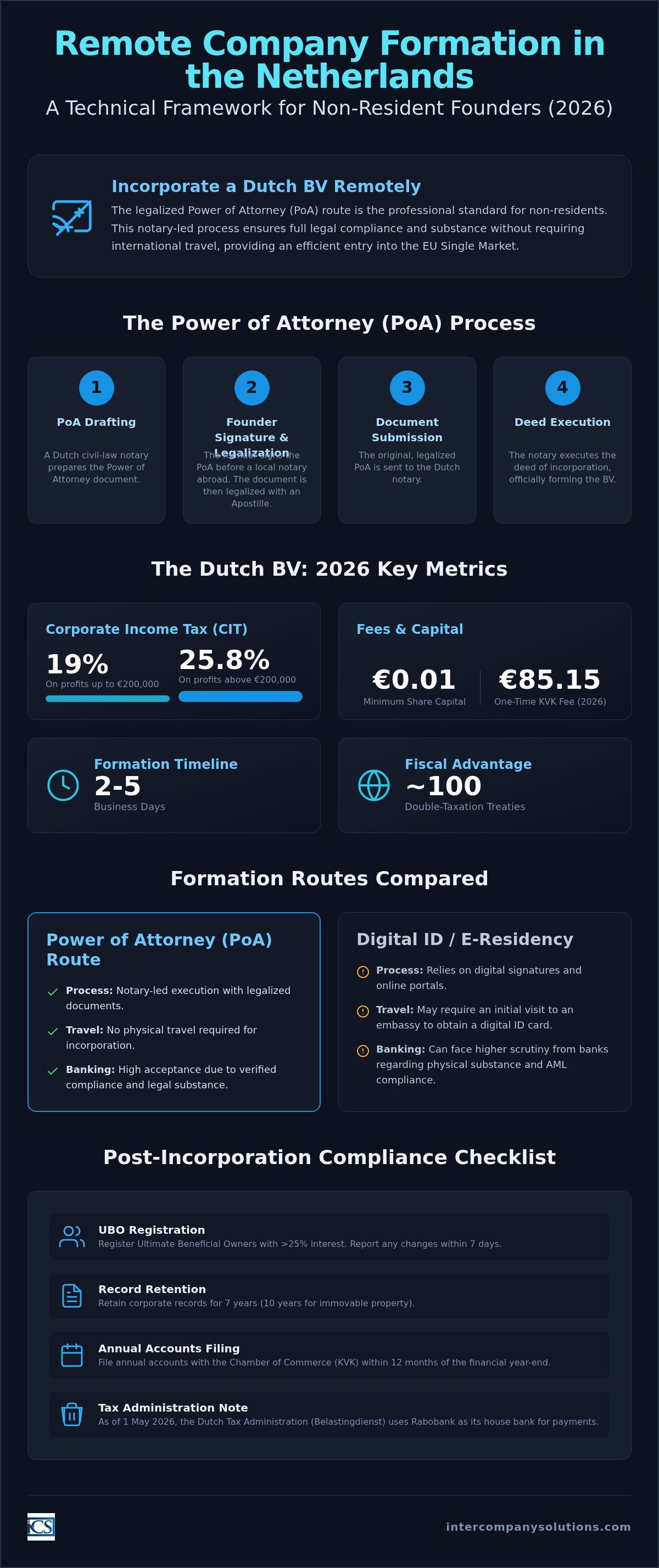
The PoA route is the standard method for Netherlands business registration when the founder is located outside the country. The process begins with the preparation of a Power of Attorney document by a Dutch notary. The founder signs this document in their country of residence before a local notary. To be valid in the Netherlands, the document usually requires an Apostille or embassy legalization. This step confirms the authenticity of the signature and the local notary's authority for use in a foreign jurisdiction.
Once the legalized original document reaches the Netherlands, a local representative executes the deed of incorporation. This method satisfies the legal requirement for forming a BV, which has a minimum capital requirement of €0.01. It's a structured path that avoids travel costs and time commitments. Founders should also account for the one-time KVK registration fee of €85.15 in 2026. This fee is paid during the initial registration at the Chamber of Commerce, typically alongside the formal execution of the deed.
Digital IDs and E-Residency Frameworks
When evaluating options for online company registration Netherlands, founders often compare the PoA route with digital ID frameworks. Digital e-Residency programs, such as the one in Estonia, allow for digital signatures but often require a physical visit to an embassy to collect a digital ID card. For many non-EU founders, this creates an initial logistical hurdle that the PoA route bypasses. Additionally, purely digital routes often face higher scrutiny from banks regarding physical substance and tax residency.
Financial institutions frequently require evidence of local management to comply with Anti-Money Laundering (AML) regulations. In the Netherlands, the involvement of a civil-law notary in the PoA process provides a layer of verified compliance that banks recognize. This difference in filing security is a critical factor for entrepreneurs. This structure is also beneficial for future fiscal operations, as the Dutch Tax Administration (Belastingdienst) has used Rabobank as its house bank since 1 May 2026. Choosing a recognized legal route simplifies these subsequent administrative and banking transitions.
Comparative Analysis of Top European Jurisdictions 2026
Selecting a European jurisdiction for expansion requires a balance between initial setup speed and long-term fiscal stability. For 2026, the Netherlands remains a primary choice for entrepreneurs due to its 2-5 business day turnaround for remote Dutch BV formation. While Estonia continues to lead for low-complexity digital startups, it lacks the extensive tax treaty depth found in larger commercial hubs. Ireland and the UK offer common-law frameworks, but post-Brexit regulatory shifts have created different levels of EU market access that founders must account for. Many international founders prioritize online company registration Netherlands because it combines rapid entry with full, unhindered access to the EU Single Market.
Taxation and Maintenance Costs
Fiscal efficiency varies significantly across the continent, particularly regarding Corporate Income Tax (CIT) structures and capital requirements. The Dutch CIT rate is 19% on taxable profits up to €200,000 and 25.8% on any amount exceeding this threshold. This tiered system is often more favorable for growing companies than the micro-company regimes in Romania, which have undergone recent changes to employment requirements. Maintenance costs in the Netherlands are predictable; the one-time KVK registration fee for 2026 is €85.15. A major advantage for the Dutch BV is the minimum share capital requirement of only €0.01, whereas a German GmbH requires a minimum of €25,000. This lower barrier to entry allows for more efficient capital allocation during the startup phase.
Administrative and Language Accessibility
Language barriers frequently create administrative delays for non-resident directors. The Netherlands reports a 93% English proficiency rate, which facilitates direct and clear interaction with the Belastingdienst (Tax Administration) and the KVK (Chamber of Commerce). This level of accessibility is rarely matched in other European hubs like Germany or France, where official correspondence is typically conducted in the local language. For foreign-owned entities, VAT application timelines generally span 6 to 8 weeks, making English-language support from legal and accounting professionals essential for maintaining compliance. Since 1 May 2026, the Belastingdienst has used Rabobank as its house bank, and all corporate tax payments must be directed accordingly.
Managing these cross-border variables requires precise data and local expertise. If you have specific questions about how these regulations apply to your residency status, you can request a consultation with a specialist to review your case. Establishing a robust entity today ensures your business is prepared for the evolving regulatory landscape of the next decade.
Tax Treaty Networks and Fiscal Compliance
International entrepreneurs who complete the online company registration Netherlands process gain access to one of the most comprehensive tax treaty networks in Europe. The Netherlands maintains approximately 100 double-tax-avoidance treaties, which provide a clear framework for managing tax residency and permanent establishment risks. These agreements are essential for businesses operating across multiple jurisdictions, as they prevent the same income from being taxed in two different countries. This legal certainty is a significant factor in the OECD analysis of the EU Single Market, which highlights the importance of standardized fiscal cooperation for cross-border trade.
For remote companies, profit repatriation often depends on withholding tax rates, which vary across European hubs. The Dutch framework focuses on facilitating international investment by reducing these barriers. This approach ensures that a Dutch BV remains a viable vehicle for global operations, provided the entity maintains sufficient local substance to satisfy treaty requirements and anti-abuse regulations. Proper planning is required to ensure that the remote management of the company doesn't inadvertently create tax liabilities in the founder's country of residence.
The Dutch Participation Exemption
The participation exemption is a specific mechanism designed to eliminate double taxation on corporate profits within a group. Under this rule, dividends and capital gains derived from a subsidiary are exempt from Dutch corporate income tax at the level of the holding company. To qualify for the Dutch participation exemption in 2026, the parent company must hold at least 5% of the nominal paid-up share capital of the subsidiary. This exemption applies regardless of whether the subsidiary is located in the Netherlands or abroad, provided the subsidiary is not held as a passive portfolio investment. It's a vital tool for international holding structures seeking to consolidate profits efficiently.
VAT and EORI Registration for Remote Entities
Once the online company registration Netherlands is finalized, the entity must apply for a VAT number through the Belastingdienst. Standard VAT rates are 21%, while a 9% rate applies to specific goods and services. For foreign-owned entities, the Netherlands VAT registration timeline typically takes 6-8 weeks. If the company intends to import or export goods outside the European Union, an Economic Operators Registration and Identification (EORI) number is also mandatory for customs clearance.
Compliance remains a continuous obligation for the company. All VAT and Corporate Income Tax (CIT) payments must be directed to Rabobank, which has served as the Belastingdienst house bank since 1 May 2026. Companies are legally required to retain their administrative records for 7 years. For companies owning immovable property, this retention period extends to 10 years to meet specific Dutch tax audit standards. Annual accounts must also be filed with the KVK within 12 months of the financial year-end to avoid administrative penalties.
Post-Incorporation Compliance and Administration
Completing the initial steps for online company registration Netherlands shifts the focus toward ongoing legal and fiscal maintenance. Maintaining a Dutch BV requires a structured approach to compliance to avoid penalties or the loss of good standing. These obligations are rooted in both local Dutch law and broader EU Anti-Money Laundering (AML) directives, which emphasize transparency and regular financial reporting. For non-resident founders, these processes are manageable through remote systems, provided that deadlines are strictly monitored.
The UBO Register and Reporting Deadlines
Transparency regarding company ownership is a mandatory requirement in the Netherlands. Any individual who holds more than 25% of the shares, voting rights, or ownership interest is classified as an Ultimate Beneficial Owner (UBO). Since the implementation of EU-wide transparency rules, all UBOs must be registered in the Trade Register managed by the KVK. In 2026, access to this register is restricted to competent authorities and "obliged entities" such as banks and notaries to protect owner privacy while maintaining regulatory oversight.
Accuracy in these records is vital. You must report any UBO changes to the KVK within 7 days of the change becoming effective. Administrative fines for non-compliance can be significant, often starting at several thousand euros for repeat omissions. Alongside ownership reporting, the company must file its annual accounts with the KVK within 12 months of the financial year-end. This filing provides the necessary transparency for creditors and tax authorities regarding the entity's financial health.
Banking and Financial Connectivity
Securing a corporate bank account is a critical post-incorporation step that often presents challenges for non-residents. While many entrepreneurs utilize fintech platforms for daily operations, establishing a relationship with a traditional Dutch bank remains beneficial for complex international trade. The Belastingdienst has used Rabobank as its house bank since 1 May 2026. All tax-related payments, including Corporate Income Tax (CIT) and VAT, must be directed to these Rabobank accounts to ensure timely processing.
Effective financial management relies on robust accounting for Dutch BV operations. Companies are legally required to retain their administrative records, including all invoices, bank statements, and contracts, for 7 years. This period extends to 10 years for documents related to immovable property. Utilizing digital accounting systems allows founders to meet these retention requirements while managing the business from abroad, ensuring all data is available for potential audits by the Dutch Tax and Customs Administration.
The Strategic Advantage of the Netherlands for Remote Setup
The Netherlands consistently secures its position as a top-tier global business hub. According to the 2025 WIPO Global Innovation Index, the country ranked 8th globally, a reflection of its robust infrastructure and supportive corporate environment. For international entrepreneurs, online company registration Netherlands represents more than just an administrative step; it's a strategic entry into a market built for tech and trade. Choosing the remote route for starting a business in the Netherlands allows founders to leverage these advantages without the immediate need for local relocation.
Innovation and Human Capital
The country's human capital is a significant asset, with a global ranking of 3rd for education levels. This provides a deep pool of skilled professionals for firms expanding their operations. The digital infrastructure is among the most advanced in Europe, anchored by the AMS-IX internet exchange. This connectivity supports high-growth firms in scaling their operations across the continent. To manage these teams effectively from abroad, many founders utilize specialized payroll services to ensure compliance with local labor laws and social security contributions. The 30% tax reimbursement ruling also offers a competitive edge for attracting international talent, provided specific salary and expertise criteria are met.
Reliability of the Dutch Legal System
Furthermore, as companies look to maximize the potential of this digital infrastructure, many are turning to AI-driven automation. Navo Inc. provides specialized GenAI consulting and coaching for synthetic workforce development, helping international firms deploy AI agents that can scale operations efficiently across the European market.
To complement this advanced infrastructure, many tech-driven companies partner with developers like Larasoft to create the bespoke, high-performance Laravel and React applications required for their European operations.
Predictability is a cornerstone of the Dutch business landscape. The legal system provides a stable foundation where business laws are applied consistently, reducing the risks associated with international expansion. The efficiency of the Chamber of Commerce (KVK) and the Tax and Customs Administration (Belastingdienst) reduces administrative friction. Unlike digital-only e-Residency programs which may lack legal substance in complex tax scenarios, the legalized PoA route used for online company registration Netherlands ensures full regulatory compliance. This method involves a civil-law notary, providing a verified legal pedigree that is often required by financial institutions and large-scale corporate partners.
This stability is reinforced by clear fiscal rules. Corporate Income Tax (CIT) is set at 19% for profits up to €200,000 and 25.8% for amounts above that. With the Belastingdienst using Rabobank as its house bank since 1 May 2026, the procedural flow for tax compliance is streamlined. Maintaining records for 7 years and filing annual accounts with the KVK within 12 months of the year-end are standard practices that uphold the integrity of the entity.
Last reviewed: September 2026
Establishing Your European Commercial Foundation
The transition to a European corporate structure requires a balance between remote accessibility and rigorous legal compliance. Utilizing the legalized Power of Attorney route ensures that your Dutch BV is established with full legal substance, satisfying both notarial requirements and the transparency standards of the UBO register. By completing the process for online company registration Netherlands, you position your firm within a jurisdiction that offers a network of 100 tax treaties and direct access to the EU Single Market.
Operational success is supported by a predictable regulatory framework. This includes managing corporate records for the mandatory seven-year period and directing all tax-related payments to Rabobank, the official house bank of the Belastingdienst since 1 May 2026. We've served over 2,000 founders worldwide and provide a 24-hour response time to all inquiries. Our commitment to procedural clarity and a 100% satisfaction guarantee ensures that your international expansion remains efficient and legally sound.
We look forward to facilitating your entry into the Dutch market. Last reviewed: September 2026
Frequently Asked Questions
Can I incorporate a company in Europe without visiting the country?
Yes, you can incorporate a company remotely through the legalized Power of Attorney route. This process involves signing the necessary documents before a local notary in your home country and having them legalized with an Apostille. A local representative then executes the deed of incorporation on your behalf. This method is the professional standard for non-resident founders who want to establish a legal entity without the logistical burden of international travel.
What is the minimum share capital for a Dutch BV in 2026?
The minimum share capital for a Dutch BV is €0.01. This low requirement was established to facilitate entrepreneurship and reduce the initial financial barriers for new businesses. While you can choose to issue more capital, the legal minimum remains a nominal amount. This flexibility allows founders to allocate their resources toward operational growth rather than tied-up capital. It represents a significant structural advantage for international investors who prioritize efficient capital allocation during the initial formation phase.
How long does remote company registration take in the Netherlands?
The online company registration Netherlands process typically takes between 3 and 5 business days once all legalized documents are received. This timeline includes the execution of the deed of incorporation by a civil-law notary and the subsequent registration with the Chamber of Commerce (KVK). While the formation itself is rapid, founders should account for an additional 6 to 8 weeks for the tax authorities to issue a VAT number for foreign-owned entities and finalize the fiscal setup.
What are the corporate tax rates for remote companies in Europe?
In the Netherlands, the Corporate Income Tax (CIT) rates for 2026 are 19% on taxable profits up to €200,000 and 25.8% on any profits exceeding that threshold. These rates apply to all Dutch BVs, regardless of whether the directors are managed remotely. Additionally, the Netherlands offers a participation exemption that can provide tax-free dividends for qualifying holding structures. All tax payments are directed to Rabobank, the house bank for the Belastingdienst since 1 May 2026.
Is a local director required for a remote European company?
A local Dutch director is not a legal requirement for incorporating a Dutch BV. You can serve as the sole director and shareholder while residing abroad. However, maintaining local substance is often necessary to access the extensive network of double-taxation treaties and to satisfy the compliance requirements of financial institutions. While a local director isn't mandatory for registration, it's a strategic consideration for companies seeking deep integration into the European financial system and long-term regulatory stability.
How do I register as a UBO for a remote Dutch company?
You register as an Ultimate Beneficial Owner (UBO) during the initial company registration with the KVK. Any individual holding more than 25% of the shares or voting rights must be included in the UBO register. This process is handled remotely as part of the incorporation paperwork. If ownership changes occur after the online company registration Netherlands is complete, you must report these updates to the KVK within 7 days to maintain legal compliance and transparency.
What documents are required for the legalized Power of Attorney route?
The required documentation includes a valid form of identification, such as a passport, and a completed formation checklist. The core document is the Power of Attorney (PoA), which must be signed in the presence of a local notary and legalized with an Apostille or embassy legalization. For corporate shareholders, additional documents like an extract from the foreign trade register and the company's articles of association are necessary to verify the authority of the signing representative.
Sources
- ICS Payroll - Dutch payroll services
- KVK - Registering with the Dutch Business Register
- Business.gov.nl - Private limited company (bv)
- Burgerlijk Wetboek Boek 2 (Dutch Civil Code, legal entities)
- Rijksoverheid - Ondernemen
- Belastingdienst - Corporate income tax rates
- Belastingdienst - Payroll taxes (loonheffingen)
- UWV - Employer obligations
- SVB - Social insurance in the Netherlands
- Belastingdienst - VAT (btw) for entrepreneurs
- European Commission - VAT rules and rates
- De Nederlandsche Bank - Supervision
- AFM - Licences and registers
- BOIP - Trademark registration in Benelux
- WIPO - Madrid System
- RVO - Doing business internationally
- Belastingdienst Douane - Customs
- CJEU, Cadbury Schweppes, C-196/04 (ECLI:EU:C:2006:544)
- Hoge Raad, ECLI:NL:HR:2021:1152
- PwC Worldwide Tax Summaries - Netherlands
- ICLG - Corporate Governance Laws and Regulations, Netherlands
Need more information on the Dutch BV company?
Contact an expertReady to start your company in the Netherlands?
| Formation time | Dutch BV formation completed in 3 to 5 business days |
|---|---|
| Process | Fully remote setup with step-by-step guidance |
| Compliance | Expert support for registration, VAT and compliance |
| Aftercare | Accounting, tax and legal support included |
| One partner | All of the above through one trusted formation partner |