


By Intercompany Solutions, Intercompany Solutions
Published August 17, 2026
All blog posts are reviewed and fact checked by our labour law lawyer Zishan Hussain and our director.Editorial standards
August 17, 2026 · 16 min read
Foreign companies often assume they can delay tax compliance until they reach a specific revenue milestone, but in the Netherlands, the registration threshold for non-resident entities is exactly €0. This means that Netherlands VAT registration for foreign companies is mandatory from the moment taxable activities begin. Meeting these requirements is often complicated by the necessity of physical mail submissions to the Belastingdienst in Heerlen and the potential for language barriers with the tax authorities.
Ensuring 100% compliance from abroad requires precision and a clear understanding of Dutch tax law. This guide serves as a technical resource for non-resident businesses, detailing the statutory requirements, application procedures, and filing obligations for 2026. You'll find specific information on obtaining your btw-id, the €85.15 KVK registration fee, and the management of remote filing. Following these steps helps you secure the necessary tax numbers while avoiding the risk of administrative penalties.
Key Takeaways
- It's mandatory for foreign entities to register for Dutch VAT before starting operations, as the €0 threshold applies to all non-resident businesses.
- Successful applications require specific documentation, including a legalized commercial register extract from your home country that's less than six months old.
- This guide outlines the step-by-step process for Netherlands VAT registration for foreign companies, including how to handle the physical mailing requirements.
- Compliance involves filing quarterly returns by strict deadlines and maintaining business records for a statutory period of seven to ten years.
- Professional accounting and tax services can facilitate your remote application and ensure 100% adherence to the latest Dutch tax regulations.
Criteria for Mandatory VAT Registration in the Netherlands
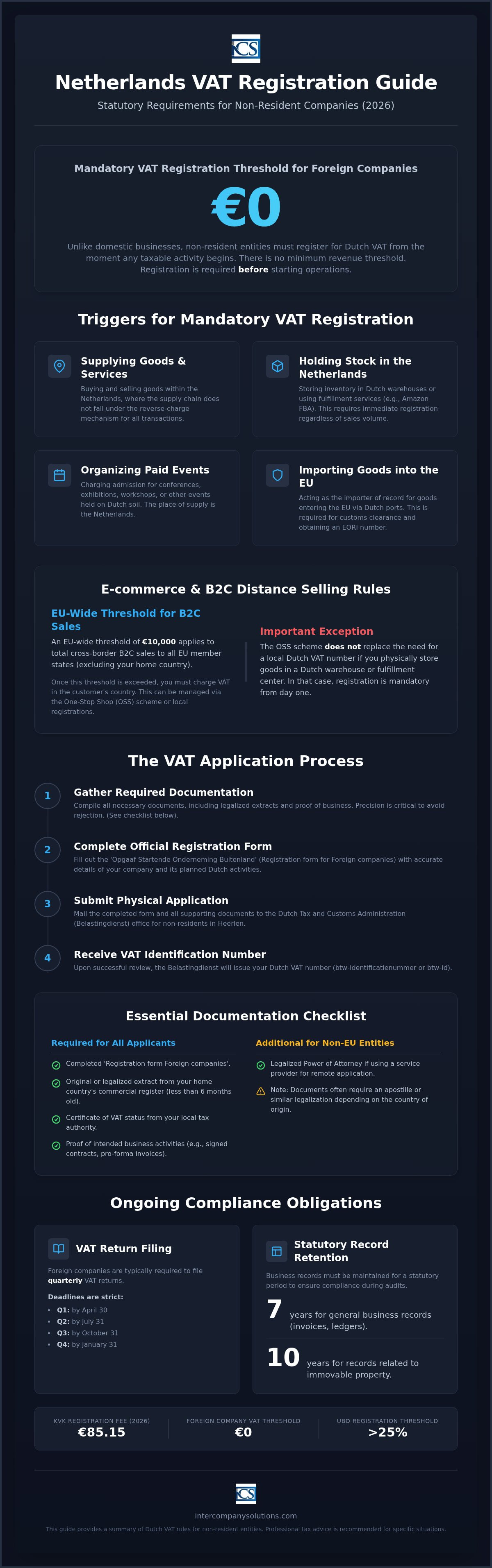
The Dutch tax administration applies strict rules for non-resident businesses. While Dutch-established companies might qualify for certain exemptions based on turnover, Netherlands VAT registration for foreign companies is mandatory from the first euro of taxable income. There's no minimum turnover threshold for non-resident entities. You must complete your registration before you commence any taxable operations within the country. This ensures you're aligned with the Dutch VAT system overview from the outset, which is a vital compliance step when starting a business in the Netherlands.
Even if your transactions fall under the "Reverse Charge" mechanism, where the VAT liability shifts to your Dutch business customer, you often still require a VAT number. This is necessary for proper reporting on your periodic returns and for reclaiming any VAT paid on Dutch costs, such as logistics or professional fees. If your company acts as the importer of record for goods entering the European Union via Dutch ports like Rotterdam, a VAT registration is essential. This process is typically linked to obtaining an EORI number, which is required for customs clearance. Non-EU companies often find that obtaining a VAT number is the first step toward optimizing their supply chain through the use of deferment licenses.
Taxable Activities for Foreign Entrepreneurs
Specific business models trigger an immediate requirement for a Dutch VAT number. If you buy and sell goods within the Netherlands where the supplier is not a Dutch entity, you're performing a taxable supply. Another common trigger is holding stock in Dutch warehouses or fulfillment centers. For example, sellers using Amazon FBA who store inventory in a Dutch facility must register for VAT regardless of their total sales volume. Additionally, if your company organizes paid admission events, such as conferences, exhibitions, or workshops on Dutch soil, the place of supply is the Netherlands, necessitating a local registration.
E-commerce and the OSS Threshold
For businesses engaged in distance selling to Dutch consumers, different rules apply depending on your location and logistics setup. There's an EU-wide threshold of €10,000 for B2C sales. Once your total sales to all EU countries, excluding your home country, exceed this amount, you must account for VAT in the customer's country. You can manage this via the One-Stop Shop (OSS) scheme or through individual local registrations. However, if you're a non-EU seller using a Dutch fulfillment hub, you must obtain a local VAT number immediately. The OSS scheme simplifies reporting for cross-border sales, but it doesn't replace the need for a local Netherlands VAT registration for foreign companies if you maintain physical inventory in a Dutch warehouse.
Essential Documentation for Non-Resident VAT Applicants
The Dutch tax administration requires a high level of documentary precision when processing applications from abroad. To initiate Netherlands VAT registration for foreign companies, you must submit the 'Registration form Foreign companies' (Opgaaf Startende Onderneming Buitenland). This document collects data on your expected turnover, the nature of your Dutch operations, and your company's global structure. Accuracy at this stage is vital; the Belastingdienst uses these details to determine your filing frequency and whether you require a fiscal representative.
You're required to provide several supporting documents alongside the primary form. These include an original or legalized extract from your home country's commercial register, which shouldn't be older than six months. You must also provide a certificate of VAT status from your local tax authority to prove you're a registered business in your country of establishment. The authorities often request proof of intended business activities to verify the VAT registration process for foreign entities. This evidence typically consists of signed contracts with Dutch clients, pro-forma invoices, or transport documents showing the movement of goods into the Netherlands.
Requirements for EU vs. Non-EU Entities
The documentation phase is the most common point of failure for Netherlands VAT registration for foreign companies due to missing legalizations. If your company is established outside the European Union, you'll need to provide a legalized Power of Attorney if you choose to work with a service provider like Intercompany Solutions. This allows us to manage the application on your behalf. Documents from non-EU countries must typically carry an Apostille or undergo consular legalization. If your corporate documents aren't in Dutch, English, German, or French, you must provide a translation by a sworn translator. You're also required to disclose any Ultimate Beneficial Owner (UBO) who holds more than 25% ownership or control in the company.
Bank Account and Physical Address Rules
While you don't always need a Dutch bank account to obtain a VAT number, the tax authorities generally require one to issue VAT refunds. Without a local IBAN, receiving credit from the Belastingdienst can be a lengthy process. You should also distinguish between a registered office and a permanent establishment. A registered office is a mailing address for compliance, whereas a permanent establishment involves a physical location with human and technical resources. Using a permanent establishment can change your status regarding Corporate Income Tax (CIT). This could subject your Dutch profits to CIT rates of 19% up to €200,000 and 25.8% above that threshold. If you're unsure about the legalization status of your specific documents, you can reach out for a document review.
The Step-by-Step VAT Application Process for Foreign Entities
The process for Netherlands VAT registration for foreign companies begins with obtaining the official 'Registration form Foreign companies' from the Belastingdienst portal. This document is a comprehensive questionnaire that requires precise data about your company's legal structure and its intended activities on Dutch soil. You must provide realistic turnover estimates for the first year of operation and specify whether you intend to hire employees. If you plan to employ staff, the form also serves as a preliminary notification for payroll tax obligations.
Once you've completed the form, you must gather the legalized corporate documents mentioned in the previous section. The Dutch tax office doesn't currently accept digital applications for the initial registration of non-resident businesses. You're required to assemble a physical application package and submit it via registered mail to the Tax Administration (Belastingdienst/Klantgegevens) in Heerlen. Using registered mail is essential to track the delivery of these sensitive documents and provide proof of submission if delays occur.
After the authorities process your application, they'll issue two distinct numbers. The first is your VAT identification number (btw-id), which you must display on your invoices and company website. The second is your turnover tax number (omzetbelastingnummer). This second number is used exclusively for your periodic tax filings and any direct communication with the Belastingdienst. Receiving these numbers confirms that your Netherlands VAT registration for foreign companies is active and that you're authorized to conduct taxable business in the country.
Timeline and KVK Registration
The standard processing time for a VAT application typically ranges from two to eight weeks, depending on the complexity of your corporate structure and the current workload at the Heerlen tax office. If you're starting a business in the Netherlands by incorporating a local BV, your VAT registration often triggers automatically after your Chamber of Commerce (KVK) appointment. For 2026, the KVK registration fee is €85.15. Purely non-resident entities without a local branch don't always require KVK registration, but they must still follow the direct path to the tax authorities.
Remote Application via Power of Attorney
You can manage the entire application process without a physical presence in the Netherlands by using a legalized Power of Attorney (POA). This document authorizes a specialist to sign the application forms and handle all subsequent correspondence with the tax authorities. For 2026, the Belastingdienst requires that the POA meets specific legalization standards. Non-EU entrepreneurs must have the document notarized and apostilled in their home country to ensure it's recognized by Dutch officials. This remote route is the standard procedure for international companies looking to establish a footprint quickly and efficiently.
Statutory Filing Obligations and Record Retention Rules
Once Netherlands VAT registration for foreign companies is active, the Belastingdienst assigns a specific filing frequency. Most non-resident businesses file their returns quarterly. High-volume traders or companies with inconsistent payment histories may be required to file monthly. The deadlines are absolute. Both the digital return and the full payment must reach the Dutch tax authorities by the last day of the month following the period. For quarterly filers in 2026, the Q1 deadline is May 30, 2026, while the Q2 deadline falls on August 31, 2026.
Compliance extends beyond filing to the maintenance of business records. You must keep a complete administration for at least 7 years. This archive includes all invoices, bank statements, and contracts. If your company deals with immovable property, the law requires a 10-year retention period. This 10-year rule also applies to businesses utilizing the One Stop Shop (OSS) scheme for EU-wide B2C sales. Keeping these records ensures you're prepared for potential audits and can substantiate any VAT recovery claims.
VAT Rates and Reporting in 2026
Most goods and services attract the 21% standard VAT rate. A reduced rate of 9% applies to specific items such as food, books, and certain medicines. If you're involved in B2B transactions across EU borders, you're also obligated to file EC Sales Lists to report intra-community acquisitions and dispatches. If your operations constitute a permanent establishment, your Dutch profits will be subject to Corporate Income Tax. The CIT rates remain 19% for the first €200,000 of profit and 25.8% for any amount above that limit.
Electronic Filing Requirements
The Dutch tax office mandates the use of the 'Mijn Belastingdienst Zakelijk' portal for all submissions. You'll need secure login credentials, which for many foreign entities involves specific credentials provided by the Belastingdienst upon registration. Late submissions or payment delays trigger automatic penalties. These administrative fines are strictly enforced to maintain the integrity of the tax system. Ensuring your Netherlands VAT registration for foreign companies is supported by an automated filing process is the most effective way to avoid these unnecessary costs.
Specialized VAT Compliance Services for International Entrepreneurs
Intercompany Solutions manages the end-to-end administration for businesses requiring a Dutch tax presence. We handle the initial application for both VAT and EORI numbers, which allows you to import goods into the EU without delay. Our team acts as a bridge between your business and the Dutch tax authorities, managing the physical mailing requirements and language barriers that often hinder non-resident applicants. We provide premium secretarial packages that include up to 10 hours of dedicated compliance support. This ensures your professional interests are managed by experts who understand the nuances of the local regulatory environment.
Our expertise extends to complex labor and tax regulations, such as the 30% tax reimbursement ruling for international staff. This ruling allows employers to provide a tax-free allowance for extraterritorial costs, making the Netherlands an attractive destination for global talent. By integrating these specialized services, you can maintain a lean operation while ensuring every aspect of your Dutch presence remains fully compliant with current laws. Addressing these applications correctly is essential for maintaining a valid tax status from the outset.
Remote Incorporation and Tax Setup
Our specialists can form a Dutch BV remotely within 3 to 5 business days. This speed is essential for businesses that need to establish a legal presence before applying for tax numbers. We manage all correspondence with the Chamber of Commerce (KVK) and the Belastingdienst on your behalf. During this process, we ensure full compliance with the UBO register requirements, specifically identifying any stakeholders with a threshold of more than 25% ownership or control. This proactive approach prevents administrative delays during the subsequent application phase.
Comprehensive Accounting Solutions
Maintaining a Dutch entity requires ongoing attention to financial reporting and statutory deadlines. We provide payroll services and accounting support tailored to the needs of international entrepreneurs. Our services include the preparation of annual accounts and the management of Corporate Income Tax (CIT) filings. For 2026, the CIT rate is 19% on profits up to €200,000 and 25.8% on profits exceeding that amount. We also offer strategic advice on Dutch tax advantages and the benefits of the extensive network of over 100 double-tax-avoidance treaties. Utilizing these frameworks can significantly optimize your company's fiscal position while ensuring 100% adherence to the 7-year record retention requirements.
Last reviewed: August 2026
Establishing Your Dutch Tax Presence in 2026
Success in the Dutch market depends on accurate compliance from day one. You've seen that non-resident businesses must adhere to a zero-euro threshold and manage specific physical mailing requirements to the tax office in Heerlen. By securing your btw-id early and maintaining records for the statutory seven to ten years, you protect your company from administrative penalties and ensure a stable foundation for growth. Netherlands VAT registration for foreign companies is a procedural hurdle that, when handled correctly, opens the door to the entire European Union.
Intercompany Solutions is the Netherlands' #1 specialized incorporation firm. We provide direct expertise in 2026 tax parameters and offer a 100% Satisfaction Guarantee on our services. Whether you're navigating the UBO threshold or setting up a remote filing process, our team is ready to facilitate your entry into the Dutch market with precision and speed.
We look forward to supporting your international expansion and ensuring your business remains fully compliant with all Dutch statutory obligations.
Frequently Asked Questions
Is a Dutch VAT number required for companies with no physical office in the Netherlands?
Yes, a Dutch VAT number is mandatory if you perform taxable activities in the Netherlands, regardless of whether you maintain a physical office. Common triggers include holding stock in a fulfillment center or acting as the importer of record. You don't need a local branch to fulfill these obligations. The tax authorities issue a non-resident VAT number specifically for these scenarios, allowing you to remain compliant while operating entirely from your home country.
What is the VAT registration threshold for foreign businesses in 2026?
For 2026, the Netherlands VAT registration for foreign companies has a threshold of €0. This differs from the Small Business Scheme (KOR) available to local entrepreneurs. You must apply for your VAT identification number before you start selling goods or providing services on Dutch soil. Failing to register before your first taxable transaction can lead to retroactive assessments and administrative fines from the Belastingdienst.
Can a non-resident company register for VAT in the Netherlands remotely?
You can register for Dutch VAT remotely by providing a legalized Power of Attorney to a professional service provider. This document must be notarized and, for non-EU founders, legalized with an Apostille. This route eliminates the need for a physical visit to the Netherlands. Once the Power of Attorney is processed, your representative can manage the entire application through the tax office in Heerlen on your behalf.
What corporate documents are needed for a Dutch VAT application?
You'll need a completed 'Registration form Foreign companies' and an original extract from your home country's commercial register not older than six months. Additionally, provide a certificate of VAT status from your local tax authority. Proof of intended business, such as signed contracts or transport documents, is also essential. If your documents aren't in Dutch, English, German, or French, you must include a translation by a sworn professional.
How long does the VAT registration process take for foreign companies?
The standard processing time for Netherlands VAT registration for foreign companies is between two and eight weeks. This duration depends on the complexity of your corporate structure and the current volume of applications at the tax office. Providing complete and correctly legalized documentation during the initial submission is the most effective way to prevent delays. Once approved, you'll receive your btw-id and turnover tax number by post.
What are the penalties for late VAT filings in the Netherlands?
The Dutch tax code imposes strict penalties for late filings or delayed payments. Administrative fines for late returns are issued automatically and start at approximately €68 for VAT, though this can increase significantly for repeat offenses. If you fail to pay the due amount on time, a separate penalty of 3% of the unpaid tax applies, with a minimum of €50 and a maximum of €5,514.
Is an EORI number automatically issued with a Dutch VAT registration?
An EORI number isn't automatically issued alongside your VAT registration. You must submit a separate application to the Dutch Customs authorities to obtain this identifier. While the processes are distinct, they're often coordinated for businesses that act as importers of record. Having both numbers is necessary to clear goods through Dutch ports and to utilize certain VAT deferment licenses that improve your company's cash flow.
Frequently Asked Questions
Need more information on the Dutch BV company?
Contact an expertReady to start your company in the Netherlands?
| Formation time | Dutch BV formation completed in 3 to 5 business days |
|---|---|
| Process | Fully remote setup with step-by-step guidance |
| Compliance | Expert support for registration, VAT and compliance |
| Aftercare | Accounting, tax and legal support included |
| One partner | All of the above through one trusted formation partner |