


September 13, 2026 · 18 min read
Establishing a Dutch presence no longer requires a flight to Schiphol or months of administrative waiting. For international entrepreneurs, the fastest way to register a company in the Netherlands is through the legalized Power of Attorney route, which allows for full incorporation without physical travel. You likely recognize the complexity of European regulatory standards and worry that remote setups might trigger delays at the Kamer van Koophandel (KVK) or complications with UBO compliance. These concerns are valid, as the current administrative environment in 2026 requires precise adherence to updated tax and transparency protocols.
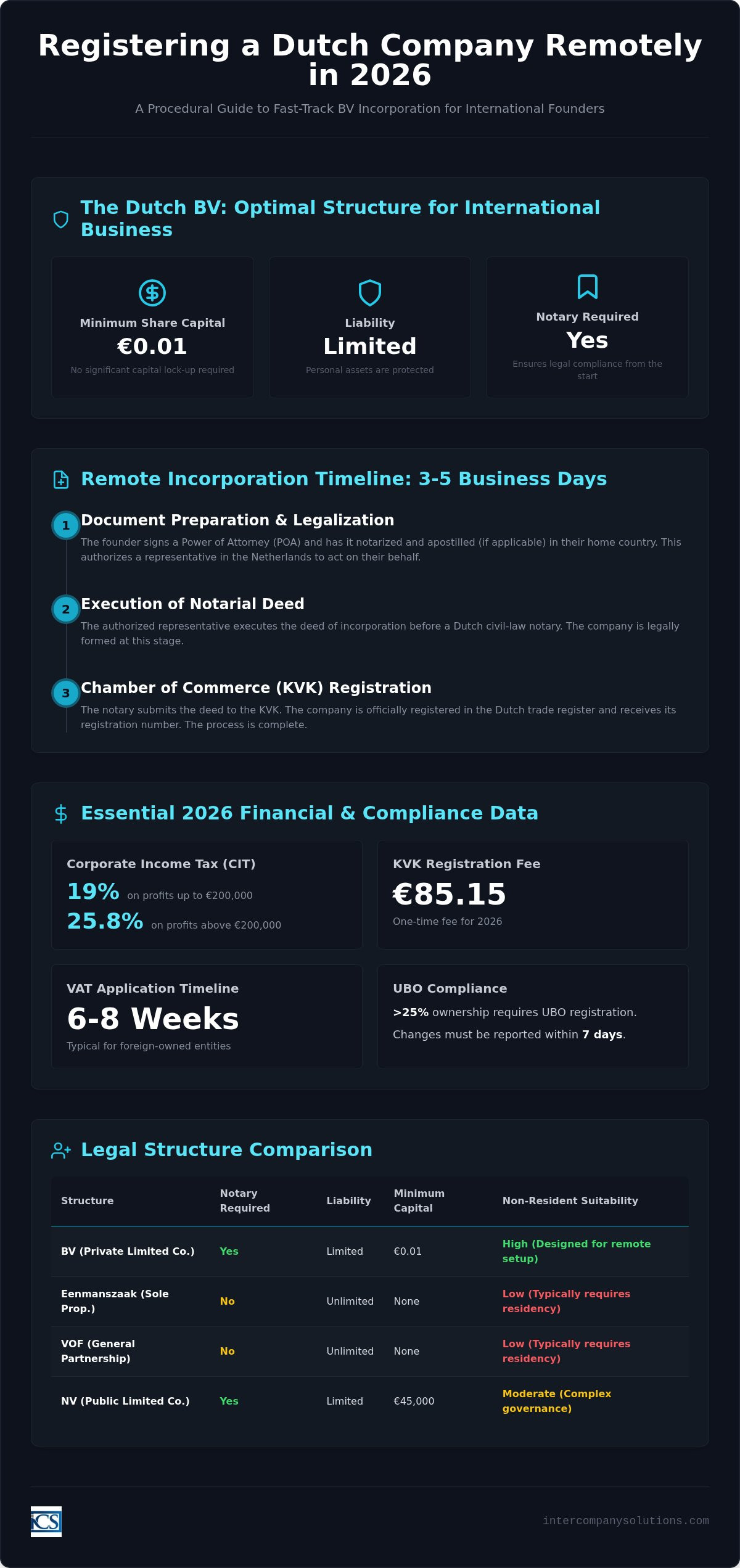
This guide provides the exact procedural steps to incorporate a Dutch BV within 3 to 5 business days. You'll learn how to manage the €85.15 KVK registration fee, meet the €0.01 minimum capital requirement, and prepare for the 6 to 8 week VAT application timeline for foreign-owned entities. We also cover the 2026 Corporate Income Tax rates of 19% on profits up to €200,000 and the transition of the Belastingdienst house bank to Rabobank. By following this structured path, you can ensure your business remains compliant with the latest UBO reporting deadlines and interest deduction caps while securing a functional legal entity from abroad.
Key Takeaways
- Learn why the Dutch BV is the most efficient legal structure for international business, requiring only €0.01 in capital while providing full limited liability.
- Utilize a legalized Power of Attorney as the fastest way to register a company in the Netherlands, allowing for a completely remote incorporation process.
- Follow a precise 3 to 5 business day timeline to secure your KVK registration and pay the 2026 one-time fee of €85.15.
- Review the essential UBO registration rules for any shareholder with more than a 25% interest so you don't encounter delays in compliance.
- Anticipate post-registration steps, such as the 6 to 8 week VAT application period and the 2026 corporate tax rates for taxable profits.
Selecting the Optimal Legal Structure for Rapid Registration
Choosing the right legal form is the first step toward a functional Dutch business. For international founders, the Besloten Vennootschap (BV) is the standard because it combines operational flexibility with limited liability. While structures like the eenmanszaak (sole proprietorship) or VOF (general partnership) don't require a civil-law notary, they expose the founder to personal liability for all business debts. This is often unsuitable for foreign-owned ventures. A Dutch BV formation requires a notarial deed, yet it remains the fastest way to register a company in the Netherlands because of the standardized Power of Attorney (POA) process used by specialists to bridge the gap between local law and global entrepreneurs.
Dutch BV vs. Other Legal Entities
Comparing incorporation speed requires looking at the total setup requirements for non-residents. An eenmanszaak is registered directly at the Kamer van Koophandel (KVK), but it's typically only available to residents or those with a physical Dutch presence and a BSN. The BV, however, allows for remote formation. Unlike the Naamloze Vennootschap (NV), which requires a minimum capital of €45,000 and complex governance, the BV is agile. It's the only structure that provides a clear path for non-residents to satisfy Dutch legal requirements without travel. While a stichting (foundation) also requires a notary, it lacks shareholders and is usually reserved for non-profit or specific holding purposes, making it less versatile for active trade.
Capital and Shareholder Requirements
The capital requirements for a Dutch BV are among the most accessible in Europe. Since the implementation of the Flex-BV rules, the minimum share capital is just €0.01. You don't need to block high amounts of capital in a bank account before incorporation, which removes a significant administrative hurdle. This accessibility is a primary reason why the BV is part of the fastest way to register a company in the Netherlands for 2026. The structure accommodates various ownership models, though the number of shareholders can impact the speed of the documentation phase. For entrepreneurs considering a broader international reach, Expert Plus Businessmen Services offers specialized advisory for company formation within the UAE market.
- Shareholders: A BV can have a single shareholder (individual or corporate) or multiple parties. If the shareholder is a foreign legal entity, additional legalized corporate documents are required.
- Directors: At least one director is required. This person can be a non-resident, which simplifies the management structure for international firms.
- UBO Registration: Any individual owning more than 25% of the shares must be registered in the UBO (Ultimate Beneficial Owner) register. Changes to this information must be reported within 7 days.
By keeping the initial structure simple, such as a single director and shareholder, you minimize the volume of documents requiring legalization. This streamlined approach ensures the notary can execute the deed of incorporation without the delays often associated with complex corporate chains. For founders managing more intricate business arrangements who require high-level strategic oversight, you can check out Robin Lohmann for expert management consultation.
The Legalized Power of Attorney: Incorporating Remotely Without Delay
The legalized Power of Attorney (POA) serves as the primary mechanism for remote Dutch BV formation. For non-resident founders, traveling to a Dutch notary's office often introduces unnecessary delays and logistical costs. By using a POA, you authorize a representative at the notary's office to execute the deed of incorporation on your behalf. This method bypasses the need for a residence permit during the incorporation phase, as Dutch law doesn't require you to live in the country to own or manage a BV. While digital video incorporation has become an option, it isn't the recommended default for foreign entrepreneurs. Video-based systems often struggle with the validation of foreign-issued identification or corporate documents from outside the EU. The POA route remains the fastest way to register a company in the Netherlands because it relies on a proven legal chain of authentication that Dutch civil-law notaries and the Chamber of Commerce (KVK) recognize without hesitation.
The Legalization and Apostille Process
The documentation phase begins in your home country. You must present your identification documents and the provided POA to a local notary. Their role is to witness your signature and verify your identity. If your home country is a member of the Hague Apostille Convention, a single apostille stamp is usually sufficient to legalize the document for use in the Netherlands. For non-member countries, a more complex legalization chain involving local ministries and the Dutch embassy may be required. The timeline for this process varies significantly by jurisdiction. In countries like the United Kingdom or Germany, apostilles are often issued within 24 to 48 hours. In other regions, this step can take several weeks. Preparing these documents accurately is critical; any error in the legalization chain will result in the Dutch notary rejecting the file, which resets your registration timeline.
Executing the Deed of Incorporation
Once the original legalized documents arrive in the Netherlands, the civil-law notary performs a final compliance check. They verify that the proposed company activities are legal and that all Ultimate Beneficial Owners (UBOs) are correctly identified. The notary then executes the deed of incorporation. At this moment, the BV officially exists as a legal entity. Immediately following the execution of the deed, the notary proceeds to register with the Netherlands Chamber of Commerce (KVK). This registration assigns your company its unique KVK number, which is required for all subsequent business activities, including opening a bank account. If you need assistance coordinating these international document requirements, you can contact our specialist team for a preliminary review of your local legalization standards.
Timeline Breakdown: From Document Submission to KVK Registration
Efficiency in the Dutch corporate landscape is driven by digital integration between notaries and the Chamber of Commerce. For standard formations, the total timeline expectation is 3 to 5 business days. This speed is contingent on the accuracy of your initial document submission and the complexity of your shareholding structure. By following a structured approach, you can achieve the fastest way to register a company in the Netherlands without facing common administrative delays. While the process is swift, it requires a precise day-by-day progression to ensure no steps are missed.
The process begins on Day 1 with a comprehensive documentation review. We verify your identification and ensure the legalized Power of Attorney (POA) matches Dutch notarial standards. Days 2 and 3 focus on the notarial execution of the deed of incorporation. Once the notary signs the deed, the BV exists as a legal entity. Finally, Days 4 and 5 are dedicated to KVK registration and the issuance of your RSIN number. This timeline assumes that all documents are correctly legalized and apostilled before the process starts.
Step-by-Step Registration Workflow
Success starts with a complete checklist. You must submit valid identification and proof of your residential address. A critical step often overlooked is the trade name availability check. The KVK will reject names that are too similar to existing businesses or names that are misleading regarding the company's activities. We perform this check before the notary drafts the deed to prevent a total reset of the registration timeline. Once the name is cleared and the deed is executed, the notary submits the electronic filing to the KVK. This digital submission is what allows for the rapid turnaround that international founders require.
Mandatory 2026 Registration Fees
Every new business must pay a one-time KVK registration fee. For 2026, this fee is €85.15. This amount is usually paid via a digital payment link or through the notary's third-party account during the formation process. Upon successful registration, the KVK issues a registration extract (uittreksel) and assigns an RSIN (Rechtspersonen en Samenwerkingsverbanden Informatie Nummer). It's a critical identifier for your business operations.
The RSIN is not just a registry number; it's the primary identifier used by the Belastingdienst to link your BV to its tax obligations. Unlike the KVK number, which is for public identification, the RSIN is used for internal government communications. It serves as the basis for your future VAT and payroll tax applications. Having this number issued within five days allows you to move immediately into the post-incorporation phase. If you're ready to begin, you can start your Dutch business journey by preparing your documentation today.
Pre-Registration Requirements and Avoiding Administrative Bottlenecks
Administrative bottlenecks often stem from incomplete preparation before the notary executes the deed. To maintain the fastest way to register a company in the Netherlands, you must resolve three primary requirements: a valid Dutch business address, a compliant trade name, and a clear UBO structure. The Chamber of Commerce (KVK) requires a physical address in the Netherlands where the company is established. This address is public record and serves as the official point of contact for the Belastingdienst and other authorities. Without a confirmed address at the time of filing, the notary cannot finalize the deed of incorporation.
UBO Compliance and Transparency
The Ultimate Beneficial Owner (UBO) register is a mandatory transparency measure for all Dutch BVs. An individual qualifies as a UBO if they hold more than 25% of the shares, voting rights, or ownership interest in the company. During the registration process, the notary must collect and verify the identity of every UBO. This is a non-negotiable step for anti-money laundering compliance.
Compliance doesn't end at incorporation. You must report any changes to the UBO information to the KVK within 7 days of the change occurring. While some UBO information is private and only accessible by competent authorities like the Financial Intelligence Unit, other details are part of the KVK Business Register. These include the name and the nature of the interest. Ensuring this data is accurate from the start prevents the KVK from flagging the file, which would otherwise stall the registration process.
Trade Name and Sector Licenses
Selecting a trade name involves more than branding; it requires adherence to the Dutch Trade Name Act. The KVK will reject names that are misleading, purely descriptive of the service, or too similar to existing registered entities. For example, a name like "Dutch Consulting BV" might be rejected for being too generic. Checking name availability in the Handelsregister before finalizing any documents is the fastest way to register a company in the Netherlands without facing name-related rejections.
Beyond the name, your business activity description must align with standard KVK classifications. If your business operates in a regulated sector, additional requirements apply:
- Finance: May require licensing from the AFM (Authority for the Financial Markets).
- Energy and Healthcare: Often involve specific oversight bodies and permit applications.
- Transport: Requires specific permits for logistics operations.
Identifying these needs early is essential. While the BV can be incorporated quickly, your ability to trade depends on having the correct permits in place. If your business falls into a regulated category, the application for these permits should run parallel to the incorporation process to avoid delays in starting operations.
Post-Incorporation Efficiency: VAT Numbers and Corporate Banking in 2026
After the KVK registration is finalized, the Belastingdienst receives an automated notification regarding your new entity. This internal process initiates your company's tax profile, but it doesn't mean you're immediately ready to trade with a VAT number. While the Power of Attorney route remains the fastest way to register a company in the Netherlands, the subsequent tax and banking steps follow their own regulatory timelines. A significant change in the 2026 fiscal landscape is the transition of the Belastingdienst house bank to Rabobank, which has handled all government tax transactions since 1 May 2026.
VAT (BTW) and EORI Applications
Dutch VAT registration for foreign-owned entities typically takes 6 to 8 weeks. This duration is due to the Belastingdienst performing additional checks on the substance and activities of the company. You'll need to apply the correct VAT rates: 21% is the standard rate, 9% applies to specific items like food or books, and 0% is used for certain international transactions. Founders engaged in global trade should also secure an EORI number. This customs identification is mandatory for moving goods across EU borders and can usually be obtained shortly after the VAT number is active. You can find a deeper breakdown in our Netherlands VAT Registration Guide.
Corporate Banking and Tax Compliance
Opening a corporate account is essential for depositing your share capital, even if it's the minimum €0.01. For non-resident directors, banks conduct extensive background checks to meet anti-money laundering (AML) requirements. Once the account is operational, your focus shifts to tax compliance. In 2026, the CIT rates are 19% on the first €200,000 of profit and 25.8% on any profit above that amount. You must also be aware of the interest deduction cap, which remains at 24.5% of EBITDA for 2026.
Dutch law mandates that you retain all business records for a minimum of 7 years. This includes digital and physical invoices, bank statements, and contracts. For businesses holding immovable property, this retention period is 10 years. Annual accounts must be submitted to the KVK within 12 months after the close of the financial year. Failure to meet these deadlines can lead to personal liability for directors. Utilizing professional Dutch BV Formation Services helps ensure these post-incorporation milestones are managed with the same efficiency as the initial registration.
Last reviewed: September 2026
Launching Your Dutch Business Remotely
Navigating the incorporation process from abroad requires a structured approach that prioritizes legal accuracy and speed. By utilizing the legalized Power of Attorney route, you can secure a Dutch BV without the need for physical travel or local residency. This method stands as the fastest way to register a company in the Netherlands, providing a fully operational entity within 3 to 5 business days. Adhering to the 2026 UBO reporting deadlines and tax regulations, such as the 19% CIT rate for the first €200,000 of profit, ensures your venture starts on a compliant foundation.
Success in the Dutch market depends on managing post-incorporation requirements with the same efficiency as the initial filing. This includes preparing for the 6 to 8 week VAT registration window, and you'll need to align with the Rabobank banking transition. Our services include premium secretarial support to manage these administrative milestones seamlessly. We look forward to facilitating your entry into this stable and growth-oriented economy.
Last reviewed: September 2026
Frequently Asked Questions
How long does it take to register a company in the Netherlands?
A standard Dutch BV incorporation typically takes between 3 and 5 business days. This timeline begins once all required documentation is finalized and the legalized Power of Attorney is received by the notary. The process is the fastest way to register a company in the Netherlands for international entrepreneurs when documentation is accurate. Lead times can vary slightly based on shareholding complexity, but digital filing with the Chamber of Commerce ensures rapid processing.
Can I register a Dutch BV remotely without traveling?
You can register a Dutch BV remotely without visiting the Netherlands by using a legalized Power of Attorney. This route allows a local notary to execute the deed of incorporation on your behalf. It's the standard procedure for non-resident founders and eliminates the need for travel or a residence permit. You'll need to sign the documents in your home country before a local notary and obtain an apostille for them to be valid.
What is the minimum share capital for a Dutch BV in 2026?
The minimum share capital for a Dutch BV in 2026 is €0.01. This low threshold was introduced to make the private limited company structure accessible to a wide range of entrepreneurs. You can issue shares with a very low nominal value, which simplifies the initial funding phase. This capital must be deposited into the company's business bank account after incorporation, though the amount doesn't need to be blocked before the registration process begins.
What are the corporate tax rates in the Netherlands for 2026?
In 2026, the Corporate Income Tax (CIT) rate is 19% on the first €200,000 of taxable profits. For any profits exceeding this threshold, the rate increases to 25.8%. These rates apply to all Dutch BVs and reflect the government's commitment to maintaining a competitive fiscal environment. It's also necessary to account for the interest deduction cap, which is limited to 24.5% of EBITDA or a €1 million threshold for the current year.
How much is the KVK registration fee in 2026?
The Chamber of Commerce (KVK) charges a one-time registration fee of €85.15 in 2026. This fee is mandatory for all new legal entities and is usually paid via a digital link or through the notary's third-party account during the formation process. Once paid, the KVK issues your registration extract and RSIN number. This is a standard administrative cost that applies regardless of whether the founders are residents or non-residents of the Netherlands.
Do I need a Dutch bank account to register a company?
You don't need a Dutch bank account to complete the initial KVK registration. However, you must open a business account shortly after incorporation to deposit the share capital and manage operational transactions. For 2026, the Belastingdienst uses Rabobank as its house bank for all tax-related payments and refunds. While you can use an EEA-based account for some activities, a local Dutch account is often preferred for smoother integration with local tax authorities.
What documents are required for the legalized Power of Attorney route?
The legalized Power of Attorney route requires the following documents:
- High-quality copies of valid identification for all directors and shareholders.
- A completed company formation checklist.
- Proof of residential address, such as a recent utility bill.
These documents must be signed in the presence of a notary in your home country and legalized with an apostille. If your country isn't a member of the Hague Apostille Convention, further legalization is required.
Sources
- KVK - Registering with the Dutch Business Register
- Business.gov.nl - Private limited company (bv)
- Burgerlijk Wetboek Boek 2 (Dutch Civil Code, legal entities)
- Rijksoverheid - Ondernemen
- Belastingdienst - Corporate income tax rates
- ICS Payroll - Dutch payroll services
- Belastingdienst - Payroll taxes (loonheffingen)
- UWV - Employer obligations
- SVB - Social insurance in the Netherlands
- Belastingdienst - VAT (btw) for entrepreneurs
- European Commission - VAT rules and rates
- IND - Highly skilled migrant
- IND - Start-up residence permit
- De Nederlandsche Bank - Supervision
- AFM - Licences and registers
- RVO - Doing business internationally
- Belastingdienst Douane - Customs
- CJEU, Cadbury Schweppes, C-196/04 (ECLI:EU:C:2006:544)
- Hoge Raad, ECLI:NL:HR:2021:1152
- PwC Worldwide Tax Summaries - Netherlands
- ICLG - Corporate Governance Laws and Regulations, Netherlands
Frequently Asked Questions
Need more information on the Dutch BV company?
Contact an expertReady to start your company in the Netherlands?
| Formation time | Dutch BV formation completed in 3 to 5 business days |
|---|---|
| Process | Fully remote setup with step-by-step guidance |
| Compliance | Expert support for registration, VAT and compliance |
| Aftercare | Accounting, tax and legal support included |
| One partner | All of the above through one trusted formation partner |