


September 14, 2026 · 16 min read
Unexpected administrative penalties often exceed the annual investment required for professional fiscal maintenance. For international entrepreneurs, the complexity of Dutch tax deadlines and the search for English-speaking specialists can create significant operational uncertainty regarding dutch bv accounting costs. You recognize that staying compliant in a foreign jurisdiction is a non-negotiable aspect of growth, yet the lack of transparency in service fees can make budgeting difficult. This guide provides a professional breakdown of recurring bookkeeping, tax filing, and annual reporting expenses for Netherlands-based private limited companies. We'll examine mandatory versus optional services and statutory deadlines for 2026. This allows you to structure a predictable budget for corporate maintenance. By understanding the specific requirements for corporate income tax and VAT, you can ensure your entity remains in good standing without encountering hidden compliance fees. This overview serves as a procedural roadmap for founders who value accuracy and long-term stability in the Dutch market.
Key Takeaways
- Establish a clear distinction between recurring bookkeeping and annual statutory filings to ensure a predictable 2026 operational budget.
- Navigate mandatory quarterly VAT (BTW) filing requirements and the specific records retention rules necessary for Dutch tax compliance.
- Evaluate how transaction volume and business complexity influence dutch bv accounting costs to select the most efficient service level for your entity.
- Secure an understanding of the mandatory timelines for filing annual accounts with the Chamber of Commerce (KVK) and submitting corporate income tax returns.
- Identify the procedural requirements for payroll administration and how a remote service model facilitates compliance for international founders.
Structure of Dutch BV Accounting and Compliance Costs
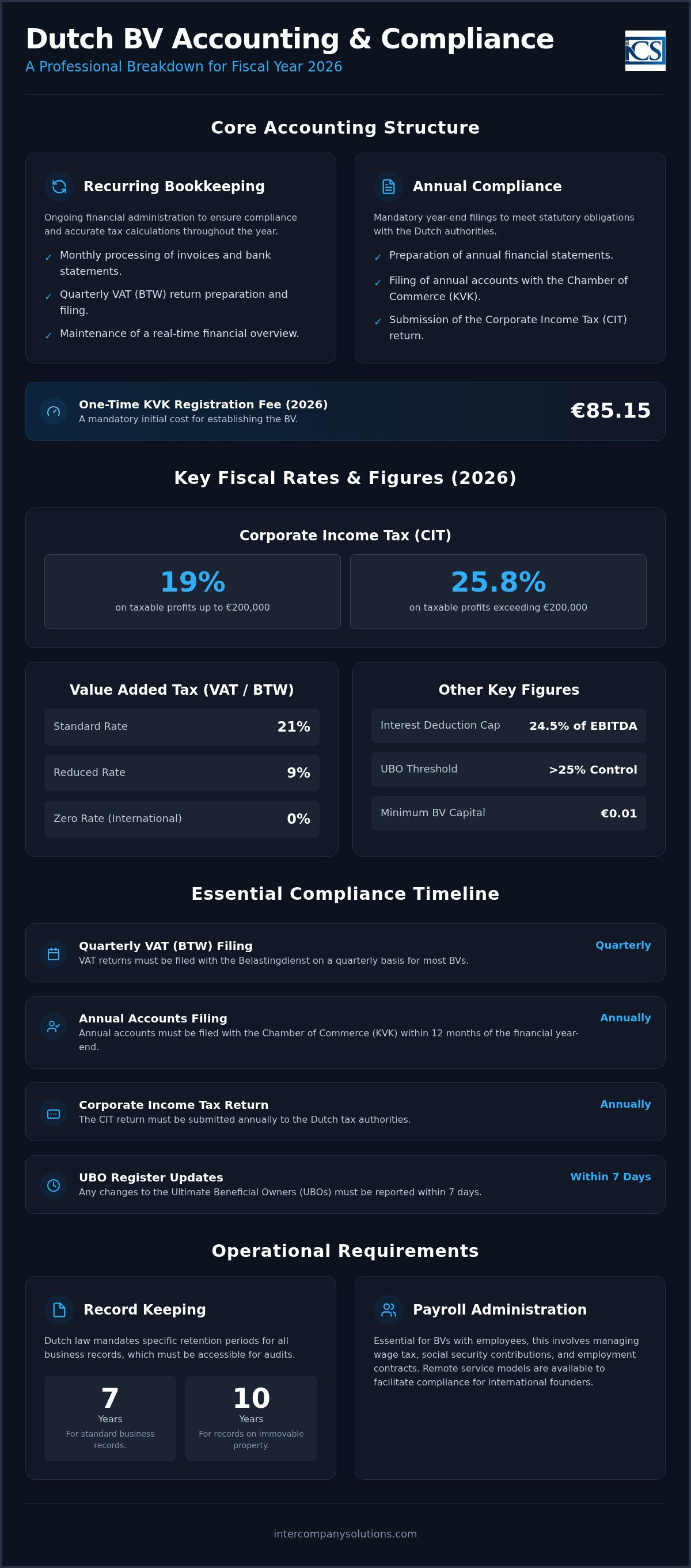
Organizing the financial administration of a Dutch private limited company requires a systematic approach to meet statutory obligations. The framework for dutch bv accounting costs is typically divided into two distinct categories: recurring bookkeeping and annual compliance. Unlike transparent entities such as the VOF or eenmanszaak, a Besloten vennootschap (Dutch BV) is a legal person that requires a notary for its incorporation. This formal structure necessitates a more rigorous level of reporting than simpler legal forms. You can find more details on the Dutch BV company formation process to understand how these initial legal steps influence your long-term compliance needs. Initial mandatory expenses include a one-time KVK registration fee of €85.15 for 2026. Beyond this, foreign-owned entities often require specialized English-language reporting and cross-border tax advisory to ensure alignment with both local and international standards.
Fixed vs. Variable Accounting Expenses
Fixed costs form the baseline. These generally include monthly bookkeeping retainers and the preparation of quarterly VAT (BTW) filings. These services ensure that your administration remains current and that tax liabilities are calculated accurately throughout the year. Variable costs arise when your business undergoes significant changes or reaches specific thresholds. Large-scale BVs may face mandatory audit requirements, which significantly increase the annual budget. Additionally, bespoke tax advice regarding international restructuring or intellectual property falls under variable expenditure. It's vital to remember that a Dutch BV with the minimum capital of €0.01 carries the same standard annual reporting obligations as a company with higher capitalization.
Regulatory Foundations for 2026
Understanding the fiscal environment is essential for accurate budgeting. Tax rates are stable. For the 2026 financial year, the corporate income tax (CIT) rate is 19% for taxable profits up to €200,000. Any profits exceeding this threshold are taxed at 25.8%. Another critical factor in dutch bv accounting costs is the interest deduction cap, which is set at 24.5% of EBITDA for 2026. This regulation limits the amount of interest a company can deduct from its taxable income, impacting the net tax position of highly leveraged entities. Proper financial planning ensures that these regulatory benchmarks are integrated into your company's fiscal strategy from the outset. This methodical approach builds trust with the Belastingdienst and prevents the accumulation of late-filing penalties.
Monthly Bookkeeping and Quarterly VAT Filings
Continuous administration is the foundation of fiscal health for any company. Daily or weekly updates prevent the administrative backlog that often drives up dutch bv accounting costs. By categorizing invoices and bank statements promptly, you maintain a real-time overview of your company's liquidity. This proactive approach allows for better cash flow management and ensures that all deductible expenses are captured. According to the Dutch government business portal, a BV must maintain an administration that reflects its current financial position at all times.
VAT (BTW) returns are typically filed on a quarterly basis with the Belastingdienst. The standard Dutch VAT rate is 21%. A reduced rate of 9% applies to specific sectors such as food, books, and certain services, while 0% is used for specific international trade scenarios. For foreign-owned entities, the issuance of a VAT number usually takes 6 to 8 weeks after the initial KVK registration. This waiting period is a critical factor in your initial operational timeline. You should account for this duration when projecting your first year of dutch bv accounting costs and business activity. If you have questions about your eligibility for specific rates, you can reach out for a consultation to clarify your position.
Electronic Record Keeping and Retention
Dutch law requires all business records to be retained for a minimum of 7 years. This includes digital files, paper invoices, and bank statements. If your BV holds immovable property, this legal retention period extends to 10 years. Digital administration must meet specific standards for accessibility and auditability set by the tax authorities. Storing records electronically is the standard, provided the integrity and authenticity of the data remain guaranteed throughout the mandatory period. Using cloud-based accounting software often facilitates this requirement while providing the transparency needed for remote compliance. When upgrading your systems, Switch My Books provides expert assistance for migrating financial data between major accounting platforms.
Businesses engaged in import and export must apply for an Economic Operators Registration and Identification (EORI) number. This is a prerequisite for customs clearance when moving goods into or out of the European Union. Additionally, quarterly filings for BVs trading within the EU must include intra-community transaction reports (ICP). These reports account for goods and services moved across borders without VAT being charged at the point of sale. For a detailed breakdown of these requirements, refer to our Netherlands VAT registration guide. Maintaining these records accurately ensures that your entity avoids late-filing surcharges and maintains a clean compliance record.
Annual Reporting and Corporate Income Tax Costs
The annual closing of a company's books represents the most significant milestone in the fiscal year. Preparation of annual financial statements is a legal requirement for every Dutch BV, regardless of its activity level or turnover. These documents provide a transparent overview of the company's financial health and serve as the basis for tax assessments. When budgeting for dutch bv accounting costs, entrepreneurs must account for the specialized expertise required to draft these statements in accordance with Dutch Generally Accepted Accounting Principles (Dutch GAAP). These accounts must be filed with the Chamber of Commerce (KVK) within 12 months of the year-end to maintain the company's "good standing" status. Failure to meet this obligation isn't just a matter of administrative fines; it can lead to personal liability for directors if the company becomes insolvent.
KVK Filing Requirements and Deadlines
The management board is responsible for preparing the financial statements within five months of the fiscal year-end. While the shareholders can grant an extension of up to five additional months, the final deadline for KVK publication remains strictly 12 months post-year-end. It's a critical deadline because the Dutch tax authorities and the KVK monitor these dates closely. Most international founders operate "small" or "micro" BVs, which benefit from simplified reporting standards. According to the Dutch government business portal, these simplified formats require fewer disclosures and a less complex balance sheet than larger entities. This categorization helps manage the overall administrative investment by reducing the volume of data that must be audited or disclosed publicly.
CIT Calculation and Payment
Finalized financial statements form the foundation for the Corporate Income Tax (CIT) return. These returns must be submitted electronically to the Belastingdienst using specialized software or through a registered tax intermediary. Accuracy is paramount here; the tax authorities cross-reference these filings with KVK records and VAT data to identify discrepancies. Since 1 May 2026, Rabobank has been the official house bank for the Dutch tax authorities, so any tax liabilities or refunds are processed through this institution. It's a good practice to finalize your accounts early to avoid the rush of the tax season and ensure you have sufficient time for any necessary tax optimizations. You can find a more comprehensive breakdown of these procedural steps in our article on accounting for Dutch BV compliance and tax obligations.
Last reviewed: September 2026
Payroll Administration and Employer Compliance
Hiring staff in the Netherlands introduces specific administrative duties that directly impact dutch bv accounting costs. Every BV with employees must register for a payroll tax number with the tax authorities before processing the first salary payment. This registration is the starting point for monthly compliance, which includes payslip generation, social security contributions, and pension management. For employees aged 21 and older, the minimum hourly wage is €14.99 as of July 1, 2026. Employers must also account for the maximum wage base for social security contributions, which is €79,409 annually for the 2026 fiscal year. Managing these variables requires a methodical approach to ensure that payments to the Belastingdienst, processed through Rabobank, are accurate and timely.
Standard payroll administration includes several mandatory components that must be managed on a monthly basis:
- Generation of digital payslips for all employees.
- Calculation and filing of social security and wage tax contributions.
- Management of pension scheme registrations and monthly premiums.
- Annual reporting of employee income to the Belastingdienst (Jaaropgave).
Our payroll and staffing services provide a structured solution by consolidating employment contracts and social security filings into a single monthly invoice. A significant advantage for many international entities is the 30% tax reimbursement ruling. This facility allows qualifying international employees to receive up to 30% of their gross salary tax-free. It's an effective tool for attracting global talent, though it requires precise calculation within the payroll system to remain compliant with tax regulations. Records related to payroll must be retained for at least 7 years to meet statutory audit standards.
Employer of Record and Staffing Solutions
Foreign entities that aren't yet ready to establish a full local HR department often utilize Employer of Record (EOR) services. This model allows a company to hire staff while the EOR provider takes legal responsibility for compliance with Dutch labor laws. This includes managing mandatory sick leave payments, providing required insurance, and adhering to collective labor agreements (CAO) where applicable. Using an EOR service provides a bridge for companies in the early stages of market entry. For a more detailed look at these options, you can review our payroll services in the Netherlands guide.
Highly Skilled Migrant (HSM) Costs
Recruiting talent from outside the European Union involves additional procedural steps and costs. To hire highly skilled migrants, a BV must typically obtain recognized sponsor status from the Immigration and Naturalisation Service (IND). The administrative fees for these applications and subsequent visa filings are essential components of your annual HR budget. HSM employees must meet specific age-related salary thresholds to qualify for their residency status and the 30% ruling. These thresholds are updated annually. In 2026, you must ensure that your salary offers meet these minimums to avoid the revocation of work permits or sponsor status. This specialized area of compliance requires careful coordination between your tax advisors and HR administration.
Strategic Cost Management with Intercompany Solutions
Managing dutch bv accounting costs effectively requires a partner that understands the intersection of legal formation and fiscal compliance. Intercompany Solutions provides a comprehensive service package that integrates company formation, VAT applications, and ongoing accounting. This centralized approach eliminates the communication gaps that often lead to administrative errors and unexpected fees. By working directly with Dutch corporate specialists, you gain clear visibility into your entity's financial obligations from the day of incorporation. Our firm acts as a bridge between the local regulatory landscape and your global business goals, ensuring that every procedural step is handled with precision.
Simplified Remote Compliance
The standard route for non-EU founders to establish an entity is the legalized Power of Attorney (POA) process. This method allows the notary to execute the deed of incorporation without requiring the founder to travel to the Netherlands. We facilitate this process remotely, typically completing the Dutch BV company formation within 3 to 5 business days. This efficiency reduces the initial setup overhead and allows you to focus on operational growth. Managing your Dutch entity entirely from abroad becomes a predictable process when the legal and administrative foundations are handled by a single provider. This remote model is designed for speed and meticulous attention to detail, matching the requirements of modern international entrepreneurs.
Ongoing Support and Consultancy
Compliance is a continuous obligation that extends beyond annual filings. For instance, any changes to the Ultimate Beneficial Owner (UBO) must be reported to the KVK within 7 days to maintain regulatory adherence. Our premium secretarial services include 10 hours of dedicated assistance in the first year to handle such administrative updates and monitor critical CIT and VAT deadlines. This proactive monitoring is essential for avoiding the surcharges associated with late submissions to the Belastingdienst. We offer an initial consultation to help entrepreneurs determine the most cost-effective structure for their specific business model. This ensures that your accounting budget aligns with your actual transaction volume and complexity. By consolidating these services, you ensure that your records, which must be retained for at least 7 years, remain audit-ready and compliant with Dutch law.
Last reviewed: September 2026
Securing Your Dutch Entity's Financial Future
Maintaining a Dutch BV requires consistent attention to statutory deadlines and precise record-keeping. By separating recurring bookkeeping from annual reporting requirements, you can build a predictable budget for dutch bv accounting costs. Ensuring your entity remains compliant with the Belastingdienst and the Chamber of Commerce prevents administrative penalties and protects your professional standing in the Netherlands. This structured approach allows you to focus on scaling your business while specialists manage the procedural details.
Intercompany Solutions serves as the leading specialized incorporation firm for foreign entrepreneurs, offering remote incorporation in 3-5 business days. We provide a transparent bridge to the Dutch market with a 100% satisfaction guarantee. Our team ensures that your corporate interests are handled with meticulous attention to detail and efficiency from the day of formation.
Establishing a robust administrative foundation today ensures your business is prepared for the regulatory requirements of 2026 and beyond. We look forward to supporting your international growth and long-term stability.
Last reviewed: September 2026
Frequently Asked Questions
What is the average monthly accounting fee for a Dutch BV?
Monthly fees vary based on the complexity and transaction volume of your entity. These costs typically cover ongoing bookkeeping and quarterly VAT filings. For many international entrepreneurs, these recurring expenses are structured as a monthly retainer to ensure predictable dutch bv accounting costs. The specific fee reflects the number of invoices processed and whether the company requires additional services like payroll or specialized tax advisory.
Is it mandatory to hire a Dutch accountant for my BV?
While there's no strict legal requirement for small BVs to hire an external accountant for daily bookkeeping, every entity must file accurate annual accounts with the Chamber of Commerce (KVK). Most foreign-owned entities choose professional assistance to ensure compliance with Dutch GAAP and local tax regulations. Using a specialist prevents administrative errors that could lead to director liability or significant penalties from the Belastingdienst, which uses Rabobank as its house bank since 1 May 2026.
What are the KVK registration and filing fees in 2026?
The one-time registration fee for a Dutch BV at the Chamber of Commerce is €85.15 in 2026. This fee is paid upon the initial entry of the company into the trade register. While there's no annual membership fee for the KVK, companies must pay small administrative fees when filing their annual accounts digitally within 12 months of the year-end. These costs are a minor part of the overall dutch bv accounting costs but remain a mandatory compliance step.
How long does it take to get a VAT number for a foreign-owned BV?
For foreign-owned entities, the issuance of a VAT (BTW) number typically takes 6 to 8 weeks after the initial KVK registration. The Belastingdienst conducts a review of the company's planned activities and substance before granting the number. During this period, the company can often still engage in preliminary business activities, but it cannot charge or reclaim VAT until the registration is finalized and the number is officially issued.
What are the retention requirements for Dutch business records?
All Dutch business records, including invoices, bank statements, and contracts, must be retained for a minimum period of 7 years. If your BV holds immovable property, this legal retention requirement extends to 10 years. Records should be stored in a manner that ensures they are accessible and auditable by the tax authorities. Digital storage is the standard practice, provided the integrity and authenticity of the data are maintained throughout the statutory period.
Can I manage my Dutch BV accounting remotely from abroad?
You can manage the entire financial administration of your Dutch entity remotely. Modern accounting software and digital portals allow for the seamless exchange of invoices and bank data between the founder and their local service provider. This accessibility ensures that you remain compliant with Dutch filing deadlines without the need for physical presence in the Netherlands. Professional firms specialize in supporting non-resident founders through secure digital workflows and remote communication.
What is the corporate tax rate for a Dutch BV in 2026?
In 2026, the corporate income tax (CIT) rate is 19% for taxable profits up to €200,000. For any profits exceeding this threshold, the tax rate is 25.8%. These rates apply to the net profit of the company after the deduction of business expenses and applicable tax credits. Accurate bookkeeping is essential to determine the correct taxable base and to ensure that the company benefits from all available fiscal incentives.
Sources
- ICS Payroll - Dutch payroll services
- KVK - Registering with the Dutch Business Register
- Business.gov.nl - Private limited company (bv)
- Burgerlijk Wetboek Boek 2 (Dutch Civil Code, legal entities)
- Rijksoverheid - Ondernemen
- Belastingdienst - Corporate income tax rates
- Belastingdienst - Payroll taxes (loonheffingen)
- UWV - Employer obligations
- SVB - Social insurance in the Netherlands
- Belastingdienst - VAT (btw) for entrepreneurs
- European Commission - VAT rules and rates
- IND - Highly skilled migrant
- IND - Start-up residence permit
- BOIP - Trademark registration in Benelux
- WIPO - Madrid System
- RVO - Doing business internationally
- Belastingdienst Douane - Customs
- CJEU, Cadbury Schweppes, C-196/04 (ECLI:EU:C:2006:544)
- Hoge Raad, ECLI:NL:HR:2021:1152
- PwC Worldwide Tax Summaries - Netherlands
- ICLG - Corporate Governance Laws and Regulations, Netherlands
Frequently Asked Questions
Need more information on the Dutch BV company?
Contact an expertReady to start your company in the Netherlands?
| Formation time | Dutch BV formation completed in 3 to 5 business days |
|---|---|
| Process | Fully remote setup with step-by-step guidance |
| Compliance | Expert support for registration, VAT and compliance |
| Aftercare | Accounting, tax and legal support included |
| One partner | All of the above through one trusted formation partner |