


September 19, 2026 · 18 min read
The 6 to 8 week processing window for foreign VAT applications often determines the success or failure of an e-commerce launch in the Dutch market. You're likely aware that administrative delays and the complexity of cross-border tax laws can lead to account suspension if your filings don't meet strict Dutch standards. This article provides a comprehensive technical guide to the Amazon seller Netherlands VAT requirements, covering registration, Union One-Stop Shop (OSS) compliance, and corporate tax obligations for the 2026 fiscal year.
We'll outline the procedural steps for remote BV formation via the legalized Power of Attorney route, including the €0.01 minimum capital requirement, the €85.15 KVK registration fee, and the 19% corporate income tax rate for profits up to €200,000. You'll learn the specifics of the mandatory 7-year record retention period, the Belastingdienst house bank transition to Rabobank, and the necessity of filing annual accounts within 12 months of year-end. This structured approach ensures your business expansion into the EU is both compliant and scalable, utilizing the Netherlands as a stable hub for your international e-commerce operations.
Key Takeaways
- Understand the application of the 21% standard VAT rate and how it affects your e-commerce pricing strategy in the Dutch market.
- Learn the procedural requirements for an Amazon seller Netherlands VAT registration, which typically takes 6–8 weeks for foreign-owned entities.
- Simplify EU-wide reporting by utilizing the Union One-Stop Shop (OSS) for distance sales exceeding the €10,000 threshold.
- Identify the quarterly filing deadlines and the legal requirement to retain all business records for a period of 7 years.
- Explore the remote BV formation route through a legalized Power of Attorney and the 19% corporate tax rate for profits up to €200,000.
Table of Contents
Understanding the Dutch VAT Framework for Amazon Sellers
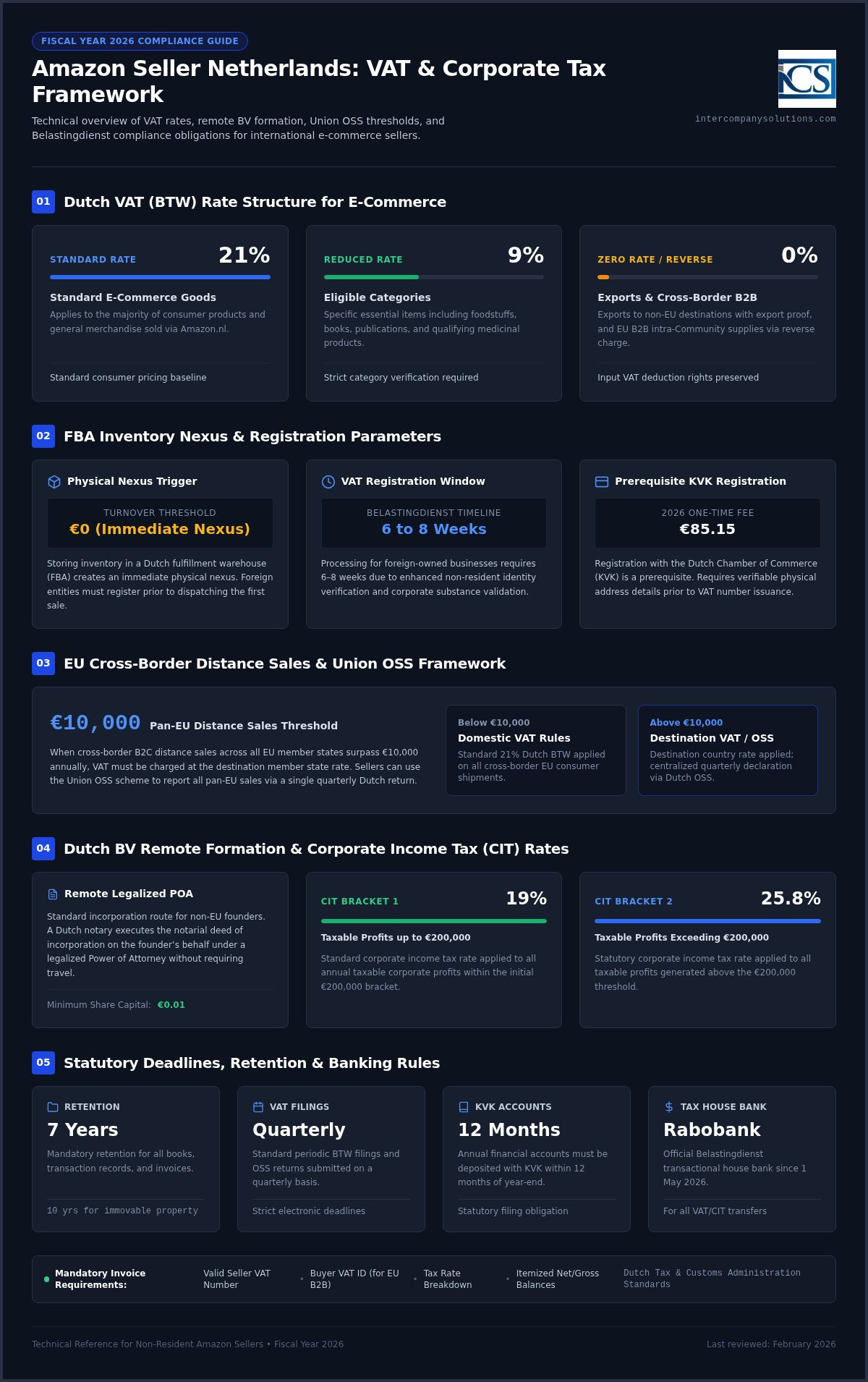
VAT, or Belasting over de Toegevoegde Waarde (BTW), is a consumption tax applied to nearly all goods and services traded within the Netherlands. For an international Amazon seller Netherlands VAT compliance starts with identifying whether the business has a physical presence or stores inventory locally. In 2026, the standard VAT rate remains 21% for the majority of e-commerce goods sold via the platform. Sellers dealing in specific categories such as food, books, or medicinal products may qualify for the reduced rate of 9%.
If you utilize Amazon’s Fulfillment by Amazon (FBA) service and your goods are stored in a Dutch warehouse, you've created a taxable nexus. This triggers an immediate requirement for VAT registration regardless of your annual turnover. Unlike resident businesses that may benefit from certain thresholds, foreign entities storing stock in the Netherlands must register before the first sale is made from that inventory. Establishing a compliant foundation often involves starting a business in the Netherlands to streamline these tax obligations.
The Role of the Belastingdienst in E-commerce
The Dutch Tax and Customs Administration, known as the Belastingdienst, is the authority responsible for managing VAT registrations and filings. It's the primary body that issues VAT identification numbers to foreign entities. Since 1 May 2026, the Belastingdienst has utilized Rabobank as its official house bank for all tax-related transactions. This means any VAT payments you owe or refunds you're entitled to will be processed through this institution. Foreign sellers must ensure their accounting systems are configured to handle these specific banking details to avoid payment delays.
VAT-Exempt vs. Taxable Supplies
Understanding the distinction between different tax treatments is vital for maintaining a structured accounting process. While the 21% rate applies to most domestic B2C sales, certain transactions are treated differently. For instance, the 0% VAT rate applies to the export of goods to countries outside the European Union. This allows sellers to reclaim input VAT on costs without charging VAT to the final customer, provided they maintain strict proof of export. Our Accounting - Ecommerce services can assist in maintaining the necessary documentation for these claims.
For B2B transactions within the EU, the reverse charge mechanism often applies. In these cases, the responsibility for reporting VAT shifts from the seller to the buyer, provided both parties have valid VAT numbers. Your invoices must reflect these distinctions accurately. Dutch accounting standards require specific details on every invoice, including your VAT number, the customer's VAT number for B2B sales, and a clear breakdown of the tax rates applied. Failure to meet these invoicing requirements can lead to audits or the rejection of VAT deduction claims.
The VAT Registration Process for Non-Resident Sellers
The administrative timeline for obtaining a VAT number in the Netherlands is a critical factor for international business planning. For foreign-owned entities, the registration process typically takes 6 to 8 weeks. This duration is often longer than what resident entrepreneurs experience due to the additional verification steps required by the Belastingdienst for non-resident applicants. A successful application requires a prerequisite registration with the Chamber of Commerce (KVK), which involves a one-time fee of €85.15 for the 2026 fiscal year.
For non-resident founders, the most efficient method to establish a Dutch entity is the legalized Power of Attorney (POA) route. This allows a notary to execute the deed of incorporation on your behalf, removing the need for physical travel to the Netherlands. A local business address is mandatory for any Amazon seller Netherlands VAT application; the tax authorities won't issue a VAT number to an entity without a verifiable physical presence in the country.
Remote BV Formation and VAT Application
The process of setting up a Dutch BV remotely follows a logical sequence. First, you must prepare valid identification documents and a clear description of your intended business activities. These descriptions are crucial as they define your tax status and KVK classification. Second, a Dutch notary executes the deed of incorporation via the legalized POA. Finally, the entity is registered with the KVK. You can learn more about the Netherlands company formation process to ensure each step aligns with current legal standards.
EORI Number Integration for Importers
An Economic Operators Registration and Identification (EORI) number is essential for any Amazon seller Netherlands VAT holder importing goods into the European Union through Dutch ports. This number acts as your identifier for all customs procedures. To ensure a seamless flow for Amazon FBA imports, your EORI number must be correctly integrated with your VAT number. A significant advantage for Dutch-registered entities is the Article 23 permit. This permit allows for VAT deferment on imports, meaning the VAT isn't paid at the border but is instead reported on the periodic VAT return. This provides a substantial cash-flow benefit compared to other EU jurisdictions where import VAT must be paid upfront. If you require assistance with these specific tax applications, you can consult with our compliance specialists to review your eligibility.
Utilizing the Union One-Stop Shop (OSS) in the Netherlands
The Union One-Stop Shop (OSS) is a centralized electronic portal that simplifies VAT obligations for an Amazon seller Netherlands VAT holder engaging in cross-border distance sales within the European Union. Under this scheme, a business registered for VAT in the Netherlands can report and pay VAT due on all B2C sales of goods to customers in other EU member states through a single quarterly return. This replaces the previous requirement to monitor individual distance selling thresholds for every specific country and maintain multiple local VAT registrations.
While the OSS return is filed through the Dutch tax portal, it's strictly for cross-border B2C transactions. Sales made to customers within the Netherlands must still be reported on your standard local Dutch VAT return. For international entrepreneurs, starting a business in the Netherlands for e-commerce provides a stable legal base to access this centralized system. The Dutch tax authorities are known for their digital efficiency, making the Netherlands a preferred "Member State of Identification" for the OSS scheme among global Amazon brands.
How OSS Simplifies Amazon Expansion
The primary advantage of the OSS system is the elimination of the administrative burden associated with managing up to 27 different VAT registrations. Instead of engaging with multiple tax authorities in different languages, you consolidate your EU-wide reporting into one submission. This centralized approach reduces the costs associated with international tax compliance and simplifies the accounting process for growing brands. It allows you to scale your Amazon presence across the entire European market without the lead times typically associated with obtaining new foreign VAT numbers. Our Accounting - Ecommerce services help ensure these consolidated reports remain accurate and reflect the specific VAT rates of each destination country.
Eligibility and Threshold Management
The OSS scheme becomes relevant once your total cross-border B2C sales within the EU exceed the unified threshold of €10,000 per calendar year. Below this threshold, you may continue to charge the VAT rate of the country where your business is established. Once you surpass this limit, you must charge the VAT rate applicable in the customer's member state. It's vital to monitor sales volumes closely to ensure timely activation of the OSS registration.
If you use Pan-European FBA, you must remember that the OSS does not replace all local obligations. Storing inventory in a foreign fulfillment center still creates a taxable nexus in that country. Therefore, while OSS covers the sales tax reporting for the final delivery to the consumer, you may still require local VAT registrations in countries where Amazon stores your stock to account for stock movements and local sales. Managing this transition from local registration to the OSS scheme requires a structured overview of your supply chain and inventory locations. For brands manufacturing products in the East, Buying Office Asia provides on-the-ground procurement support to ensure your supply chain remains efficient before goods even reach European warehouses.
Standard VAT returns in the Netherlands are processed on a quarterly basis. Every Amazon seller Netherlands VAT registrant must complete both the submission and the payment by the last day of the month following the quarter's end. This means your Q1 return is due by April 30th. Precise timing is essential because the Belastingdienst house bank, Rabobank, must receive the funds before the deadline to avoid late-payment penalties. If you're a non-resident seller, you're still bound by these quarterly cycles once your VAT number is active.
Dutch law requires you to retain all business records for a minimum of 7 years to satisfy audit requirements. This retention period increases to 10 years if your business deals with immovable property. These records must include all digital sales data, purchase invoices, and bank statements. Additionally, you're required to file your company’s annual accounts with the Chamber of Commerce (KVK) within 12 months of the financial year-end. Maintaining these records in a structured manner is a core component of long-term compliance for any international brand operating within the Dutch jurisdiction.
Accounting Standards for Amazon Sellers
Maintaining a compliant ledger requires the seamless integration of Amazon Seller Central reports with Dutch bookkeeping software. Your accounting process must accurately reflect Amazon fees, refunds, and promotional discounts as separate line items. When selling across multiple marketplaces, you must handle currency conversions using the exchange rates provided by the European Central Bank or the Dutch tax authorities. For a detailed breakdown of these requirements, you can review our accounting for Dutch BV: 2026 compliance guide.
Corporate Income Tax (CIT) Considerations
While VAT is a consumption tax, your Dutch BV is also subject to Corporate Income Tax on its global profits. In 2026, the CIT rate is 19% on taxable profits up to €200,000. Any profits exceeding this threshold are taxed at 25.8%. Your tax strategy must also account for the interest deduction cap, which remains at 24.5% of EBITDA for the 2025 and 2026 fiscal years. This ensures that the tax base isn't eroded through excessive interest payments to related parties.
Transparency is a critical element of Dutch corporate law. You're required to report any changes to the Ultimate Beneficial Owner (UBO) registry within 7 days if an individual's interest in the company exceeds the 25% threshold. This reporting is mandatory for all BV structures and is strictly monitored by the authorities. Ensuring these details are current prevents administrative complications that could impact your standing as an Amazon seller Netherlands VAT holder and disrupt your access to the EU market.
Structural Support for E-commerce Growth in the Netherlands
Establishing a Dutch BV provides a robust corporate framework for EU operations. Professional secretarial support ensures your entity remains in good standing by managing statutory filings and maintaining the UBO registry as required by law. This structural integrity is vital for an Amazon seller Netherlands VAT holder who needs to demonstrate reliability to both tax authorities and the marketplace platform. Remote management allows you to oversee these operations from any global location while maintaining a local presence through your registered entity. This flexibility is a key advantage for international entrepreneurs who don't wish to relocate but require a stable entry point into the European market.
As your Amazon brand scales, you might require local logistics or management staff to handle increased order volumes or local customer service. Our professional payroll services in the Netherlands support businesses in complying with Dutch labor law and social security contributions. A structured VAT strategy, integrated with these operational supports, creates a scalable model for long-term success across the European continent. By aligning your tax compliance with professional administrative services, you reduce the risk of account suspension and position your business for sustainable growth within the EU trade zone.
The Advantage of a Specialized Incorporation Firm
Working with a specialized firm provides direct access to experts who understand the nuances of Dutch tax treaties and corporate law. We coordinate directly with Dutch notaries to facilitate the legalized Power of Attorney route, ensuring that non-resident founders can incorporate without the need for travel. This coordination extends to the Belastingdienst, where we act as a bridge to manage the VAT application process. This professional oversight is essential for ensuring your application stays within the typical 6 to 8 week window, as the tax authorities require precise documentation and a clear description of business activities before issuing a VAT number to a foreign-owned entity.
Next Steps for Amazon Sellers
The first step in your expansion is an initial consultation to determine if a BV structure suits your specific business model and inventory strategy. Once the entity is formed and the €85.15 KVK fee is paid, the focus shifts to building your financial infrastructure. We assist in coordinating bank account applications with Rabobank or suitable digital alternatives that support international e-commerce transactions. Establishing these accounts is a prerequisite for receiving Amazon disbursements and paying your VAT obligations to the Dutch authorities. For a broader perspective on the registration process and specific requirements for international entities, you may refer to our Netherlands VAT registration: 2026 foreign company guide.
Strategic Expansion into the Dutch E-commerce Market
Securing your position as a compliant Amazon seller Netherlands VAT holder is a strategic requirement for accessing the broader European Union. By establishing a Dutch BV through the 3-5 day remote incorporation process, you create a professional foundation that supports both local sales and EU-wide distribution via the OSS system. This structured approach allows you to manage tax obligations efficiently while focusing on scaling your brand's presence across international marketplaces. Utilizing the Power of Attorney route ensures that your global operations aren't interrupted by travel requirements or local administrative hurdles.
Our specialized e-commerce accounting support ensures that your quarterly filings and annual accounts meet the strict standards of the Belastingdienst and KVK. We provide a 100% satisfaction guarantee on our corporate services, acting as your proactive partner in maintaining regulatory adherence. Taking these steps now prevents administrative delays and protects your Amazon account from suspension due to non-compliance. With the right structural support, your business can leverage the competitive CIT rates and VAT deferment benefits that the Netherlands offers to international entrepreneurs.
We look forward to facilitating your entry into the Dutch market with precision and professional clarity.
Last reviewed: June 2024
Frequently Asked Questions
Do I need a Dutch BV to sell on Amazon in the Netherlands?
You don't strictly need a Dutch BV to sell on Amazon, but it's often the most practical structure for international growth. A BV requires a minimum capital of €0.01 and must be incorporated through a notary. For non-resident founders, this can be handled remotely in 3 to 5 business days using a legalized Power of Attorney. This entity provides limited liability and a professional foundation for managing your tax obligations.
How long does it take to get a Dutch VAT number for an Amazon seller?
The process to obtain an Amazon seller Netherlands VAT number for a foreign-owned entity typically takes 6 to 8 weeks. This timeline includes the verification of your business activities by the Belastingdienst. You must ensure your Chamber of Commerce (KVK) registration is complete before applying. Starting this process early is vital to avoid delays in your product launch, especially if you plan to use Dutch fulfillment centers for your inventory storage.
What is the current VAT rate for e-commerce in the Netherlands?
In 2026, the standard Dutch VAT rate for most e-commerce goods is 21%. A reduced rate of 9% applies to specific product categories such as food, books, and medicinal items. If you're exporting goods to countries outside the European Union, a 0% rate may apply. You must maintain clear records to justify the application of these rates, as the tax authorities require precise documentation for every transaction processed through your Amazon seller account.
Can I register for Dutch VAT remotely without visiting the country?
Yes, you can register for VAT and incorporate a business in the Netherlands without visiting the country. The standard route for non-resident founders is the legalized Power of Attorney process. This allows a Dutch notary to execute the necessary deeds while you remain abroad. After incorporation, you'll pay a one-time KVK registration fee of €85.15. The VAT application is then managed electronically, providing a streamlined path to compliance for international entrepreneurs.
How does the OSS system affect Amazon sellers in the Netherlands?
The Union One-Stop Shop (OSS) system allows you to report VAT for all B2C distance sales across the EU in a single quarterly return. This becomes mandatory once your cross-border sales exceed the €10,000 EU-wide threshold. Using the OSS portal in the Netherlands eliminates the need to maintain separate VAT registrations in every member state where your customers are located, provided you don't store stock in those specific foreign jurisdictions.
What are the record-keeping requirements for Dutch VAT compliance?
Dutch law requires you to retain all business records for at least 7 years to ensure compliance during potential tax audits. This retention period increases to 10 years for records related to immovable property. Your files must include Amazon sales reports, purchase invoices, and bank statements. Since 1 May 2026, all tax-related payments for an Amazon seller Netherlands VAT holder are processed through Rabobank, the Belastingdienst house bank, ensuring clear institutional transaction tracking.
Is a fiscal representative required for non-EU Amazon sellers?
While not always mandatory for basic registration, a fiscal representative is required if you want to benefit from an Article 23 permit. This permit allows you to defer import VAT, which means the tax is reported on your periodic return rather than paid at the border. For non-EU sellers, this provides a significant cash-flow advantage. A representative acts as the point of contact for the tax authorities and ensures your import documentation is accurate.
What are the corporate tax rates for a Dutch e-commerce business in 2026?
For the 2026 fiscal year, the corporate income tax (CIT) rate is 19% on profits up to €200,000. Profits exceeding this amount are taxed at 25.8%. Additionally, you must be aware of the interest deduction cap, which is 24.5% of EBITDA. Annual accounts must be filed with the KVK within 12 months of the financial year-end. These rates and deadlines are strictly enforced for all private limited companies operating in the Netherlands.
Sources
- ICS Payroll - Dutch payroll services
- KVK - Registering with the Dutch Business Register
- Business.gov.nl - Private limited company (bv)
- Burgerlijk Wetboek Boek 2 (Dutch Civil Code, legal entities)
- Rijksoverheid - Ondernemen
- Belastingdienst - Corporate income tax rates
- Belastingdienst - Payroll taxes (loonheffingen)
- UWV - Employer obligations
- SVB - Social insurance in the Netherlands
- Belastingdienst - VAT (btw) for entrepreneurs
- European Commission - VAT rules and rates
- De Nederlandsche Bank - Supervision
- AFM - Licences and registers
- RVO - Doing business internationally
- Belastingdienst Douane - Customs
- CJEU, Cadbury Schweppes, C-196/04 (ECLI:EU:C:2006:544)
- Hoge Raad, ECLI:NL:HR:2021:1152
- PwC Worldwide Tax Summaries - Netherlands
- ICLG - Corporate Governance Laws and Regulations, Netherlands
Frequently Asked Questions
Need more information on the Dutch BV company?
Contact an expertReady to start your company in the Netherlands?
| Formation time | Dutch BV formation completed in 3 to 5 business days |
|---|---|
| Process | Fully remote setup with step-by-step guidance |
| Compliance | Expert support for registration, VAT and compliance |
| Aftercare | Accounting, tax and legal support included |
| One partner | All of the above through one trusted formation partner |