


September 25, 2026 · 16 min read
The ultimate beneficial owner registration Netherlands process is not a one-time box to tick. For a foreign-owned Dutch BV, it starts with tracing who ultimately owns or controls the company, including through holding structures. When a BV is newly incorporated, the civil-law notary handles the initial UBO registration alongside the KVK registration.
The analysis can be less straightforward when no individual holds shares directly or when control arises through voting rights or another arrangement. A person may qualify by holding more than 25% of the shares or voting rights, or through another form of effective control. If no individual meets the criteria, the company must register its senior managing official or officials as pseudo-UBOs. The KVK explains the registration requirements.
This guide explains how to identify UBOs through indirect ownership, prepare and submit the required information, and maintain accurate records under the Wwft. It also covers the 7-day deadline for reporting changes to the KVK, helping you manage ongoing compliance and reduce the risk of administrative penalties.
Key Takeaways
- Map ownership through each holding company or trust to identify the individuals who ultimately own or control a Dutch BV.
- For a new BV, coordinate the UBO declaration with the notary and KVK registration. Prepare the information needed to verify each UBO’s identity.
- Follow the ultimate beneficial owner registration Netherlands process to understand how to register UBOs and keep the company’s details current.
- Include UBO details in your company’s compliance checks, and update the KVK when ownership or control information changes.
- Accurate UBO information may be relevant when dealing with banks and tax authorities. Check their requirements for your specific situation.
Table of Contents
Understanding the UBO Register and Wwft Compliance
A Dutch company’s ownership record must identify the people who ultimately own or control it, not simply list its immediate shareholders. A UBO is a natural person with significant ownership or control, directly or indirectly. The international concept of a Beneficial Owner helps explain why a company’s registered shareholder may not be the person who ultimately benefits from or controls it.
The Dutch Chamber of Commerce (KVK) maintains the central UBO register. The registration obligation forms part of the Money Laundering and Terrorist Financing Prevention Act (Wwft), the Dutch framework for combating money laundering and terrorist financing. UBO information supports transparency and customer due diligence by authorities and institutions subject to the Wwft. Treat the register as an ongoing compliance record, not just a form completed at incorporation.
Purpose of the Register in 2026
The register supports efforts to identify who stands behind an organisation and prevent the misuse of corporate structures for financial crime. It also forms part of the Netherlands’ implementation of European Union anti-money laundering requirements. Access is no longer open to the general public. It is restricted to legally authorised categories, including competent authorities, Wwft-obligated institutions, UBOs seeking their own information, and parties that demonstrate a legitimate interest. The KVK explains UBO registration and access.
Two 2026 details are relevant to the wider compliance context. The KVK registration fee is €85.15 (2026, one-time). Separately, the Belastingdienst house bank is Rabobank since 1 May 2026. Neither fact changes the company’s duty to keep its UBO information accurate.
Entities Subject to UBO Registration
Dutch BVs, NVs and foundations (stichtings) are among the entities required to register UBOs. They require a notarial deed to establish. Registration rules also apply to certain other legal entities and partnerships, so don’t assume an organisation is exempt simply because it isn’t a BV. An eenmanszaak isn’t a separate legal entity and doesn’t register a UBO. For a VOF, CV or maatschap, check the applicable KVK requirements for that partnership form.
A shareholder or parent company in an ownership chain is a legal entity, not a UBO. Trace ownership and control through each company until you identify the natural person or people at the end of the chain. For example, if a holding company owns shares in a Dutch BV, the BV’s UBO analysis must look beyond the holding company to the individuals who ultimately own or control it. Listed companies and their direct and indirect 100% subsidiaries are exempt from UBO registration. A foreign legal entity with only a Dutch branch also does not register its UBOs in the Dutch register.
For an overview of the wider steps involved in establishing a Dutch business, see our guide to starting a business in the Netherlands.
Criteria for Identifying Ultimate Beneficial Owners
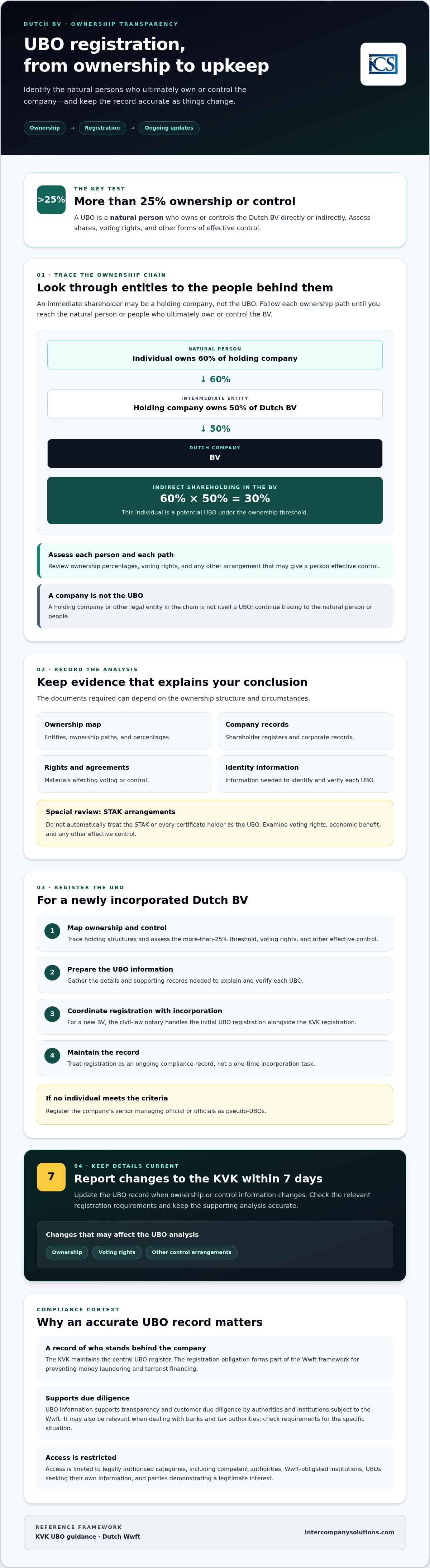
Apply the UBO threshold of more than 25% to ownership and control, then trace each ownership path to the individuals behind the Dutch entity. A person can qualify through shares, voting rights or another form of effective control. A company or foundation in the ownership chain is not itself a UBO because a UBO must be a natural person.
Direct ownership is held by an individual in the Dutch entity. Indirect ownership runs through one or more intermediate entities. For example, if an individual owns 60% of a holding company and that holding company owns 50% of a Dutch BV, the individual’s indirect shareholding in the BV is 30%. This makes the individual a potential UBO under the ownership threshold. Assess each chain and each person separately, including voting rights and any other control rights.
The 25% Threshold and Ownership Evidence
For each ownership path, record the entities, ownership percentages and relevant rights. Keep supporting materials such as shareholder registers, corporate records, ownership charts and agreements that affect voting or control. These records help explain the analysis if the KVK requests evidence. The documents needed can depend on the structure and circumstances. The KVK’s UBO guidance sets out registration information and how an interest is recorded.
A STAK, or Dutch foundation that holds shares and issues depositary receipts, requires a closer review. Don’t automatically treat the STAK as the UBO or assume every certificate holder qualifies. Examine who holds voting rights, who receives the economic benefit and whether any person has other effective control. The legal and contractual arrangements determine which individuals meet the criteria.
Control and the Pseudo-UBO
Share percentage alone doesn’t settle every case. Review the articles of association, shareholder agreements and other arrangements for rights that may give an individual decisive influence. These can include the ability to appoint or dismiss more than half of the directors, veto rights over key decisions, or influence over corporate strategy. Assess such rights in context. A veto over a limited matter does not automatically establish UBO status.
If no individual can be identified as a UBO through ownership or control, the company must register its senior managing official or officials as pseudo-UBOs. This is a fallback, not an exemption from registration. Identify the appropriate statutory director or board members, document why no qualifying individual was found, and ensure the registered details match the company’s current governance records. This analysis is a central step in the ultimate beneficial owner registration Netherlands process, particularly where foreign holding structures or layered control rights are involved.
The Ultimate Beneficial Owner Registration Netherlands Process for Dutch BVs
For a newly incorporated Dutch BV, the civil-law notary handles the initial UBO registration alongside the company’s registration with the Dutch Chamber of Commerce (KVK). The notary reviews the proposed ownership and control information as part of the incorporation process and carries out identity checks. Establish the ownership chain before the deed is executed, especially where foreign holding companies are involved.
Prepare accurate information about each identified UBO, including identity details and the nature and extent of their ownership or control. For a layered structure, provide an ownership chart and supporting corporate records so the route from the BV to each individual is clear. The KVK’s UBO registration guidance explains the information to be recorded. The KVK registration fee of €85.15 (2026, one-time) is the general registration fee, not a separate UBO filing fee.
Step-by-Step Filing Procedure
For a newly formed BV, the notary submits the initial registration as part of the incorporation and KVK process. Before filing, organise the information so discrepancies can be resolved promptly:
- Identify the natural persons who meet the UBO criteria and collect the identification documents requested for the notary’s checks.
- Map direct and indirect ownership, voting rights and other relevant control rights. Use an organisational chart when the structure has multiple entities.
- Confirm that names, ownership details and supporting documents are consistent before the notary submits the registration.
Don’t assume that a company appearing as a shareholder can be registered as the UBO. The filing must identify the natural person or persons who ultimately own or control the BV. For an existing BV, changes to UBO details must be reported to the KVK within 7 days.
Remote Registration for Foreign Founders
Non-EU founders can generally use the legalized Power of Attorney route for remote BV formation. The founder grants authority to act on their behalf, and the Dutch notary executes the deed without the founder travelling to the Netherlands. The notary will specify the required form of the Power of Attorney and which identity documents or legalization steps are needed for the founder’s circumstances. Requirements can vary based on the country where documents are signed or issued.
Intercompany Solutions reports a 3-5 day formation timeframe for remote Dutch BV formation, but this is not a statutory KVK or UBO confirmation deadline. Timing depends on document readiness, the notary’s checks and the registration process. The Dutch BV formation process includes the notarial and KVK steps. For foreign founders, understanding how those steps fit together is central to the ultimate beneficial owner registration Netherlands process.
Maintaining Compliance and Reporting Changes
UBO information must stay accurate after registration. If a change affects a UBO’s status or registered details, report it within 7 days. Changes can include a new qualifying owner, a revised ownership or control arrangement, or changed personal details. Check the current KVK requirements and submit updates promptly. An annual review should not delay reporting a change that has already occurred.
Trigger Events for Updates
Use changes in ownership, governance and personal information as prompts to review the register. For example, a share transfer may cause a new individual to cross the UBO threshold. A restructuring of a foreign parent company may also change who ultimately owns or controls the Dutch BV, even if the BV’s direct shareholder remains the same. Changes to a UBO’s address or nationality should also be checked against the registered details. The KVK’s UBO guidance explains how to report changes.
Maintain an ownership chart and keep relevant evidence, such as shareholder records and documents describing control rights, with the company’s records. Records must be retained for 7 years (10 for immovable property). During the annual preparation of financial statements, review whether the ownership chart, UBO details and supporting documents still match the company’s actual structure. Treat this as a practical control, not a separate annual UBO filing deadline.
Ongoing Compliance and Consequences
Assign responsibility for monitoring changes and make UBO checks part of routine corporate administration. A review alongside accounting and tax work can help identify share transfers or group restructures that need attention. Keep the UBO record consistent with governance documents and assess tax obligations separately, including the company’s corporate income tax position.
Failure to meet UBO registration obligations can lead to enforcement. Under the 2026 administrative fine policy, the standard first-time fine is €2,750. Repeat offences can attract a higher fine, and serious cases may result in criminal prosecution. The applicable response depends on the facts and the nature of the breach. Check the KVK’s current guidance and address discrepancies without delay.
Use a scheduled annual review to catch record inconsistencies, but act as soon as a reportable change occurs. This distinction is central to the ultimate beneficial owner registration Netherlands process: monitoring supports accuracy, while the 7-day deadline governs reporting after a change.
For help coordinating incorporation and ongoing compliance, contact Intercompany Solutions to discuss UBO compliance for your Dutch BV.
Strategic Considerations for International Entrepreneurs
For international founders, UBO records also form part of the information used in wider business checks. Keep the ownership chart and supporting corporate documents consistent with the company’s actual structure. Banks and tax authorities assess matters under their own procedures, so an accurate UBO filing supports those processes but does not guarantee an account or determine a VAT outcome.
Banking and Fiscal Integration
The Belastingdienst house bank is Rabobank since 1 May 2026, as reflected in the Belastingdienst’s information on its bank account. This concerns the tax authority’s banking arrangement. It does not require a business to bank with Rabobank. A bank considering a business account may conduct its own customer due diligence and request information about the company’s owners, controllers, activities and source of funds. Confirm the document requirements directly with the bank.
UBO registration and VAT registration are separate procedures. A foreign-owned entity should assess whether its activities create a Dutch VAT registration obligation and apply through the relevant Belastingdienst process. The tax authority may request business and ownership information, but a UBO entry alone does not establish VAT liability or guarantee that a VAT number will be issued. See the Belastingdienst’s VAT guidance for current requirements. For foreign-owned entities, VAT registration typically takes 6–8 weeks.
For international trade or a request for tax treaty relief, counterparties or authorities may ask for documents explaining the company’s ownership and tax position. UBO evidence can help identify the natural persons behind the entity, but it does not alone establish eligibility for treaty benefits. Check the rules and evidence requirements for the specific transaction and relevant countries.
Privacy and Practical Support
UBO data is not generally open to public inspection. A party seeking access on the basis of legitimate interest must meet the applicable criteria. Access is not automatic. The KVK describes the rules in its UBO registration guidance. Keep personal information accurate while sharing supporting documents only where a competent authority or institution has a valid reason to request them.
International founders can use a structured incorporation process to coordinate company formation and related filings. Review the steps for starting a business in the Netherlands, and verify legal and tax requirements with the relevant Dutch authorities. This helps keep UBO records aligned with the company’s wider administrative responsibilities without treating registration as a substitute for banking, VAT or treaty-specific checks.
Keep Your Dutch BV’s UBO Records Current
Reliable UBO compliance starts with tracing ownership and control to the relevant individuals, including through indirect holdings. For a new BV, the notary handles the initial UBO registration with the KVK. After registration, review the information when ownership or personal details change, and report updates within 7 days.
The ultimate beneficial owner registration Netherlands process is both an incorporation step and an ongoing responsibility. Keep clear supporting records, check that the registered information remains accurate, and account for the separate due diligence requirements banks and other institutions may apply.
For foreign founders, Intercompany Solutions facilitates remote Dutch BV formation, with a stated formation timeframe of 3-5 days, and provides secretarial support for ongoing compliance. The timeframe concerns formation and is not a guarantee of UBO confirmation or completion of other external checks.
With a documented ownership structure and a clear process for reviewing changes, you can approach Dutch compliance with greater confidence and keep your company’s records in order.
Frequently Asked Questions
What is the minimum share capital required for a Dutch BV in 2026?
The minimum share capital for a Dutch BV is €1. This is the minimum capital amount, not the total cost of establishing or operating a BV. Incorporation also requires a notarial deed, and other costs may apply. The capital requirement is separate from the KVK registration fee. Check the Dutch government’s BV guidance for information about this legal structure.
How quickly must UBO changes be reported to the Dutch Chamber of Commerce?
Report UBO changes within 7 days. The reporting deadline applies when registered UBO information changes, including details about identity, ownership or control. Keep a record of changes and the date they take effect so the company can submit updates promptly. The KVK’s UBO registration guidance explains how to report changes and what information may be required.
Which Dutch bank serves as the house bank for the Belastingdienst in 2026?
The Belastingdienst house bank is Rabobank since 1 May 2026. This is the tax authority’s banking arrangement; it does not require a business to hold an account with Rabobank. A business account application is separate, and the chosen bank sets its own assessment process. Check the bank’s requirements directly, including what ownership and control information it needs for customer due diligence.
Is UBO registration mandatory for non-resident owners of a Dutch company?
Yes. A Dutch BV must register its UBOs even if its owners live outside the Netherlands. The obligation applies to the Dutch company, so the owners’ country of residence does not remove the registration requirement. The company must identify the relevant natural persons through its ownership and control structure. The KVK’s guidance sets out registration requirements for Dutch entities.
What are the corporate tax rates for a Dutch BV in 2026?
The corporate income tax rate is 19% on profits up to €200,000 and 25.8% on profits above that amount. The applicable tax depends on the company’s taxable profit and circumstances. UBO registration does not determine the company’s tax treatment. Consult the Belastingdienst’s corporate income tax information to check the rules and rates applicable to the company.
Can UBO registration be completed remotely for foreign entrepreneurs?
Yes. For a newly incorporated Dutch BV, the notary handles the initial UBO registration alongside the KVK registration. Non-EU founders can use the legalized Power of Attorney route, under which the Dutch notary executes the deed without the founder travelling to the Netherlands. The notary will confirm the documents and identity checks required for the specific ownership structure and the countries involved.
What is the KVK registration fee for a new Dutch company in 2026?
The KVK registration fee is €85.15 (2026, one-time). This is the general fee for registering a new company with the KVK, not a separate UBO filing fee. It is distinct from notarial and other professional costs that may apply during incorporation. Review the KVK’s registration information for current fee and filing details before submitting an application.
Sources
- KVK - Registering with the Dutch Business Register
- Business.gov.nl - Private limited company (bv)
- Burgerlijk Wetboek Boek 2 (Dutch Civil Code, legal entities)
- Rijksoverheid - Ondernemen
- Belastingdienst - VAT (btw) for entrepreneurs
- European Commission - VAT rules and rates
- De Nederlandsche Bank - Supervision
- AFM - Licences and registers
- RVO - Doing business internationally
- Belastingdienst Douane - Customs
- CJEU, Cadbury Schweppes, C-196/04 (ECLI:EU:C:2006:544)
- Hoge Raad, ECLI:NL:HR:2021:1152
- PwC Worldwide Tax Summaries - Netherlands
- ICLG - Corporate Governance Laws and Regulations, Netherlands
Need more information on the Dutch BV company?
Contact an expertReady to start your company in the Netherlands?
| Formation time | Dutch BV formation completed in 3 to 5 business days |
|---|---|
| Process | Fully remote setup with step-by-step guidance |
| Compliance | Expert support for registration, VAT and compliance |
| Aftercare | Accounting, tax and legal support included |
| One partner | All of the above through one trusted formation partner |