


September 6, 2026 · 18 min read
The Netherlands attracted USD 43 billion in foreign direct investment in the first quarter of 2026, ranking as the world's second-largest recipient of international capital. This influx confirms the country's status as a primary hub for global trade, even as regulatory requirements for foreign founders become more specific. You're likely aware that a Dutch presence offers significant logistical advantages, but the uncertainty regarding travel mandates and non-EU resident rights often slows the expansion process.
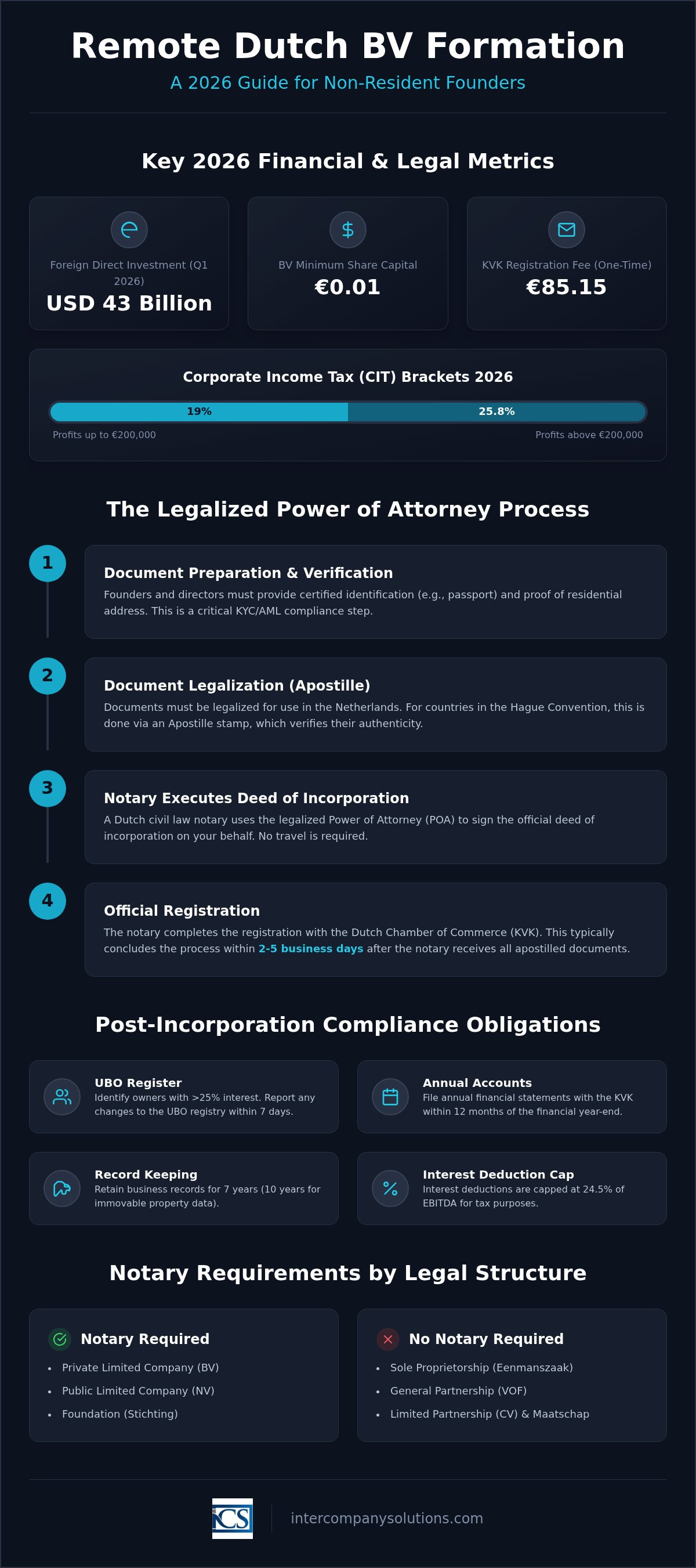
This guide explains how to start a business in the Netherlands remotely using the legalized Power of Attorney route, which allows for full incorporation without a physical visit to a notary. We provide a technical overview of the 2026 legal landscape, including the €85.15 KVK registration fee and the two-bracket corporate tax system where a 19% rate applies to the first €200,000 of profit. You'll learn the precise steps for statutory compliance, from meeting the 24.5% EBITDA interest deduction cap to filing annual accounts within 12 months of year-end. This professional framework ensures your Dutch BV is established with the procedural accuracy required by the Belastingdienst and the Chamber of Commerce.
Key Takeaways
- Non-resident entrepreneurs can legally own and direct a Dutch BV without maintaining a physical presence in the country.
- You can start a business in the Netherlands remotely by utilizing the legalized Power of Attorney process, which eliminates the need for international travel during incorporation.
- Formation requirements for 2026 include a one-time KVK registration fee of €85.15 and a minimum share capital of €0.01 for the private limited company structure.
- Corporate tax compliance involves a two-bracket system with a 19% rate for profits up to €200,000 and a requirement to report UBO changes within seven days.
- The standard remote registration timeline typically spans two to five business days once the notary receives the apostilled documentation.
Table of Contents
Legal Framework for Remote Dutch Company Formation
Dutch corporate law provides a flexible foundation for international expansion, specifically through the Besloten Vennootschap (BV). It's entirely legal for non-residents to own and direct a Dutch BV without maintaining a physical residence in the country. This regulatory openness is a key driver for foreign investment, as detailed in this Dutch economic overview. Many entrepreneurs choose to start a business in the Netherlands remotely to capitalize on the country's stable legal environment and strategic location. While the law allows for various structures, the BV remains the standard for remote setups because it offers limited liability and a professional image for global trade. To incorporate, you'll need at least one shareholder and one director. These roles can be held by the same individual, regardless of their residency status or nationality.
Every Dutch company must maintain a local business address for registration with the Chamber of Commerce (KVK). This address serves as the official point of contact for the Dutch tax authorities (Belastingdienst). Additionally, you must identify all Ultimate Beneficial Owners (UBOs) who hold more than 25% of the shares or voting rights. Under current 2026 regulations, any changes to UBO details must be reported to the registry within 7 days to maintain compliance.
The Role of the Dutch Notary
A civil law notary is mandatory to incorporate a BV, NV, or stichting in the Netherlands. Unlike simpler forms like the eenmanszaak or VOF, these structures require a formal deed of incorporation. The notary holds a public office and is responsible for verifying the identity of all founders and ensuring the articles of association comply with Dutch law. For those who start a business in the Netherlands remotely, the notary executes the deed based on a legalized Power of Attorney. Once the deed is signed, the notary handles the initial registration with the KVK, where a one-time registration fee of €85.15 applies in 2026. This process ensures the company is legally recognized and ready for tax registration.
Residency and Visa Considerations
Owning a Dutch company doesn't grant an automatic right to live or work in the Netherlands. Non-EU residents can own 100% of the shares and act as managing directors from abroad without any specific visa. If you plan to visit for business meetings, a standard Schengen visa allows for stays up to 90 days. It's vital to distinguish between business ownership and the Highly Skilled Migrant (HSM) program. To live in the Netherlands permanently as an entrepreneur, you'd typically need to apply for a startup visa or a self-employed permit through the IND. For those focusing on purely remote operations, Dutch BV Company Formation provides the necessary legal vehicle to access the European market without relocation.
Last reviewed: September 2026
The Legalized Power of Attorney Process
The primary mechanism for non-resident founders to start a business in the Netherlands remotely is the legalized Power of Attorney (POA). While Dutch law allows for digital incorporation in certain domestic scenarios, the POA remains the standard for international entrepreneurs due to stringent identification requirements. This document grants a local representative the authority to sign the deed of incorporation before a Dutch notary on your behalf. It ensures that the formation process proceeds without the need for international travel, maintaining full compliance with Dutch anti-money laundering (AML) and Know Your Customer (KYC) protocols.
Verification is the most critical phase of this process. Every founder and director must complete a comprehensive checklist that includes providing certified identification and proof of residential address. For those who eventually seek a residence permit for a start-up, having a correctly incorporated BV is a prerequisite. For remote operations, the focus remains on the accuracy of the underlying documentation and its acceptance by the Dutch authorities.
Document Legalization and Apostille
To be valid in the Netherlands, your local documents must undergo legalization. If your home country is a member of the Hague Apostille Convention, you can obtain an apostille stamp from your local designated authority. This single stamp confirms the document's authenticity for use in Dutch legal proceedings. If your country is not a member, you'll need to follow a multi-step legalization process involving your local Ministry of Foreign Affairs and the Dutch embassy or consulate. This step is non-negotiable; the notary cannot execute the deed without verified, legalized copies of your passport and proof of address. If you're unsure about the specific requirements for your jurisdiction, you can contact our specialists for a localized document checklist.
Executing the Deed of Incorporation
Once the original legalized documents reach the notary's office in the Netherlands, the timeline for execution is efficient. The notary typically signs the deed of incorporation within 2 to 5 business days. At this moment, the Dutch BV officially gains its legal personality. Following the signature, the notary registers the company with the Chamber of Commerce (KVK), where the €85.15 registration fee is settled. It's also at this stage that the company is registered with the tax authorities. Since 1 May 2026, Rabobank has served as the house bank for the Belastingdienst, and all tax-related payments or refunds will flow through this institutional framework. Your company's legal existence is confirmed the moment the deed is signed, allowing you to begin operational planning immediately.
Last reviewed: September 2026
Statutory Requirements and Costs in 2026
Establishing a Dutch BV involves specific fixed statutory fees and capital requirements that must be met during the formation process. For entrepreneurs who start a business in the Netherlands remotely, these costs are predictable and transparent. The Dutch Chamber of Commerce (KVK) charges a one-time registration fee of €85.15 in 2026. This fee is paid directly to the KVK upon the company's entry into the Trade Register. Additionally, the minimum share capital for a Dutch BV is set at a nominal €0.01. This allows founders to allocate capital based on their operational needs rather than legislative mandates.
Beyond the initial setup, companies must adhere to ongoing statutory obligations. Corporate Income Tax (CIT) is structured in two brackets for 2026: a rate of 19% applies to taxable profits up to €200,000, while profits exceeding this threshold are taxed at 25.8%. Your company must also file annual accounts with the KVK within 12 months of the financial year-end. To ensure financial compliance, all records must be retained for at least 7 years; this period extends to 10 years for documentation related to immovable property.
Corporate Structure Comparison
Choosing the correct legal form is essential for liability protection and tax efficiency. While several structures exist, the BV is the primary choice for international entrepreneurs. Unincorporated structures like the eenmanszaak do not offer a separate legal personality, meaning the owner is personally liable for all business debts. The following table outlines the key differences between common Dutch business entities in 2026.
| Feature | Dutch BV (Limited) | Eenmanszaak (Sole Trader) | VOF (Partnership) |
|---|---|---|---|
| Notary Required | Yes | No | No |
| Minimum Capital | €0.01 | None | None |
| Liability | Limited to company assets | Unlimited personal liability | Unlimited personal liability |
| Remote Formation | Possible via POA | Requires residency | Requires residency |
UBO Register and Transparency Rules
Transparency is a cornerstone of the Dutch corporate landscape. Every BV is required to register its Ultimate Beneficial Owners (UBOs) in the national UBO register. A UBO is defined as any individual who holds more than 25% of the shares, voting rights, or ownership interest in the company. Following a 2022 EU court ruling, public access to this register is restricted in 2026. Access is granted only to competent authorities like the Belastingdienst and "obliged entities" such as banks and notaries for due diligence purposes.
Compliance with UBO regulations is strictly monitored. Any changes to the status or details of a company's UBOs must be reported to the KVK within 7 days of the change. Failure to maintain an accurate UBO registry can lead to administrative fines or legal complications. For more detailed information on common misconceptions regarding the formation process, you can explore our guide on how to incorporate in the Netherlands: Facts vs. Myths 2026.
Last reviewed: September 2026
Step-by-Step Remote Registration Timeline
The process to start a business in the Netherlands remotely is structured to provide speed and legal certainty for international founders. Once the notary receives the original legalized and apostilled documents, the turnaround for formal formation is typically 3 to 5 business days. This timeline begins with the initial document collection phase, where we provide a comprehensive checklist to ensure all identification and proof of address requirements are met. Accuracy during this preparatory stage is vital, as it prevents administrative delays during the notarial session and the subsequent entry into the Dutch Trade Register.
Following the document verification, the notary executes the deed of incorporation. At this point, the company is legally born and receives its unique registration numbers. The sequence of events moves from legal formation to tax registration and operational setup, ensuring that every regulatory box is checked before you commence trading in the European market.
Chamber of Commerce (KVK) Registration
Upon the execution of the deed of incorporation, the company is registered with the Chamber of Commerce (KVK). The KVK number is issued immediately, serving as the company's official identification for all domestic commercial activities. Simultaneously, the company receives its RSIN (Legal Entities and Partnerships Identification Number). The RSIN is a critical identifier used by the Dutch tax authorities (Belastingdienst) to link the entity to its tax records. It also serves as the basis for the company's VAT number. For more detailed answers on the nuances of this process, you can review our Netherlands company registration for non-residents guide.
Tax and Banking Setup
After incorporation, the company must apply for its VAT number and, if engaged in importing or exporting goods outside the EU, an EORI number. For foreign-owned entities, the VAT application process typically takes 6 to 8 weeks. The Belastingdienst conducts a thorough review to ensure the business is active and compliant. During this window, you should finalize your banking infrastructure. Since 1 May 2026, Rabobank has served as the house bank for the Belastingdienst, facilitating all government-related financial transactions. While opening a business account for a non-resident BV requires specific documentation and evidence of business ties to the Netherlands, we provide assistance with the bank account opening process to ensure your company reaches full operational readiness. You can find further details on the broader requirements for starting a business in the Netherlands on our dedicated resource page.
Last reviewed: September 2026
Post-Incorporation Compliance and Tax Obligations
The successful formation of your company is only the first phase of international expansion. Once you start a business in the Netherlands remotely, you must adhere to the specific fiscal and administrative requirements set by the Dutch tax authorities (Belastingdienst). Maintaining compliance ensures your entity retains its legal standing and avoids administrative penalties. The Dutch system operates on a principle of transparency and regular reporting; it's a framework that requires business owners to be proactive in their financial management.
The primary tax obligation for a Dutch BV is Corporate Income Tax (CIT). For the 2026 fiscal year, the CIT rate is 19% on taxable profits up to €200,000. Profits exceeding this threshold are taxed at a rate of 25.8%. Your business must also manage Value Added Tax (VAT), which is typically charged at a standard rate of 21% or a reduced rate of 9% for specific goods and services. A significant change in 2026 is the transition of the Belastingdienst house bank. Since 1 May 2026, Rabobank has served as the official institution for all tax-related financial flows.
Mandatory Record Keeping
Dutch law dictates strict protocols for the preservation of business data. You're required to retain all primary records for a period of at least 7 years. These records include your ledger, invoices, bank statements, and contracts. If your business owns or manages immovable property, this retention requirement extends to 10 years. Digital storage is permitted, provided the data remains accessible and legible for audit purposes. Ensuring these records are accurate is a prerequisite for your annual filings. You can learn more about managing these requirements in our guide on accounting for Dutch BV.
Corporate Income Tax and CIT Monitoring
Managing your CIT liability involves more than just profit calculation. The Dutch government applies an interest deduction limitation, known as the earnings stripping rule. For 2026, the deduction for net interest costs is capped at the higher of €1 million or 24.5% of the company's EBITDA. This rule prevents excessive debt-loading and is a critical consideration for group structures. You must also file your annual accounts with the Chamber of Commerce (KVK) within 12 months of the financial year-end. Choosing the right entry model impacts these obligations. For a comparison of different setups, see our analysis of the Dutch BV vs branch office.
Last reviewed: September 2026
Strategic Expansion into the Dutch Market
The 2026 Dutch corporate landscape remains highly accessible for international entrepreneurs who utilize the legalized Power of Attorney route. By following a structured timeline, you can achieve a legal turnaround in 3 to 5 business days without the need for physical travel. This process ensures your Dutch BV meets all statutory requirements, including the €85.15 KVK registration fee and the 24.5% EBITDA interest deduction cap. Choosing to start a business in the Netherlands remotely allows you to leverage a stable 19% corporate tax rate on initial profits while maintaining your global mobility.
Professional support for non-EU founders simplifies the entry into the European market. Our specialists provide comprehensive assistance with VAT registration and banking setup, ensuring your new entity is fully operational and compliant with the latest Belastingdienst standards. We're ready to facilitate your professional growth in the Netherlands through a reliable and transparent incorporation process.
Last reviewed: September 2026
Frequently Asked Questions
Can a non-resident start a Dutch business without visiting the Netherlands?
Yes, non-residents can start a business in the Netherlands remotely by using the legalized Power of Attorney (POA) route. This procedure allows a local representative to sign the deed of incorporation before a Dutch notary on your behalf. You must provide legalized and apostilled identification documents from your home country. This framework ensures that you can establish a fully compliant Dutch BV without the need for international travel or a physical presence during the formation phase.
What is the minimum share capital for a Dutch BV in 2026?
The minimum share capital required to incorporate a Dutch BV is €0.01. This nominal requirement was introduced to lower the barrier to entry for international entrepreneurs. You can choose to issue a higher amount of capital depending on your specific business needs or investor requirements. The capital must be formally recorded in the deed of incorporation and reflected in the company's initial balance sheet and subsequent annual filings with the Chamber of Commerce.
How long does the remote incorporation process take?
Remote incorporation of a Dutch BV typically takes 3 to 5 business days once the notary receives your original legalized documents. This timeline includes the execution of the deed and registration with the Dutch Chamber of Commerce (KVK), where a one-time fee of €85.15 applies in 2026. Please consider that additional time is required for document legalization and the 6 to 8 week application period for a VAT number for foreign-owned entities.
Which bank handles Dutch Tax Administration payments in 2026?
Rabobank has served as the official house bank for the Dutch Tax Administration (Belastingdienst) since 1 May 2026. All corporate tax payments, VAT settlements, and government refunds for your Dutch business are processed through this institutional framework. While you can maintain operational accounts at other financial institutions, your interactions with the tax authorities will be facilitated through Rabobank's systems. This central transition ensures a standardized flow for all statutory financial obligations within the Netherlands.
What are the corporate income tax rates for Dutch companies in 2026?
Dutch companies are subject to a two-bracket corporate income tax (CIT) system in 2026. A rate of 19% applies to the first €200,000 of taxable profit. Profits exceeding this threshold are taxed at a rate of 25.8%. It's essential to monitor these thresholds and ensure your tax filings are submitted correctly. Additionally, the interest deduction cap for 2026 is limited to the higher of €1 million or 24.5% of the company's EBITDA.
Is a local Dutch director required for a remote BV setup?
No, Dutch law does not require you to appoint a local resident director to start a business in the Netherlands remotely. A non-resident individual or a foreign legal entity can serve as the sole director and shareholder of a Dutch BV. While you must maintain a local business address for registration purposes, the management and control of the company can be exercised entirely from abroad. This flexibility allows foreign founders to maintain full control over their Dutch operations.
What is the UBO registration threshold for Dutch companies?
The threshold for registration in the Dutch Ultimate Beneficial Owner (UBO) register is an ownership interest of more than 25%. Any individual holding more than 25% of the shares, voting rights, or ownership interest must be registered. Compliance is strictly enforced; any changes to UBO details must be reported to the Chamber of Commerce within 7 days. Access to this register is restricted to competent authorities and specific entities such as banks and notaries.
What are the VAT rates currently applicable in the Netherlands?
The standard VAT rate in the Netherlands is 21%, which applies to most goods and services. A reduced rate of 9% is applicable to specific items such as food, medicines, and certain books. A 0% rate exists for international trade and specific cross-border services. Effective from 1 January 2026, the VAT rate on overnight accommodation has increased to 21%. Foreign-owned entities should expect a VAT registration timeline of approximately 6 to 8 weeks after incorporation.
Sources
- KVK - Registering with the Dutch Business Register
- Business.gov.nl - Private limited company (bv)
- Burgerlijk Wetboek Boek 2 (Dutch Civil Code, legal entities)
- Rijksoverheid - Ondernemen
- Belastingdienst - Corporate income tax rates
- Belastingdienst - VAT (btw) for entrepreneurs
- European Commission - VAT rules and rates
- IND - Highly skilled migrant
- IND - Start-up residence permit
- De Nederlandsche Bank - Supervision
- AFM - Licences and registers
- RVO - Doing business internationally
- Belastingdienst Douane - Customs
- CJEU, Cadbury Schweppes, C-196/04 (ECLI:EU:C:2006:544)
- Hoge Raad, ECLI:NL:HR:2021:1152
- PwC Worldwide Tax Summaries - Netherlands
- ICLG - Corporate Governance Laws and Regulations, Netherlands
Need more information on the Dutch BV company?
Contact an expertReady to start your company in the Netherlands?
| Formation time | Dutch BV formation completed in 3 to 5 business days |
|---|---|
| Process | Fully remote setup with step-by-step guidance |
| Compliance | Expert support for registration, VAT and compliance |
| Aftercare | Accounting, tax and legal support included |
| One partner | All of the above through one trusted formation partner |