

November 9, 2026 · 16 min read
For an agritech company, the best Dutch base is not automatically the largest city. Setting up an agritech business in the Netherlands often leads founders to consider South Holland, where horticulture, greenhouse technology and related businesses form a concentrated ecosystem. The right location still depends on what the company will do and whether the site suits those activities.
When setting up an agritech business in the Netherlands, weigh access to customers, research partners and production facilities alongside practical requirements. A registered business address and local zoning rules can affect which activities suit a particular site, while the legal structure shapes how the company is established and administered.
This article explains how South Holland’s agritech ecosystem compares with other Dutch opportunities, what to consider when selecting a location, and how zoning and legal structure fit into the setup. It also outlines the market factors that may matter to international founders, so you can assess which location and operating model align with your plans.
Key Takeaways
- Assess South Holland’s greenhouse and horticulture cluster against your need for research links, production facilities and customers.
- Match your planned activities to the location: a Dutch business address is required for registration, and zoning can restrict permitted uses.
- Choose a legal structure based on your operating model and liability needs; a BV requires a notary, while several partnership forms do not.
- Evaluate Dutch market opportunities in light of the country’s export activity and the role of processing and re-exporting agricultural goods.
- Identify which permits and regulatory requirements apply to your specific activities, especially if your business involves farming or food production.
Table of Contents
- South Holland’s horticulture and agritech ecosystem
- Business location and zoning
- Legal business structure
- Market opportunities for international agritech businesses
- What permits and regulations apply to agriculture, food production, and agricultural technology in the Netherlands?
- Intercompany Solutions
South Holland’s horticulture and agritech ecosystem
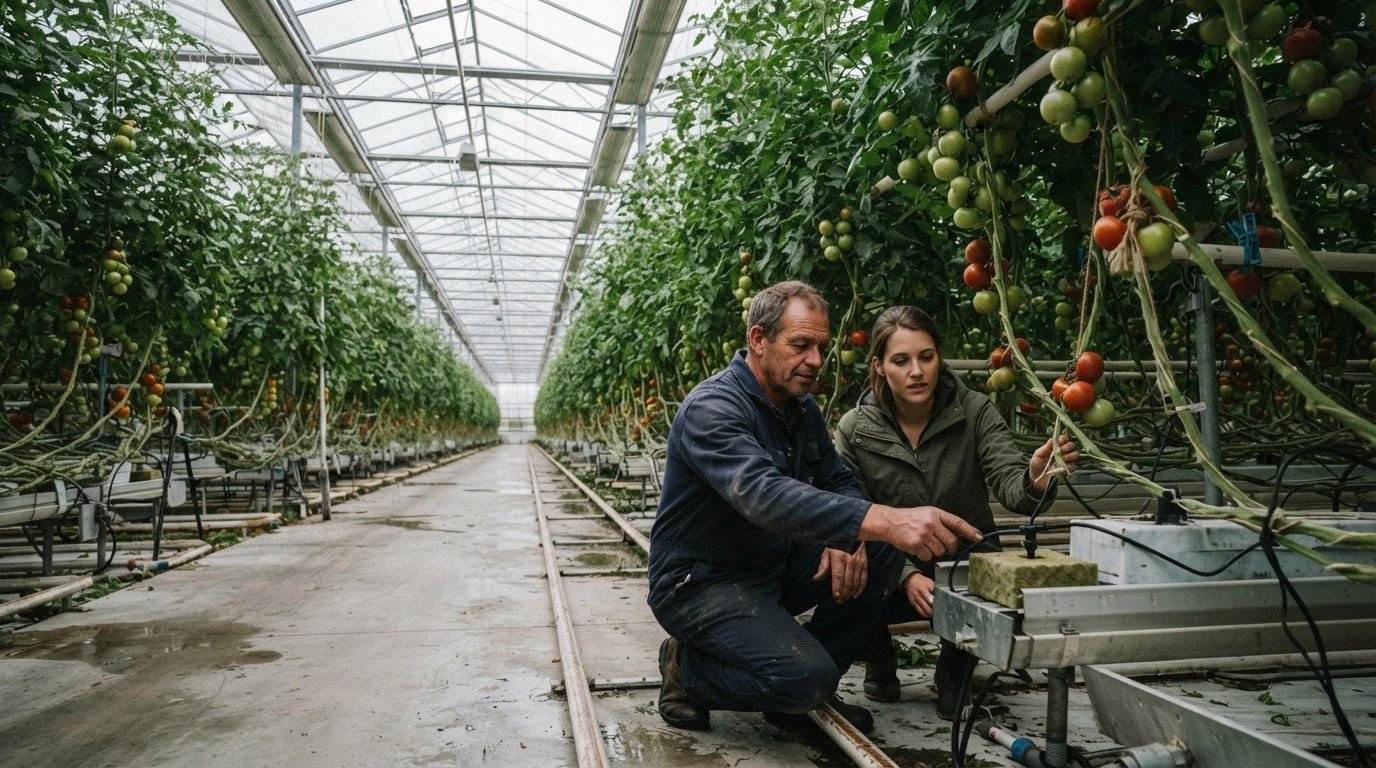
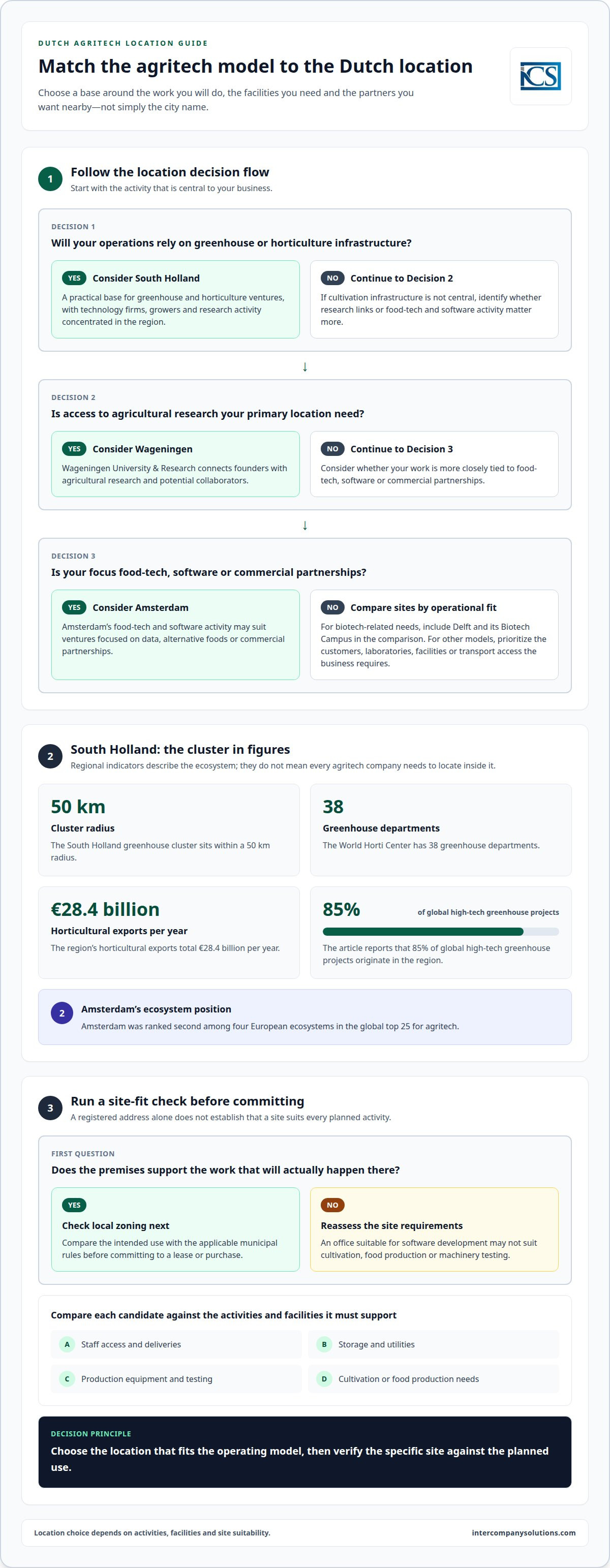
South Holland is a practical base for greenhouse and horticulture ventures, with technology firms, growers and research activity concentrated in the region. Amsterdam has a separate agritech and food-tech ecosystem, while Wageningen connects founders with agricultural research.
The South Holland greenhouse cluster sits within a 50 km radius, and the World Horti Center has 38 greenhouse departments. The region’s horticultural exports total €28.4 billion per year, while 85% of global high-tech greenhouse projects originate there. These figures describe a connected environment for testing growing systems, sensors and production methods. They do not mean every company needs to locate inside the cluster: software and equipment businesses may prioritize access to customers, laboratories or transport.
Amsterdam was ranked second among four European ecosystems in the global top 25 for agritech. Its food-tech and software activity may suit ventures focused on data, alternative foods or commercial partnerships. Wageningen University & Research brings agricultural research into the wider country ecosystem, while Delft adds the Biotech Campus. Together, these institutions help founders identify relevant expertise and potential collaborators.
Startup support can include mentoring through an eligible facilitator. Non-EU founders applying for the Dutch startup residence permit need a signed agreement with a facilitator experienced in guiding innovative startups. The permit lasts one year, making facilitator selection relevant to both business development and the immigration route.
Grants and Tax Incentives
Grants, subsidies and tax incentives are forms of public support that may reduce the cost of eligible innovation or investment. Their relevance depends on the company’s activity and each scheme’s conditions. The Netherlands Enterprise Agency (RVO) publishes information about business support schemes; assess eligibility against the project’s research, development and production plans rather than assuming a scheme will apply.
Facilities and Funding Options
Facilities include farmland, greenhouses, laboratories and incubators used to develop or test an agritech product. Their suitability depends on whether the business needs cultivation space, controlled growing conditions or research capacity. Funding can include private investment: Dutch agritech startup Almacena raised a further €3.5 million in early 2023. That example illustrates one route, not a typical funding amount or a guarantee of investment.
Agricultural drones, sensors, AI, data and precision-farming tools can be subject to different Dutch and EU requirements, depending on how they operate and use data or equipment. Identify each product’s functions and intended use, then map the rules relevant to those activities.
For non-EU founders, the one-year startup residence permit requires an agreement with an experienced facilitator. After it ends, a founder can continue under the self-employment scheme. Immigration eligibility and permission to work depend on the route used.
Startup costs depend on the site, equipment, staffing, research needs and production model. A software venture and a greenhouse operator have different cost drivers, so build the budget around planned activities rather than relying on a general industry estimate.
Access to farmland, greenhouses, laboratories and incubators depends on the facilities needed for the business model and the intended use of each site. Founders can compare those requirements with regional options, then use guidance on starting a business in the Netherlands to understand the company setup process.
Business location and zoning
A Dutch business needs a registered address in the Netherlands, and zoning rules may restrict activities at a particular site. Before committing to a location for an agritech venture, assess whether its premises suit the intended use.
Choosing a Business Location
Choosing a business location means matching the company’s operations to a suitable address and site. This matters because an address used for registration does not automatically make every planned activity suitable there. Business.gov.nl’s guidance on business locations is a useful starting point for understanding location considerations.
First, define the work that will take place on the premises. An agritech software company may need space for staff and equipment testing, while a greenhouse operator needs a site suited to cultivation. A business handling food production should include those activities when comparing locations. These operating needs help define what a suitable property must provide.
Compare candidate sites against practical needs, including staff access, deliveries, storage, utilities and production equipment. A site suited to office-based development may not work for greenhouse operations or machinery testing. Distinguish these requirements early, because a change in operating model can also change which site features matter most.
Then assess the local zoning position. In the Netherlands, zoning regulations may restrict which business activities are permitted at a particular location. The intended use of a building or plot, for example, may not align with cultivation, food production or equipment testing. Review the applicable municipal rules for the site and planned activities before committing to a lease or purchase.
Agriculture and Technology Permits
Permits and regulatory requirements depend on the company’s activities, products and operating locations. Agriculture, food production and technology development can involve different assessments. Describe each planned activity separately instead of relying on the broad label “agritech.”
For example, distinguish between developing a sensor, testing it on a farm, operating a greenhouse and handling food. The product’s intended use and where the work takes place help identify the requirements to consider. An office-based software venture has a different operational profile from a company growing crops or processing food.
Use the same activity description to assess premises and plan operations. Record what the company will do, which equipment it will use, and whether crops or food will be handled on site. This links location decisions to relevant regulatory questions and prevents treating an office, laboratory and production site as interchangeable.
Legal business structure
A Dutch agritech venture can operate through a sole proprietorship, partnership or legal entity. The right form depends on ownership, collaboration, investment plans and how the business will manage liability and administration. Business.gov.nl explains the main Dutch legal structures, including which forms require a notary.
For farming founders, the choice of structure affects how growers, software developers and investors work together. A founder testing a sensor independently may choose differently from farmers forming a shared company or an international team seeking investment. Consider ownership and development plans before selecting a legal form.
| Structure | Notary required? | Typical consideration |
|---|---|---|
| Eenmanszaak | No | One individual operates the business. |
| VOF | No | Partners operate a business together. |
| CV | No | General and limited partners have different roles. |
| Maatschap | No | Professionals collaborate under a shared arrangement. |
| BV | Yes | A legal entity suited to a company with shareholders. |
| NV | Yes | A legal entity with shares that can be transferable. |
| Stichting | Yes | A legal entity without shareholders. |
An eenmanszaak may suit an individual founder, while a VOF or maatschap can formalize collaboration. A CV distinguishes general partners from limited partners. These forms do not require a notary, while a BV, NV and stichting do. Partners should document decision-making, contributions and profit allocation in their agreements.
A BV requires a notarial deed of incorporation. For a BV, the UBO threshold >25%; UBO changes reported within 7 days. According to KVK, annual accounts filed with KVK within 12 months of year-end.
Tax and administration depend on the company’s activities. VAT rates 21%/9%/0%. For foreign-owned entities, VAT typically takes 6-8 weeks. The Belastingdienst house bank is Rabobank since 1 May 2026.
Plan recordkeeping and governance alongside product development. The applicable retention periods are records retained 7 years (10 for immovable property). A venture involving farmers, research partners and investors should also define who owns its technology and how future decisions are made. These arrangements help the legal structure support collaboration as the business grows.
Market opportunities for international agritech businesses
The Netherlands offers international entrepreneurs opportunities in production, processing and agricultural technology. Export activity can connect businesses with customers beyond the domestic market, while established research and business networks can support product development.
The Netherlands is the world’s second-largest exporter of agricultural produce, after the United States. It exported €79.8 billion in agricultural products in 2022, compared with total EU agricultural exports of €133.7 billion. More than half of Dutch agricultural exports, €42.5 billion, came from processing and re-exporting imported goods. That distinction matters: opportunities can lie in logistics, processing and production technology, not only crop growing.
Agricultural exports accounted for approximately 17.5% of total Dutch exports, and about 73% of Dutch agricultural production or technologies were exported. These figures indicate international demand and the sector’s outward focus. Agritech entrepreneurs can consider whether their product supports export-oriented growers, processors or supply chains. Examples include tools for monitoring crop quality, automating production or reducing resource use.
The startup base also provides context for market entry. The Netherlands had over 290 agritech-related start-ups in recent years. A directory recorded 88 agri-tech software companies with 1-10 employees as of October 1, 2026, and 55 with 11-50 employees. These figures suggest activity across company sizes, although they do not establish demand for any particular product.
Research and innovation offer another point of access. The Netherlands spends almost a billion on agrifood research and development, while Wageningen University & Research is ranked the world’s number one agrifood university. The National Protein Strategy aims to deliver self-sufficient levels of plant proteins over the next five to ten years. These priorities create opportunities to develop plant-protein production, food processing and related technologies.
Regional strengths can help founders focus their commercial approach. Brabant accounts for 50% of Dutch patent applications, and over 30% of a study’s 1,600-plus Brabant high-tech companies were active in agritech. Amsterdam, Delft and Wageningen each have distinct research and business connections, so entrepreneurs can assess which location aligns with customers and collaborators.
Market size alone is not a sales plan. Define the buyer, the problem they face and the measurable value your product offers before choosing a route to market. For example, a software company could target growers who need production data, while an equipment firm could focus on processors seeking automation. This helps international founders turn Dutch sector opportunities into a specific commercial proposition.
The Netherlands exports €65 billion worth of agricultural products annually. Research cited on food demand estimates that 70% more food will be needed over the next 50 years to feed the global population adequately. Horticulture and agrifood are among the Netherlands government’s nine top sectors, and the country hosts production and R&D operations for all of the top 10 agrifood players. The agricultural sector contributed 1.4% to the economy. The directory also recorded 23 agri-tech software companies with 51-200 employees.
What permits and regulations apply to agriculture, food production, and agricultural technology in the Netherlands?
Requirements depend on a company’s activities, products and operating locations. A Dutch venture growing crops, processing food or developing farm software should assess each activity separately before launch.
Start by describing the business model in operational terms. Distinguish, for example, between developing a sensor, testing it on a farm, operating a greenhouse and selling produce. These activities have different practical implications, so the broad label “agritech” alone cannot identify the relevant rules or permissions.
For agricultural production, map the proposed site, cultivation method, inputs and outputs. For food production, describe how products are handled, processed and prepared for sale. This gives the business a clearer basis for assessing applicable requirements with the relevant Dutch authorities. Do not assume a technology company and a food producer face the same assessment simply because both serve agriculture.
Some government estimates aim to reduce total livestock numbers in the Netherlands by 30% by 2030. This context may matter to businesses developing livestock-related products or production models. It does not, by itself, establish a permit requirement for a particular company. Assess the actual activity and its location rather than treating a sector-wide estimate as an individual operating rule.
Agricultural technology also needs a product-specific assessment. For a drone, document its intended use, operating environment and role in farm work. For a sensor, define what it measures and how its output is used. For AI software, describe the decisions it supports, such as crop monitoring or production planning. These details help identify the regulatory questions relevant to the product and its use.
Include data in the assessment if a platform collects, stores or shares information. Record what data the system handles, who uses it and whether it connects to other equipment or services. A precision-farming tool that processes field measurements functions differently from an automated system that controls machinery. Clear product documentation helps focus the review.
Keep a written activity map linking each operation to its site, equipment and output. A greenhouse business might list cultivation, testing and produce handling separately; a software startup might document development, field trials and customer use. Update the map whenever the company changes its product or adds an activity. This provides a practical basis for identifying permit and regulatory questions before committing to a launch plan.
Requirements depend on the specific activity, product and use, not on a general “agritech” label. Document where and how the technology will be used, what data it handles and the role it plays. Use that assessment to identify relevant requirements with the appropriate Dutch authorities.
Intercompany Solutions
Intercompany Solutions helps international founders connect their Dutch business plans with the company structure and administration needed to operate. If a BV fits your agritech venture, Dutch BV Company Formation covers establishing the company, including registration and compliance support.
This support is relevant when you are moving from assessing the Dutch market to preparing a company for commercial activity. The right setup depends on your ownership, planned activities and operational needs. Contact Intercompany Solutions to discuss your plans for setting up an agritech business in the Netherlands and the next steps.
Plan for the next stage of your agritech venture
As your product moves from testing toward commercial use, review whether your company structure and operating arrangements still match its activities. Setting up an agritech business in the Netherlands is a starting point; keep business decisions aligned with the venture as it develops. Ground each next step in your intended market, operating model and growth plans.
Intercompany Solutions helps international founders with Dutch company formation. Contact the team when you are ready to discuss establishing your business in the Netherlands.
A clear plan gives your agritech venture a practical foundation for its next stage.
Frequently Asked Questions
Start by defining the business activities and choosing a legal structure that fits its ownership and operations. For founders setting up an agritech business in the Netherlands, registration also requires a physical Dutch business address. For a BV, a notary executes the deed of incorporation; non-EU founders can use a legalized Power of Attorney route without travelling. Register the company with the Netherlands Chamber of Commerce (KVK). KVK forwards company details to the Tax Administration for VAT registration where applicable.
Dutch agritech founders can choose from structures such as an eenmanszaak, VOF, CV, maatschap or BV. An eenmanszaak suits a single operator, while partnerships can accommodate collaboration; a BV is a separate legal entity and requires a notary. Tax obligations depend on the structure and activities. VAT rates are 21%/9%/0%, depending on the goods or services and applicable conditions.
Opportunities include helping growers and food businesses improve production, automate tasks or use agricultural data. Competition may come from software firms, equipment developers and established providers serving the same customers. Compare competitors by their target users and the problems their products address, rather than by company size alone. Key business risks include weak customer fit, difficulty integrating with existing operations and premises unsuited to planned activities. Pilot feedback can help test demand before scaling.
First identify whether the business needs cultivation space, controlled growing conditions or research capacity, then compare those needs with regional options. South Holland has a greenhouse cluster, while Wageningen offers agricultural research links and Delft has the Biotech Campus.
Sources
- KVK - Registering with the Dutch Business Register
- Business.gov.nl - Private limited company (bv)
- Burgerlijk Wetboek Boek 2 (Dutch Civil Code, legal entities)
- Rijksoverheid - Ondernemen
- Belastingdienst - Corporate income tax rates
- Belastingdienst - VAT (btw) for entrepreneurs
- European Commission - VAT rules and rates
- IND - Highly skilled migrant
- IND - Start-up residence permit
- BOIP - Trademark registration in Benelux
- WIPO - Madrid System
- RVO - Doing business internationally
- Belastingdienst Douane - Customs
- CJEU, Cadbury Schweppes, C-196/04 (ECLI:EU:C:2006:544)
- Hoge Raad, ECLI:NL:HR:2021:1152
- PwC Worldwide Tax Summaries - Netherlands
- ICLG - Corporate Governance Laws and Regulations, Netherlands
Need more information on the Dutch BV company?
Contact an expertReady to start your company in the Netherlands?
| Formation time | Dutch BV formation completed in 3 to 5 business days |
|---|---|
| Process | Fully remote setup with step-by-step guidance |
| Compliance | Expert support for registration, VAT and compliance |
| Aftercare | Accounting, tax and legal support included |
| One partner | All of the above through one trusted formation partner |