


August 30, 2026 · 17 min read
Establishing a Dutch branch office might appear to be an efficient entry strategy, but for many international firms, the absence of a distinct liability shield makes the parent company vulnerable to local debts and legal claims. In 2026, setting up a subsidiary in the Netherlands as a private limited company (BV) remains the most effective method for isolating risk and securing long-term regulatory stability. You're likely aware of the country's strategic position in the EU, but the specific administrative timelines for VAT registration and Corporate Income Tax (CIT) compliance require careful planning.
This article offers a professional analysis of the legal, fiscal, and administrative requirements for your Dutch establishment. We'll provide a clear decision framework for choosing between a BV and a branch while detailing the 2026 tax thresholds, including the 19% CIT rate for profits up to €200,000. You'll also find a validated path to remote incorporation via a legalized Power of Attorney, allowing for setup without the need for international travel. We'll cover everything from the €85.15 KVK registration fee and the six to eight week VAT timeline for foreign-owned entities to the updated banking infrastructure where Rabobank serves as the Belastingdienst house bank.
Key Takeaways
- Evaluate the liability advantages of a Dutch BV over a branch office to ensure the foreign parent company remains legally shielded from local obligations.
- Utilize the legalized Power of Attorney workflow for setting up a subsidiary in the Netherlands to complete the incorporation process without the need for international travel.
- Align your fiscal planning with 2026 tax standards, including the 19% Corporate Income Tax rate for profits up to €200,000 and the 24.5% EBITDA interest deduction cap.
- Account for administrative timelines and costs, such as the €85.15 KVK registration fee and the 6–8 week VAT application window for foreign-owned entities.
- Maintain regulatory compliance by implementing mandatory written employment agreements and adhering to Dutch social security and sick-leave requirements.
Table of Contents
The Strategic Landscape of Dutch Market Entry in 2026
The Netherlands continues to secure its position as a premier European hub, ranking as the 8th most innovative global economy according to the 2025 World Intellectual Property Organization (WIPO) report. For international corporations, setting up a subsidiary in the Netherlands offers a stable environment for capital growth and risk mitigation. The current investment climate has shifted toward 100% digital-ready entities, where administrative efficiency is prioritized over physical bureaucracy. This evolution allows for rapid market entry while maintaining high standards of regulatory compliance. It's a strategic move for firms looking to establish a robust footprint in the Eurozone while benefiting from a pro-business legislative framework.
Innovation and Education as Expansion Drivers
Access to a highly skilled labor force is a primary factor for corporate expansion. The Netherlands currently holds the 3rd place global ranking for education, ensuring a steady supply of specialized talent for the technology, finance, and healthcare sectors. With a 93% English proficiency rate among the local population, the country acts as the primary gateway for non-EU firms entering the European Union. This linguistic capability reduces operational friction and simplifies the integration of international management teams. The local infrastructure, including world-class logistics and digital connectivity, provides the necessary framework for scaling a Dutch private limited company (BV) across the continent. These factors combined create an ecosystem that supports global scaling for non-EU entrepreneurs who require a reliable base for international trade.
Remote Accessibility for Foreign Investors
Modern corporate governance in the Netherlands has fully normalized remote business management within the corporate register. Foreign investors don't need to reside in the country to maintain a compliant entity or oversee daily operations. The Dutch Chamber of Commerce (KVK) and the tax authorities have streamlined their systems to support cross-border digital governance for 2026. For non-resident founders, the standard route involves a legalized Power of Attorney (PoA), which enables a notary to execute the deed of incorporation on their behalf. This process eliminates the requirement for international travel during the formation phase.
Specialized firms act as the essential bridge between local Dutch law and global operational needs. These facilitators ensure that every step, from the initial document preparation to the eventual VAT registration, meets the 2026 regulatory standards. Choosing Dutch BV Company Formation through a professional partner allows entrepreneurs to focus on market strategy while the technical requirements of legal establishment are handled with procedural clarity. This remote-first approach ensures that the path to entry is both fast and legally sound, providing a validated route for global mobility.
Structural Comparison: Dutch Branch vs. Subsidiary (BV)
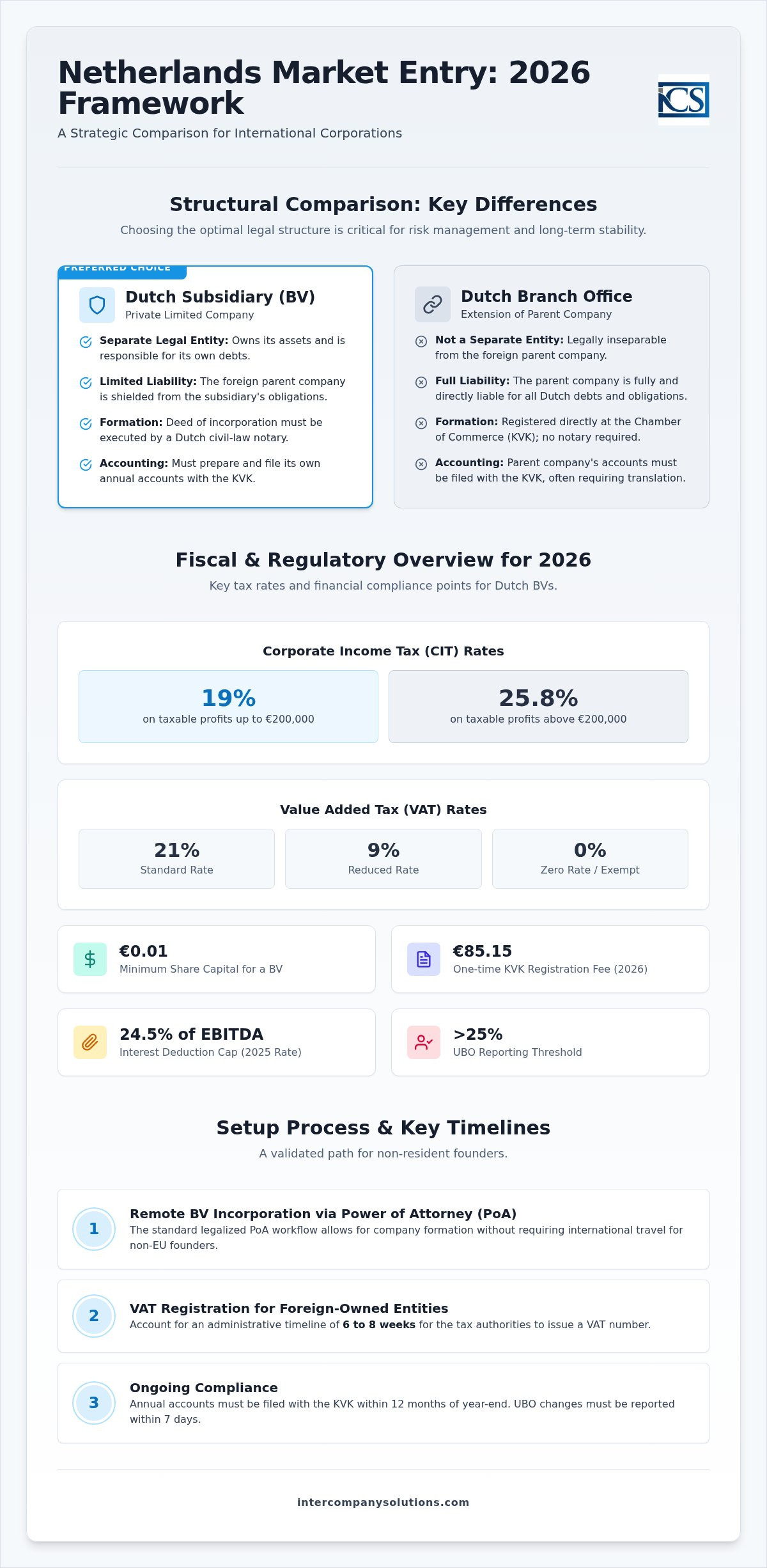
Selecting a legal framework requires a clear choice between a branch office and a subsidiary. A branch is legally inseparable from the foreign parent company; it does not possess a separate legal personality under Dutch law. Consequently, the parent company is the direct legal party in all Dutch transactions and is responsible for all obligations. Conversely, establishing a Dutch private limited company (BV) creates a separate legal person. This entity owns its own assets and is responsible for its own debts. This structural separation is the primary reason why international firms prefer the subsidiary model for European operations.
| Feature | Dutch Branch Office | Dutch Subsidiary (BV) |
|---|---|---|
| Legal Status | Extension of parent company | Separate legal entity |
| Liability | Parent company is fully liable | Limited to the subsidiary's assets |
| Registration | Registered at KVK (no notary) | Deed executed by a Dutch notary |
| Accounting | Parent accounts filed with KVK | Local accounts filed with KVK |
| Governance | Controlled by parent board | Local or parent board of directors |
Liability and Risk Isolation
The subsidiary model functions as a legal firewall. Because the BV is a distinct person, the parent company is generally not liable for the subsidiary's debts or contractual failures. This isolation is critical when entering local contracts or hiring staff, as it prevents Dutch obligations from impacting the parent's global balance sheet. According to business.gov.nl, a branch does not offer this protection, leaving the parent's global assets exposed to Dutch creditors. For a Dutch BV Company Formation, the minimum share capital is €0.01, yet the protection it offers to the parent company is substantial.
Operational Credibility and Local Presence
Market perception often favors the BV over a foreign branch. Establishing a local entity signals a long-term commitment to the region, which is a decisive factor for Dutch banks, suppliers, and customers. Standalone entities often find it more straightforward to obtain VAT numbers and establish local banking relationships. While a branch must file the parent company's global financial statements with the Chamber of Commerce (KVK), a subsidiary only files its own local annual accounts. This preserves the confidentiality of the parent company's broader financial position. The Netherlands Foreign Investment Agency highlights that the BV is the standard vehicle for international trade due to its clear governance and risk profile. If you require a detailed assessment of these structures, you may request a structural analysis from our consultants.
Last reviewed: August 2026
Fiscal and Regulatory Compliance for Subsidiaries
Operating a corporate entity in the Dutch jurisdiction requires strict adherence to specific tax thresholds and reporting timelines. For the 2026 fiscal year, Corporate Income Tax (CIT) is applied at a rate of 19% on taxable profits up to €200,000. Any profit exceeding this amount is taxed at 25.8%. Beyond base rates, the Netherlands applies an interest deduction cap to prevent excessive debt financing; this limit is set at 24.5% of the company's EBITDA. These figures are central to the financial planning phase when setting up a subsidiary in the Netherlands, as they dictate the net profitability of the local operation.
Value Added Tax (VAT) compliance is another critical administrative pillar. The standard VAT rate is 21%, with reduced rates of 9% and 0% applying to specific categories of goods and services. For foreign-owned BVs, the VAT registration process typically spans six to eight weeks. During this period, the tax authorities conduct a thorough review of the company's intended activities and substance. Since 1 May 2026, Rabobank has served as the house bank for the Belastingdienst, facilitating all corporate tax settlements and refunds. Accuracy in these initial filings is paramount to avoid delays in operational readiness.
Corporate Tax and Incentives
The Dutch tax system includes mechanisms to prevent double taxation and attract international talent. The Participation Exemption is a vital feature for subsidiaries, as it generally exempts dividends and capital gains derived from qualifying subsidiaries from Dutch CIT. This allows for the efficient movement of capital within a global corporate structure. Additionally, the Netherlands offers the 30% tax reimbursement ruling for qualifying international employees. For 2026, the minimum taxable salary requirement for this ruling is €48,013, or €36,497 for employees under 30 with a qualifying master's degree. The 30% allowance is capped at a salary of €262,000. Managing these incentives requires precise Payroll and Staffing services to ensure all thresholds are met and maintained.
Reporting and Record-Keeping Obligations
Transparency and data retention are mandatory under Dutch law. All corporate records must be retained for a minimum of seven years, though this period extends to ten years for documents related to immovable property. Ultimate Beneficial Owner (UBO) requirements apply to any individual holding a stake of more than 25% in the entity. Any changes to the UBO registry must be reported within seven days to remain compliant. Finally, every subsidiary must file its annual accounts with the Chamber of Commerce (KVK) within 12 months of the financial year-end. Failure to meet these deadlines can result in administrative fines and potential personal liability for directors.
Last reviewed: August 2026
The Step-by-Step Remote Incorporation Workflow
The process for setting up a subsidiary in the Netherlands is designed for efficiency, particularly for international founders who cannot travel. The primary workflow centers on the legalized Power of Attorney (PoA) route. This allows a Dutch notary to execute the deed of incorporation without the founder's physical presence. Initially, you must submit a detailed checklist along with identification documents for all directors and shareholders. These documents usually require legalization and an apostille to be recognized by the Dutch authorities. This remote-first approach is the standard for non-EU founders, as digital video incorporation is not the default for non-resident registrations.
Legal Documentation and Notarial Deeds
In the Netherlands, a civil-law notary must execute the deed of incorporation for every BV and NV. This is a statutory requirement that ensures the legality of the company's foundation. For foreign corporate shareholders, you'll need to provide an extract from your local trade register and a certificate of incumbency. These documents must be properly legalized to prove the authority of the person signing the PoA. The notary also drafts the Articles of Association, which define the company's internal regulations, its name, statutory seat, and corporate purpose. Once the notary executes the deed, the company officially exists as a separate legal entity with a minimum share capital of just €0.01.
KVK and Tax Authority Registration
Once the deed is signed, the company must be registered in the Dutch Trade Register (Handelsregister) managed by the Chamber of Commerce (KVK). For 2026, the one-time KVK registration fee is €85.15. This registration generates your KVK number, which is essential for opening bank accounts and signing commercial contracts. It's the unique identifier that confirms your entity's standing in the local market. Following KVK registration, the entity must apply for corporate tax and VAT identification numbers from the Belastingdienst. All tax settlements and refunds are processed through Rabobank, which has served as the Belastingdienst house bank since 1 May 2026.
For foreign-owned BVs, the VAT registration timeline typically ranges from six to eight weeks. If your subsidiary intends to import or export goods outside the EU, you must also apply for an EORI number. This step is vital for customs clearance and international trade. Managing these administrative layers requires a structured approach to Netherlands company formation to ensure no deadlines are missed and the entity is fully operational within the expected timeframe.
Last reviewed: August 2026
Employment and Payroll Trends for Dutch Subsidiaries
Operating a business in the Netherlands requires strict adherence to local labor laws, which mandate a written employment agreement for every staff member. As of 1 July 2026, the statutory minimum hourly wage for employees aged 21 and over is €14.99 according to business.gov.nl. Employers are responsible for withholding wage taxes and social security contributions, with the 2026 maximum annual wage for social insurance set at €79,409. Additionally, Dutch law requires employers to provide up to 104 weeks of sick pay at a minimum of 70% of the employee's salary, necessitating robust financial planning for workforce management.
Hiring Highly Skilled Migrants
To recruit specialized talent from outside the European Union, a company must obtain recognized sponsor status from the Immigration and Naturalisation Service (IND). For the 2026 fiscal year, the gross monthly salary requirements for the Highly Skilled Migrant (HSM) visa are €5,942 for migrants aged 30 and over, and €4,357 for those under 30. This status allows for expedited visa processing, typically completed within two to four weeks. Becoming a recognized sponsor is a strategic requirement for entities that rely on international expertise to maintain a competitive advantage in the European market.
Compliance in Employer Obligations
The 30% ruling serves as a primary incentive for attracting international staff, though it is subject to specific caps and thresholds. In 2026, the 30% tax-free allowance applies only to salaries up to a maximum of €262,000 as per belastingdienst.nl. To qualify, an employee's taxable salary must meet the minimum threshold of €48,013, or €36,497 for those under 30 with a qualifying master's degree. The option for 30% ruling holders to choose partial non-resident tax status was abolished in 2025; transitional arrangements for existing users will conclude on 31 December 2026.
Managing these monthly reporting cycles and ensuring compliance with sectoral pension funds is a core component of Payroll and Staffing services. All payroll tax settlements must be processed through Rabobank, which has served as the house bank for the Belastingdienst since 1 May 2026. Companies are legally required to retain payroll and corporate records for seven years to ensure full transparency during potential audits by the Dutch tax authorities.
Last reviewed: August 2026
Strategic Implementation of Your Dutch Market Entry
Transitioning into the Dutch market in 2026 requires a balance of legal precision and fiscal foresight. Choosing a BV structure ensures your parent company remains protected from local liabilities while establishing a credible presence in the Eurozone. The current regulatory environment demands strict adherence to CIT thresholds and UBO reporting. Setting up a subsidiary in the Netherlands through the remote Power of Attorney route allows you to finalize these complex procedures without the need for international travel.
Intercompany Solutions provides a structured path to entry with a 3-5 business day turnaround for initial formation. Our expertise in remote PoA incorporation ensures that your identification and documentation meet all notarial standards. We back our procedural clarity with a 100% satisfaction guarantee to provide the reliability your international expansion requires.
The Netherlands remains a top choice for global scaling. With the right administrative framework, your Dutch entity is positioned for long-term growth and stability.
Last reviewed: August 2026
Frequently Asked Questions
What is the minimum share capital required for a Dutch subsidiary?
The minimum share capital for a Dutch private limited company (BV) is €0.01. This low threshold was established to reduce the financial barriers for international entrepreneurs looking to enter the market. When setting up a subsidiary in the Netherlands, you must define the share value in the articles of association. While the legal minimum is nominal, you can choose a higher amount to reflect the company's initial funding requirements or operational scale.
Can I set up a Dutch subsidiary remotely without visiting the Netherlands?
You can complete the entire incorporation process remotely by using the legalized Power of Attorney (PoA) route. This method allows a Dutch notary to execute the deed of incorporation on your behalf without requiring your physical presence in the country. You'll need to sign the formation documents and have them legalized or apostilled in your home jurisdiction. This is the standard procedure for non-resident founders who want to establish a legal entity efficiently.
What are the corporate tax rates for Dutch subsidiaries in 2026?
In 2026, the Corporate Income Tax (CIT) rate is 19% on taxable profits up to €200,000. For any profits exceeding this threshold, the rate increases to 25.8%. It's also necessary to account for the interest deduction cap, which is 24.5% of EBITDA. All tax settlements are typically processed through Rabobank, which has served as the official house bank for the Dutch Tax Office (Belastingdienst) since 1 May 2026.
How long does the VAT registration process take for a foreign-owned entity?
The VAT registration process for foreign-owned entities generally takes between six and eight weeks. This timeline begins once the company is registered with the Chamber of Commerce (KVK). The tax authorities conduct a review to verify the company's intended activities and local substance. Because you can't reclaim or charge VAT until the registration is finalized, it's vital to account for this administrative window when planning your initial Dutch business operations.
Do I need a local director to register a subsidiary in the Netherlands?
Dutch law doesn't require you to appoint a local resident director to register a subsidiary. Both the directors and shareholders can be foreign individuals or legal entities. However, maintaining a local presence is often beneficial for tax substance and can simplify the process of opening a corporate bank account. While remote management is permitted, the company must have a valid Dutch business address and meet all local filing and compliance obligations.
What is the difference between a Dutch branch and a Dutch BV?
A Dutch BV is a separate legal entity, whereas a branch is an extension of the foreign parent company. When setting up a subsidiary in the Netherlands as a BV, the parent company's liability is limited to the subsidiary's assets. In a branch structure, the parent company remains fully liable for all Dutch debts and legal claims. This distinction makes the BV the preferred vehicle for international firms seeking to isolate risk and establish credibility.
What is the KVK registration fee for a new company in 2026?
The one-time registration fee for the Dutch Chamber of Commerce (KVK) is €85.15 in 2026. This fee is paid when the notary registers the company in the Handelsregister. After payment, the KVK issues a unique registration number that is required for all official business, including signing commercial contracts and applying for tax numbers. This registration confirms the entity's legal existence and is a mandatory step in the Dutch company formation process.
Sources
- ICS Payroll - Dutch payroll services
- KVK - Registering with the Dutch Business Register
- Business.gov.nl - Private limited company (bv)
- Burgerlijk Wetboek Boek 2 (Dutch Civil Code, legal entities)
- Rijksoverheid - Ondernemen
- Belastingdienst - Payroll taxes (loonheffingen)
- UWV - Employer obligations
- SVB - Social insurance in the Netherlands
- Belastingdienst - VAT (btw) for entrepreneurs
- European Commission - VAT rules and rates
- IND - Highly skilled migrant
- IND - Start-up residence permit
- De Nederlandsche Bank - Supervision
- AFM - Licences and registers
- BOIP - Trademark registration in Benelux
- WIPO - Madrid System
- RVO - Doing business internationally
- Belastingdienst Douane - Customs
- CJEU, Cadbury Schweppes, C-196/04 (ECLI:EU:C:2006:544)
- Hoge Raad, ECLI:NL:HR:2021:1152
- PwC Worldwide Tax Summaries - Netherlands
- ICLG - Corporate Governance Laws and Regulations, Netherlands
Need more information on the Dutch BV company?
Contact an expertReady to start your company in the Netherlands?
| Formation time | Dutch BV formation completed in 3 to 5 business days |
|---|---|
| Process | Fully remote setup with step-by-step guidance |
| Compliance | Expert support for registration, VAT and compliance |
| Aftercare | Accounting, tax and legal support included |
| One partner | All of the above through one trusted formation partner |