


August 20, 2026 · 16 min read
The Netherlands remains a primary destination for global expansion, but the administrative entry process in 2026 rewards technical precision over commercial strategy. Most international entrepreneurs find the shift from their domestic regulations to Dutch corporate law challenging, particularly when distinguishing between EU and non-EU registration paths. Meeting the requirements for opening a business in the Netherlands demands an exact understanding of local protocols to avoid delays or administrative fines.
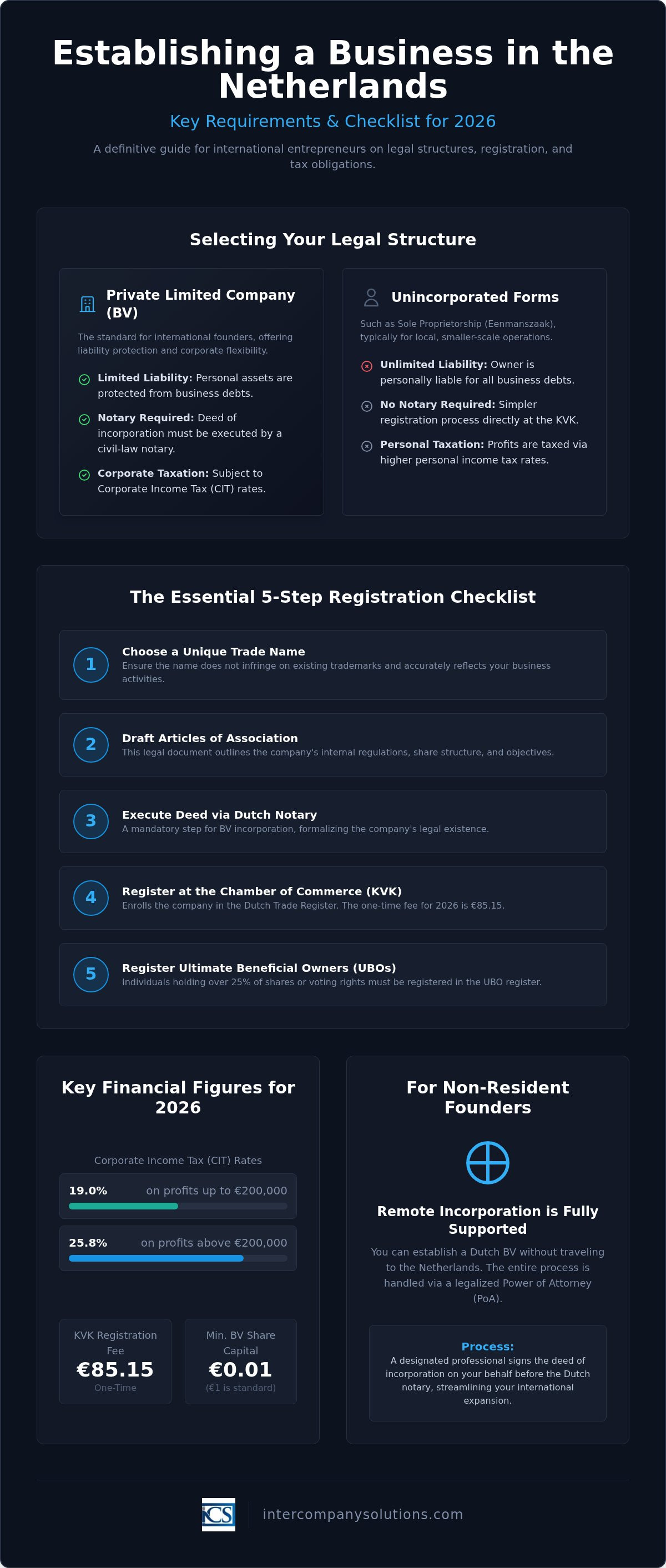
This guide provides a definitive checklist of the legal, tax, and administrative prerequisites necessary to establish a Dutch entity. You'll find specific data on the €85.15 KVK registration fee, the 19% and 25.8% corporate income tax brackets, and the mandatory UBO registration for individuals holding more than 25% of shares. We also confirm the validity of the remote BV formation process via legalized Power of Attorney, which allows for incorporation without a physical trip to the country. By following these verified steps, you can secure a compliant and functional foundation for your Dutch operations.
Key Takeaways
- Learn why the Besloten Vennootschap (BV) is the standard legal structure for international entrepreneurs due to its limited liability and corporate flexibility.
- Access a detailed checklist of the requirements for opening a business in the Netherlands, covering identification protocols and the 2026 KVK fee of €85.15.
- Understand the remote incorporation process for non-EU founders using the legalized Power of Attorney route to establish a Dutch entity without physical travel.
- Identify your 2026 corporate tax liabilities, including the 19% rate for profits under €200,000 and the 25.8% rate for amounts exceeding this threshold.
- Review mandatory compliance obligations such as the Ultimate Beneficial Owner (UBO) registration for individuals holding more than 25% of shares.
Table of Contents
Regulatory Framework for Dutch Business Entities
The Dutch legal system for corporate entities is codified in the Burgerlijk Wetboek (Dutch Civil Code). This framework provides a stable environment for international trade, which is a cornerstone of the Dutch economic overview. When evaluating the requirements for opening a business in the Netherlands, you must first recognize that the law treats corporate entities as distinct legal personalities. A private limited company, or BV, requires at least one director and one shareholder. These roles can be held by the same individual, making the structure accessible for solo entrepreneurs and large subsidiaries alike.
Most commercial activities in the Netherlands don't require a specific business license. However, regulated sectors like financial services, healthcare, and certain transport industries must obtain permits from relevant authorities before commencing operations. Identifying whether your activity falls under a regulated category is a critical first step in the formation process.
The Role of the Chamber of Commerce (KVK)
Every commercial entity must register in the Handelsregister (Trade Register) managed by the KVK. This process ensures market transparency across the Dutch jurisdiction. The KVK charges a one-time registration fee of €85.15 for 2026. Once registered, information regarding directors and shareholders becomes accessible to the public. You must also register individuals who hold more than 25% of the shares or voting rights in the UBO (Ultimate Beneficial Owner) register. Choosing a unique trade name is mandatory. It shouldn't infringe on existing trademarks or mislead the public about the nature of the business.
Statutory Requirements for the Dutch BV
The Dutch BV is the most common choice for foreign investors due to its flexible nature. Since the 2012 reforms, the minimum share capital is just €0.01, though €1 is a standard professional choice. Incorporation requires a deed executed by a Dutch civil-law notary. This document outlines the articles of association and the company's internal regulations. You must provide a registered local business address within the Netherlands to complete the registration. For non-resident founders, meeting the requirements for opening a business in the Netherlands often involves using a legalized Power of Attorney (PoA). Intercompany Solutions facilitates this process by preparing the necessary PoA documents, allowing the notary to sign the deed on your behalf without you needing to visit the country.
Last reviewed: August 2026
Selecting a Legal Structure: BV vs. Other Forms
Choosing the correct legal entity is a foundational decision that dictates your liability profile and tax obligations. This choice is central to the requirements for opening a business in the Netherlands, as registration procedures vary significantly between incorporated and unincorporated forms. For most international entrepreneurs, the Besloten Vennootschap (BV) serves as the standard due to its status as a separate legal personality, which protects personal assets from corporate debts. This distinction is vital for those entering the Dutch market from abroad, as it provides a predictable layer of security that unincorporated structures lack.
Private Limited Company (BV) vs. Sole Proprietorship
The Dutch BV requires a deed of incorporation drafted and executed by a civil-law notary. This process establishes the company as a distinct entity with its own rights and obligations. In contrast, a sole proprietorship (Eenmanszaak) doesn't require a notary but leaves the owner personally liable for all business obligations with their private assets. Solo traders often transition to a BV once their turnover increases to benefit from the corporate tax structure and liability protection. For 2026, BVs are subject to Corporate Income Tax (CIT) at a rate of 19% on taxable profits up to €200,000 and 25.8% on profits exceeding that threshold. Sole traders are taxed via personal income tax rates, which can be significantly higher for profitable enterprises.
Structural Requirements for the NV
Large-scale enterprises or those intending to list on a public exchange utilize the Naamloze Vennootschap (NV). Unlike the BV, which has a minimum capital requirement of €0.01, the NV requires a minimum starting capital of €45,000. This structure also necessitates a notary for incorporation and follows more stringent reporting and governance standards. If you're unsure which entity suits your capital structure, you can consult with our formation specialists for a tailored assessment.
When to Consider a Foundation (Stichting) or Partnership
The Stichting is a unique Dutch structure often used for non-profit activities or to separate legal ownership from economic interest. Understanding these nuances is part of the broader requirements for opening a business in the Netherlands. Like the BV and NV, a foundation requires a notary deed. Conversely, partnerships like the Vennootschap onder firma (VOF) or Commanditaire vennootschap (CV) don't require a notary. These forms are typically used for joint ventures or professional practices. While easier to set up, partners in a VOF remain jointly and severally liable for the entity's debts, a risk factor that international founders must weigh carefully against the administrative simplicity of unincorporated structures.
Last reviewed: August 2026
The Essential Registration Checklist for 2026
Completing the administrative requirements for opening a business in the Netherlands involves a structured sequence of registrations with local authorities. You must first prepare high-resolution copies of your valid passport and a recent proof of residential address, such as a utility bill or bank statement. For non-resident founders, these documents usually require legalization or an apostille to be accepted by Dutch notaries and the Chamber of Commerce. Ensuring these documents are current and correctly formatted prevents delays during the identity verification phase of incorporation.
Once your identity is verified and the deed of incorporation is signed, the company must be entered into the Trade Register. The KVK charges a one-time registration fee of €85.15 for 2026. This payment is typically handled via a digital invoice or during the physical appointment at a KVK office. After successful registration, you'll receive your unique KVK number, which serves as your primary business identifier for all future legal and financial transactions in the country.
KVK Registration and UBO Register Requirements
During the registration process, you must provide a clear description of your business activities. The KVK uses SBI codes (Standaard Bedrijfsindeling) to categorize your company for statistical and regulatory purposes. Accurate categorization is vital, as it can influence your insurance premiums and sector-specific obligations. You're also legally required to submit a declaration for the Ultimate Beneficial Owner (UBO) register. A UBO is defined as any individual holding more than 25% of the shares, voting rights, or ownership interest. This transparency measure is a mandatory part of Netherlands company formation and must be updated within one week of any changes to the ownership structure.
Tax Administration (Belastingdienst) and VAT Obligations
The KVK automatically notifies the Dutch Tax Administration (Belastingdienst) once your company is registered. You don't usually need to file a separate application for a tax ID, but the authorities will assess whether your company is a taxable person for VAT (BTW) purposes. If approved, you'll receive a VAT identification number and a VAT tax number. Companies engaged in importing or exporting goods outside the EU must also apply for an EORI number through Dutch Customs. This number is essential for clearing goods and managing digital declarations.
Compliance doesn't end with registration. Dutch law mandates a 7-year record retention period for all business administration, including invoices, contracts, and bank statements. If your business owns immovable property in the Netherlands, this retention period extends to 10 years. Keeping digital backups that meet Dutch audit standards ensures you're prepared for any future inquiries from the Tax Administration. These rigorous record-keeping standards are fundamental to maintaining your company's standing within the Dutch regulatory environment.
Last reviewed: August 2026
Requirements for Foreign and Non-Resident Founders
Non-resident entrepreneurs face specific procedural hurdles when meeting the requirements for opening a business in the Netherlands. While EU and EEA citizens benefit from the freedom of establishment, non-EU founders must distinguish between company ownership and the right to reside in the country. You can incorporate a Dutch BV remotely without a residence permit, but you must provide a valid Dutch business address. The Chamber of Commerce (KVK) maintains strict substance criteria for business addresses. A simple PO box is insufficient; the registered address must be a physical location where the business can actually be conducted and where the company's records are accessible for inspection.
Remote Incorporation via Legalized Power of Attorney
Remote formation is executed through a legalized Power of Attorney (PoA). This method allows a formation agent to sign the deed of incorporation before a Dutch notary on your behalf, removing the need for physical travel. You must have your identity documents and the PoA legalized by a notary in your home country. Depending on your jurisdiction, you might also need an apostille or embassy legalization. Standard BV formations typically have a turnaround time of 2-5 business days once all legalized documents are received in the Netherlands. This process ensures full legal compliance and allows you to begin operations quickly while remaining abroad.
Residence Permits and the Startup Visa Pathway
Non-EU founders who wish to relocate must apply for a specific residence permit through the IND. For short-term stays under 90 days, a standard Schengen visa is usually sufficient for business meetings and initial setup. However, long-term operations often require a more permanent solution like the Startup Visa. This one-year permit requires an innovative business plan and a contract with a government-approved facilitator. After the first year, you can transition to a self-employed permit if you meet certain criteria. Alternatively, established companies can use the Highly Skilled Migrant (HSM) status to relocate key personnel, provided the entity becomes a recognized sponsor. Understanding these migration paths is a core component of starting a business in the Netherlands for non-European citizens.
Meeting the requirements for opening a business in the Netherlands as a non-resident involves both corporate and immigration compliance. You don't need to be a resident to be a shareholder or a director of a Dutch BV, but you do need the correct permits if you intend to perform work while physically present in the country. We recommend verifying your residency status and tax residency early in the process to avoid conflicting obligations between your home country and the Dutch Tax Administration.
Last reviewed: August 2026
Maintaining Compliance and Operational Standards
Once your company is active, the focus shifts from the initial requirements for opening a business in the Netherlands to long-term regulatory adherence. Dutch authorities expect precise record-keeping and timely filings to maintain market transparency. Your administrative obligations include filing periodic tax returns and publishing annual financial statements. Failure to meet these deadlines can result in administrative fines or the loss of "good standing" status with the Tax Administration.
Corporate Income Tax (CIT) and Annual Reporting
For the 2026 fiscal year, the Corporate Income Tax (CIT) is structured into two distinct brackets. You'll pay 19% on taxable profits up to €200,000 and 25.8% on any profit exceeding this threshold. The deadline for filing the CIT return is typically five months after the end of the fiscal year. For a standard financial year ending December 31, 2025, you must submit the return by May 31, 2026. Extensions are possible but must be requested before the original deadline.
Transparency is a core principle of the Dutch system. You're required to publish your annual accounts with the KVK. The level of detail required depends on whether your company is categorized as micro, small, medium, or large based on asset value, net turnover, and employee count. Most small BVs only need to file a condensed balance sheet and limited notes. Maintaining a structured ledger is vital for these filings. For detailed guidance on managing these duties, refer to our resource on Accounting for Dutch BV compliance.
Payroll and Employer Obligations for Dutch Staff
Hiring employees introduces additional requirements for opening a business in the Netherlands. You must provide a written employment agreement that complies with Dutch labor law and ensures mandatory pension contributions where applicable. Employers are responsible for withholding payroll tax and social security contributions from gross salaries. These must be reported and paid to the Tax Administration on a monthly or four-week basis.
International entrepreneurs often utilize the 30% tax reimbursement ruling to attract global talent. For 2026, the minimum taxable annual salary to qualify is €48,013. For employees under the age of 30 with a Master's degree, the threshold is €36,497. Note that this ruling only applies to a maximum gross salary of €262,000. Managing these variables requires a robust administrative setup. Utilizing professional Dutch payroll services ensures that your entity remains compliant with evolving wage tax regulations and social insurance changes. Active entities must also file quarterly VAT (BTW) returns. The deadline for payment and filing is the last day of the month following the quarter's end.
Last reviewed: August 2026
Establishing Your Dutch Presence in 2026
Success in the Dutch market depends on a technical approach to corporate compliance and administrative precision. We've outlined that the Besloten Vennootschap (BV) remains the standard for international trade, offering a robust liability shield and a clear tax structure with CIT rates of 19% up to €200,000. Fulfilling the requirements for opening a business in the Netherlands is a streamlined process when you utilize the legalized Power of Attorney route, which allows for full remote incorporation within 2-5 business days.
Ongoing operational standards, including the 7-year record retention period and mandatory UBO filings, ensure your entity remains in good standing with the Tax Administration. Intercompany Solutions has assisted over 2,000 founders worldwide with these complex procedures, backed by a 100% satisfaction guarantee. Our experience ensures that every statutory detail is managed with the professional care required for a stable international enterprise.
We're ready to facilitate your entry into the Dutch economy with the efficiency and legal integrity your business deserves.
Last reviewed: August 2026
Frequently Asked Questions
Can a non-resident open a business in the Netherlands remotely?
Yes, you can establish a Dutch entity without being a resident or physically visiting the country. This is achieved through a legalized Power of Attorney (PoA) process. You must have your identification documents and the PoA signed in the presence of a local notary or at a Dutch embassy in your home country. Once these documents are sent to the Netherlands, a formation agent executes the deed of incorporation before a Dutch notary.
What is the minimum share capital required for a Dutch BV in 2026?
The minimum share capital for a Dutch BV remains €0.01 following the Flex-BV legislation introduced in 2012. While this is the legal minimum, many founders choose a standard amount like €1, €100, or €1,000 to simplify share division among multiple shareholders. This capital doesn't need to be deposited into a Dutch bank account before the company is registered, allowing for a faster incorporation process for international entrepreneurs.
How much is the KVK registration fee for a new Dutch company?
The one-time registration fee at the Dutch Chamber of Commerce (KVK) is €85.15 for the 2026 calendar year. This fee covers the entry of your company into the Trade Register (Handelsregister) and is mandatory for all new commercial entities. You'll receive your KVK number immediately after the registration is finalized. Most founders pay this fee via a digital invoice or through their formation specialist during the incorporation phase.
Do I need a Dutch bank account to register a company in the Netherlands?
You don't need a Dutch bank account to complete the initial registration of your company. The KVK and the notary don't require proof of a local account during the formation process. However, you'll eventually need a business account to manage operations, pay the 2026 CIT rates, and handle VAT returns. Many international founders use electronic money institutions (EMIs) or fintech solutions if they don't have a local physical presence.
What are the corporate income tax (CIT) rates in the Netherlands for 2026?
For 2026, corporate income tax (CIT) is applied at two specific rates based on taxable profit. You'll pay 19% on profits up to €200,000. Any taxable profit exceeding this €200,000 threshold is taxed at a rate of 25.8%. These rates apply to all active Dutch BVs. Understanding these figures is a core part of the requirements for opening a business in the Netherlands to ensure accurate financial forecasting and tax compliance.
Who is considered an Ultimate Beneficial Owner (UBO) in the Netherlands?
An Ultimate Beneficial Owner (UBO) is any natural person who holds more than 25% of the shares, voting rights, or ownership interest in a company. If no individual meets this 25% threshold, the company's senior managing directors must be registered as pseudo-UBOs. Registration in the KVK UBO register is a mandatory compliance step. You must report any changes to UBO information within one week to avoid administrative penalties or fines.
How long does it take to register a Dutch business?
Standard Dutch business registration typically takes between 2 and 5 business days. This timeline begins once the Dutch notary receives your legalized identification documents and the signed Power of Attorney. The KVK usually processes the registration within 24 hours of the deed being signed. For non-EU founders, the total lead time may be longer depending on how quickly documents can be legalized and couriered from their home country to the Netherlands.
Sources
- KVK - Registering with the Dutch Business Register
- Business.gov.nl - Private limited company (bv)
- Burgerlijk Wetboek Boek 2 (Dutch Civil Code, legal entities)
- Rijksoverheid - Ondernemen
- Belastingdienst - Corporate income tax rates
- ICS Payroll - Dutch payroll services
- Belastingdienst - Payroll taxes (loonheffingen)
- UWV - Employer obligations
- CJEU, Cadbury Schweppes, C-196/04 (ECLI:EU:C:2006:544)
- Hoge Raad, ECLI:NL:HR:2021:1152
- PwC Worldwide Tax Summaries - Netherlands
- ICLG - Corporate Governance Laws and Regulations, Netherlands
Need more information on the Dutch BV company?
Contact an expertReady to start your company in the Netherlands?
| Formation time | Dutch BV formation completed in 3 to 5 business days |
|---|---|
| Process | Fully remote setup with step-by-step guidance |
| Compliance | Expert support for registration, VAT and compliance |
| Aftercare | Accounting, tax and legal support included |
| One partner | All of the above through one trusted formation partner |