


September 28, 2026 · 16 min read
The notarization process for remote Dutch company formation doesn’t usually mean signing the incorporation deed from abroad. For a non-EU founder using the standard remote route, a Power of Attorney (PoA) signed abroad can authorize a Dutch civil-law notary to execute the deed without the founder travelling to the Netherlands. The key is to distinguish formalizing the PoA from the notary’s execution of the BV’s incorporation deed.
It’s reasonable to be unsure which documents need notarization, legalization or translation. PoA requirements can depend on the country where it is signed and the acting notary’s instructions, so confirm the requirements before signing or arranging certification. Video incorporation is not the default route for non-resident founders.
This guide explains the usual remote route for a non-EU founder, what the PoA authorizes, and what to confirm before signing. It also covers how nationality, identity documents and ownership structure may affect the documents the notary requests.
Key Takeaways
- Understand why a Dutch civil-law notary must execute a BV’s incorporation deed, even when the founder completes the process remotely.
- Follow the usual sequence for the notarization process for remote Dutch company formation: provide company and founder details, review the documents, formalize the authorization, then have the notary execute the deed.
- Before signing a Power of Attorney, confirm with the acting notary which formalities apply in your country, including legalization, translation, originals and signing format.
- Compare remote authorization with in-person signing, and confirm which route the notary accepts for your nationality and ownership structure.
- Allow for KVK registration as a separate stage after deed execution. Confirm the filing sequence and any post-formation steps with the notary.
Table of Contents
- Why notarization is part of remote Dutch BV company formation
- How the remote Dutch BV notarization process works with a Power of Attorney
- Remote Power of Attorney, in-person signing, or video incorporation: what differs?
- Documents and formalities to confirm before remote notarization
- After the deed: KVK registration and practical next steps
Why notarization is part of remote Dutch BV company formation
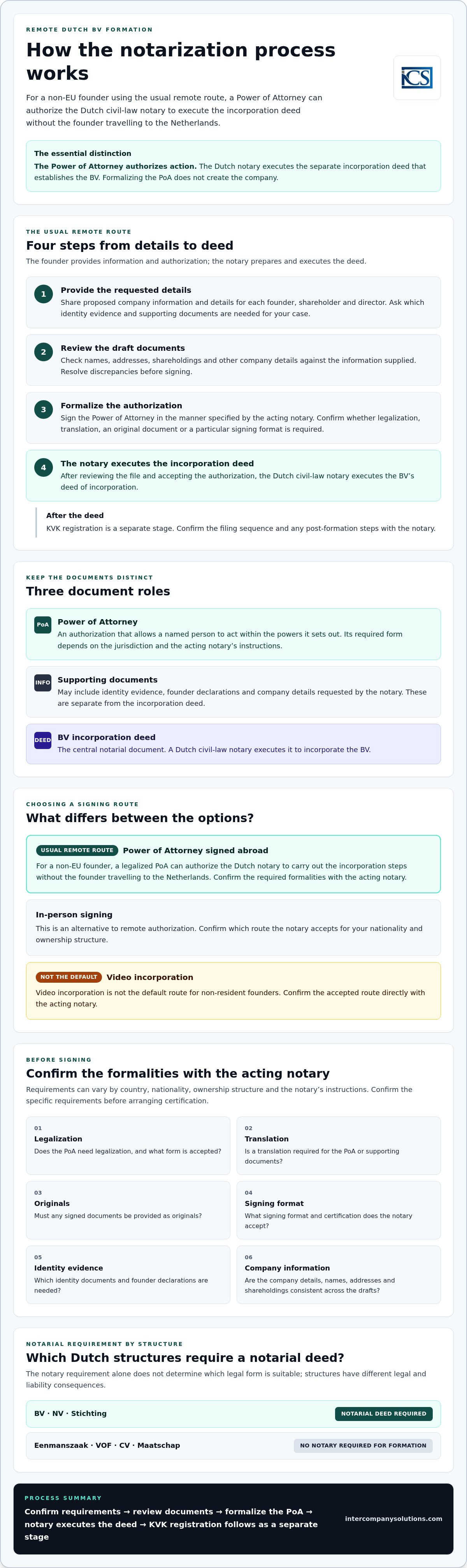
Remote formation changes how a founder provides documents or authorizes someone to act on their behalf. It does not remove the notarial step: a Dutch civil-law notary prepares and executes the incorporation deed that establishes a BV. In the usual remote route for a non-EU founder, a Power of Attorney (PoA) can authorize the notary to execute the deed without the founder travelling to the Netherlands. The acting notary confirms which formalities apply to the founder’s circumstances.
Power of Attorney vs. incorporation deed
A PoA is an authorization document. It allows a named person, such as the notary or an authorized representative, to act within the powers it sets out. The incorporation deed is a separate legal document that the Dutch civil-law notary executes to incorporate the BV. Formalizing the PoA does not itself create the company.
What does the Dutch notary notarize during BV incorporation?
The central notarial document is the deed of incorporation, not every document submitted during the process. The notary may also request identity evidence, founder declarations, company details and authorization paperwork, but these are separate from the deed. Ask the acting notary to confirm which documents need a particular form of certification and what that form is called. KVK’s BV incorporation guidance explains the notarial deed requirement. The Besloten Vennootschap (BV) is the Dutch private limited company discussed in this guide.
This distinction is central to the notarization process for remote Dutch company formation: the founder may formalize authorization abroad, while the Dutch notary executes the incorporation deed. The PoA’s required form can depend on the founder’s jurisdiction and the notary’s requirements. Confirm these details before signing or arranging legalization.
Which Dutch legal structures require a notarial deed?
A notarial deed is required to form a BV, NV or stichting. An eenmanszaak, VOF, CV or maatschap does not require a notary for its formation. These structures differ in their legal and liability consequences, so the notary requirement alone should not determine which form is suitable. For an overview of the BV formation route, see this Dutch BV formation guide.
For a remote BV, keep the documents distinct: the PoA authorizes action, supporting documents provide information the notary requests, and the notarial deed establishes the company. Confirm the required PoA formalities and deed arrangements directly with the acting civil-law notary.
How the remote Dutch BV notarization process works with a Power of Attorney
For a non-EU founder using the standard remote route, a legalized Power of Attorney allows the Dutch civil-law notary to carry out the incorporation steps without the founder travelling to the Netherlands. The exact formalities depend on the founder’s jurisdiction and the acting notary’s requirements. Confirm them before arranging signatures or legalization. Dutch civil-law notaries have a distinct role in Dutch legal procedures, so don’t assume that a document certified by a notary in another country meets the Dutch notary’s requirements. See the Dutch civil-law notaries for more information about their role.
The notarization process for remote Dutch company formation usually follows this sequence:
- 1. Provide the requested details. Give the notary the proposed company information and details for each founder, shareholder and director. Ask which identity evidence and supporting documents are needed for your case.
- 2. Review the draft documents. Check names, addresses, shareholdings and other company details against the information supplied. Resolve discrepancies before signing so the notary can prepare the deed using consistent information.
- 3. Formalize the authorization. Sign the Power of Attorney in the manner specified by the acting notary. Confirm whether it must be legalized or translated, provided as an original, or signed in a particular format. Requirements can vary by jurisdiction and case.
- 4. The notary executes the deed. Once the notary has reviewed the file and accepted the authorization, the notary executes the BV’s incorporation deed. Under this route, the founder does not travel to the Netherlands. The PoA authorizes action; it does not itself incorporate or register the BV.
What the founder and Dutch notary each do
The founder supplies accurate information, responds to document requests and signs the authorization as instructed. The notary reviews the file, confirms whether the documents meet the requirements for the case, prepares the incorporation deed and executes it. Before signing the PoA, ask the notary to identify any outstanding documents. Don’t assume the same checklist applies to every founder.
How company details move from review to deed execution
Company, shareholder and director information should match across the materials submitted to the notary. For example, a difference in the spelling of a shareholder’s name between identity evidence and a company document may need clarification. The notary determines what evidence and format are acceptable. KVK’s BV formation guidance provides general context on forming a Dutch BV, while the acting notary confirms the requirements for the specific file. For broader formation information, see this Dutch company formation guide.
Remote Power of Attorney, in-person signing, or video incorporation: what differs?
The route for signing a Dutch BV’s incorporation documents depends on your circumstances and the acting civil-law notary’s requirements. For non-EU founders using the standard remote route, a legalized Power of Attorney (PoA) authorizes the notary to execute the deed without the founder travelling to the Netherlands. In-person signing and video incorporation may be options to discuss, but neither should be assumed to suit every founder.
| Route | Founder presence | Authorization method | Who confirms eligibility? |
|---|---|---|---|
| Legalized Power of Attorney | For the standard non-EU remote route, the founder does not travel to the Netherlands. | The founder signs a PoA in the form required by the acting notary. Legalization or other formalities may depend on the founder’s jurisdiction. | The acting Dutch civil-law notary confirms the required form and whether the route fits the case. |
| In-person signing | The founder attends in person if this route is agreed with the notary. | The founder signs the documents as instructed by the notary. The notary confirms which documents require signature and how. | The acting notary confirms the arrangements and documents for the founder’s circumstances. |
| Video incorporation | The founder may participate remotely only if the route is available and the founder meets the applicable requirements. | Any digital identification and signing steps must be accepted by the acting notary for that specific incorporation. | The acting notary confirms whether the founder is eligible and whether the route can be used. |
When is a legalized Power of Attorney the practical remote route?
For a non-EU founder who wants to complete the BV formation without travelling, the legalized PoA route is the standard remote option described in this guide. The PoA authorizes the relevant action; it does not itself incorporate the company. Before signing, ask the notary to specify the required wording and signing formalities, and whether legalization, translation or an original document is needed. Requirements can differ by jurisdiction, so don’t assume this route or its formalities automatically apply to every EU or resident founder.
When should a founder ask about signing in person or digitally?
Ask the notary about in-person signing if you can attend and want to understand what you would sign directly. Ask about video incorporation if you want to check whether it is available for your specific circumstances. Video incorporation is not the default for non-resident founders. The KVK’s BV formation guidance provides general context, but the acting notary must confirm the route and formalities for your file. The Dutch civil-law notary’s role is distinct from that of a notary in another country.
Use the notarization process for remote Dutch company formation as a sequence to verify with the notary, not as a guarantee that every case follows identical steps. If you’d like to discuss a Dutch BV formation route, contact the formation team.
Documents and formalities to confirm before remote notarization
Prepare the file using the acting Dutch civil-law notary’s instructions, not a checklist copied from another founder’s case. Requirements can depend on where a document was issued, where it will be signed and the details of the proposed BV. Before arranging signatures abroad, ask the notary to confirm the documents, formats and sequence required for your file. This preparation is a practical part of the notarization process for remote Dutch company formation.
How to prepare identification and company information
Start with the identity documents requested for each founder and the notary’s completed checklist. Then confirm which company details and supporting information are needed for the proposed shareholders, directors and ownership arrangements. The exact evidence required is case-specific, so don’t treat this framework as a universal list.
- Identity evidence: Check which documents the notary requires for each relevant person, and whether copies or another format are acceptable.
- Completed checklist: Use the notary’s own checklist and resolve unanswered items before signing or submitting documents.
- Company and ownership details: Confirm the requested information about the BV, shareholders, directors and proposed ownership structure.
- Consistency check: Compare names and other details across the documents. Resolve spelling or information differences with the notary before the file is finalized.
Ask whether the notary needs additional evidence for a particular shareholder, director or ownership arrangement. Requirements may differ between founders, including within the same incorporation file. KVK’s guidance on setting up a BV provides general formation context, but the acting notary must confirm the documents and formalities for your case.
Legalization, translation and signing format
Don’t assume that a document issued or signed abroad can be used in the Netherlands in its current form. Ask the acting notary whether each document needs legalization, translation, an original copy or a particular signing format. The answer can depend on the document’s origin and the notary’s requirements. Apostille, consular legalization and translation rules should not be treated as universal.
Confirm the order of steps before signing. Ask whether the notary must review a draft first, whether the document should be signed in a specific way, and whether any formalization must happen before it is sent to the Netherlands. This can help avoid arranging a signature or certification that doesn’t match the notary’s instructions. Keep the notary’s written directions with your document checklist so you can verify each item before submission.
After the deed: KVK registration and practical next steps
The notary’s execution of the incorporation deed and the BV’s registration with the Dutch Chamber of Commerce (KVK) are distinct stages. Deed execution is a key part of the notarization process for remote Dutch company formation, but don’t assume it completes every registration step. Before the deed is executed, confirm with the acting notary who will submit the KVK registration, what information or documents are still required, and what confirmation you’ll receive after the registration is processed.
What happens after the notary executes the deed?
KVK’s guidance on setting up a BV explains the role of the notarial deed and KVK registration in forming a Dutch BV. The notary can confirm how those steps will be handled for your file. Ask whether the notary will arrange registration or whether you must take a separate action. Also clarify when you can expect confirmation and any registration details. Make sure the sequence and responsibilities are clear before you sign, particularly when the founder is abroad.
Before the process moves forward, confirm:
- Who submits the registration information to KVK and whether you need to provide anything further.
- Whether any details or documents remain outstanding after deed execution.
- What confirmation or company registration information you’ll receive, and from whom.
- Whether the notary expects any follow-up from you once the filing has been made.
These checks distinguish the notarial act from the next administrative stage without assuming that every founder follows identical arrangements. For current registration information, refer to KVK and ask the notary how its published guidance applies to your incorporation.
Where to get support for the full formation sequence
A remote formation file may involve coordination between the founder, the notary and the registration process. Intercompany Solutions supports foreign entrepreneurs with remote Dutch BV formation, including coordination of legal documentation and KVK registration. Its Dutch BV formation guide provides broader information about the formation process. A free initial consultation is available if you want to discuss your circumstances and the steps to confirm with the notary.
Prepare your next formation steps with confidence
Remote formation doesn’t remove the Dutch notarial deed requirement. For a non-EU founder using the standard remote route, a properly formalized Power of Attorney allows the Dutch civil-law notary to execute the deed without the founder travelling to the Netherlands. The notary must confirm which formalities apply to your jurisdiction and circumstances.
Keep the steps distinct: the Power of Attorney authorizes action, the notary executes the incorporation deed, and KVK registration is a separate stage. Before signing, confirm the required documents, legalization, translation and signing format, as well as who will handle registration after the deed is executed.
Intercompany Solutions supports foreign entrepreneurs with remote Dutch BV formation, including coordination of legal documents and KVK registration. A free initial consultation is available to discuss your planned formation route and the points to confirm with the notary.
With the requirements clear before you sign, you can move through each stage in an informed and organized way.
Frequently Asked Questions
Does a Dutch BV need a notary if the founder is abroad?
Yes. A Dutch BV still requires a Dutch civil-law notary to execute its incorporation deed, even if the founder lives abroad. For a non-EU founder using the standard remote route, a legalized Power of Attorney can authorize the notary to act without the founder travelling to the Netherlands. Confirm the required formalities for the Power of Attorney with the acting notary. KVK’s BV formation guidance explains the deed requirement.
Can I incorporate a Dutch BV remotely without travelling to the Netherlands?
Yes, a non-EU founder can generally use the remote Power of Attorney route without travelling to the Netherlands. The founder provides the requested information and formalizes the authorization as instructed, while the Dutch notary executes the incorporation deed. The exact documents and formalities depend on the founder’s circumstances and jurisdiction, so confirm the process with the acting notary before signing or arranging document legalization.
Is video notarization the standard process for non-resident Dutch BV formation?
No. Video incorporation should not be assumed to be the standard route for non-resident founders. For non-EU founders, the usual remote route described here is a legalized Power of Attorney, with the Dutch notary executing the deed. Digital incorporation may only be considered if the acting notary confirms that the founder and proposed incorporation meet the applicable requirements. Ask the notary directly before relying on a video process.
What is the difference between a Power of Attorney and the incorporation deed?
A Power of Attorney is an authorization document. It allows the person or professional named in it to take specified actions on the founder’s behalf. The incorporation deed is a separate document executed by the Dutch civil-law notary to establish the BV. Signing or legalizing a Power of Attorney does not itself incorporate the company or complete its KVK registration. Confirm the wording and scope of the authorization with the notary.
Do documents signed abroad need an apostille or legalization for a Dutch BV?
Not always. Whether a document needs an apostille, other legalization, translation or a particular signing format depends on its origin and the requirements of the acting Dutch notary. Don’t arrange certification based on a general checklist or another founder’s experience. Ask the notary to confirm the required formalities for each document and the correct sequence before you sign or send originals from abroad.
Which documents should I prepare for remote Dutch company formation?
Start with the identification documents requested by the notary and its completed checklist. You may also need to provide details about the proposed company, shareholders, directors and ownership arrangements. The exact evidence and format are case-specific. Ask whether the notary needs additional information for any shareholder or director, and check that names and other details match across documents before signing or submitting them.
Do all Dutch company types require notarization?
No. A notarial deed is required to form a BV, NV or stichting. An eenmanszaak, VOF, CV or maatschap does not require a notary for formation. These legal forms also differ in other ways, so the notary requirement alone doesn’t determine which structure is appropriate. For BV requirements, consult KVK’s guidance on setting up a BV.
Sources
- KVK - Registering with the Dutch Business Register
- Business.gov.nl - Private limited company (bv)
- Burgerlijk Wetboek Boek 2 (Dutch Civil Code, legal entities)
- Rijksoverheid - Ondernemen
- CJEU, Cadbury Schweppes, C-196/04 (ECLI:EU:C:2006:544)
- Hoge Raad, ECLI:NL:HR:2021:1152
- PwC Worldwide Tax Summaries - Netherlands
- ICLG - Corporate Governance Laws and Regulations, Netherlands
Need more information on the Dutch BV company?
Contact an expertReady to start your company in the Netherlands?
| Formation time | Dutch BV formation completed in 3 to 5 business days |
|---|---|
| Process | Fully remote setup with step-by-step guidance |
| Compliance | Expert support for registration, VAT and compliance |
| Aftercare | Accounting, tax and legal support included |
| One partner | All of the above through one trusted formation partner |