


September 24, 2026 · 15 min read
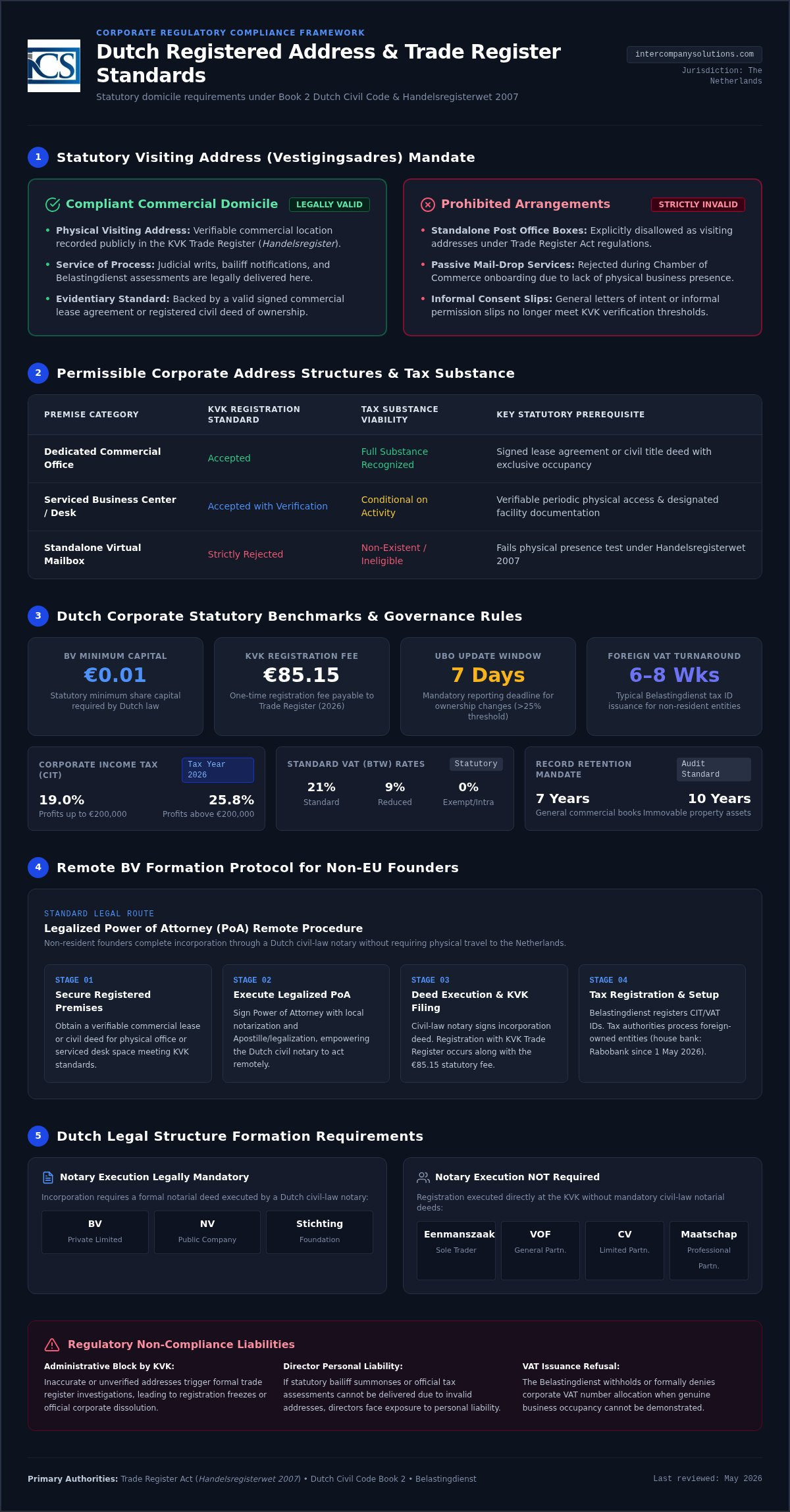
Securing a compliant registered address Netherlands company setup requires demonstrable commercial occupancy rather than a passive postal forwarding service. The Dutch Chamber of Commerce (KVK) actively audits corporate locations to eliminate paper-only entities, meaning simple permission slips and basic mail-drop services are routinely rejected during the incorporation process. International founders frequently assume that any commercial mailing point satisfies statutory mandates, only to face formal Handelsregister refusals or multi-week delays when applying for corporate VAT numbers from the Belastingdienst.
Establishing an authentic corporate presence protects your Dutch enterprise from these administrative hurdles and anti-money laundering investigations. You'll gain a thorough understanding of Dutch statutory domicile rules under the Trade Register Act, current KVK verification standards, and compliant setup options for your corporate entity. We break down the legal differences between non-compliant virtual mailboxes and legitimate commercial serviced premises, detailing the precise lease documentation needed to ensure your remote formation workflow remains fully compliant from day one.
Key Takeaways
- Establishing a legally valid registered address Netherlands company structure requires a verifiable physical visiting address under the Dutch Trade Register Act, as standalone postal boxes are strictly prohibited.
- Dutch Chamber of Commerce registration standards mandate a signed commercial lease contract or deed of ownership, meaning informal permission slips are no longer accepted for corporate premises.
- Non-compliant address selections risk administrative rejection by the Trade Register and can delay Belastingdienst VAT number issuance beyond the typical six to eight weeks for foreign-owned entities.
- International founders must secure qualifying third-party commercial premises before executing the deed of incorporation through a civil-law notary via legalized Power of Attorney.
- Physical address compliance functions alongside mandatory Dutch corporate governance rules, including the €0.01 minimum share capital requirement and the seven-day reporting deadline for ownership changes.
Table of Contents
- Statutory Mandate: Why Every Dutch Entity Requires a Registered Address
- Permissible Address Structures for Companies in the Netherlands
- Compliance Risks: How Invalid Addresses Jeopardize Operations
- Step-by-Step Procedure to Establish a Compliant Registered Address
- Corporate Formation and Governance: Completing Your Dutch Setup
Statutory Mandate: Why Every Dutch Entity Requires a Registered Address
Every commercial entity in the Netherlands must maintain a verified physical address recorded in the Trade Register (Handelsregister). Under Book 2 of the Dutch Civil Code and the Dutch Trade Register Act (Handelsregisterwet 2007), a post office box cannot serve as a business visiting address (bezoekadres). This statutory requirement applies to all corporate forms, including a Dutch private limited liability company (BV). Regulatory bodies such as the Netherlands Chamber of Commerce (KVK) and the Dutch Tax and Customs Administration (Belastingdienst) direct all legally binding communications to this designated physical location.
Operating without a valid corporate domicile leads to administrative enforcement. If an entity lists an inaccurate location, the KVK can initiate an investigation, place an administrative block on the trade register file, or dissolve the company. Directors risk personal liability for company obligations if official notifications cannot be delivered due to address irregularities. For non-resident entrepreneurs starting a business in the Netherlands, establishing a legitimate registered address Netherlands company presence is the first administrative step required prior to corporate formation.
Legal Functions of the Visiting Address (Vestigingsadres)
The visiting address acts as the company's official legal domicile. Bailiffs serve judicial writs, court summonses, and statutory tax assessments directly to this location. Delivery to the public visiting address counts as legally completed service under Dutch procedural law, whether an operational director is on site or not. Additionally, this public record ensures transparency under commercial law, granting creditors and contracting counterparties a confirmed point of legal contact.
Chamber of Commerce Verification Standards
Securing a registered address Netherlands company filing requires verifiable documentation proving your legal right of occupancy. KVK registration officers cross-examine entries to eliminate phantom entities and address fraud. To register a corporate domicile successfully, the applicant must present one of two acceptable proofs:
- An executed commercial lease agreement specifying the company's designated office space or designated desk facility.
- A registered civil deed of ownership demonstrating title to the commercial property.
Informal consent forms or general letters of intent are no longer accepted for commercial premises. If the KVK detects an unverifiable or shared location lacking individual lease documentation, the registrar immediately halts the commercial registration workflow until genuine occupancy is proven.
Permissible Address Structures for Companies in the Netherlands
Establishing an authentic corporate presence requires aligning KVK registration standards with Belastingdienst tax substance criteria. Selecting an unsuitable arrangement risks administrative rejection during corporate onboarding. Standalone virtual mailboxes with no physical working space are strictly disallowed by Dutch trade registrars. Qualifying as an authentic Dutch corporate taxpayer allows the enterprise to access standard corporate income tax rates of 19% on taxable profits up to €200,000 and 25.8% on profits exceeding that threshold.
| Address Structure | KVK Acceptance Criteria | Tax Substance Viability | Key Regulatory Requirement |
|---|---|---|---|
| Dedicated Commercial Office | Accepted with signed lease or title deed | Full tax substance recognized | Exclusive commercial occupancy right |
| Serviced Business Center / Desk | Accepted with landlord consent form | Conditionally accepted based on activity | Verifiable periodic physical access |
| Residential Premise (Director Home) | Accepted for Dutch residents only | Limited commercial substance | Municipal zoning approval and landlord consent |
| Virtual Mailbox / Postal Forwarding | Strictly rejected for visiting address | Zero tax substance recognition | Prohibited under Trade Register Act |
Commercial Leases and Serviced Business Centers
A direct commercial lease for dedicated office space provides undisputed statutory compliance for international enterprises. Alternatively, serviced business centers offer practical options if structured properly. The commercial agreement must explicitly state that the tenant holds the legal right to register its corporate seat (statutaire zetel) and visiting address on the premises. Commercial center operators must provide continuous physical access alongside executed landlord consent documentation confirming the company's operational presence.
Residential Premises and Shared Co-Working Desks
A residential address is permissible only if the managing director legally resides in the Netherlands and municipal zoning regulations permit commercial activity at that location. The property owner or mortgage lender must also provide written authorization. For shared co-working facilities, the arrangement complies with the Trade Register Act only when the contract provides a dedicated, verifiable workstation with regular physical access. Postal drop addresses that offer nothing beyond letter-scanning fail statutory verification checks.
Substance Criteria for Corporate Taxation and VAT
Securing a Trade Register entry does not automatically satisfy corporate tax standards. The Belastingdienst evaluates physical substance before granting an active Dutch VAT registration number. For foreign-owned entities, VAT registration typically takes 6 to 8 weeks to process, during which tax inspectors evaluate whether your local address supports authentic economic activity. Establishing tax substance requires physical facilities within national borders where core business records remain accessible and operational management can take place. If you are preparing your corporate structure and want to ensure your setup complies with local statutory governance, you can reach out to our corporate specialists for administrative support.
Compliance Risks: How Invalid Addresses Jeopardize Operations
Operating with an unverified corporate address threatens your company's legal standing from the moment papers are filed. The Dutch Chamber of Commerce actively monitors high-density commercial locations where hundreds of entities share a single mailbox without corresponding operational workspace. When registration officials flag a non-compliant mail drop, Trade Register entry is blocked. Establishing a legitimate registered address Netherlands company profile is essential to prevent structural disqualification when executing Dutch company formation procedures. Statutory Dutch compliance mandates that all business accounts, correspondence, and financial documentation must remain accessible and retained for 7 years, or 10 years for records concerning immovable property.
Belastingdienst Registration and VAT Withholding
Tax inspectors examine physical business footprints before activating tax profiles. If an entity uses a suspicious corporate address entry, the Belastingdienst conducts unannounced physical desk audits. Finding an unmanned mail-collection point instead of genuine commercial premises causes tax officers to withhold corporate VAT numbers entirely. All corporate tax assessments and domestic settlement payments route directly through Rabobank, which serves as the Belastingdienst house bank since 1 May 2026. Without an activated VAT status, your Dutch company can't trade across the European Union or recover input taxes paid on business expenses.
Banking Due Diligence and Anti-Money Laundering Laws
Commercial banks enforce rigorous compliance protocols under the Dutch Anti-Money Laundering and Anti-Terrorist Financing Act (Wwft). Institutional compliance officers evaluate the physical footprint of any company applying for an account. Risk assessment frameworks immediately reject corporate applications associated with mass mail drops. To satisfy banking scrutiny, businesses must provide:
- A valid, executed lease agreement that grants continuous physical operating rights.
- Clear commercial justification connecting the company's activities to the registered location.
- Transparent access to primary management records stored at the Dutch premises.
Failing these risk evaluations leaves an entity legally incorporated but financially paralyzed, as traditional banks will refuse to open operational business accounts without demonstrable local substance.
Step-by-Step Procedure to Establish a Compliant Registered Address
Securing compliant commercial premises must take place before a Dutch civil-law notary executes your deed of incorporation. Corporate service providers are prohibited by law from acting as registered office providers, which means founders must contract directly with independent commercial landlords or serviced business centers. Aligning your property contract with regulatory standards ensures that establishing your registered address Netherlands company entry proceeds without administrative friction. Once the commercial lease is active and the company is listed, the Dutch Chamber of Commerce levies a one-time KVK registration fee of €85.15 under 2026 statutory rates.
Contracting Independent Commercial Premises
Begin by selecting an established commercial business center or leasing private office space directly from a property owner. You must negotiate a formal tenancy contract that explicitly permits corporate seat registration and official business operations. Commercial leases must also guarantee physical facilities suitable for maintaining operational records. If a foreign corporate shareholder acts as the incorporating party, you'll need certified corporate registry extracts along with sworn English or Dutch translations accompanied by apostilles before lease signing can conclude.
Integrating the Address into Notarial Company Formation
After finalizing your commercial lease, submit the executed document to your Dutch civil-law notary. For international and non-EU entrepreneurs, the standard formation method is the remote route via a legalized Power of Attorney. Under this established procedure, the civil-law notary executes the deed of incorporation on your behalf, so you don't need to travel to the Netherlands. The notary registers the company and submits the verified visiting address directly to the KVK Handelsregister at the point of execution. Coordinating these steps properly allows remote incorporations to be completed smoothly within 2 to 5 business days.
Corporate Formation and Governance: Completing Your Dutch Setup
Establishing a compliant registered address Netherlands company foundation is a critical baseline, but ongoing corporate governance demands equal diligence. Under Dutch corporate law, legal entities such as the BV, NV, and stichting require execution of a notarial deed by a civil-law notary, whereas unincorporated forms like the eenmanszaak, VOF, CV, and maatschap do not. For a private limited company, statutory capitalization remains accessible, with the legal minimum share capital set at €0.01. Once formation documents are executed, directors must satisfy recurring statutory filings to maintain active legal standing in the Netherlands.
Statutory Registry Compliance and Governance
Dutch transparency regulations mandate strict adherence to beneficial ownership tracking. Companies must record all Ultimate Beneficial Owners (UBOs) holding direct or indirect equity stakes or voting rights exceeding 25%. When shifts in corporate shareholding or control cross this threshold, your company must report these UBO changes to the Trade Register within 7 days. If you are structuring an international subsidiary, review the core legal parameters for Dutch BV formation to ensure cross-border share capital aligns with statutory requirements. Intercompany Solutions coordinates the remote legal incorporation process via notarial proxy, but our firm does not provide registered office or address facilities.
Post-Formation Administration and Filing
Long-term operational compliance extends to accounting standards and tax reporting. Dutch businesses must prepare and file annual financial statements with the KVK within 12 months of the fiscal year-end. Domestic transactions apply VAT rates of 21%, 9%, or 0%, depending on the underlying supply of goods or commercial services. As your organization hires staff, integrating structured payroll services ensures wage tax deductions and social security remittances comply with Dutch labor standards. To discuss your prospective corporate structure and administrative requirements, you can contact our specialists directly.
Establish Your Compliant Corporate Presence in the Netherlands
Securing an authentic registered address Netherlands company setup protects your business from Trade Register rejections and unnecessary VAT delays. By executing a direct tenancy agreement with a legitimate commercial business center or property owner, you establish the legal substance necessary to clear strict KVK audits and banking compliance checks.
Intercompany Solutions has assisted over 1,000 international founders with corporate registrations since 2015. Our specialists handle remote company formations within 2 to 5 business days through a legalized Power of Attorney, providing end-to-end legal guidance, VAT registration management, and ongoing corporate accounting.
Entering the Dutch market with verified documentation positions your enterprise for sustainable commercial growth across the European Union from your first day of operation.
Last reviewed: September 2026
Frequently Asked Questions
Can a Netherlands company use a P.O. box as its registered address?
No, a Dutch company cannot list a P.O. box (postbus) as its statutory visiting address. Under the Dutch Trade Register Act, every enterprise must register a physical street location where actual commercial administration takes place and bailiff notifications can be served. While a company may maintain a separate postal box for general mail correspondence, the official visiting address recorded in the Trade Register must always be a physical building.
Can foreign non-residents register a Dutch BV at a residential property?
Non-resident founders cannot register a company at a Dutch residential address unless a local resident director legally lives there and provides written authorization. Additionally, the property's municipal zoning plan and underlying tenancy agreement or mortgage deed must expressly allow commercial business activities. Non-resident entrepreneurs operating remotely typically lease space in a serviced commercial business center to satisfy physical establishment rules.
Does Intercompany Solutions provide registered office or virtual address services?
No, Intercompany Solutions does not provide registered office, virtual mailbox, or commercial real estate rental services. Under Dutch law and regulatory practice, the firm restricts its services to corporate formations, secretarial services, accounting, and payroll administration. Founders must secure their own commercial lease contracts or serviced workspace agreements directly with independent property providers before executing the notarial incorporation deed.
What documents are required to prove a registered address to the KVK?
To register an address, the Dutch Chamber of Commerce requires a fully executed commercial lease agreement or a registered property deed confirming ownership. If the commercial lease is with a shared business center, the facility operator must provide an explicit consent declaration alongside proof of their own head lease or title. Informal permission letters from third parties without lease verification are rejected by KVK registrars.
How does an address affect corporate income tax and VAT registration?
The registered address Netherlands company listing directly impacts whether the Belastingdienst approves corporate VAT applications. For foreign-owned companies, tax officials evaluate physical substance to confirm genuine operations within the country before assigning a VAT number, a process that typically takes 6 to 8 weeks. Establishing an authentic physical establishment also protects your access to corporate income tax rates of 19% up to €200,000 and 25.8% above.
What is the one-time registration fee for the Dutch Chamber of Commerce?
The Dutch Chamber of Commerce charges a mandatory, one-time Handelsregister entry fee of €85.15 under current 2026 statutory rates. This administrative charge is invoiced directly by the KVK upon the initial listing of the legal entity. It is separate from any professional incorporation fees or private commercial office lease commitments.
Can a registered address be changed after company incorporation?
Yes, an entity can change its visiting address after incorporation by submitting a digital or paper filing to the KVK Handelsregister. The company board must provide a copy of the new lease contract or commercial occupancy agreement to validate the relocation. If the statutory corporate seat defined in the articles of association also changes, the company must execute a formal notarial amendment to the deed.
Sources
- ICS Payroll - Dutch payroll services
- KVK - Registering with the Dutch Business Register
- Business.gov.nl - Private limited company (bv)
- Burgerlijk Wetboek Boek 2 (Dutch Civil Code, legal entities)
- Rijksoverheid - Ondernemen
- Belastingdienst - Payroll taxes (loonheffingen)
- UWV - Employer obligations
- SVB - Social insurance in the Netherlands
- Belastingdienst - VAT (btw) for entrepreneurs
- European Commission - VAT rules and rates
- De Nederlandsche Bank - Supervision
- AFM - Licences and registers
- RVO - Doing business internationally
- Belastingdienst Douane - Customs
- CJEU, Cadbury Schweppes, C-196/04 (ECLI:EU:C:2006:544)
- Hoge Raad, ECLI:NL:HR:2021:1152
- PwC Worldwide Tax Summaries - Netherlands
- ICLG - Corporate Governance Laws and Regulations, Netherlands
Need more information on the Dutch BV company?
Contact an expertReady to start your company in the Netherlands?
| Formation time | Dutch BV formation completed in 3 to 5 business days |
|---|---|
| Process | Fully remote setup with step-by-step guidance |
| Compliance | Expert support for registration, VAT and compliance |
| Aftercare | Accounting, tax and legal support included |
| One partner | All of the above through one trusted formation partner |