


October 1, 2026 · 15 min read
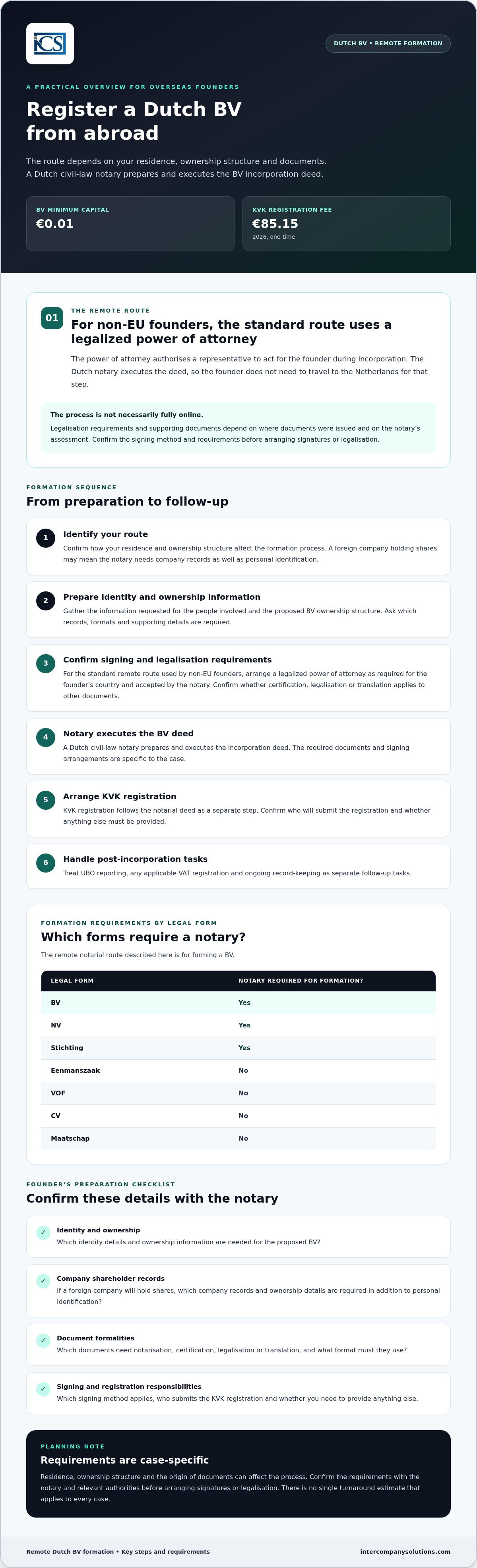
Establishing a Dutch BV doesn’t always require a trip to the Netherlands. In many cases, founders can register a Dutch company from abroad by preparing the required documents and arranging for a notary to execute the incorporation deed. For non-EU founders, the standard remote route uses a legalized power of attorney. The exact process depends on the founder’s residence and ownership structure.
It’s understandable to be unsure which documents need notarisation or legalisation, or whether foreign identity and company records could affect the process. You can avoid preventable delays by identifying those requirements before arranging signatures or legalisation.
This guide explains how to choose a registration route, prepare documents for the notary, and plan for the steps after incorporation. It also covers KVK registration, UBO reporting, tax registrations, and ongoing record-keeping. Requirements can vary with your circumstances, so confirm the details for your case with the notary and relevant authorities.
Key Takeaways
- To register a Dutch company from abroad, first identify the route that fits your residence and ownership structure. For non-EU founders, the standard remote BV route uses a legalized power of attorney.
- Prepare identity and ownership documents before the notarial process begins. Confirm with the notary which documents need notarisation or legalisation.
- A Dutch BV requires a notarial deed. In the standard remote route for non-EU founders, the notary executes the deed without the founder travelling to the Netherlands.
- After incorporation, treat KVK registration, UBO reporting, any applicable VAT registration, and ongoing record-keeping as separate follow-up tasks.
- Budget for the BV minimum capital €0.01 and KVK registration fee €85.15 (2026, one-time). Confirm how these requirements apply to your circumstances.
Table of Contents
What does it mean to register a Dutch company from abroad?
Remote registration means completing the applicable formation process without travelling to the Netherlands. It doesn’t necessarily mean every step takes place online. To establish a Dutch private limited company, or Besloten Vennootschap (BV), a Dutch civil-law notary prepares and executes the incorporation deed. This guide focuses on forming a BV, rather than the registration procedures for every Dutch legal form.
The route depends on the founder’s residence, the ownership structure, and the documents involved. For example, if a foreign company will hold shares, the notary may need company records as well as personal identification. Before arranging signatures or legalisation, ask the notary to confirm the documents and signing method required for your case. The notary and relevant authorities determine the requirements that apply.
Does a foreign founder need to visit the Netherlands?
Not always. The standard remote BV formation route for non-EU founders uses a legalized power of attorney. The notary can then execute the deed without the founder travelling to the Netherlands for that step. The required legalisation and supporting documents depend on where the documents were issued and on the notary’s assessment. Remote registration does not necessarily mean that every step happens by video or through an online process.
Which Dutch legal forms require a notary?
A notary is required to establish a BV, NV, or stichting. The other common forms listed below do not require a notary for their formation. Choose a legal form based on the intended business and ownership arrangement, not simply on whether a founder is based abroad. See the Business.gov.nl guide to choosing a business structure for an official overview.
| Legal form | Notary required for formation? |
|---|---|
| BV | Yes |
| NV | Yes |
| Stichting | Yes |
| Eenmanszaak | No |
| VOF | No |
| CV | No |
| Maatschap | No |
These distinctions matter because the remote notarial route in this guide applies to BV formation. Before you register a Dutch company from abroad, check that a BV suits your planned structure, then ask the notary which documents and signing arrangements apply to your circumstances.
How does remote Dutch BV registration work for overseas founders?
Remote formation generally involves preparing the information requested by the notary, completing any required legalisation, having the deed executed, and arranging registration with the Dutch Chamber of Commerce (KVK). The civil-law notary prepares and executes the BV deed. KVK registration follows as a separate step. Confirm with the notary who will submit the registration and whether you need to provide anything else. The official government checklist gives a broader overview of starting a business in the Netherlands.
Non-EU founders using the standard remote route can complete the process without travelling to the Netherlands by using a legalized power of attorney. Requirements depend on the founder’s country and circumstances. Confirm them with the notary before signing or sending documents. There is no single turnaround estimate that applies to every case.
How does the legalized Power of Attorney route work?
A power of attorney authorises a representative to act for the founder during the incorporation process. The document must be legalised as required for the founder’s country and accepted by the notary. The Dutch notary then executes the deed. Ask the notary which legalisation method applies, where the document must be completed, and whether any other formalities are needed.
What documents should a founder prepare?
Start by gathering identity information for the people involved and clear details of the proposed ownership structure. If a company will hold shares, the notary may also need information about that entity and its ownership. This is a preparation checklist, not a universal document list. Ask the notary which records are required, what format they must be in, and whether certification, legalisation, or translation applies.
- Collect: the identity and ownership information requested for the proposed BV.
- Check: whether any foreign-issued document needs legalisation, certification, or translation.
- Confirm: the signing arrangements and power-of-attorney wording with the notary before arranging signatures.
- Complete: the formation checklist for your case, and resolve missing or inconsistent details before the deed is prepared.
Preparing documents early helps surface questions before the deed is ready. If you’re unsure which route or documents apply, you can discuss your formation process before proceeding.
Which registration route fits EU and non-EU founders?
The route depends on where the founder lives, where their documents were issued, and how the BV will be owned. The standard remote route for non-EU founders uses a legalized power of attorney, so the Dutch notary can execute the deed without the founder travelling. For EU founders and other circumstances, don’t assume the same document or signing process applies. Ask the notary to review your case before preparing documents.
A BV is a Dutch limited-liability form, but it isn’t automatically the right fit for every business. Consider the planned ownership and operating structure before proceeding. This Dutch BV formation guide explains the formation process, while the guide to starting a business in the Netherlands provides broader context on legal forms.
| Route | What is established | What to confirm |
|---|---|---|
| Non-EU founder using the remote route | The standard remote route uses a legalized power of attorney. The notary executes the BV deed, and the founder does not travel to the Netherlands for that step. | The notary confirms the required documents and legalisation method for the founder’s country, as well as any requirements arising from the ownership structure. |
| Other remote cases, including EU-based founders | Remote handling may be possible, but the non-EU power-of-attorney route should not be assumed to apply unchanged. | Ask the notary which signing method, documents, and formalities apply to the founder’s residence and circumstances. |
| In-person incorporation | The founder travels to the Netherlands to take part in the notarial process in person. | Confirm with the notary whether this route is suitable and which documents are still required. In-person attendance does not remove document requirements. |
What changes for a non-EU founder registering remotely?
The legalized power of attorney is the standard remote route for a non-EU founder. Residence, document origin, and a more complex shareholding structure can affect preparation, so the notary should confirm the requirements for your case. Immigration or stay questions are separate from the incorporation route and should not be treated as automatic requirements for forming a BV.
When should a founder compare a BV with another legal form?
Compare structures if your intended business or ownership arrangement may not need a BV. A BV, NV, and stichting require a notary; an eenmanszaak, VOF, CV, and maatschap do not. The right choice depends on the planned structure and should be considered separately from whether incorporation can be handled remotely.
To register a Dutch company from abroad, confirm both the intended legal form and the notary’s requirements for your route. Residence alone does not determine which structure or process is right for you.
What must founders arrange after Dutch BV registration?
Incorporation is the start of the BV’s administrative obligations, not the end of the process. Check that the company’s KVK details are correct, confirm how its ultimate beneficial owners are recorded, and assess which tax registrations apply to its activities. Keep KVK registration, UBO information, VAT, and ongoing record-keeping on your follow-up checklist as separate tasks.
Which KVK and UBO obligations follow incorporation?
Confirm that the BV has been entered in the Dutch Chamber of Commerce (KVK) register and that its registered information is accurate. The required reference wording is “BV minimum capital €0.01” and “KVK registration fee €85.15 (2026, one-time).” Check the KVK’s registration fee information for current details.
The notary handles the initial UBO registration as part of the formation process. The required reference wording is “UBO threshold >25%.” Review the KVK’s UBO guidance to determine who qualifies. For subsequent updates, use the wording “UBO changes reported within 7 days.” Keep ownership information current and confirm reporting details with KVK if the company’s ownership or control changes.
What tax and record-keeping steps should founders plan for?
VAT registration depends on the BV’s activities and circumstances. Check the Belastingdienst guidance on VAT rates before invoicing. The required rate wording is “VAT rates 21%/9%/0%”; the applicable rate depends on the transaction. For foreign-owned entities, use the wording “VAT for foreign-owned entities typically 6-8 weeks” when planning registration, and confirm the requirements that apply with the Belastingdienst.
Keep business records in an orderly form. The required retention wording is “records retained 7 years (10 for immovable property).” Check the Belastingdienst record-keeping guidance for the rules that apply to your records. A BV must also prepare and file annual accounts. The required filing wording is “annual accounts filed with KVK within 12 months of year-end.”
For corporate income tax, use the required wording “CIT 19% up to €200,000 and 25.8% above.” Confirm the company’s reporting and payment obligations with the Belastingdienst, as they depend on its circumstances. If you register a Dutch company from abroad, assign responsibility for these follow-up tasks early, especially when records and ownership information are held in different countries.
How can a specialist support registration from abroad?
Coordination can help when founders are collecting identity and ownership documents across countries, arranging legalisation, and communicating with a Dutch notary. A specialist can help organise formation documents and coordinate incorporation and KVK registration follow-up. This support does not replace the notary’s role: the notary prepares and executes the deed, and the notary and relevant authorities determine the requirements for each founder’s circumstances.
Before choosing support, clarify which steps will be coordinated and which remain your responsibility. Requirements can depend on your residence, ownership structure, the origin of your documents, and the proposed BV. Discuss a timeline after those details have been reviewed.
What should founders confirm before choosing formation support?
Ask who will coordinate with the notary, check document legalisation requirements, and follow up on KVK registration. Clarify what the assistance covers, what information or signatures you must provide, and who will respond to questions from the notary or authorities. Request a current timeline once the ownership structure and document requirements have been reviewed, rather than relying on a general estimate.
What should the first consultation clarify?
Prepare a short outline of your residence, proposed shareholders and ownership, intended business activity, and preferred legal form. Ask which identity or ownership documents are needed, whether documents from your country require legalisation, and whether translations may be necessary. These details help identify questions for the notary, who confirms the requirements for your case.
For founders planning to register a Dutch company from abroad, Intercompany Solutions supports Dutch BV formation, remote incorporation, legal documentation, and KVK registration, with VAT applications and ongoing compliance support also available. The right route depends on your circumstances. A consultation can help clarify the steps before the notarial process begins.
Prepare your next steps with clarity
To register a Dutch company from abroad, first confirm that a BV fits your intended ownership and business structure. Then establish which formation route applies to your residence and documents. For non-EU founders, the standard remote route uses a legalized power of attorney, with the Dutch notary executing the deed. Ask the notary to confirm the documents and legalisation method required for your circumstances.
Plan for the steps that follow incorporation too. KVK registration, UBO details, any applicable VAT registration, and ongoing record-keeping each need attention. Gathering identity and ownership information early can help you clarify requirements before the notarial process begins.
Intercompany Solutions supports international entrepreneurs with remote Dutch BV formation, including legal documentation and KVK registration. An initial consultation can help clarify your route and the questions to confirm with the notary and authorities.
With the route and document requirements established at the outset, you can move through incorporation with a clearer plan.
Frequently Asked Questions
Can I register a Dutch BV from abroad without travelling to the Netherlands?
Yes, a Dutch BV can generally be formed remotely, depending on the founder’s circumstances and the notary’s requirements. For non-EU founders, the standard remote route uses a legalized power of attorney, allowing the notary to execute the deed without the founder travelling to the Netherlands. Remote formation does not necessarily mean an online or video process. Confirm the signing and document arrangements with the notary handling the incorporation.
How does a legalized Power of Attorney work for a non-EU founder?
A power of attorney authorises a representative to act for the founder during the incorporation process. Under the standard remote route for non-EU founders, the document is legalised as required and the Dutch civil-law notary executes the BV deed. The correct legalisation method depends on the country where the document is issued. Before arranging legalisation, ask the notary to confirm the wording, signing process, and supporting documents.
What documents do I need to register a Dutch company from abroad?
The documents depend on the founder, ownership structure, and country of origin. Be prepared to provide identity information and details of the proposed shareholders and ownership. If a company will own shares, the notary may also request information about that entity. There is no universal document list. Ask the notary whether records need certification, legalisation, or translation before sending them or signing a power of attorney.
Does a Dutch BV require a notary if all founders live abroad?
Yes. A Dutch BV requires a Dutch civil-law notary to prepare and execute its incorporation deed, regardless of where the founders live. Founders living abroad may be able to use a remote route, but the notarial step still applies. For non-EU founders, the standard remote route uses a legalized power of attorney. Confirm the process and document formalities with the notary. See Business.gov.nl’s business structure guidance.
How long does remote Dutch BV registration take?
There isn’t one reliable timeline for every remote formation. The time required can depend on the ownership structure, whether documents are complete, and whether legalisation or translation is needed. Ask for a current estimate after the notary has reviewed your circumstances and documents. Avoid relying on a general turnaround figure before those checks are complete. Gathering identity and ownership information and confirming document requirements early can help you prepare.
Can a foreign-owned Dutch BV register for VAT?
Yes, a foreign-owned Dutch BV can apply for VAT registration when its activities and circumstances make registration applicable. VAT rates 21%/9%/0%; the correct rate depends on the transaction. VAT registration for foreign-owned entities typically takes 6-8 weeks. Check the Belastingdienst VAT registration guidance to understand the process and confirm which requirements apply to the company.
What must I do after my Dutch company is registered?
Check the BV’s KVK details and UBO information, then confirm whether VAT registration applies to its activities. The UBO threshold >25%; UBO changes reported within 7 days. Keep business records in line with the applicable retention rules and file annual accounts with KVK within 12 months of year-end. See KVK’s UBO guidance and its annual accounts information for details.
Sources
- KVK - Registering with the Dutch Business Register
- Business.gov.nl - Private limited company (bv)
- Burgerlijk Wetboek Boek 2 (Dutch Civil Code, legal entities)
- Rijksoverheid - Ondernemen
- Belastingdienst - Corporate income tax rates
- Belastingdienst - VAT (btw) for entrepreneurs
- European Commission - VAT rules and rates
- IND - Highly skilled migrant
- IND - Start-up residence permit
- CJEU, Cadbury Schweppes, C-196/04 (ECLI:EU:C:2006:544)
- Hoge Raad, ECLI:NL:HR:2021:1152
- PwC Worldwide Tax Summaries - Netherlands
- ICLG - Corporate Governance Laws and Regulations, Netherlands
Need more information on the Dutch BV company?
Contact an expertReady to start your company in the Netherlands?
| Formation time | Dutch BV formation completed in 3 to 5 business days |
|---|---|
| Process | Fully remote setup with step-by-step guidance |
| Compliance | Expert support for registration, VAT and compliance |
| Aftercare | Accounting, tax and legal support included |
| One partner | All of the above through one trusted formation partner |