


August 27, 2026 · 18 min read
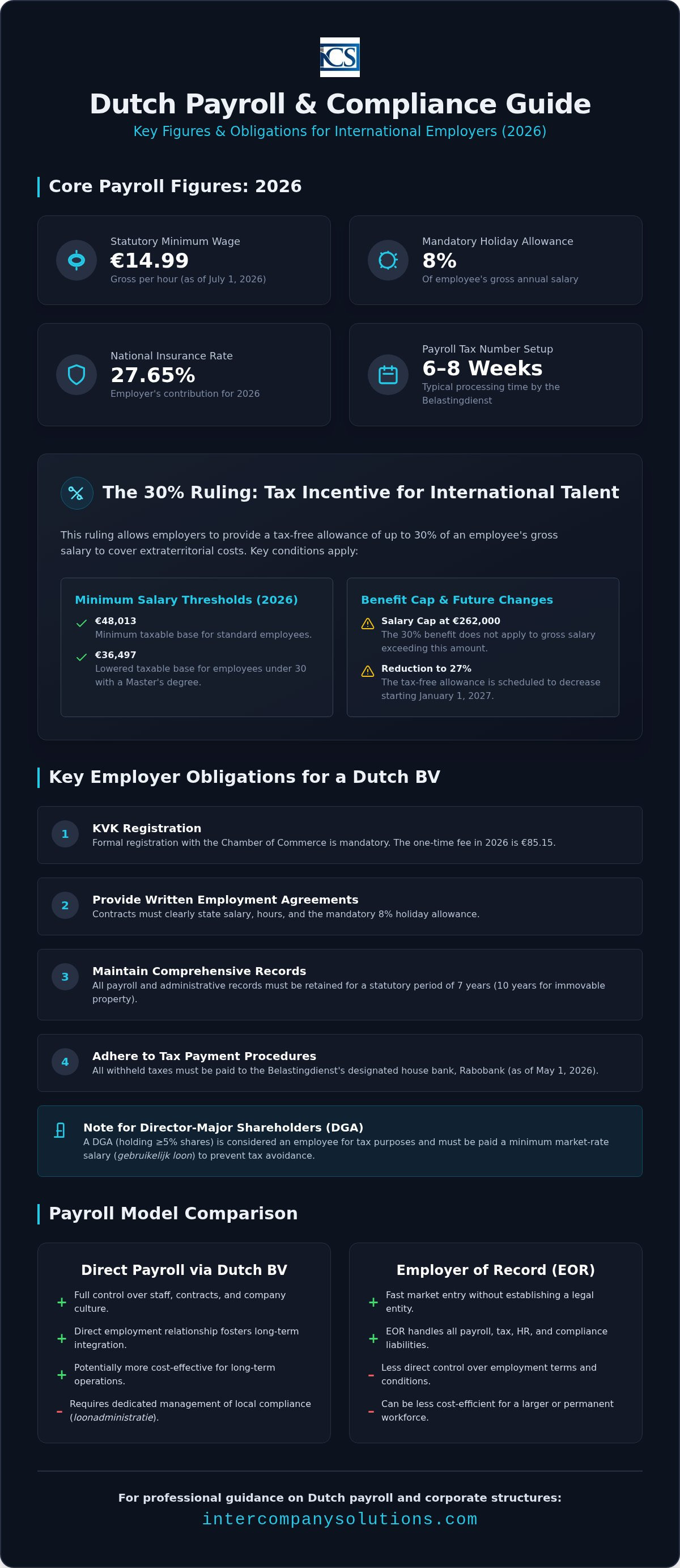
The Dutch statutory minimum wage reached €14.99 gross per hour on July 1, 2026, establishing a new baseline for international firms with a local presence. Successfully managing payroll services Netherlands requires a precise understanding of these shifting thresholds alongside the 27.65% national insurance contribution rate. You likely find that the complexity of Dutch labor law, particularly regarding mandatory 8% holiday allowances and evolving social security mandates, presents a significant administrative burden when managed from abroad.
This guide offers a professional breakdown of Dutch payroll compliance and the strategic application of the 30% ruling for your international staff. You'll gain a clear perspective on employer obligations, including the €48,013 minimum salary threshold for the 30% allowance and the upcoming reduction of this benefit to 27% in 2027. We detail the procedural requirements for remote administration, the impact of the 24.5% interest deduction cap, and the necessity of aligning with the Belastingdienst's house bank, Rabobank. By following this structured overview, you can ensure full regulatory adherence while optimizing the tax position of your global workforce.
Key Takeaways
- Understand the statutory requirements of Dutch loonadministratie, including the mandatory 8% holiday allowance and the 27.65% national insurance contribution rate for 2026.
- Identify the specific salary thresholds for the 30% ruling, such as the €48,013 minimum taxable base required to secure tax-free reimbursements for international staff.
- Implement professional payroll services Netherlands by obtaining a payroll tax number from the Belastingdienst, a process that typically requires 6–8 weeks to complete.
- Evaluate the cost-efficiency of the local BV payroll model compared to the Employer of Record (EOR) structure for long-term international operations.
- Maintain regulatory compliance by utilizing Rabobank for tax payments and adhering to the mandatory 7-year retention period for all payroll and administrative records.
Table of Contents
- Understanding the Dutch Payroll System for International Employers
- Tax Optimization: The 30% Ruling and Social Security
- Comparison: Outsourced Payroll vs. Employer of Record (EOR)
- Setting Up Your Dutch Payroll Administration: A Step-by-Step Guide
- Professional Payroll and Staffing Solutions by Intercompany Solutions
Understanding the Dutch Payroll System for International Employers
In the Netherlands, payroll administration, or loonadministratie, is a strictly regulated process that extends beyond simple salary distribution. For international companies operating via a Dutch BV, this system serves as the primary mechanism for collecting wage taxes and social insurance contributions. The Belastingdienst, or Dutch Tax Administration, oversees this process. Every employer must obtain a unique payroll tax number before their first employee starts work. This registration typically takes several weeks to finalize. Once active, the employer becomes responsible for calculating and withholding national insurance, employee insurance, and the income-related healthcare contribution. Utilizing professional payroll services Netherlands ensures these calculations align with the latest 2026 tax brackets and contribution thresholds.
Accuracy in these filings is paramount. The Dutch authorities operate on a system of trust backed by rigorous audits. Employers must maintain comprehensive records for every employee, including copies of identification, wage statements, and tax declarations. These records must be retained for a statutory period of 7 years (10 for immovable property). Failure to produce these documents during an audit can result in substantial retroactive assessments.
Employer Obligations for Dutch BV Entities
Operating a BV requires formal registration with the Chamber of Commerce (KVK), which carries a one-time fee of €85.15 in 2026. Beyond registration, employers must provide a written employment agreement to every staff member. This document must clearly state the salary, working hours, and the mandatory 8% holiday allowance. Compliance also involves meeting strict monthly filing deadlines. All withheld taxes and contributions must be paid to the Belastingdienst house bank, which has been Rabobank since 1 May 2026. A comprehensive understanding of the Dutch tax system is vital here. Errors in withholding or late payments often trigger automatic penalties. Most international firms find that centralized payroll services Netherlands provide the necessary oversight to prevent these avoidable costs.
Payroll Compliance for Non-Resident Directors
Special rules apply to the Director-Major Shareholder (DGA). This is usually an individual holding at least 5% of the company's shares. Under the "fictitious employment" rule, a DGA is legally treated as an employee for tax purposes, even if they're the sole owner. This necessitates a minimum salary, known as gebruikelijk loon, which must reflect the market value of the position. In 2026, the tax authorities maintain specific benchmarks for this salary to prevent tax avoidance through excessive dividend distributions. For directors residing outside the EU, social security status depends on bilateral treaties. If no treaty exists, the DGA might remain subject to Dutch social insurance unless they can prove coverage in their home country. Managing these nuances is a core component of effective corporate governance for international founders.
Tax Optimization: The 30% Ruling and Social Security
The 30% ruling remains a primary fiscal incentive for international businesses hiring specialized talent in the Dutch market. It allows an employer to grant a tax-free allowance of up to 30% of the gross salary to compensate for "extraterritorial costs" incurred by the employee. This incentive significantly reduces the effective tax rate for the individual while lowering the employer's cost base for social security contributions. The OECD Taxing Wages report highlights the importance of such incentives in maintaining competitiveness within high-tax jurisdictions. For 2026, the tax-free allowance remains at 30%, though it's scheduled to decrease to 27% starting January 1, 2027.
Eligibility for this ruling depends on specific salary thresholds and the scarcity of the employee's skills. In 2026, the minimum gross salary required is €48,013, which is the taxable base after the 30% allowance is applied. For employees under 30 who hold a Master's degree, a lower threshold of €36,497 applies. It's also vital to note the salary cap; the 30% benefit is capped at a gross salary of €262,000. Any income exceeding this amount is subject to standard progressive tax rates. Engaging specialized payroll services Netherlands ensures that these thresholds are monitored monthly to prevent the loss of the ruling due to salary fluctuations.
Implementing the 30% Tax Reimbursement
The application for the 30% ruling must be submitted to the Belastingdienst within four months of the employee's start date to ensure retroactive effect. This process requires proof that the employee was recruited from abroad and lived more than 150 kilometers from the Dutch border for at least 16 of the 24 months prior to their start. Non-resident directors can also qualify for this benefit, provided they're in a formal employment relationship with the Dutch BV and meet the salary criteria. This is a common gap in international setups where directors assume they're ineligible due to their residency status. If you're unsure about your eligibility, you can reach out to our tax specialists for a preliminary assessment.
Dutch Social Security and Insurance Contributions
Employer obligations extend to national insurance (volksverzekeringen) and employee insurance (werknemersverzekeringen). National insurance includes AOW (pensions at 17.9%), Anw (survivor benefits at 0.1%), and Wlz (long-term care at 9.65%). These are withheld from the employee's gross pay up to a threshold of €38,883. On top of the gross salary, employers pay the Zvw healthcare contribution, which is 6.10% in 2026 on income up to €79,409. Additionally, the Wet verbetering poortwachter mandates that employers manage and pay at least 70% of the salary for employees on sick leave for up to two years. Many industries also require participation in mandatory pension funds, which can add another 10% to 20% to the total labor cost depending on the applicable Collective Labour Agreement (CAO).
Comparison: Outsourced Payroll vs. Employer of Record (EOR)
International entrepreneurs entering the Dutch market must decide between establishing a local subsidiary or utilizing an intermediary to manage their workforce. While an Employer of Record (EOR) offers a rapid entry, a Dutch BV provides significantly greater fiscal control and long-term cost efficiency. The choice affects not only day-to-day operations but also the company's ability to utilize specific tax incentives. Professional payroll services Netherlands help bridge this gap by providing local expertise for those choosing the BV route, ensuring compliance with both labor law and tax mandates.
Cost structures differ significantly between these two models. EOR providers typically charge a percentage of the employee's gross salary, which often ranges from 10% to 15%. For a highly skilled migrant earning €80,000, this results in high recurring monthly costs. In contrast, managing payroll through a BV involves fixed service fees that don't scale with the employee's salary level. This becomes particularly relevant when considering the broader corporate tax strategy, including the 19% CIT rate on profits up to €200,000 and the 24.5% interest deduction cap on EBITDA. For companies with more than two employees, the BV model usually represents a more sustainable financial path.
The Local BV Payroll Model
Direct employment through a BV allows for maximum control over the employee relationship. Contracts are drafted directly under Dutch law, ensuring clarity on leave, termination, and intellectual property rights. This model integrates seamlessly with your broader accounting for Dutch BV, allowing for consolidated tax planning and efficient management of the 8% holiday allowance. High-growth firms benefit from this structure as it facilitates the 30% ruling application directly; this ensures the employer retains the associated social security savings rather than paying them out as part of an EOR fee. Using dedicated payroll services Netherlands ensures these benefits are captured accurately in the monthly loonadministratie.
Employer of Record (EOR) Solutions
EOR solutions serve as a temporary bridge for companies testing the Dutch market with a single employee or for short-term projects. The EOR acts as the legal employer, handling all filings and payments to the Belastingdienst. However, this model introduces limitations regarding tax optimization. Applying for the 30% ruling through an EOR can be administratively complex and may not offer the same flexibility as direct employment via a BV. Furthermore, because the EOR holds the legal relationship, the client company has less direct influence over specific employment terms and secondary benefits. Once a team expands, the cumulative percentage-based fees of an EOR typically exceed the operational costs of a dedicated Dutch corporate structure.
Setting Up Your Dutch Payroll Administration: A Step-by-Step Guide
The process of establishing a compliant payroll system begins with Dutch BV formation. For international founders, this is typically handled via the legalized Power of Attorney route, allowing the notary to execute the deed without the founder needing to travel to the Netherlands. Once the KVK registration is complete and the €85.15 fee is paid, the company exists legally, but it's not yet ready to pay staff. You must first obtain a payroll tax number from the Belastingdienst. This specific registration involves a 6–8 week timeline. It's a critical waiting period that businesses must account for when planning their first local hires.
After receiving your tax number, you must set up a digital payroll environment to manage employee data and monthly calculations. This system serves as the repository for all employment records, which you're legally required to retain for 7 years. Coordinating this setup through professional payroll services Netherlands ensures that the initial configuration aligns with Dutch tax software requirements and social security categories from day one.
Administrative Prerequisites
Before executing the first run, you must collect a Citizen Service Number (BSN) for every employee. For staff members recruited from outside the EU, you're required to verify their residence and work permits according to IND regulations. This verification is a prerequisite for applying the 30% ruling discussed in previous sections. Additionally, you need to establish a business bank account for salary disbursements. While salaries can be paid from various SEPA accounts, all withheld taxes must be transferred to the Belastingdienst's house bank, which has been Rabobank since 1 May 2026. Accurate data collection at this stage prevents retroactive corrections in the loonheffingen returns.
Monthly Payroll Workflow
The monthly cycle involves a precise gross-to-net calculation. This must include the mandatory 8% holiday allowance, which is a statutory requirement for all Dutch employment contracts. You're responsible for generating digital payslips, or loonstroken, which clearly outline the gross salary, tax withholdings, and social insurance contributions. The final step is filing the monthly tax return. This return must be submitted to the authorities before the statutory deadline, typically the end of the following month. Reliable payroll services Netherlands automate these filings to ensure that payments to Rabobank are made on time, avoiding the automatic penalties associated with late submissions.
Last reviewed: August 2026
Professional Payroll and Staffing Solutions by Intercompany Solutions
Intercompany Solutions operates a specialized division, ICS Payroll, specifically designed to support international entrepreneurs with payroll services Netherlands. This service manages the entire lifecycle of employment administration, starting from the drafting of compliant employment contracts to the final 30% ruling applications. By centralizing these tasks, the firm acts as a proactive facilitator between your global operations and the Dutch regulatory framework. We ensure that every administrative step aligns with the latest 2026 standards for social security and wage tax withholding.
Efficiency is achieved through the seamless integration of payroll with our broader accounting services. This holistic approach ensures that salary costs, social security withholdings, and pension contributions are correctly reflected in your corporate tax filings. Clients receive a single monthly invoice that covers all employment-related costs, simplifying the treasury process for non-resident directors. This transparency is vital for accurately calculating the 19% CIT rate on profits up to €200,000 and adhering to the 24.5% interest deduction cap on EBITDA.
Why Partner with Intercompany Solutions?
The team possesses specific expertise in the Highly Skilled Migrant (HSM) visa process, coordinating directly with the IND to ensure all immigration requirements are met before payroll commences. We maintain a 24-hour response time for all compliance inquiries, providing the speed required in a modern business environment. For non-resident owners, the entire support structure is accessible remotely through the legalized Power of Attorney route. This removes the need for international travel while ensuring the BV remains in full compliance with local labor laws.
Comprehensive Compliance Monitoring
Our payroll services Netherlands division proactively monitors changes in Dutch labor law and tax rates to prevent non-compliance. We manage all direct communication with the Belastingdienst and ensure that all tax payments are correctly routed to Rabobank, the tax authority's house bank since 1 May 2026. This meticulous attention to detail extends to the mandatory 7-year record retention period, ensuring your BV is always audit-ready. To begin structuring your local workforce and optimizing your tax position, you can request an initial consultation via Intercompany Solutions Payroll.
Last reviewed: August 2026
Optimizing Your Dutch Workforce for 2026 and Beyond
Managing payroll in the Netherlands requires strict adherence to the 7-year record retention rule and the updated 2026 salary thresholds for the 30% ruling. Establishing a local BV remains the most cost-effective long-term strategy for firms looking to maximize tax optimization and maintain direct control over their employment contracts. Implementing professional payroll services Netherlands allows your business to scale without the administrative friction of navigating social security contributions or the specific requirements of the Belastingdienst.
Our specialized division for foreign entrepreneurs ensures that your loonadministratie is handled with a 24-hour response time and a commitment to meticulous accuracy. We provide the stability needed to manage payments to Rabobank and filings for highly skilled migrants with a 100% satisfaction guarantee. By delegating these procedural burdens, you can focus on your core operations while we ensure your entity remains in full compliance with Dutch labor law and corporate tax mandates, including the 19% CIT bracket and the 24.5% EBITDA interest deduction cap.
We're here to facilitate a seamless transition into the Dutch market, ensuring your administrative processes are as efficient as your business growth. Our experts handle the technical details so you can operate with total confidence.
Last reviewed: August 2026
Frequently Asked Questions
What are the mandatory payroll taxes for a Dutch employer in 2026?
Employers must withhold wage tax and national insurance, which for 2026 is 27.65% for AOW, ANW, and WLZ on income up to €38,883. You also pay the Zvw healthcare contribution of 6.10% on income up to €79,409. WW-Awf premiums for unemployment insurance are also mandatory. These payments are due monthly to Rabobank. Professional payroll services Netherlands ensure these calculations include the statutory 8% holiday allowance and any applicable sector-specific pension contributions.
How long does it take to set up payroll services in the Netherlands?
Establishing a payroll administration typically takes 6 to 8 weeks. This timeframe accounts for the Belastingdienst's processing of your payroll tax number application. You must first register with the KVK and pay the €85.15 one-time fee. After the tax office issues your number, you can configure the digital environment to collect BSNs and generate monthly loonstroken. This sequence is essential for ensuring your first salary run is fully compliant with Dutch tax law.
Can I manage Dutch payroll remotely as a non-resident director?
Managing Dutch payroll remotely is standard practice for non-resident directors using the legalized Power of Attorney route. This process allows you to set up a BV and its administration without traveling to the Netherlands. Secure digital portals facilitate the collection of employee identity documents and the execution of monthly filings. You can oversee all salary payments and tax withholdings from abroad, provided you maintain the mandatory 7-year record retention period for all administrative data.
What is the 30% ruling and how does it benefit my Dutch company?
The 30% ruling is a tax incentive allowing employers to pay 30% of an employee's gross salary as a tax-free allowance. This benefit compensates for extraterritorial costs and reduces the overall social security burden for the company. In 2026, the employee must earn a minimum taxable salary of €48,013 to qualify. It's a vital tool for Dutch companies to attract international expertise while maintaining a competitive cost structure compared to standard employment models.
What is the minimum salary requirement for a Dutch BV director (DGA)?
The minimum salary for a director-major shareholder (DGA) is determined by the gebruikelijk loon rules. This salary must be at least 75% of the wage for the most comparable role or equal to the highest-paid employee in the company. Dutch tax authorities set these benchmarks to ensure directors pay appropriate wage tax. This requirement applies even if the company's profits are subject to the 19% CIT rate for the first €200,000 of taxable income.
Are there specific requirements for hiring highly skilled migrants in the Netherlands?
Hiring highly skilled migrants requires your company to be an IND-recognized sponsor. You must adhere to specific salary thresholds, which for 2026 are €48,013 for standard applicants and €36,497 for those under 30 with a Master's degree. Employers must also maintain copies of work permits and BSNs. These requirements are strictly enforced, and non-compliance can lead to the loss of sponsor status or significant fines from the Dutch labor inspectorate.
What happens if I fail to file my Dutch payroll taxes on time?
Failing to file payroll taxes on time triggers automatic default penalties and interest charges from the Belastingdienst. All tax liabilities must be paid to Rabobank by the end of the month following the payroll period. Inaccurate filings can lead to retroactive assessments during audits, which cover a 5-year period. Utilizing professional payroll services Netherlands ensures that your loonheffingen returns are submitted accurately and on time, protecting your company from avoidable financial and legal risks.
How do I apply for a Dutch payroll tax number for my foreign-owned company?
You apply for a payroll tax number by submitting a registration form to the Belastingdienst after your KVK registration is finalized. This application requires details about your Dutch BV's activities and your planned workforce. The process usually takes between 6 and 8 weeks for foreign-owned entities. Once the tax number is issued, you're legally authorized to withhold taxes and social security contributions, which must be stored in your records for at least 7 years.
Sources
- ICS Payroll - Dutch payroll services
- KVK - Registering with the Dutch Business Register
- Business.gov.nl - Private limited company (bv)
- Burgerlijk Wetboek Boek 2 (Dutch Civil Code, legal entities)
- Rijksoverheid - Ondernemen
- Belastingdienst - Corporate income tax rates
- Belastingdienst - Payroll taxes (loonheffingen)
- UWV - Employer obligations
- SVB - Social insurance in the Netherlands
- IND - Highly skilled migrant
- IND - Start-up residence permit
- De Nederlandsche Bank - Supervision
- AFM - Licences and registers
- BOIP - Trademark registration in Benelux
- WIPO - Madrid System
- CJEU, Cadbury Schweppes, C-196/04 (ECLI:EU:C:2006:544)
- Hoge Raad, ECLI:NL:HR:2021:1152
- PwC Worldwide Tax Summaries - Netherlands
- ICLG - Corporate Governance Laws and Regulations, Netherlands
Need more information on the Dutch BV company?
Contact an expertReady to start your company in the Netherlands?
| Formation time | Dutch BV formation completed in 3 to 5 business days |
|---|---|
| Process | Fully remote setup with step-by-step guidance |
| Compliance | Expert support for registration, VAT and compliance |
| Aftercare | Accounting, tax and legal support included |
| One partner | All of the above through one trusted formation partner |