


September 5, 2026 · 16 min read
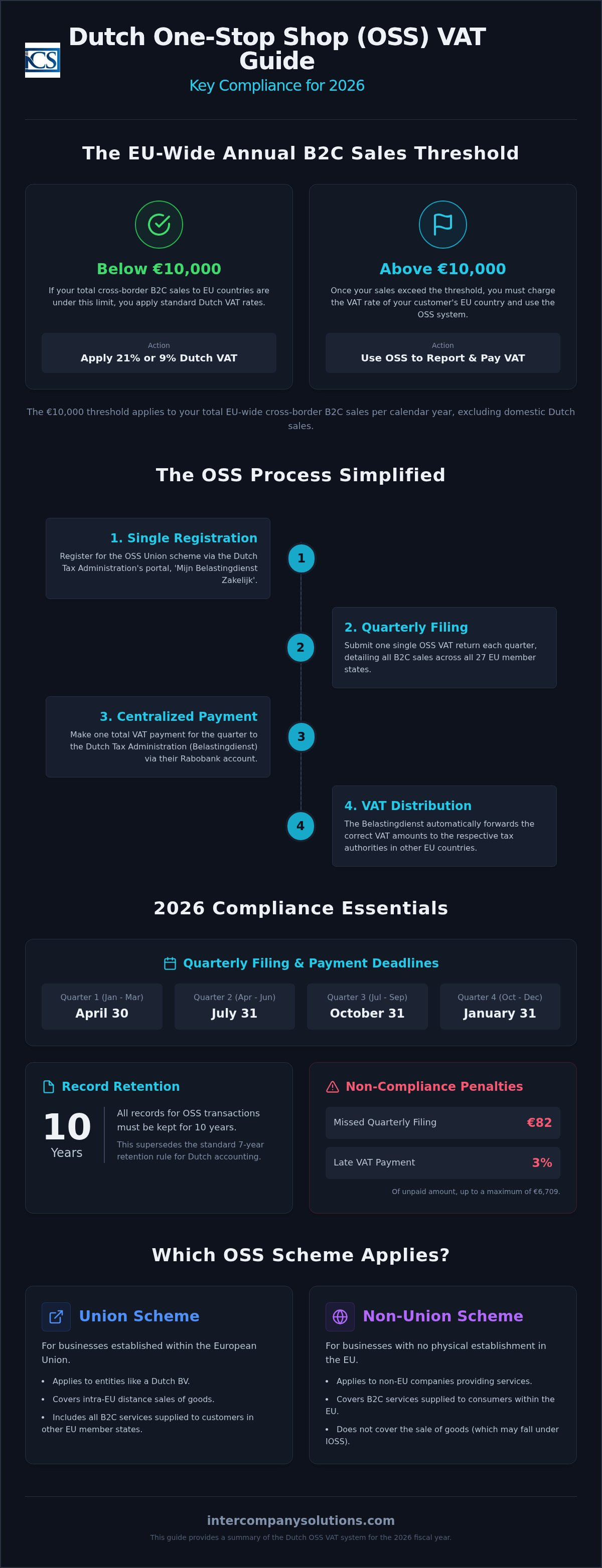
The €10,000 EU-wide threshold for cross-border B2C sales remains the critical pivot point for international entrepreneurs in 2026. Once your sales cross this mark, the OSS VAT filing Netherlands system becomes the primary mechanism for maintaining compliance without the need for individual registrations in every member state. You likely recognize that managing multiple tax IDs is administratively heavy and carries significant risk if a single deadline is missed. Missing a quarterly filing now results in a fixed €82 penalty, while late payments incur charges of 3% of the unpaid VAT amount, with a maximum penalty of €6,709.
This reference guide provides the technical specifications required to manage your Dutch One-Stop Shop obligations with absolute precision. We've compiled the essential data for the 2026 fiscal year to ensure your cross-border operations remain stable and legally sound. You'll find a breakdown of the quarterly submission dates, the digital mandate for non-EU refund requests effective from 1 April 2026, and the specific 10-year record retention requirements that supersede standard Dutch accounting rules. This overview clarifies the procedural differences between Union and Non-Union schemes to help you maintain a transparent relationship with the Dutch Tax Administration.
Key Takeaways
- Identify when cross-border B2C sales exceed the €10,000 EU-wide threshold to transition from local Dutch VAT rates to destination-based reporting.
- Consolidate your EU-wide tax obligations into a single quarterly OSS VAT filing Netherlands via the 'Mijn Belastingdienst Zakelijk' portal.
- Ensure all tax payments are received by the Dutch Tax Administration’s Rabobank account by the last day of the month following each reporting quarter to avoid penalties.
- Maintain comprehensive records for 10 years for all OSS transactions to satisfy specific evidentiary standards that exceed the standard 7-year retention rule.
- Adapt to the mandatory digital submission requirements for all VAT refund requests effective from 1 April 2026 to maintain regulatory compliance.
Table of Contents
Understanding the One-Stop Shop (OSS) VAT System in the Netherlands
The One-Stop Shop (OSS) system acts as a centralized administrative hub for managing VAT on cross-border B2C transactions. This optional scheme allows international entrepreneurs to consolidate their tax reporting across all 27 EU member states into a single portal. By using the OSS VAT filing Netherlands portal, you avoid the administrative burden of registering with the tax authorities of every country where your customers reside. This system evolved from the earlier Mini One-Stop Shop (MOSS) and was expanded in July 2021 to include distance sales of physical goods alongside digital services. For a Dutch BV, the Belastingdienst functions as the intermediary authority, collecting the total VAT amount and distributing the respective portions to other EU member states.
The Union Scheme vs. the Non-Union Scheme
The OSS is divided into specific regimes based on your company's location and business model. The Union scheme applies to businesses established within the EU, such as a Dutch BV. If you've completed Netherlands company formation, you'll use this scheme for all intra-EU distance sales of goods and B2C services. Conversely, the Non-Union scheme is designed for businesses without any EU establishment that provide services to EU consumers. For those importing goods from outside the EU with a value not exceeding €150, the Import One-Stop Shop (IOSS) provides a similar simplification. In these cases, an intermediary based in the Netherlands often manages the registration and reporting to ensure compliance with European Union value added tax regulations.
Key Advantages for International Entrepreneurs
Centralizing your tax obligations through the Dutch portal offers several procedural benefits. First, it significantly reduces administrative costs by eliminating the requirement for multiple VAT registrations and the associated local accounting fees in various jurisdictions. Second, you communicate exclusively with the Dutch tax authorities in a single language, which streamlines the resolution of any inquiries. Finally, payment processing is simplified. You make one total payment to the Belastingdienst, which has used Rabobank as its house bank since 1 May 2026. This single transfer covers your entire EU-wide B2C VAT liability for the quarter, ensuring your OSS VAT filing Netherlands remains efficient and reliable. This structure allows you to focus on scaling your operations without the friction of decentralized tax compliance.
Last reviewed: September 2026
Eligibility Criteria and the €10,000 Threshold
The European Union applies a unified threshold of €10,000 per calendar year for cross-border B2C distance sales. For entrepreneurs operating a Dutch BV, this threshold determines whether you apply local rates or destination-based rates. If your total annual EU-wide sales remain below €10,000, you continue to apply the standard 21% or reduced 9% Dutch VAT rates to all EU customers. Once your turnover exceeds this limit, you must charge the VAT rate applicable in the member state where your customer is located. Registration for the One-Stop Shop is the most efficient way to manage this transition. Without it, you'd be legally required to register for VAT in every single member state where you make sales once the threshold is breached.
Calculating the Threshold for Dutch Entities
It's vital to categorize your revenue streams accurately to monitor this limit. The €10,000 calculation includes all B2C cross-border sales of goods within the EU and telecommunications, broadcasting, and electronic (TBE) services. However, domestic sales within the Netherlands are excluded from this specific EU-wide threshold calculation. Since Dutch VAT regulations mandate precise reporting, keeping separate ledgers for domestic and cross-border B2C transactions is a standard requirement for compliance. If you operate multiple entities, remember that the threshold applies to the taxable person, not per country of destination.
Voluntary Registration Benefits
Some entrepreneurs choose to register for the scheme before reaching the €10,000 limit. This proactive approach allows for a consistent pricing strategy across the EU from day one. It also simplifies the accounting process during the early stages of Dutch BV formation, as you won't need to adjust your checkout systems mid-year when the threshold is hit. For businesses with high growth projections, early adoption of OSS VAT filing Netherlands procedures prevents administrative bottlenecks during peak sales periods. If you're unsure how these thresholds apply to your specific product categories, you can reach out to our tax specialists for a detailed assessment.
Last reviewed: September 2026
Step-by-Step OSS VAT Filing and Quarterly Deadlines
Accessing the 'Mijn Belastingdienst Zakelijk' portal is the first procedural step for your OSS VAT filing Netherlands. You'll need either DigiD or a level 3 eHerkenning token to log in. Once inside, you must compile a comprehensive report of all B2C sales categorized by the specific EU member state and the applicable VAT rate. This data serves as the foundation for the EU One-Stop Shop (OSS) VAT System, ensuring that the tax collected is correctly attributed to the country of consumption. You have exactly one month following the end of each calendar quarter to submit this declaration and ensure the funds reach the Dutch tax authorities.
2026 Filing Deadlines and Payment Procedures
Compliance hinges on meeting the strict quarterly deadlines set by the Belastingdienst. For the 2026 fiscal year, these dates are:
- Q1 (January–March): 30 April 2026
- Q2 (April–June): 31 July 2026
- Q3 (July–September): 31 October 2026
- Q4 (October–December): 31 January 2027
You must use the unique payment reference generated by the portal for every individual filing. This reference is the only way the tax office can link your payment to your return. A critical administrative change occurred on 1 May 2026: the Belastingdienst house bank is Rabobank. You must update all saved payment templates and international transfer instructions to reflect this Rabobank account. Payments sent to previous accounts may be delayed or returned, potentially triggering late-payment interest or penalties. Ensuring these details are correct is a standard part of our Accounting & Tax Services for international entrepreneurs.
Correcting Errors in Previous Returns
If you discover an error in a previously submitted return, the OSS system allows for corrections within your current filing. You don't file a separate replacement return for the past period; instead, you include the adjustment in your next quarterly declaration. This simplified correction method is available for up to three years after the original return's due date. When handling overpayments, the system offsets the credit against your current liability. For significant downward adjustments, you're required to maintain internal documentation, such as credit notes or return logs, to justify the change during a potential audit.
Last reviewed: September 2026
Mandatory Documentation and 7-Year Record Retention
Statutory requirements in the Netherlands are strict regarding the preservation of business evidence. Dutch law imposes a minimum 7-year retention period for all VAT-related records. This timeline ensures that the Belastingdienst can perform retroactive audits to verify the accuracy of your OSS VAT filing Netherlands declarations. For companies dealing with immovable property, this requirement extends to 10 years. You must store these documents in a manner that allows for immediate inspection upon request. Failure to provide adequate documentation can lead to the summary withdrawal of your OSS registration, which would then require you to register for VAT in every individual EU member state where you conduct business.
Specific Data Points to Retain
To justify the VAT rates applied to cross-border sales, you must collect and store specific evidence regarding your customers' locations. The tax authorities typically look for at least two pieces of non-contradictory evidence, such as the billing address, the IP address used during the transaction, or the country code of the bank account used for payment. Additionally, every invoice must clearly state the specific VAT rate applied, whether it's the Dutch standard 21%, the reduced 9%, or a specific rate from another EU member state like Germany or France. If you sell physical goods, you must also retain proof of transport, such as waybills or delivery receipts, to confirm the goods actually crossed the border. You should also keep any correspondence with customers that confirms their status as a non-taxable person.
Digital Record Standards
Digital archives must remain legible and accessible throughout the entire retention period. Simply saving a file is often insufficient; the data must be stored in its original format to preserve the integrity of the information. Professional accounting for Dutch BV services ensure that your digital systems meet these Dutch standards, preventing data corruption or loss over time. Maintaining these archives is a critical component of OSS VAT filing Netherlands compliance. If a company undergoes liquidation, the responsibility for maintaining these records for the remaining years of the statutory period typically falls to a designated custodian, often one of the former directors. The Belastingdienst expects these records to be available regardless of the company's active status.
Last reviewed: September 2026
Strategic Compliance for International Entrepreneurs
Establishing a Dutch BV is the primary method for non-EU founders to utilize the Union OSS scheme. By opting for the legalized Power of Attorney route, remote founders can finalize the incorporation deed through a notary without traveling to the Netherlands. This remote process allows for the immediate initiation of tax registrations. Integrating your OSS VAT filing Netherlands into a broader corporate structure ensures that your business remains compliant with Corporate Income Tax (CIT) requirements, where rates are 19% on profits up to €200,000 and 25.8% above this threshold. A Dutch BV requires a minimum share capital of only €0.01, making it an accessible vehicle for international e-commerce operations.
The Role of a Fiscal Representative
International entrepreneurs often require a fiscal representative to manage their VAT obligations effectively. A general fiscal representative acts on behalf of a foreign company for all its deliveries and services, whereas limited fiscal representation is typically restricted to the import of goods and subsequent supplies. This representation simplifies interactions with the Dutch Chamber of Commerce (KVK) and ensures that all communications with the tax authorities are handled by local specialists. For businesses with cross-border teams, utilizing professional payroll services in the Netherlands is essential to manage social security and wage tax obligations alongside your VAT duties. This integrated approach prevents administrative gaps that could lead to penalties or delays in your OSS VAT filing Netherlands process.
VAT Registration Timelines for 2026
Planning your market entry requires an understanding of the current administrative lead times. For foreign-owned entities, the issuance of a VAT number typically takes between 6 and 8 weeks. This step is a mandatory prerequisite; you cannot apply for the OSS system until your primary VAT registration is active. The initial KVK registration fee for 2026 is a one-time payment of €85.15. Once your VAT number is secured, you can then proceed with the OSS application to manage your EU-wide B2C sales. It's also necessary to remember that any changes to Ultimate Beneficial Owner (UBO) information, for those holding more than 25% of shares, must be reported within 7 days to maintain corporate compliance.
Efficient tax strategy involves more than just meeting quarterly deadlines. It's about ensuring that your corporate structure functions as a robust vehicle for European trade. By aligning your VAT reporting with your annual accounts, which must be filed with the KVK within 12 months of the year-end, you maintain a transparent and reliable corporate profile. This holistic approach to compliance protects your professional interests and facilitates long-term growth in the European market while keeping your records accessible for the required 7-year retention period.
Last reviewed: September 2026
Optimizing Your European VAT Strategy for 2026
Success in the European market requires strict adherence to the quarterly reporting cycle and the destination-based VAT principles established by the Union scheme. By monitoring the €10,000 threshold and maintaining digital records for the statutory 7-year period, you ensure your Dutch BV remains a compliant gateway for international trade. The transition to Rabobank as the primary house bank for the Belastingdienst on 1 May 2026 underscores the need for precise administrative updates in your payment workflows. Managing these technical requirements correctly prevents the risk of penalties and ensures your business maintains a transparent standing with the Dutch tax authorities.
Since 2015, we've assisted over 2,000 founders worldwide with remote incorporation and ongoing tax compliance. Our team provides a 100% satisfaction guarantee on compliance services to ensure your OSS VAT filing Netherlands is executed without error. We're dedicated to acting as your proactive facilitator in the Netherlands, providing the procedural clarity needed to scale your operations across all 27 EU member states. Your professional interests are in experienced hands as you focus on your core business growth.
Last reviewed: September 2026
Frequently Asked Questions
Can a non-EU company register for OSS in the Netherlands?
A non-EU company can register for the Non-Union scheme in the Netherlands if it has no establishment anywhere in the EU. If the company chooses to establish a Dutch BV, it'll use the Union scheme instead. This process allows for centralized reporting of services provided to EU consumers. Registration requires a Dutch VAT number first. Foreign-owned entities usually wait 6–8 weeks for VAT number issuance before they can finalize the OSS application.
What happens if I miss an OSS VAT filing deadline?
Missing a deadline triggers immediate financial consequences from the Dutch Tax Administration. A fixed penalty of €82 applies for late filing. Late payments result in a penalty of 3% of the unpaid amount, with a minimum of €50 and a maximum of €6,709. You must ensure all funds reach the Rabobank account of the Belastingdienst by the last day of the month following the reporting quarter. Consistent non-compliance may lead to exclusion from the scheme.
Is it possible to claim VAT on expenses through the OSS return?
You cannot deduct input VAT on business expenses through an OSS return. The OSS portal is exclusively for reporting and paying the output VAT collected from consumers in other EU member states. To reclaim VAT paid on Dutch business expenses, you must file a regular Dutch VAT return. If you've paid VAT in other EU countries where you aren't registered, you must submit a separate digital refund request through the official portal.
Do I still need to file a regular Dutch VAT return if I use OSS?
You must continue filing regular Dutch VAT returns if your business conducts domestic sales within the Netherlands or needs to reclaim input VAT. The OSS VAT filing Netherlands system only covers cross-border B2C transactions. If your Dutch BV has no domestic sales and no expenses with deductible VAT, you might only file OSS returns, but this is rare. Most active businesses maintain both filings to ensure full compliance with Dutch tax regulations and CIT reporting.
How do I determine the correct VAT rate for other EU countries?
You must apply the VAT rate of the member state where your consumer is located. These rates vary across the EU, with standard rates ranging from 17% to 27%. The European Commission provides a database for verifying these figures. For Dutch entities, the standard VAT rate is 21%, while the reduced rate is 9%. It's your responsibility to ensure the correct foreign rate is applied at the point of sale before reporting it through the Dutch portal.
What is the difference between OSS and IOSS for e-commerce sellers?
The primary difference lies in the origin of the goods. The OSS scheme handles B2C sales of goods already located within the EU or services provided by EU entities. The Import One-Stop Shop (IOSS) specifically facilitates the collection and payment of VAT for goods imported from outside the EU with a value not exceeding €150. Both systems aim to simplify trade, but IOSS requires an intermediary for many non-EU sellers to manage the import process.
Can I use the OSS scheme for B2B sales in the EU?
The OSS scheme isn't available for B2B transactions. It's strictly designed for Business-to-Consumer (B2C) sales of goods and services. Intra-EU B2B sales generally follow the reverse-charge mechanism, where the buying business accounts for the VAT in its own country. You must verify the VAT identification number of your business customers through the VIES system to ensure they qualify for B2B treatment rather than being processed through your quarterly OSS return.
Sources
- ICS Payroll - Dutch payroll services
- KVK - Registering with the Dutch Business Register
- Business.gov.nl - Private limited company (bv)
- Burgerlijk Wetboek Boek 2 (Dutch Civil Code, legal entities)
- Rijksoverheid - Ondernemen
- Belastingdienst - Corporate income tax rates
- Belastingdienst - Payroll taxes (loonheffingen)
- UWV - Employer obligations
- SVB - Social insurance in the Netherlands
- Belastingdienst - VAT (btw) for entrepreneurs
- European Commission - VAT rules and rates
- De Nederlandsche Bank - Supervision
- AFM - Licences and registers
- RVO - Doing business internationally
- Belastingdienst Douane - Customs
- CJEU, Cadbury Schweppes, C-196/04 (ECLI:EU:C:2006:544)
- Hoge Raad, ECLI:NL:HR:2021:1152
- PwC Worldwide Tax Summaries - Netherlands
- ICLG - Corporate Governance Laws and Regulations, Netherlands
Need more information on the Dutch BV company?
Contact an expertReady to start your company in the Netherlands?
| Formation time | Dutch BV formation completed in 3 to 5 business days |
|---|---|
| Process | Fully remote setup with step-by-step guidance |
| Compliance | Expert support for registration, VAT and compliance |
| Aftercare | Accounting, tax and legal support included |
| One partner | All of the above through one trusted formation partner |