


September 30, 2026 · 15 min read
A headline tax rate rarely shows a company’s full tax position. The Netherlands tax advantages for businesses depend on factors such as legal structure, income type, and whether specific eligibility conditions are met. A measure available to a company may not apply to its employees, and cross-border activity can add further considerations.
Comparing tax rates can help when deciding where to establish or expand a business, but rates alone don’t show which measures may be available or what conditions could limit their use. Start by mapping your business activities, ownership, workforce, and international connections.
This article explains key Dutch tax measures that may be relevant in 2026, including corporate tax provisions, the participation exemption, and the 30% ruling for eligible employees. It also outlines important limits and questions to verify before choosing a structure or making investment plans. Use it to identify which issues need tailored tax advice for your circumstances.
Key Takeaways
- Assess Netherlands tax advantages for businesses against your structure, activities, ownership, and income types, rather than treating any measure as a guaranteed saving.
- Use the corporate income tax bands as a starting point, then assess how taxable profit and applicable limits affect your company’s position.
- Check participation exemption and treaty conditions against your ownership and cross-border circumstances before relying on them.
- Separate VAT obligations for your business from the 30% ruling, which concerns eligible employees and has specific conditions.
- Before establishing or expanding, map your activities and ownership, verify relevant rules, and compare total tax with the related compliance requirements.
Table of Contents
- Netherlands tax advantages for businesses: what counts as a real benefit?
- Dutch corporate income tax in 2026: rates, profit bands, and limits
- Participation exemption and tax treaties: when cross-border benefits may apply
- VAT and the 30% ruling: separate business obligations from employee relief
- How to assess Dutch tax advantages before setting up or expanding
Netherlands tax advantages for businesses: what counts as a real benefit?
A tax advantage is a rule that may reduce, defer, or clarify a qualifying tax position. It is not a guaranteed saving, and it does not apply to every business. A measure offers a practical benefit only when the company, income, ownership, and other relevant facts meet its conditions.
The Taxation in the Netherlands overview provides general background on the system. For business decisions, check the applicable rules with the Dutch Tax Administration and assess how they apply to your circumstances. The guide to starting a business in the Netherlands provides a starting point for considering your setup alongside its tax position.
Measures by tax level
- Company level: Corporate income tax rates apply to taxable profits. The Dutch Tax Administration sets out the rates and bands for 2026 in its corporate income tax guidance.
- Shareholder level: The participation exemption may be relevant to qualifying shareholdings. Cross-border tax treaties may also affect how income is taxed, depending on the countries and circumstances involved.
- Employee level: The 30% ruling is an employee-related tax facility. It is not a company tax deduction that automatically applies to all employers or staff.
Which Dutch tax measures are relevant to businesses?
Corporate income tax is one part of the overall assessment. In 2026, the rates are 19% up to €200,000 and 25.8% above €200,000, but those rates alone do not establish the amount payable. The participation exemption and treaty treatment require separate assessment. Review the Dutch Tax Administration’s guidance on the participation exemption and relief from double taxation against the relevant ownership and cross-border facts. Employers considering the 30% ruling should separately check the Tax Administration’s 30% ruling guidance for employee eligibility.
Why headline rates do not show the full tax position
Taxable profit, available deductions, ownership, and income type can all affect the result. The legal structure and location of business activities may also matter. For example, a Dutch company with overseas shareholders or operations may need to consider both Dutch rules and relevant foreign rules. That does not mean a particular treaty benefit or exemption will apply.
To assess which Netherlands tax advantages for businesses may be relevant to your plans, test the rules against your specific facts. Cross-border situations merit professional review because treatment can depend on the countries, entities, income, and arrangements involved. Avoid choosing a structure based on a headline rate alone.
Dutch corporate income tax in 2026: rates, profit bands, and limits
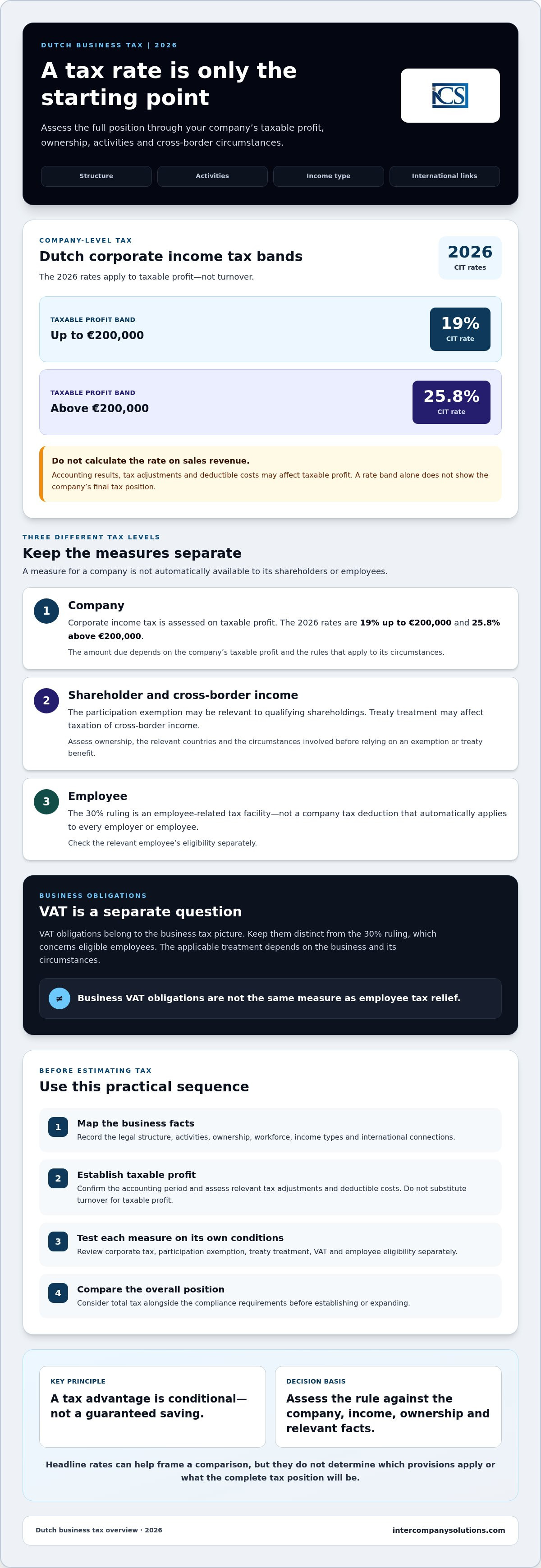
The 2026 Dutch corporate income tax (CIT) rates are 19% up to €200,000 and 25.8% above. These bands apply to taxable profit, not turnover. Sales revenue alone therefore does not tell you which tax band applies or how much tax the company will owe.
| Taxable profit band | CIT rate |
|---|---|
| Up to €200,000 | 19% |
| Above €200,000 | 25.8% |
Check the Belastingdienst guidance on corporate income tax rates for the applicable tax year. The rates are a starting point, not a complete calculation. The amount due depends on taxable profit and the rules that apply to the company’s circumstances. Don’t apply the higher rate to turnover or assume that the headline rate alone represents the company’s effective tax burden.
How the 2026 Dutch corporate tax bands work
Start by determining the company’s taxable profit for the relevant period. Then assess how the 2026 bands apply under the current corporate income tax rules. This is different from applying a rate to total sales: accounting results and tax adjustments may affect taxable profit. A sample liability can therefore be misleading unless the assumptions about the accounts and tax position are verified.
What to check before estimating a company’s tax
Before preparing an estimate, confirm the accounting period and establish the company’s taxable profit. Review its ownership and any cross-border facts that may affect the treatment of income or the application of Dutch rules. Deductible costs and tax adjustments depend on current law and the company’s specific circumstances, so don’t assume that every accounting expense receives the same tax treatment.
For a broader overview of Dutch tax incentives for international businesses, Invest in Holland outlines measures that may be relevant to foreign investors. Each measure has its own eligibility conditions. For filing and record-keeping, consult the related guide, Accounting for Dutch BV: Compliance and Tax Obligations in 2026, alongside current Belastingdienst guidance.
These checks are important when assessing Netherlands tax advantages for businesses. A reliable estimate starts with the company’s actual figures and circumstances, not a rate viewed in isolation.
Participation exemption and tax treaties: when cross-border benefits may apply
Cross-border structures can raise questions about how dividends, gains, and other income are taxed in more than one country. The Dutch participation exemption and tax treaties may be relevant, but neither provides an automatic benefit. The outcome depends on the companies involved, ownership and income, and the applicable Dutch rules and treaty.
Participation exemption: eligibility before expected benefit
The participation exemption may exclude qualifying benefits from a subsidiary, such as dividends and capital gains, from the Dutch parent company’s taxable profit. The general ownership threshold is at least 5% of the shares. Meeting that threshold alone does not establish eligibility: the subsidiary must also satisfy the relevant qualification rules. In particular, a non-qualifying portfolio investment may fall outside the exemption. Review the Belastingdienst participation exemption guidance for current conditions and exceptions.
Classification can depend on the subsidiary’s activities and other facts, so don’t assume that a holding company structure or a 5% shareholding settles the question. Confirm the treatment before relying on the exemption in financial projections or choosing a holding structure. If the facts do not clearly fit the published guidance, seek specialist tax advice.
Tax treaties and international business income
A tax treaty between the Netherlands and another country may allocate taxing rights and provide mechanisms to address double taxation. Its effect depends on the specific treaty, the type of income, and the taxpayer’s circumstances. A treaty does not necessarily remove tax in either country or automatically eliminate filing and reporting obligations.
Assess each income stream separately. Dividends, interest, royalties, and business profits may be treated differently under domestic law and the relevant treaty. Check the treaty text and current Dutch rules for the countries involved, and confirm that the company’s arrangements meet any conditions for relief. The Belastingdienst guidance on preventing double taxation is a useful starting point, but it does not replace reviewing the applicable treaty.
Specialist review can be useful before establishing a Dutch holding company, transferring shares, or routing income through entities in multiple countries. These facts can affect both eligibility and compliance. Treat Netherlands tax advantages for businesses as questions to verify against the actual structure, not as guaranteed outcomes based on a general description.
VAT and the 30% ruling: separate business obligations from employee relief
VAT and the 30% ruling affect different parts of a business’s tax position. VAT treatment concerns taxable supplies and business transactions. The 30% ruling is a conditional employee tax measure. It is not a corporate income tax deduction, and an employer cannot assume it applies to every international hire.
Dutch VAT rates and business transactions
The Netherlands has three VAT rates. The correct rate depends on the goods or services supplied and the circumstances of the transaction. Check the classification against current Belastingdienst VAT rate guidance before invoicing or estimating VAT.
| VAT rate | Application |
|---|---|
| 21% | Standard rate; apply where the supply is subject to the standard rate. |
| 9% | Reduced rate; applies only to supplies that qualify under the rules. |
| 0% | Zero rate; applies only where the supply and transaction meet the relevant conditions. |
Don’t assign a rate based on a broad product label alone. The precise supply and transaction circumstances matter. Businesses making cross-border sales should also check the relevant place-of-supply and reporting rules. For an overview of registration, consult Netherlands VAT Registration: 2026 Foreign Company Guide alongside the Tax Administration’s current instructions.
The 30% ruling for qualifying international employees
The 30% ruling may allow an employer to provide a tax-free allowance to an employee who meets the current conditions. For 2026, the allowance may be up to 30% of salary, subject to eligibility requirements, a salary cap of €262,000, and a minimum taxable salary of €48,013 for general applicants. For employees under 30 with a qualifying master’s degree, the minimum taxable salary is €36,497. Confirm the applicable conditions and calculation with the Belastingdienst’s 30% ruling guidance.
The measure concerns an eligible employee, not every foreign employee or employer. Employers should verify eligibility and handle the required payroll administration before applying it. See the guidance on Dutch payroll administration for related employer considerations. This distinction helps clarify which Netherlands tax advantages for businesses relate to company transactions and which may concern the workforce.
How to assess Dutch tax advantages before setting up or expanding
A structured review helps you assess Netherlands tax advantages for businesses against your actual plans, rather than relying on a single rate or incentive. Work through these steps before selecting a structure or committing to a cross-border arrangement.
A practical pre-entry tax assessment checklist
- Define the business activity. Record what the company will do, where it will operate, and where its customers and suppliers are located.
- Map ownership. Identify shareholders, parent companies, subsidiaries, and the countries where each is established or tax resident.
- List income and transactions. Separate expected business income from dividends, other investment income, cross-border sales, and employee-related arrangements.
- Verify potentially relevant rules. Check current Dutch guidance and the relevant foreign rules. For example, use the Belastingdienst corporate income tax guidance for company tax obligations, and verify treaty or incentive conditions against the specific facts.
- Model tax and compliance together. Estimate the likely tax position alongside accounting, reporting, registration, and filing requirements. Compare the total obligations of each option, not just an advertised rate.
Keep a record of the assumptions behind the assessment, including planned employee numbers, expected activities, ownership changes, and cross-border transactions. If a structure or forecast depends on treaty relief, an exemption, or another material cross-border assumption, request written advice from a qualified adviser before relying on it.
When professional implementation support can help
Once you have selected a structure, formation, tax registration, bookkeeping, and filings need to work together. These are implementation tasks, separate from determining whether a tax measure applies. Confirm who will handle each obligation and what information must be maintained. The Dutch Tax Administration’s guidance and the Chamber of Commerce’s annual accounts information can help identify relevant filing requirements.
For practical setup information, consult the Dutch company formation guide. The broader business-starting guide can also help organize pre-entry questions. Intercompany Solutions provides Dutch BV formation and accounting and tax services for businesses putting their plans into operation.
Discuss your proposed structure and tax compliance requirements with Intercompany Solutions before proceeding.
Make your Dutch tax assessment part of the business plan
The Netherlands tax advantages for businesses depend on more than a headline rate. Corporate tax applies to taxable profit, while measures such as the participation exemption, treaty relief, and the 30% ruling have distinct conditions and may apply at different levels. VAT treatment also depends on the supply and transaction.
Before establishing or expanding, map your activities, ownership, income, employees, and cross-border transactions. Verify which rules apply, then compare the expected tax position with the accounting, reporting, and filing work required. If a decision relies on a cross-border assumption, obtain advice based on the specific countries and facts involved.
Intercompany Solutions supports Dutch BV formation and ongoing accounting and tax compliance. Remote formation is available, with timing dependent on shareholding complexity. Eligibility for a tax measure still depends on your circumstances and the applicable rules.
A careful assessment gives you a clearer basis for choosing a structure and planning next steps. With the relevant facts and obligations in view, you can move forward with greater confidence.
Frequently Asked Questions
What are the main tax advantages for businesses in the Netherlands?
Potentially relevant measures include the corporate income tax framework, the participation exemption for qualifying shareholdings, and treaty provisions that may affect cross-border income. The 30% ruling is a separate employee-related measure, not a general company tax benefit. Eligibility depends on the company’s activities, ownership, income, and circumstances. Check current Belastingdienst guidance before including a measure in your tax forecasts.
What is the Dutch corporate income tax rate in 2026?
In 2026, corporate income tax is 19% up to €200,000 and 25.8% above €200,000. These bands apply to taxable profit, not turnover. The rates alone don’t determine the tax due because taxable profit and applicable rules depend on the company’s accounts and circumstances. Check the Belastingdienst corporate income tax rates and obtain a calculation based on the relevant accounting period.
Does the Dutch participation exemption apply to every BV?
No. The participation exemption isn’t automatic for every BV or shareholding. A key condition is generally a shareholding of at least 5%, but other qualification rules and exceptions also apply, including rules concerning non-qualifying portfolio investments. The subsidiary’s characteristics and the parent company’s circumstances matter. Check the Belastingdienst participation exemption guidance before relying on the exemption in a structure or tax forecast.
Can a foreign-owned Dutch company benefit from tax treaties?
It may, if a treaty between the Netherlands and the relevant country applies to the company’s facts and income. Treaties can allocate taxing rights or provide mechanisms to address double taxation, but they don’t automatically remove tax or filing obligations. The outcome depends on the specific treaty, income type, and circumstances. Review the treaty alongside domestic rules and the Belastingdienst guidance on preventing double taxation.
What VAT rates apply to businesses in the Netherlands?
The Netherlands has VAT rates of 21%, 9%, and 0%. The applicable rate depends on the goods or services supplied and the transaction circumstances. Don’t assign a rate based on a general product description alone. Check the classification and relevant conditions using current Belastingdienst VAT rate guidance. Businesses with cross-border transactions should also assess the related VAT treatment and reporting requirements.
Can an employer apply the 30% ruling for an international employee?
An employer may apply the 30% ruling only for an employee who meets the current eligibility conditions and where the required application process is followed. It doesn’t apply automatically to every international employee or employer. For 2026, the allowance may be up to 30% of salary, subject to applicable limits and requirements. Employers should verify the employee’s circumstances and consult the Belastingdienst 30% ruling guidance.
Sources
- ICS Payroll - Dutch payroll services
- KVK - Registering with the Dutch Business Register
- Business.gov.nl - Private limited company (bv)
- Burgerlijk Wetboek Boek 2 (Dutch Civil Code, legal entities)
- Rijksoverheid - Ondernemen
- Belastingdienst - Payroll taxes (loonheffingen)
- UWV - Employer obligations
- SVB - Social insurance in the Netherlands
- Belastingdienst - VAT (btw) for entrepreneurs
- European Commission - VAT rules and rates
- CJEU, Cadbury Schweppes, C-196/04 (ECLI:EU:C:2006:544)
- Hoge Raad, ECLI:NL:HR:2021:1152
- PwC Worldwide Tax Summaries - Netherlands
- ICLG - Corporate Governance Laws and Regulations, Netherlands
Need more information on the Dutch BV company?
Contact an expertReady to start your company in the Netherlands?
| Formation time | Dutch BV formation completed in 3 to 5 business days |
|---|---|
| Process | Fully remote setup with step-by-step guidance |
| Compliance | Expert support for registration, VAT and compliance |
| Aftercare | Accounting, tax and legal support included |
| One partner | All of the above through one trusted formation partner |