


September 4, 2026 · 18 min read
The Netherlands secured its position as the world's second-largest recipient of foreign direct investment in early 2026, attracting USD 43 billion in the first quarter alone. This high volume of capital reflects a stable economic environment where international entrepreneurs prioritize direct access to the European single market through Netherlands company registration for non-residents. You likely recognize that establishing a Dutch entity is a strategic move, yet the perceived complexity of a foreign legal system often creates hesitation. Many founders remain uncertain about whether they can complete the incorporation process without the need for international travel.
This professional guide addresses the legal requirements for your business, focusing on the 2026 regulatory framework. We outline the standardized remote formation procedure through a legalized Power of Attorney, which allows a notary to execute the deed of incorporation on your behalf. You'll find precise details on the €0.01 minimum capital for a BV, the €85.15 Chamber of Commerce registration fee, and the current corporate tax structure. This overview provides a procedural roadmap to ensure full compliance with the Dutch Tax and Customs Administration, covering everything from UBO registration deadlines to the 2026 transition of the Belastingdienst house bank to Rabobank. Intercompany Solutions specializes in remote BV formation, providing the technical expertise required to manage these administrative steps efficiently.
Key Takeaways
- Execute the standard remote formation of a Dutch BV through the legalized Power of Attorney route without the need for physical travel.
- Identify the 2026 financial requirements for Netherlands company registration for non-residents, including the €0.01 minimum share capital and KVK registration fees.
- Navigate Dutch tax obligations, including the current Corporate Income Tax rates and the interest deduction caps applicable to non-resident-owned entities.
- Determine the most suitable legal structure for your business by comparing entities that require a notary, such as the BV, with those that do not.
- Streamline post-incorporation compliance by understanding the requirements for local banking and the updated payment procedures for the Dutch Tax and Customs Administration.
Table of Contents
Eligibility and Legal Requirements for Non-Resident Founders
The Dutch legal framework allows founders from any global jurisdiction to establish a commercial presence in the country. There are no nationality restrictions for shareholders or directors. A mandatory requirement for Netherlands company registration for non-residents is the provision of a local Dutch business address for registration with the Chamber of Commerce (KVK). This address serves as the official seat of the company and is where the entity is legally reachable. It's a fundamental step for your company to be recognized as a Dutch legal person.
The Dutch Besloten Vennootschap (BV) stands as the preferred legal structure for international trade, logistics, and technology sectors. Its popularity stems from the limited liability it offers and the minimal capital requirements, where the minimum share capital is just €0.01. Structurally, a BV requires at least one shareholder and one director. These roles can be held by the same individual, allowing for simplified governance in single-founder startups. This structure provides a professional image while maintaining flexibility for various business models.
Foreign Entrepreneur Participation in Dutch BVs
Non-EU residents face no legal barriers regarding the percentage of share ownership they can hold. You don't need to be a resident of the Netherlands to act as a director or shareholder of a private limited company. Many international entrepreneurs succeed in starting a business in the Netherlands while remaining based in their home country. Ownership rights remain consistent regardless of the founder's physical location. This flexibility makes the Netherlands a primary choice for global expansion. When starting a business in the Netherlands, you should ensure that your corporate structure aligns with both local regulations and your international tax planning goals.
Documentation for International Shareholders
The incorporation process requires specific documentation to satisfy "Know Your Customer" (KYC) protocols and anti-money laundering regulations. Every officer must provide a valid identification document, such as a passport. Non-resident directors are also required to provide proof of their residential address, typically through a recent utility bill or bank statement. If your original documents are issued in a language other than English, Dutch, or German, you must provide a certified translation. Accurate documentation prevents delays in the registration process. Netherlands company registration for non-residents typically moves faster when all files are legalized and ready for the notary's review. Intercompany Solutions handles the verification of these documents to ensure they meet the strict standards of the Dutch KVK and the tax authorities.
The Step-by-Step Remote Registration Process
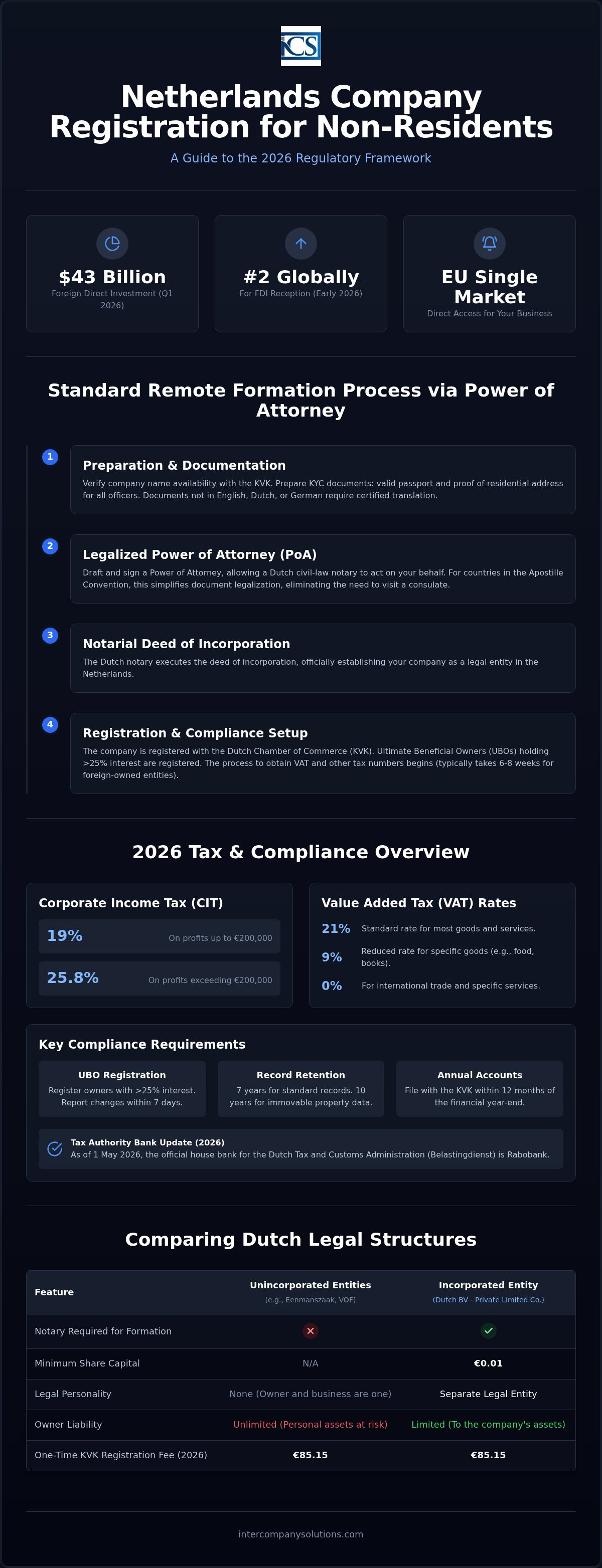
The process of Netherlands company registration for non-residents is designed for efficiency, allowing founders to establish a legal entity without traveling to the country. The standard route for non-EU entrepreneurs involves the legalized Power of Attorney (PoA) procedure. Under this arrangement, a Dutch notary acts on your behalf to sign the deed of incorporation. This method ensures that the legal requirements of the Dutch Civil Code are met while maintaining full accessibility for international owners. You don't need to visit a Dutch consulate in person if your home country is a member of the Apostille Convention, which simplifies the document verification process significantly.
Phase 1: Preparation and Power of Attorney
The initial stage involves selecting a company name that is distinct and compliant with Dutch naming conventions. You can verify name availability through the KVK foreign company registration database. Once the name is confirmed, the formation documents, including the PoA and the draft articles of association, are prepared. These documents specify the company's objectives, the share capital (which can be as low as €0.01 for a BV), and the governance structure. Professional oversight during this phase prevents delays during the notary's final review.
For founders residing outside the Netherlands, the PoA must be legalized in their home country. This typically requires a signature in the presence of a local notary. Depending on your jurisdiction, you may also need an apostille or further legalization by the Dutch embassy. After legalization, the physical documents are sent to the Dutch notary for final verification. This phase is critical for establishing the legal identity of the shareholders and directors involved and ensures the notary can execute the deed with full legal certainty.
Phase 2: Incorporation and KVK Filing
The formal incorporation occurs when the Dutch notary executes the deed of incorporation. Because the notary uses the legalized PoA, your physical presence in the Netherlands is not required during the signing. Following the execution of the deed, the company is registered in the Trade Register of the Chamber of Commerce (KVK). This registration is a public record that confirms the existence of your Dutch entity and its legal representation.
Registration usually takes place within 24 to 48 hours of the deed being signed. For 2026, the KVK registration fee is a one-time payment of €85.15. This entry into the registry provides your company with its unique KVK number, which is necessary for all subsequent business activities, including VAT applications and contract signings. Managing the Netherlands company formation timeline effectively allows most businesses to be fully registered within 3 to 5 business days. If you require assistance with document legalization or local compliance, you may contact our specialists for direct guidance on your specific case.
Comparative Analysis of Dutch Legal Entities
Choosing the appropriate legal structure is a central component of Netherlands company registration for non-residents. The Dutch legal system distinguishes between entities with and without legal personality. For most international entrepreneurs, the Besloten Vennootschap (BV) is the standard choice. It provides a clear separation between personal assets and corporate liabilities. In contrast, simpler forms like the eenmanszaak (sole proprietorship) or the Vennootschap onder firma (VOF) do not offer this protection. While these partnerships don't require a notary for formation, they expose the owners to unlimited personal liability for business debts. This is a significant risk for non-residents who may not have a local residence permit to support a sole proprietorship.
Legal structures that require a deed of incorporation executed by a Dutch notary include the BV, the NV (public limited company), and the stichting (foundation). The involvement of a notary ensures that the articles of association comply with Dutch law and that the initial registration is handled correctly. For 2026, the minimum share capital for a BV remains €0.01, whereas an NV requires a minimum of €45,000. This low entry barrier for the BV makes it accessible for startups and holding companies alike. Partnership structures such as the VOF, CV (limited partnership), and maatschap do not require a notary but fail to provide the corporate shield necessary for many international trade operations. If you are also considering the United Kingdom for your business setup, Form My Company offers specialized packages for UK company formation.
Dutch BV vs Branch Office for Non-Residents
A primary consideration for foreign corporations is whether to establish a subsidiary BV or a branch office. A Dutch BV is a distinct legal entity with its own rights and obligations. This structure limits the liability of the parent company to the amount of capital contributed. Conversely, a branch office is merely an extension of the foreign parent company. In this scenario, the parent company remains fully liable for all actions and debts of the Dutch branch. BVs are frequently preferred due to the Dutch participation exemption, which can prevent double taxation on dividends and capital gains. Establishing a BV through Dutch BV Company Formation services provides a more robust framework for local contracts and tax compliance.
Minimum Capital and Liability Thresholds
The current minimum capital requirement for a BV is €0.01, a rule established to facilitate entrepreneurship. This capital must be issued and paid up upon incorporation. Liability for shareholders is strictly limited to the value of their shares, provided the company is managed according to statutory requirements. For larger enterprises seeking to list on a stock exchange, the NV structure is necessary, requiring the €45,000 minimum capital. Founders must also remember that any changes to the Ultimate Beneficial Owner (UBO) must be reported to the registry within 7 days to maintain compliance. This structured approach to liability and capital ensures a transparent environment for international trade.
Tax Obligations and Compliance for Non-Resident Owned BVs
Establishing a Dutch entity requires a clear understanding of the fiscal landscape to ensure long-term stability. Corporate Income Tax (CIT) is applied using a two-bracket system based on the company's taxable profit. For 2026, profits up to €200,000 are taxed at a rate of 19%. Any taxable amount exceeding this threshold is subject to a rate of 25.8%. These rates apply to all private limited companies, including those established through Netherlands company registration for non-residents. Managing these obligations correctly from the start prevents unforeseen liabilities and maintains the company's standing with the Dutch Tax and Customs Administration.
Specific anti-abuse measures also dictate how profits are calculated. The interest deduction cap for 2026 is 24.5% of the company's EBITDA. This regulation restricts the amount of interest a company can deduct from its taxable income, ensuring that corporate structures aren't used solely for tax erosion through excessive debt. Compliance also involves strict reporting deadlines. You must file your annual accounts with the Chamber of Commerce (KVK) within 12 months of the financial year-end. It's also required by law to retain all business records for a period of 7 years, or 10 years if the records concern immovable property. Since 1 May 2026, all tax payments must be directed to the Belastingdienst house bank, Rabobank.
Value Added Tax (VAT) and EORI Requirements
VAT registration is a separate procedure that follows company incorporation. For entities owned by non-residents, the processing time at the Belastingdienst typically takes 6 to 8 weeks. The standard VAT rate in the Netherlands is 21%, while a reduced rate of 9% applies to specific goods like food and books. A 0% rate is used for certain international transactions. If your business engages in international trade with countries outside the European Union, you must obtain an Economic Operators Registration and Identification (EORI) number. This identifier is mandatory for all customs activities and is linked to your VAT number to facilitate cross-border logistics.
UBO Registry and Transparency Rules
Transparency is a cornerstone of the Dutch business environment. You're required to register all Ultimate Beneficial Owners (UBOs) who hold an interest of more than 25% in the company. This includes individuals with direct or indirect ownership of shares or voting rights. Accuracy in this registry is vital; any changes to UBO status or personal details must be reported to the registry within 7 days. Maintaining up-to-date UBO records is critical for retaining access to corporate banking services, as Dutch financial institutions use this information for mandatory "Know Your Customer" (KYC) audits. Failure to comply with these transparency rules can lead to the freezing of business accounts or administrative penalties. Our Payroll and Staffing services can assist with administrative compliance if your BV also employs staff in the Netherlands.
Post-Incorporation Essentials: Banking and VAT
Finalizing your KVK entry and paying the one-time €85.15 registration fee marks the end of the formation phase. You'll then need to focus on operational compliance. Opening a Dutch business bank account is essential for managing local transactions and fulfilling tax obligations. Since 1 May 2026, Rabobank has served as the house bank for the Belastingdienst. This means all tax payments and refunds are now routed through their systems. You must ensure your banking setup aligns with these tax authority requirements to avoid delays in processing.
Corporate Banking for Non-Residents
Dutch financial institutions operate under strict anti-money laundering and "Know Your Customer" protocols. Banks require full transparency regarding Ultimate Beneficial Owners (UBO) and often demand proof of business substance. This means a company must demonstrate genuine economic activity within the Netherlands to maintain an account. A virtual office alone is typically insufficient for most high-street banks. For those who completed Netherlands company registration for non-residents remotely, accessing banking services often requires specialized support. Remote bank account assistance is a standard feature in premium secretarial support packages. This helps founders organize the necessary documentation without visiting the Netherlands in person.
Ongoing Accounting and Payroll Compliance
Your BV must maintain accurate financial records to facilitate quarterly or monthly VAT filings. The Belastingdienst requires that all accounting records be retained for a minimum of 7 years. If your company owns immovable property, this retention period extends to 10 years. All financial reporting should align with Dutch Generally Accepted Accounting Principles (GAAP) or International Financial Reporting Standards (IFRS) to ensure legal validity. Accurate bookkeeping is the foundation of your corporate standing.
If you plan to hire staff, you'll need to register for payroll taxes and social security. Intercompany Solutions provides payroll services for entities hiring staff in the Netherlands. This includes assistance with the Highly Skilled Migrant (HSM) scheme for companies bringing international talent. As of 2026, recognized sponsors must adhere to specific salary thresholds, such as €5,942 per month for individuals aged 30 and older. Consistent management of your accounting and payroll ensures that your Netherlands company registration for non-residents remains in good standing with all local authorities. Reliable payroll management is vital for your company's reputation and legal compliance.
Last reviewed: September 2026
Establishing Your Commercial Presence in the Dutch Market
The Dutch regulatory environment continues to offer a stable and efficient platform for international expansion. Through the standardized Power of Attorney route, you can complete Netherlands company registration for non-residents without the need for international travel. You don't have to visit the country to finalize the process, which incorporates all 2026 legal requirements, including the BV minimum capital of €0.01 and the KVK registration fee of €85.15. By establishing a Dutch entity, you gain direct access to the European single market under a professional and transparent legal framework.
Long-term success requires a proactive approach to tax compliance and corporate transparency. Our Rotterdam-based legal and tax experts manage the complexities of UBO reporting and VAT applications, ensuring your business adheres to the latest Belastingdienst standards. We facilitate remote incorporation in 3-5 business days and stand behind our services with a 100% satisfaction guarantee. This structured approach allows you to focus on your core business growth while we handle the administrative foundations of your Dutch entity.
We look forward to acting as your professional guide during your entry into the Netherlands.
Last reviewed: September 2026
Frequently Asked Questions
Can a non-resident register a company in the Netherlands without visiting?
Yes, you can complete the entire process remotely. The standard method for Netherlands company registration for non-residents is the legalized Power of Attorney route. You sign the necessary documents in your home country before a local notary. Once these are legalized or apostilled, they're sent to a Dutch notary who executes the deed of incorporation. You don't need to travel to the Netherlands at any point during the formation.
What is the minimum share capital required for a Dutch BV in 2026?
The minimum share capital for a Dutch private limited company (BV) is €0.01. This capital must be issued and paid up at the time of incorporation. While the requirement is low, you should consider a capital amount that reflects your business goals. For public limited companies (NV), the minimum capital requirement is significantly higher, set at €45,000. Most international entrepreneurs choose the BV for its low entry barrier.
How long does the Netherlands company registration process take for foreigners?
Netherlands company registration for non-residents typically takes between 3 and 5 business days. This timeline begins once the Dutch notary receives your legalized Power of Attorney and identification documents. After the deed is signed, registration with the Chamber of Commerce (KVK) follows within 24 to 48 hours. Intercompany Solutions assists with the remote collection of these documents to ensure a smooth transition. VAT registration usually takes an additional 6 to 8 weeks.
What are the corporate tax rates for Dutch companies in 2026?
In 2026, the Netherlands applies a two-tier Corporate Income Tax (CIT) system. Profits up to €200,000 are subject to a 19% tax rate. Any taxable profit exceeding this €200,000 threshold is taxed at 25.8%. These rates apply to all BVs regardless of the residency of the shareholders. It's vital to ensure your accounting aligns with these brackets to manage your tax liability effectively and maintain compliance with Dutch fiscal laws.
Is a Dutch notary required for all types of company registration?
A Dutch notary is only required for specific legal entities that possess legal personality. These include the BV, NV, and stichting (foundation). If you choose a structure like an eenmanszaak, VOF, CV, or maatschap, you don't need a notary for formation. However, these simpler structures don't offer limited liability protection, which is why the BV remains the most popular choice for non-resident investors who want to protect their personal assets.
What are the reporting requirements for the Dutch UBO registry?
You must register every Ultimate Beneficial Owner (UBO) who holds more than 25% of the shares, voting rights, or ownership interest in the company. This transparency rule applies to both direct and indirect owners. If any changes occur regarding the UBO's status or personal details, you're legally obligated to report these updates to the UBO register within 7 days. Maintaining accurate records is essential for keeping your corporate bank accounts active.
Which bank handles Belastingdienst transactions in 2026?
Since 1 May 2026, Rabobank has served as the primary house bank for the Dutch Tax and Customs Administration (Belastingdienst). All corporate tax payments, including VAT and CIT, must be directed to the updated Rabobank accounts. This change also affects how tax refunds are issued to your business. You should update your internal payment systems to ensure that all financial interactions with the tax authorities are processed without administrative delays or payment rejections.
Sources
- ICS Payroll - Dutch payroll services
- KVK - Registering with the Dutch Business Register
- Business.gov.nl - Private limited company (bv)
- Burgerlijk Wetboek Boek 2 (Dutch Civil Code, legal entities)
- Rijksoverheid - Ondernemen
- Belastingdienst - Corporate income tax rates
- Belastingdienst - Payroll taxes (loonheffingen)
- UWV - Employer obligations
- SVB - Social insurance in the Netherlands
- Belastingdienst - VAT (btw) for entrepreneurs
- European Commission - VAT rules and rates
- IND - Highly skilled migrant
- IND - Start-up residence permit
- De Nederlandsche Bank - Supervision
- AFM - Licences and registers
- RVO - Doing business internationally
- Belastingdienst Douane - Customs
- CJEU, Cadbury Schweppes, C-196/04 (ECLI:EU:C:2006:544)
- Hoge Raad, ECLI:NL:HR:2021:1152
- PwC Worldwide Tax Summaries - Netherlands
- ICLG - Corporate Governance Laws and Regulations, Netherlands
Need more information on the Dutch BV company?
Contact an expertReady to start your company in the Netherlands?
| Formation time | Dutch BV formation completed in 3 to 5 business days |
|---|---|
| Process | Fully remote setup with step-by-step guidance |
| Compliance | Expert support for registration, VAT and compliance |
| Aftercare | Accounting, tax and legal support included |
| One partner | All of the above through one trusted formation partner |