


August 29, 2026 · 18 min read
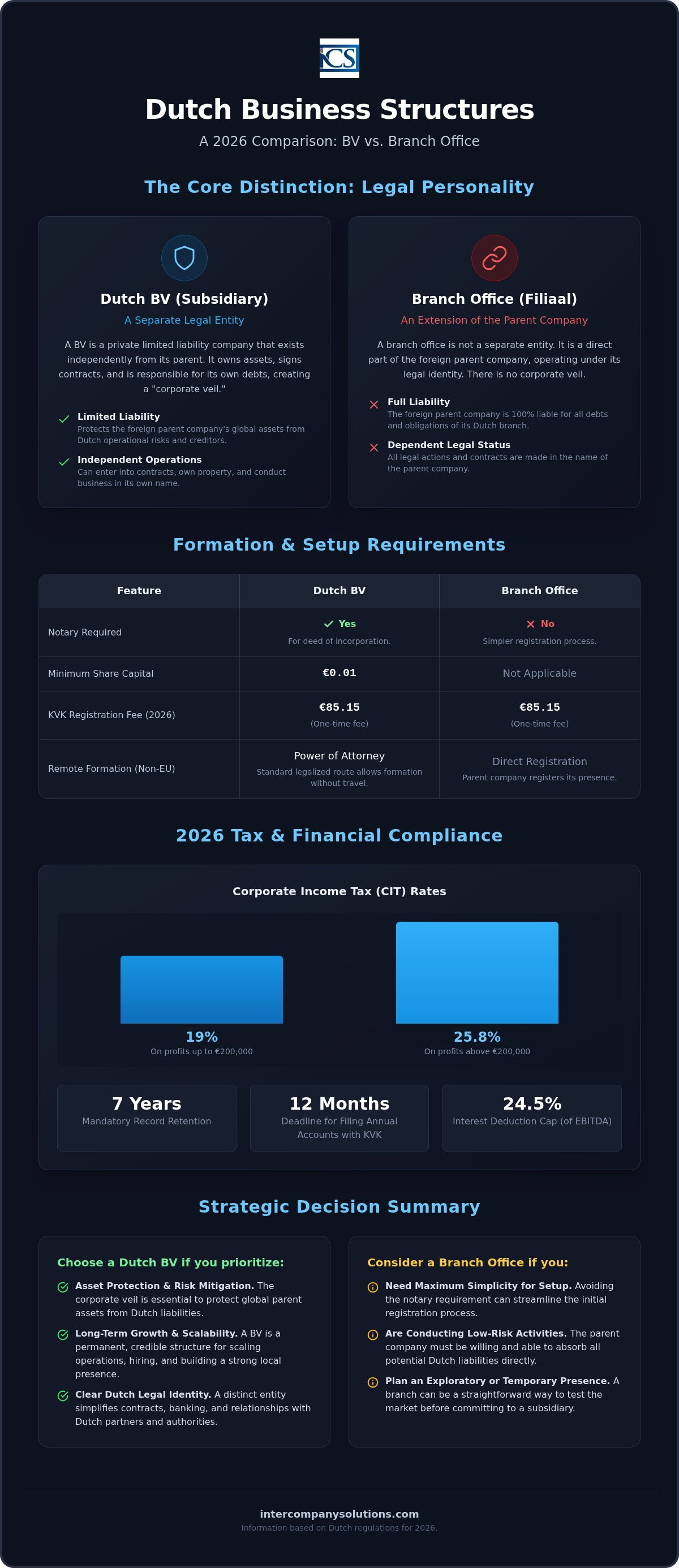
The perceived simplicity of a branch office often masks a significant legal burden for the foreign parent company. While the lack of a notary requirement makes the branch appear to be the path of least resistance, the resulting absence of a corporate veil exposes global assets to Dutch creditors. Choosing between a Netherlands BV vs branch office is a decision that dictates your legal risk profile and your ability to scale within the European market throughout 2026.
We understand that international founders prioritize a credible local presence and clear tax obligations. This comparative analysis provides a technical breakdown of Dutch corporate structures, focusing on how to optimize tax efficiency under the current 19% and 25.8% corporate income tax (CIT) thresholds. You'll learn the specific differences in liability, the requirements for registering Ultimate Beneficial Owners (UBOs), and the procedural steps for remote formation via a Power of Attorney. We also examine practical compliance matters, from maintaining records for the mandatory seven year period to managing the interest deduction cap of 24.5% of EBITDA. This guide ensures you select the structure that aligns with your long term commercial objectives in the Netherlands.
Key Takeaways
- Distinguish between the limited liability of a Dutch BV and the total parent company exposure inherent in a branch office structure.
- Review the 2026 corporate income tax rates of 19% on profits up to €200,000 and 25.8% for amounts exceeding this threshold.
- Compare the administrative setup of a Netherlands BV vs branch office, noting the mandatory Dutch notary for BVs and the one-time €85.15 KVK registration fee for both.
- Utilize the legalized Power of Attorney route to incorporate a BV remotely, allowing non-resident founders to finalize the process without traveling to the Netherlands.
- Prepare for ongoing compliance by following the seven-year record retention rule and filing annual financial statements with the KVK within 12 months of year-end.
Table of Contents
Defining the Netherlands BV and the Branch Office
Establishing a commercial presence in the Netherlands requires a fundamental choice between creating a new legal entity or extending an existing foreign one. This decision, typically framed as a comparison of a Netherlands BV vs branch office, centers on the concept of legal personality and how it interacts with Dutch law. The Dutch Chamber of Commerce, known as the KVK, acts as the central authority for both structures, maintaining the Handelsregister (Business Register) where all active businesses must be listed. While both allow for local trade and hiring, their relationship with the parent company is distinct.
The Dutch BV: A Local Legal Entity
A Besloten vennootschap (BV) is a private limited liability company that exists as a separate legal person. This means the company owns its own assets, enters into contracts in its own name, and is responsible for its own liabilities. To establish a BV, you must engage a Dutch civil law notary to draft and execute the deed of incorporation. The Dutch government simplified this process in 2012 by setting the minimum share capital at just €0.01.
Governance within a BV is divided between shareholders and directors. Shareholders provide the capital and hold voting rights, while directors manage the daily operations and ensure compliance with Dutch regulations. Because the BV is a subsidiary, it provides a corporate veil that protects the foreign parent company from the BV's debts, provided the directors act within the law. This makes Dutch BV company formation a preferred choice for entrepreneurs seeking to isolate their global assets from Dutch operational risks.
The Netherlands Branch Office: An International Extension
A Netherlands branch office, or "filiaal," is not a separate legal entity. Instead, it's considered a permanent establishment and a direct extension of the foreign parent company. When you register a branch, you're not incorporating a new business in the Netherlands; you're simply registering the foreign entity's presence at a Dutch address. There's no requirement for a Dutch notary to establish a branch, which can simplify the initial setup.
Because the branch lacks its own legal personality, it cannot own assets or enter into contracts independently of the parent company. All legal actions taken by the branch are legally the actions of the foreign head office. This means the parent company remains fully liable for all Dutch obligations, including tax debts, lease agreements, and employment contracts. Both the BV and the branch must pay a one-time KVK registration fee of €85.15 for the 2026 fiscal year. While the branch avoids the cost of a notary, it requires the parent company to assume all Dutch business risks directly on its balance sheet.
Legal Liability and Governance Requirements
The primary reason international firms choose a subsidiary is the separation of legal risk. When comparing the Netherlands BV vs branch office, the most stark contrast lies in how Dutch law treats the parent organization. A BV functions as a distinct legal person, effectively ring-fencing its commercial liabilities. According to business.gov.nl, this structure ensures that the foreign parent company's global assets remain protected in the event of a contract dispute or insolvency. In contrast, a branch office is an extension of the parent. Any legal claim against the Dutch branch is, by definition, a claim against the foreign head office. It's essential to understand this distinction when deciding between a Netherlands BV vs branch office for your expansion.
| Feature | Dutch BV (Subsidiary) | Netherlands Branch Office |
|---|---|---|
| Legal Personality | Separate legal entity | Extension of parent company |
| Parent Company Liability | Limited to capital contribution | Full liability for all debts |
| Contractual Capacity | Enters contracts in its own name | Parent company is the legal party |
Asset Protection and Risk Mitigation
The corporate veil of a BV provides a robust layer of security. While managing directors can be held personally liable for gross negligence, the parent company's exposure is limited to its capital contribution. For a branch, the lack of a separate legal personality means the parent company assumes direct responsibility for all Dutch obligations. This includes lease agreements, employment contracts, and tax debts. Understanding these tax and liability differences is essential for risk management.
Compliance and UBO Reporting
A Dutch BV must register its Ultimate Beneficial Owners (UBOs) in the UBO register maintained by the Chamber of Commerce. A UBO is any natural person holding more than 25% of the shares or voting rights. It's a strict requirement to report any changes to UBO status within 7 days. While branches of foreign companies are currently exempt from the Dutch UBO register, they must still provide ownership transparency to financial institutions and the tax authorities.
Governance standards for 2026 require meticulous record-keeping for all registered entities. You must retain all Dutch entity records for at least 7 years, or 10 years if the business involves immovable property. Annual accounts must be filed with the KVK within 12 months of the financial year-end. It's vital for non-resident directors to maintain these standards to avoid administrative fines or personal liability issues. Don't overlook the 7-day reporting window for UBO changes to ensure ongoing compliance. If you need assistance with statutory compliance or governance structures, you can request a consultation with our legal specialists.
Tax Treatment and Financial Compliance in 2026
The Dutch tax framework provides a structured environment for both subsidiaries and permanent establishments. While both entities are subject to Dutch corporate income tax (CIT) on their local profits, the choice of a Netherlands BV vs branch office significantly impacts how you access double taxation treaties. A BV, as a Dutch resident company, typically has direct access to the Netherlands' extensive treaty network. A branch office generally relies on the treaties of its foreign parent company. This distinction often makes the BV a more efficient vehicle for managing international cash flows and dividend distributions.
Corporate Income Tax (CIT) Brackets
For the 2026 fiscal year, the Belastingdienst applies a two-tier CIT structure. Profits up to €200,000 are taxed at a competitive rate of 19%. Any taxable profit exceeding this €200,000 threshold is subject to a rate of 25.8%. It's vital to account for the interest deduction cap, which is set at 24.5% of EBITDA for 2026. This limitation applies to both BVs and branches, preventing excessive base erosion through internal financing. Additionally, the Dutch participation exemption remains a cornerstone of the tax system; it exempts dividends and capital gains from CIT if the Dutch entity holds at least 5% of the shares in a qualifying subsidiary.
Financial transactions with the tax authorities have also seen administrative changes. Since 1 May 2026, Rabobank has served as the house bank for the Belastingdienst. All tax payments and refunds are processed through this institution, requiring precise coordination with your local accounting and tax services to ensure timely settlements.
Annual Accounts and KVK Filing Deadlines
Compliance cycles are strict for all Dutch business structures. You must file annual accounts with the KVK within 12 months of the end of the financial year. The depth of these filings depends on the size of the entity. Small BVs often benefit from simplified reporting requirements, whereas large entities must undergo a mandatory external audit. A branch office faces a different requirement: it must file the annual financial statements of its foreign parent company with the Dutch Chamber of Commerce. This means your parent company's global financial data becomes part of the Dutch public record.
- VAT Registration: Foreign-owned entities should expect a VAT registration period of 6 to 8 weeks.
- VAT Rates: The standard Dutch VAT rate is 21%, with reduced rates of 9% and 0% for specific categories.
- Record Retention: You are legally required to retain all business records for 7 years. This period extends to 10 years for documents related to immovable property.
Maintaining these standards is non-negotiable. Failure to file accounts on time or maintain records can lead to administrative penalties or the assumption of personal liability for directors in the event of bankruptcy. By aligning your financial procedures with these 2026 requirements, you establish a transparent and compliant foundation for your Dutch operations.
Operational Setup and Administrative Procedures
The administrative path for a Netherlands BV vs branch office diverges significantly at the point of registration. While a branch office is established by registering the foreign parent company's details directly with the Chamber of Commerce (KVK), a BV requires a more formal incorporation process. For both structures, you must account for a one-time KVK registration fee of €85.15 for the 2026 fiscal year. This fee is paid during the final stage of the setup when the entity or branch is officially entered into the Handelsregister.
The Remote Incorporation Process
Non-resident founders typically utilize the legalized Power of Attorney (POA) route to finalize their business setup. This method allows the incorporation to proceed without the physical presence of the directors in the Netherlands. The process follows a structured three-step sequence:
- Document Collection: You must provide legalized identification documents, proof of residential address, and the signed Power of Attorney for the directors and shareholders.
- Notary Execution: A Dutch civil law notary reviews the documents and executes the deed of incorporation. This step is mandatory for a BV, as it establishes the company's articles of association.
- KVK and Tax Registration: Once the deed is signed, the company is registered with the KVK. The tax authorities (Belastingdienst) are then notified to issue the necessary tax identification numbers.
Managing this process remotely ensures that your Dutch BV formation is completed efficiently, often within 3 to 5 business days once all documentation is received. After registration, the focus shifts to financial infrastructure. Since 1 May 2026, Rabobank has served as the house bank for the Belastingdienst, making a Dutch business account beneficial for tax settlements. Many founders also consider Electronic Money Institutions (EMIs) for faster initial setup, though traditional banks remain the standard for long term local credibility. You should anticipate a timeline of 6 to 8 weeks for VAT registration for foreign owned entities.
Payroll and Staffing for Foreign Entities
Hiring staff in the Netherlands introduces specific employer obligations regardless of your chosen structure. Both BVs and branches must register as employers with the tax authorities to manage payroll taxes and social security contributions. International staff may qualify for the 30% tax reimbursement ruling, which allows employers to provide 30% of the employee's gross salary tax free to cover extraterritorial expenses. Utilizing professional payroll services Netherlands helps ensure compliance with these complex labor laws and the timely filing of monthly returns.
Establishing a local team often requires an Employer of Record (EOR) service if you don't yet have a full HR department. This allows you to manage staff under Dutch employment law while we handle the technical administration of contracts and benefits. By delegating these procedural tasks, you can focus on market entry while maintaining full adherence to Dutch regulatory standards.
Strategic Decision: Choosing the Best Dutch Presence
The selection between a Netherlands BV vs branch office is a strategic decision that affects your liability, tax efficiency, and market perception. A branch office is often suitable for light, temporary operations where the foreign parent company wishes to maintain direct control over a specific project or test the market for a limited duration. However, for most international founders, the Dutch BV remains the preferred vehicle for long-term European expansion. The subsidiary structure creates a professional distance between the Dutch operations and the global parent; this ensures that any local commercial risks are contained within the Netherlands.
Credibility and Local Banking Access
A Dutch BV carries significant weight with local suppliers and government bodies. This credibility is essential when undergoing Know Your Customer (KYC) procedures at major financial institutions. Since 1 May 2026, Rabobank has served as the house bank for the Belastingdienst, and most Dutch banks prioritize applications from local legal entities. Branch offices frequently face difficulty opening corporate accounts because banks must audit the entire foreign parent company, which increases the compliance burden for the institution. A BV, as a resident entity, simplifies this process and establishes a more reliable foundation for Dutch transactions.
Summary of Costs and Maintenance
The initial formation of a BV involves a one-time KVK registration fee of €85.15 and mandatory notary fees. While a branch office avoids the notary requirement, it carries higher long-term administrative friction. You must file the parent company's financial statements with the KVK annually, which may lead to unwanted transparency regarding your global operations. In contrast, a BV only files its own accounts, protecting the parent's financial privacy. Efficiency in remote management is a key benefit for non-resident directors, provided they maintain strict adherence to Dutch filing deadlines.
The final verdict for 2026 is clear. While a branch serves as a temporary bridge, the BV offers the best balance of risk mitigation and operational ease. It allows for remote management through the legalized Power of Attorney route and ensures your business is future-proofed. Converting a branch to a BV later is a complex legal procedure; starting with a Dutch BV company formation is almost always the more efficient path for international entrepreneurs.
- Liability Protection: A BV limits the parent company's risk to its capital contribution of at least €0.01.
- Tax Thresholds: Both structures pay CIT at 19% on the first €200,000 and 25.8% on profits above this amount.
- Transparency: A branch requires the parent company to file its global financial statements with the KVK Handelsregister.
- Records Retention: All Dutch business records must be retained for at least 7 years.
Last reviewed: August 2026
Securing Your Dutch Market Entry for 2026
Deciding between a Netherlands BV vs branch office is a fundamental step in defining your European risk profile. A branch office provides a direct link to your existing firm but necessitates the public disclosure of parent company financial data and carries unlimited liability. The Dutch BV offers a robust legal ring-fence for your global assets with a minimum share capital requirement of only €0.01. This structure simplifies local banking access and ensures your presence is viewed as a permanent, credible entity by Dutch authorities and clients.
Our team specializes in the remote incorporation process via the legalized Power of Attorney route, completing the setup in 3 to 5 business days without requiring your physical presence. We've served over 2,000 international founders, providing the full compliance and accounting support necessary to maintain your standing with the Belastingdienst. By choosing the right structure now, you avoid the administrative complexity of future legal conversions.
We're ready to help you establish a secure and compliant foundation for your business growth in the Netherlands.
Last reviewed: August 2026
Frequently Asked Questions
What is the primary difference between a Dutch BV and a branch office?
The primary difference is legal personality and liability. A BV is a separate legal entity, meaning the parent company's liability is limited to its capital contribution. A branch is an extension of the parent company, which remains fully liable for all Dutch debts and obligations. This distinction is the core of the Netherlands BV vs branch office comparison for risk management and asset protection for international firms.
Can I register a Dutch BV remotely without traveling to the Netherlands?
Yes, you can incorporate a Dutch BV remotely using the legalized Power of Attorney (POA) route. In this process, a Dutch civil law notary executes the deed of incorporation on your behalf based on documents you provide from abroad. This standard procedure for non-resident founders allows you to finalize the registration without a physical visit to the Netherlands, making the entry process efficient and direct.
What are the corporate tax rates for a Dutch subsidiary in 2026?
For the 2026 fiscal year, the corporate income tax (CIT) is 19% on taxable profits up to €200,000. Any profit exceeding this threshold is taxed at a rate of 25.8%. These rates apply to both subsidiaries and branch offices. Additionally, you must consider the interest deduction cap, which is set at 24.5% of EBITDA to prevent base erosion through internal financing and ensure full compliance with Dutch tax regulations.
Does a Netherlands branch office require a separate VAT number?
Yes, a branch office must obtain its own Dutch VAT number if it carries out taxable activities in the Netherlands. While the branch is legally an extension of the foreign parent, the Dutch tax authorities (Belastingdienst) treat it as a separate fiscal entity for VAT purposes. Registration for foreign owned entities typically takes between 6 and 8 weeks to complete once the Chamber of Commerce registration is finalized.
How much share capital is required to start a Dutch BV?
The minimum share capital required to incorporate a Dutch BV is €0.01. This low threshold was introduced in 2012 to make the private limited company structure more accessible to entrepreneurs globally. You can choose to issue a higher amount of capital depending on your specific business needs, but the legal requirement remains at this nominal level for the formal deed of incorporation executed by the notary during the setup.
Are annual accounts mandatory for a Dutch branch office?
Yes, a branch office is required to file the annual financial statements of its foreign parent company with the Dutch Chamber of Commerce (KVK). Unlike a BV, which files its own local accounts, the branch must make the parent company's global financial data part of the public record in the Netherlands. These filings must be completed within 12 months of the financial year-end to avoid administrative penalties or liability issues.
How long does the Netherlands business registration process take?
The registration process for a Netherlands BV vs branch office typically takes between 3 and 5 business days once all required documents are received. This timeline includes the execution of the deed by a notary and the official entry into the KVK Handelsregister. VAT registration is a separate step that follows the initial incorporation and generally requires an additional 6 to 8 weeks for processing by the tax authorities.
Sources
- ICS Payroll - Dutch payroll services
- KVK - Registering with the Dutch Business Register
- Business.gov.nl - Private limited company (bv)
- Burgerlijk Wetboek Boek 2 (Dutch Civil Code, legal entities)
- Rijksoverheid - Ondernemen
- Belastingdienst - Corporate income tax rates
- Belastingdienst - Payroll taxes (loonheffingen)
- UWV - Employer obligations
- SVB - Social insurance in the Netherlands
- Belastingdienst - VAT (btw) for entrepreneurs
- European Commission - VAT rules and rates
- De Nederlandsche Bank - Supervision
- AFM - Licences and registers
- RVO - Doing business internationally
- Belastingdienst Douane - Customs
- CJEU, Cadbury Schweppes, C-196/04 (ECLI:EU:C:2006:544)
- Hoge Raad, ECLI:NL:HR:2021:1152
- PwC Worldwide Tax Summaries - Netherlands
- ICLG - Corporate Governance Laws and Regulations, Netherlands
Need more information on the Dutch BV company?
Contact an expertReady to start your company in the Netherlands?
| Formation time | Dutch BV formation completed in 3 to 5 business days |
|---|---|
| Process | Fully remote setup with step-by-step guidance |
| Compliance | Expert support for registration, VAT and compliance |
| Aftercare | Accounting, tax and legal support included |
| One partner | All of the above through one trusted formation partner |