


August 24, 2026 · 16 min read
You don't have to visit a Dutch Chamber of Commerce office in person to secure your business's future in the Netherlands. For many international entrepreneurs, the process of KVK registration for foreigners seems daunting because of complex administrative forms and the logistical challenge of attending appointments from abroad. It's common to feel overwhelmed by the uncertainty of UBO requirements or the specific documentation needed for non-resident entities. These administrative barriers often create unnecessary friction for those looking to enter the Dutch market.
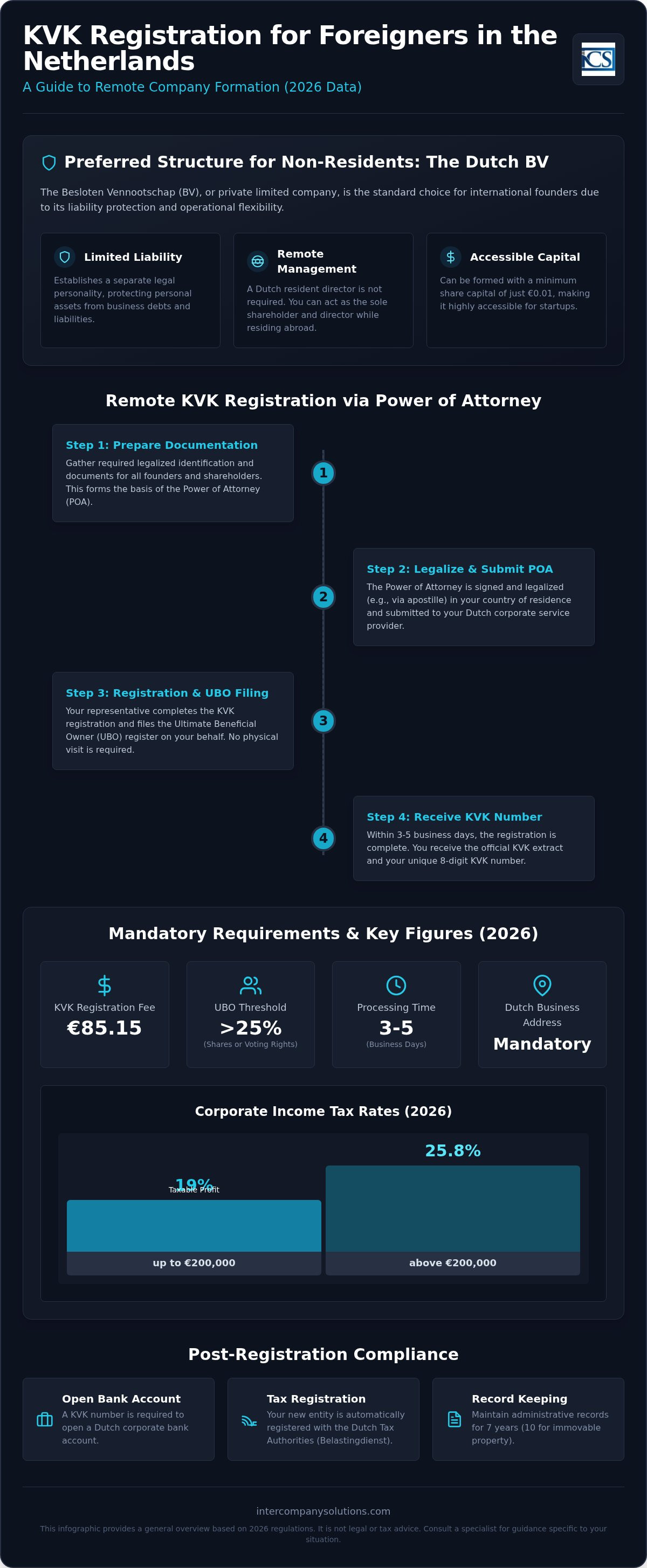
This guide provides a professional roadmap for registering your business with the Dutch Chamber of Commerce in 2026. We'll outline the exact steps for remote registration via a legalized Power of Attorney, ensuring you meet the mandatory UBO threshold of over 25% and comply with current transparency laws. You'll gain a clear understanding of the €85.15 registration fee, the corporate tax rates of 19% up to €200,000 and 25.8% above, and the procedural requirements for foreign founders. This information ensures your company starts on a foundation of full legal and tax compliance from day one.
Key Takeaways
- Complete KVK registration for foreigners remotely using a legalized Power of Attorney, bypassing the requirement for a physical appointment in the Netherlands.
- Select the Dutch BV as the optimal legal structure to ensure limited liability and eligibility for non-resident entrepreneurs.
- Comply with statutory transparency laws by identifying Ultimate Beneficial Owners (UBOs) who hold more than 25% of shares or voting rights.
- Prepare for mandatory costs including the €85.15 registration fee and verify the 2026 corporate tax rates of 19% and 25.8% based on profit thresholds.
- Establish a valid Dutch business address and provide legalized identification to facilitate registration within the standard 3-5 business day timeframe.
Table of Contents
Legal Framework of the Dutch Business Register (KVK)
The Dutch Chamber of Commerce, known locally as the Kamer van Koophandel (KVK), manages the Handelsregister. This central database is the primary source of truth for all economic entities operating within the Netherlands. Under the Dutch Commercial Register Act (Handelsregisterwet), registration is a strict statutory requirement rather than a matter of choice. The register serves the vital function of providing transparency for third parties, such as creditors, partners, and government agencies. It allows anyone to verify a company's legal status, its registered address, and the specific individuals authorized to sign contracts on its behalf.
Obtaining a KVK number is the first practical step in establishing a business presence. Without this eight-digit identifier, you'll find it impossible to open a corporate bank account or sign commercial lease agreements. The KVK registration for foreigners ensures that international entrepreneurs are integrated into the Dutch legal and tax systems, facilitating a stable environment for cross-border trade. For 2026, the one-time statutory registration fee is set at €85.15, which must be paid to activate the registration.
Defining the Mandatory Registration Requirement
Registration is required for any entity performing independent economic activity with the intent to make a profit. This definition is broad. It covers traditional physical offices and extends to foreign companies that maintain a permanent establishment or a branch in the Netherlands. For online businesses, the obligation depends on the level of 'substance' within the country. If your business stores inventory in a Dutch warehouse or employs local staff to manage sales, the KVK will likely deem your activity as a registerable Dutch establishment.
Distinguishing Between Foreign Entities and Local Establishments
Foreign legal entities, such as a German GmbH or a US LLC, have two primary paths for entry. They can register a branch office (filiaal) without forming a new Dutch legal entity, or they can incorporate a Dutch BV. While a branch office is an extension of the parent company, it still requires KVK registration for foreigners to operate legally. You should be aware of the "Formal Foreign Companies" designation. This applies to entities incorporated abroad that have no real economic link to their home country and conduct all their business in the Netherlands. Such companies face stricter reporting requirements to prevent the misuse of foreign corporate forms. Additionally, you must distinguish between a representative office and a branch. A representative office is limited to non-commercial activities like market research and doesn't usually trigger the same registration or tax obligations as a commercial branch.
Selecting the Appropriate Legal Structure for Non-Residents
Choosing the right legal form is the most critical decision in the setup process. For non-residents, the choice is usually between a Dutch BV and a branch office. It's a binary choice for most international entrepreneurs. While a sole proprietorship (eenmanszaak) is a common choice for locals, it's generally unavailable to non-residents because it requires a Dutch Citizen Service Number (BSN). Most international founders find that the Dutch BV offers the most flexibility and legal protection.
The Dutch BV: The Preferred Vehicle for International Founders
The Besloten Vennootschap (BV) is the standard private limited company in the Netherlands. It's favored because it establishes a separate legal personality. This means your personal assets remain protected from business debts and liabilities. You can form a BV with a minimum share capital of just €0.01, making it highly accessible for startups and small enterprises.
The process for Dutch BV formation is streamlined for international clients. One of the primary benefits is that it doesn't require a Dutch resident director. You can act as the sole shareholder and director while residing entirely outside the Netherlands. However, you must maintain a physical Dutch business address to complete the KVK registration for foreigners. This structure is ideal for those who want to build a local brand while managing operations remotely. If you're unsure which path fits your business model, you can speak with our specialists for personalized advice.
Branch Offices vs. Representative Offices
If you already operate an established foreign corporation, you might consider a branch office (filiaal) instead of a new subsidiary. A branch isn't a separate legal entity; it's an extension of your existing company. While this simplifies some internal accounting, the parent company remains 100% liable for all Dutch obligations and debts. To register a branch, you'll need to submit the parent company’s articles of association and recent extracts from your local commercial register to the KVK.
Alternatively, a representative office serves as a low-cost entry point for market research or promotional activities. A representative office cannot engage in commercial sales or sign revenue-generating contracts. If your goal is to trade or provide services within the Eurozone, a BV or a full branch is required to facilitate KVK registration for foreigners and subsequent VAT applications. You'll need to prove local substance to satisfy tax authorities if you choose the branch route for international trade.
Statutory Requirements and Documentation for Foreign Founders
Successful KVK registration for foreigners depends on the meticulous preparation of specific documentation and the fulfillment of physical presence requirements. The Dutch Chamber of Commerce requires every new entity to provide a valid Dutch business address. This cannot be a PO Box; it must be a physical location where the business's administrative records are kept and where the company is reachable. You'll need to submit a signed rental agreement or a consent statement from the property owner to prove your right to use the address as your registered office.
The 2026 KVK registration fee is fixed at €85.15. This is a one-time administrative cost that you must pay at the time of registration. If you're completing the process remotely, this fee is typically handled as part of the incorporation package. Accuracy in your initial filing is vital because any subsequent changes to your company's registered details, such as a change in directors or address, must be updated in the register within eight days. Failure to maintain accurate records can lead to administrative complications with both the KVK and the tax authorities.
Identification and Residency Criteria (EU vs. Non-EU)
EU nationals can register a business without a residence permit but still require a registered Dutch address. Non-EU founders must provide identification documents that have been legalized or carry an apostille from their home country. You don't need a visa to incorporate a BV, but managing the company from within the Netherlands requires an IND permit. For visa-specific details, refer to our guide on starting a business in the Netherlands.
The UBO Register and Transparency Obligations
The UBO threshold is strictly defined as any natural person holding more than 25% of shares or voting rights. The KVK maintains this data in a restricted register to combat money laundering and financial crime. While public access is limited to designated authorities and financial institutions, registration remains a mandatory part of the KVK registration for foreigners. Non-compliance or late reporting of UBO changes results in fines starting at €2,750.
The Remote KVK Registration Process via Power of Attorney
While official Dutch sources often state that an in-person visit is mandatory, this isn't the case for international founders. You can complete the entire process without traveling to the Netherlands. Remote registration is the standard procedure for international clients at Intercompany Solutions. This method utilizes a legalized Power of Attorney (PoA) signed in your home country. Once the physical documents reach the Dutch notary, the registration is typically completed within 3 to 5 business days. The KVK number is issued immediately upon the execution of the deed of incorporation.
Procedural Steps for Remote Incorporation
The remote route follows a strict three-step sequence. First, you must submit your identification and a completed KVK checklist to your formation agent. This checklist covers the company name, activities, and structure. Second, the agent drafts the Power of Attorney and incorporation documents. You'll need to sign these before a local notary or at a Dutch embassy for legalization. Third, the Dutch civil-law notary uses the legalized PoA to execute the deed of incorporation. This legal framework allows for the efficient KVK registration for foreigners without physical residency requirements.
KVK Forms and Administrative Filing
The administrative side involves specific KVK forms. Form 6 is used to register the legal entity itself, whether it's a new Dutch BV or a foreign branch. Form 11 registers the directors and authorized signatories in the Business Register. Your formation agent handles the digital or in-person submission of these forms to ensure accuracy. They also settle the mandatory €85.15 registration fee on your behalf. Since the KVK requires precise data, professional filing prevents delays that often occur with self-submissions or incomplete documentation during KVK registration for foreigners.
Post-Registration Compliance and Tax Obligations
Once the KVK registration for foreigners is finalized, the Dutch Chamber of Commerce automatically notifies the Tax Administration (Belastingdienst). However, don't assume your VAT number will arrive immediately. For foreign-owned BVs, the Belastingdienst often requires additional proof of local substance before issuing a VAT ID. This substance can include having a local director, a physical office where decisions are made, or local employees. Without sufficient substance, your application for a VAT number for international trade may face delays or rejection.
For the 2026 fiscal year, your company will be subject to Corporate Income Tax (CIT). The rates are set at 19% on taxable profits up to €200,000 and 25.8% on any amount exceeding that threshold. Keeping accurate records is a legal necessity. You must adhere to a 7-year record retention period for all corporate documents, which extends to 10 years if your business involves immovable property. Professional payroll and staffing services can help manage the administrative burden if you decide to hire local personnel to satisfy substance requirements.
VAT Registration and EORI Numbers
Commercial activities within the EU require a valid VAT number to facilitate tax-free intra-community transactions. If your company plans to import or export goods from outside the European Union, you must also apply for an EORI number. This Economic Operators Registration and Identification number is mandatory for customs filings. To ensure your business remains in good standing, you can utilize corporate administration services in the Netherlands to manage these ongoing filings and ensure all deadlines are met.
Annual Reporting and Accounting Requirements
Every Dutch BV has a statutory obligation to file annual accounts with the KVK Business Register. These filings provide transparency regarding the company's financial health to the public and potential creditors. The standard deadline for filing is typically within 12 months after the end of your fiscal year. Failure to file on time can lead to personal liability for directors and significant fines from the Bureau of Economic Investigation. You can refer to our accounting for Dutch BV guide for a detailed breakdown of CIT filing deadlines and specific reporting requirements. Maintaining a steady rhythm of compliance after the initial KVK registration for foreigners is essential for the long-term stability of your Dutch enterprise.
Last reviewed: August 2026
Establishing Your Dutch Business Presence in 2026
Successful entry into the Dutch market requires a clear understanding of the statutory obligations and procedural paths available to international founders. By selecting a Dutch BV and utilizing a legalized Power of Attorney, you can manage the entire registration process without physical presence in the Netherlands. This approach ensures your business adheres to the 2026 regulatory standards, including mandatory UBO filings and the initial €85.15 registration fee. Expertise in 2026 Dutch tax compliance is vital to managing the CIT rates of 19% and 25.8% effectively.
Professional KVK registration for foreigners typically concludes within 3 to 5 business days once all documentation is verified. Maintaining local substance and adhering to the 7-year record retention rule will safeguard your company's standing with the Tax Administration. Our team provides the procedural clarity needed to handle these complexities with efficiency and precision.
The Netherlands continues to offer a stable and transparent environment for global growth. With the right administrative foundation, your enterprise is well-positioned to leverage the benefits of the Dutch corporate landscape.
Frequently Asked Questions
Can a foreigner register a business in the Netherlands without a residence permit?
Yes, foreigners can register a business in the Netherlands without a residence permit or physical residency. You can incorporate a Dutch BV and fulfill the KVK registration requirements remotely. However, if you intend to move to the Netherlands to manage the company's daily operations, you must apply for a specific residence permit through the IND. The KVK registration for foreigners focuses on the legal entity's Dutch address rather than the founder's personal location.
What is the KVK registration fee for a Dutch company in 2026?
The KVK registration fee for a Dutch company in 2026 is a one-time payment of €85.15. This statutory fee is mandatory for all new businesses and must be settled at the time of registration. Once paid, the Chamber of Commerce activates your registration and provides an official extract. You should also account for separate costs such as notarial fees for the deed of incorporation, which are not included in the basic KVK administrative charge.
How long does it take to get a KVK number as a non-resident?
Obtaining a KVK number as a non-resident typically takes 3 to 5 business days once the legalized documents reach the Netherlands. The process is streamlined for those using the Power of Attorney route, as the Dutch notary can execute the deed and register the company immediately. Delays are uncommon and usually stem from incomplete address documentation or identification papers that lack the necessary apostille or legalization required for international founders.
Do I need to visit the Netherlands to register my company with the KVK?
You don't need to visit the Netherlands to register your company if you choose the remote incorporation process. This procedure involves signing a legalized Power of Attorney in your home country, which allows a Dutch specialist to handle the KVK filing on your behalf. It's the most efficient method for international entrepreneurs who want to establish a Dutch presence without the travel costs and logistical challenges of attending an in-person appointment at a KVK office.
What documents are required for KVK registration for non-EU citizens?
Non-EU citizens must provide a legalized copy of their passport and a recent utility bill or bank statement as proof of residential address. These documents must be apostilled to be accepted by Dutch authorities. Additionally, you'll need a signed consent form for your Dutch business address and a declaration for the UBO register. Any individual holding more than 25% of the shares or voting rights must be clearly identified to satisfy Dutch transparency and anti-money laundering laws.
Is a Dutch bank account required for KVK registration?
A Dutch bank account isn't a requirement for the initial KVK registration process. Most financial institutions in the Netherlands will actually ask for your KVK number and a recent extract from the Business Register before they consider your application for a corporate account. You must first complete the KVK registration for foreigners to obtain these documents. Once your company is registered, you can then proceed with opening a local or international business bank account.
What is the difference between a KVK number and a VAT number?
A KVK number is an eight-digit registration code that identifies your business in the Dutch Handelsregister, while a VAT number is used for tax filings with the Belastingdienst. KVK registration is the first step and is a statutory requirement for all businesses. While the KVK notifies the tax authorities of your new company, you must often submit a separate application to receive a VAT number, especially if you need to prove local substance for international trade activities.
Can I register a sole proprietorship (eenmanszaak) as a foreigner?
Registering a sole proprietorship is generally restricted to foreigners who have a Dutch residence permit and a Citizen Service Number (BSN). Non-residents usually find it impossible to meet these requirements, making the Dutch BV the most accessible option. A BV doesn't require a BSN for the founder and allows for remote registration. This structure also provides limited liability protection, which is a significant advantage for international entrepreneurs compared to the personal liability of a sole proprietorship.
Sources
- KVK - Registering with the Dutch Business Register
- Business.gov.nl - Private limited company (bv)
- Burgerlijk Wetboek Boek 2 (Dutch Civil Code, legal entities)
- Rijksoverheid - Ondernemen
- Belastingdienst - Corporate income tax rates
- ICS Payroll - Dutch payroll services
- Belastingdienst - Payroll taxes (loonheffingen)
- UWV - Employer obligations
- CJEU, Cadbury Schweppes, C-196/04 (ECLI:EU:C:2006:544)
- Hoge Raad, ECLI:NL:HR:2021:1152
- PwC Worldwide Tax Summaries - Netherlands
- ICLG - Corporate Governance Laws and Regulations, Netherlands
Need more information on the Dutch BV company?
Contact an expertReady to start your company in the Netherlands?
| Formation time | Dutch BV formation completed in 3 to 5 business days |
|---|---|
| Process | Fully remote setup with step-by-step guidance |
| Compliance | Expert support for registration, VAT and compliance |
| Aftercare | Accounting, tax and legal support included |
| One partner | All of the above through one trusted formation partner |