


September 2, 2026 · 16 min read
The Netherlands secured the 8th position in the 2026 IMD World Competitiveness Ranking, reflecting a notable rise driven by its advanced technological infrastructure and openness to international trade. Despite this high standing, many international entrepreneurs hesitate to establish a presence here because they fear complex legal hurdles or high fiscal burdens. It's natural to feel concerned about the prospect of managing a foreign entity when you're unsure if the local system supports your growth or requires your constant physical presence for registration and compliance.
This professional analysis provides clarity on why incorporate in the Netherlands by addressing the specific strategic and legal realities of 2026. You'll find a detailed breakdown of the current corporate tax rates, which remain at 19% for profits up to €200,000, and a verification of the remote incorporation process. As a specialized firm, Intercompany Solutions acts as the professional bridge for the legalized Power of Attorney route, allowing for a fully compliant Dutch BV formation without the need for travel. We'll also cover the one-time KVK registration fee of €85.15, the 24.5% EBITDA interest deduction cap, and the transition of the Belastingdienst house bank to Rabobank to ensure your business remains informed and compliant.
Key Takeaways
- Distinguish between common tax haven myths and the actual OECD-compliant fiscal framework that positions the Netherlands as a strategic trade hub.
- Understand the precise requirements for a Dutch BV, including the €0.01 minimum share capital and the mandatory involvement of a notary.
- Discover why incorporate in the Netherlands to leverage a workforce with 93% English proficiency, which facilitates management without Dutch language skills.
- Verify the 2026 Corporate Income Tax rates of 19% and 25.8% and the application of the participation exemption for holding structures.
- Identify the legal steps for remote incorporation through the legalized Power of Attorney route, removing the requirement for international founders to travel.
Table of Contents
Dutch Business Climate: Strategic Hub vs. Tax Haven Myth
The Netherlands is frequently described as a "Gateway to Europe," a title earned through its strategic infrastructure and long-standing trade history. While some observers label the jurisdiction a tax haven, the reality is an OECD-compliant fiscal framework that prioritizes transparency and substance. The Economy of the Netherlands maintains a top-tier global position, ranking 8th in the 2025 WIPO Global Innovation Index. This ranking highlights the country's commitment to technological advancement and a stable commercial environment.
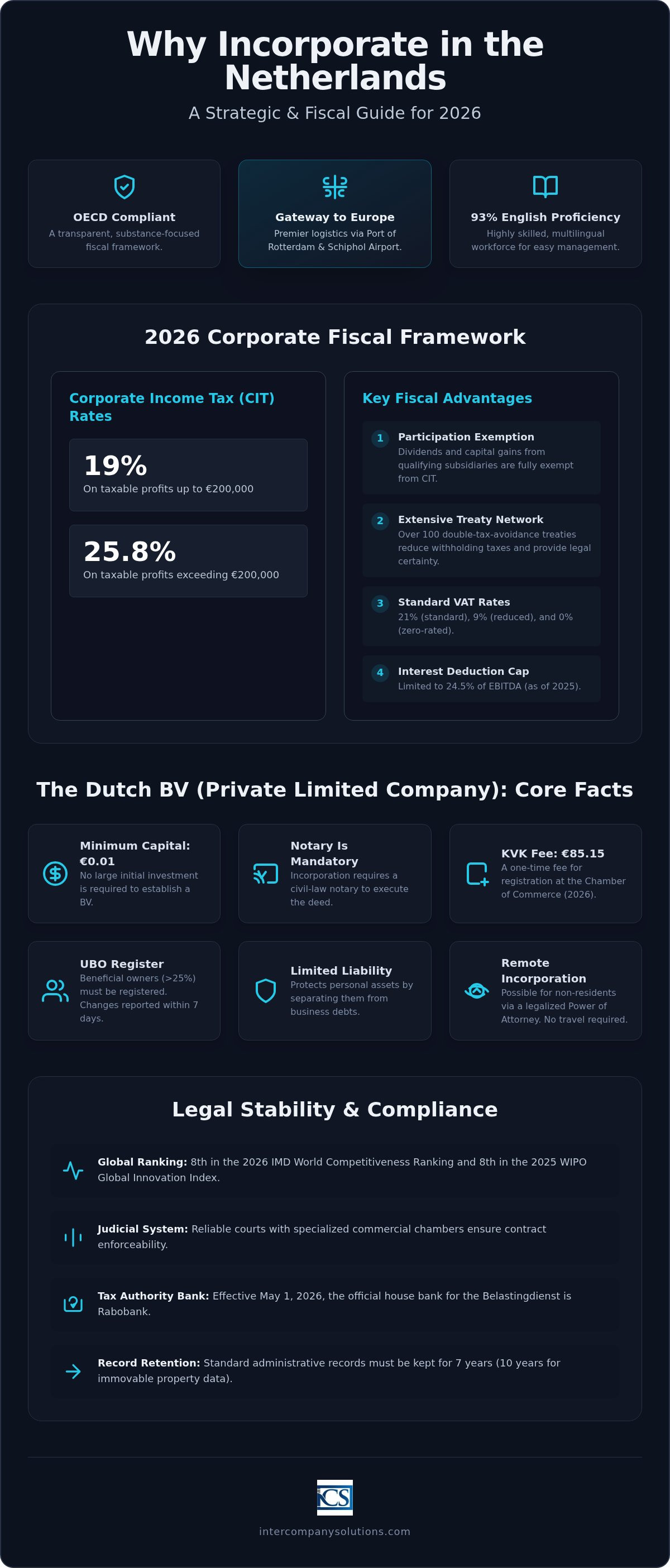
One primary reason why incorporate in the Netherlands is the access to a network of over 100 double-tax-avoidance treaties. These treaties provide legal certainty for international trade by preventing the same income from being taxed in two different jurisdictions. This framework supports a predictable business climate rather than offering loopholes, making it a reliable base for international operations. The corporate income tax (CIT) rates for 2026 are 19% up to €200,000 and 25.8% above, which aligns with European averages and demonstrates a standard, non-zero tax environment.
International Trade and Global Connectivity
The Dutch logistics network, centered around the Port of Rotterdam and Schiphol Airport, allows for efficient corporate scaling across the European Union. For companies involved in physical goods, the Netherlands offers VAT-efficient distribution models. Using a Dutch BV can facilitate import VAT deferment, which significantly improves cash flow for trading entities. This connectivity extends to holding structures, where the treaty network minimizes withholding taxes on cross-border payments, provided the entity meets modern substance requirements. The system is designed to support the movement of capital and goods without the friction of multiple taxation layers.
Stability and Legal Certainty
Foreign investors prioritize the Netherlands for its reliable judicial system and specialized commercial courts. Disputes are handled with a high degree of technical expertise, ensuring that contracts are enforceable and rights are protected. The Netherlands Chamber of Commerce (KVK) operates with total transparency. Every new entity pays a KVK registration fee €85.15 (2026, one-time). This administrative clarity extends to intellectual property protection. The Dutch legal framework provides robust safeguards for patents and trademarks, which is a critical factor for innovative companies. Legal structures like the BV, which has a BV minimum capital €0.01, require a notary for incorporation. This process ensures a level of formal integrity that builds trust with international banks and partners.
Last reviewed: September 2026
The Dutch BV Structure: Requirements and Capital Myths
Starting a business in a foreign jurisdiction often leads to misconceptions about financial barriers. One common myth is that setting up a private limited company requires a large initial investment. In reality, the BV minimum capital €0.01 allows for a flexible entry point for startups and international investors alike. This accessibility is one reason why incorporate in the Netherlands is a popular choice for global entrepreneurs. Unlike an eenmanszaak or VOF, a Dutch BV (Besloten Vennootschap) must be incorporated via a notary who prepares and executes the deed of incorporation.
Following the execution of the deed, the company must be registered with the Chamber of Commerce (KVK). The KVK registration fee €85.15 (2026, one-time) is a mandatory administrative cost. All BVs must also comply with the UBO register by identifying individuals with a UBO threshold >25% of ownership or control. It's a legal obligation that UBO changes reported within 7 days to ensure the KVK records remain accurate and transparent.
Legal Entity Comparison
The BV is the preferred structure for most foreign entrepreneurs because it offers limited liability and operational flexibility. This structure is a primary factor in why incorporate in the Netherlands, as it provides a professional image for international trade. In contrast, an NV requires a minimum capital of €45,000 and is subject to stricter reporting rules. When comparing a BV to a sole proprietorship (eenmanszaak), the primary advantage is the separation of personal and business assets. While an eenmanszaak is easier to set up, the owner remains personally liable for all obligations. All BVs must ensure their annual accounts filed with KVK within 12 months of year-end to maintain good standing.
Ownership and Residency Facts
Dutch law allows for full foreign ownership. Shareholders and directors don't need to live in the Netherlands or hold Dutch citizenship. You do, however, need a local business address to complete the registration process. The Netherlands Foreign Investment Agency highlights these open-market policies as a key driver for international growth. In 2026, the legalized Power of Attorney route remains the standard for Dutch BV Company Formation, enabling remote setup for non-resident founders. If your structure involves multiple international layers, you can contact our team to discuss the specific documentation required for UBO compliance.
Last reviewed: September 2026
Workforce and Operational Realities for Foreigners
The Dutch labor market is defined by high accessibility for international business owners. A significant factor in why incorporate in the Netherlands is the language proficiency of the local population. Statistical data confirms that 93% of the Dutch population is proficient in English, which allows foreign directors to manage their entities without learning the local language. This cultural alignment reduces operational friction during recruitment and daily management, as technical discussions and legal filings can often be conducted in English.
The Netherlands continues to attract global talent through the 30% tax reimbursement ruling. For 2026, this incentive is capped at a salary of €262,000. While the partial non-resident status was abolished for new applicants starting January 1, 2025, the ruling remains a powerful tool for attracting highly skilled migrants. The local workforce is currently ranked 3rd globally for education levels. This educational standard is a compelling reason why incorporate in the Netherlands when you're seeking to build a high-performance team with specialized technical skills.
Hiring and Payroll Compliance
Compliance with Dutch labor law is mandatory for any BV with employees. All employment relationships must be documented in written agreements that specify wages, hours, and notice periods. For companies that need to scale quickly without establishing a full internal HR department, using an Employer of Record (EOR) is a viable path. This allows you to hire staff immediately while ensuring full adherence to local regulations. Professional payroll services in the Netherlands can manage these complex administrative requirements, including pension contributions and social security filings.
Innovation and Tech Ecosystem
The Netherlands serves as a primary hub for fintech, agrifood, and sustainable energy. Innovative companies often benefit from the WBSO (R&D tax credit), which reduces wage tax and social security contributions for research-driven activities. This environment is supported by numerous tech accelerators and a startup-friendly regulatory approach. Establishing a presence here provides proximity to major European markets and a collaborative ecosystem that values technological advancement. The country's ranking as 8th in the 2025 WIPO Global Innovation Index further validates its position as a leading destination for research and development.
Last reviewed: September 2026
Fiscal Advantages: 2026 Tax Rates and Participation Exemption
The Dutch fiscal system is often misunderstood as having excessively high rates. While the standard Corporate Income Tax (CIT) rates for 2026 are 19% on profits up to €200,000 and 25.8% on the excess, the effective tax burden for many international businesses remains competitive. This balance between standard rates and specific incentives is a central reason why incorporate in the Netherlands for both trade and holding activities. Value-added tax (VAT) is also structured clearly with a standard rate of 21%, a reduced rate of 9%, and a 0% rate for specific international transactions, such as intra-community supplies within the EU.
The Participation Exemption for Holding Companies
One of the most significant pillars of Dutch tax law is the participation exemption. This rule ensures that dividends and capital gains derived from a qualifying subsidiary are not taxed at the level of the Dutch holding company. To qualify, the Dutch entity must generally hold at least 5% of the shares in the subsidiary. This policy prevents double taxation within corporate groups and makes the country an ideal location for regional headquarters. For a deeper analysis of these criteria, you can review our Dutch participation exemption guide. This exemption is a major factor for global investors deciding why incorporate in the Netherlands to manage their international portfolios.
Interest Deduction and CIT Compliance
Fiscal stability in 2026 also involves adherence to interest deduction limitations. The net interest deduction is currently capped at 24.5% of the company’s EBITDA or a threshold of €1 million, whichever is higher. This rule aligns with EU anti-tax avoidance directives and requires precise accounting to ensure compliance. Companies must also follow strict record-keeping standards; business records must be retained for 7 years, while records related to immovable property require a 10-year retention period.
Administrative changes in 2026 include the Belastingdienst house bank transition. Belastingdienst house bank is Rabobank since 1 May 2026. Ensuring your accounting systems and payment instructions reflect this change is essential for timely tax compliance. Maintaining these high standards of transparency and adherence is what preserves the integrity of the Dutch business climate for foreign owners.
Last reviewed: September 2026
Incorporating Remotely: The Legal Path for Non-Residents
A common misconception among international founders is that establishing a Dutch company requires physical travel to the Netherlands. While local presence was historically expected, the modern legal framework allows for a fully remote setup. This accessibility is a compelling reason why incorporate in the Netherlands, as it enables entrepreneurs to launch operations from their home country without the logistical burden of international travel. For non-EU founders, the established route is the legalized Power of Attorney (PoA) process.
Remote registration typically takes 3 to 5 business days once the necessary documentation is finalized. The involvement of a Dutch notary is mandatory for the formation of a BV; they are responsible for executing the deed of incorporation. By utilizing the PoA route, the founder authorizes the notary or a representative to sign the deed on their behalf. This ensures the process remains legally sound while providing the speed and flexibility required by global businesses.
Steps to Remote Formation
The remote process begins with document submission and rigorous identity verification. Founders must provide legalized copies of their identification and proof of address. If the shareholder is a foreign legal entity, additional corporate documents, such as an excerpt from the foreign trade register, are required. Once these documents are verified, the notary prepares the draft deed of incorporation. The founder then signs the Power of Attorney in their country of residence, which often requires legalization or an apostille depending on the jurisdiction. You can access specialized Dutch BV company formation services to manage these procedural requirements and coordinate with the notary. After the notary executes the deed, the company is registered with the Chamber of Commerce (KVK), and the one-time KVK registration fee €85.15 is paid.
Post-Incorporation Compliance
After the BV is legally established, the focus shifts to operational compliance. International trade requires both a VAT number and an EORI number. For foreign-owned entities, obtaining a VAT number typically takes 6–8 weeks. You'll also need to open a business bank account to manage capital and tax payments. While traditional banks are an option, many founders choose digital-first solutions like bunq for their remote-friendly onboarding processes. The first 12 months are critical for establishing corporate substance, which involves maintaining a local business address and ensuring all administrative filings are up to date. Annual accounts filed with KVK within 12 months of year-end is a mandatory requirement to avoid penalties. Consistent compliance during this period reinforces the legitimacy of your Dutch entity in the eyes of the Belastingdienst and international partners.
Last reviewed: September 2026
Securing Your Strategic Entry into the Dutch Market
The Netherlands remains a top-tier economy for international expansion, providing a stable fiscal environment and a highly educated workforce. By understanding the 19% Corporate Income Tax rate on profits up to €200,000 and the legal validity of remote registration, founders can move past common misconceptions. These operational facts demonstrate why incorporate in the Netherlands is a sound decision for businesses targeting the European single market in 2026.
Intercompany Solutions facilitates this transition through a fast-track 3 to 5-day incorporation process. We specialize in complex non-EU founder cases and provide comprehensive VAT and accounting support to ensure full compliance with the Dutch tax authorities. Our team manages the procedural requirements of the legalized Power of Attorney route so you can focus on scaling your operations.
Establishing your Dutch BV is a methodical process that rewards precision. We are ready to provide the expertise necessary to secure your company's future in the Netherlands.
Last reviewed: September 2026
Frequently Asked Questions
Can I incorporate in the Netherlands without being a resident?
Yes, residency is not a legal requirement for shareholders or directors of a Dutch BV. International entrepreneurs from over 50 countries have established entities without living in the Netherlands. You don't need to be a resident to provide a local business address for registration with the KVK. This flexibility is a major reason why incorporate in the Netherlands, as it allows for global ownership while maintaining a professional European headquarters.
What is the minimum share capital required for a Dutch BV in 2026?
For a private limited company, the BV minimum capital €0.01. This low threshold replaces the historical requirement of €18,000, making the structure accessible to startups and small enterprises. You can choose to issue more capital if your business strategy requires it, but the legal minimum remains nominal. This capital must be registered during the incorporation process handled by the notary when the deed is executed.
How long does the Dutch company registration process take for foreigners?
Registration typically takes 3 to 5 business days for foreign entrepreneurs. This duration depends on the complexity of the shareholding structure and the timely submission of legalized documents. Once the notary executes the deed of incorporation, registration is finalized with the KVK registration fee €85.15 (2026, one-time). We focus on efficiency to ensure your business is operational and ready for VAT registration as quickly as possible.
Do I need to speak Dutch to start a business in the Netherlands?
You don't need to speak Dutch to start a business in the Netherlands successfully. English is the primary language for international commerce here, with 93% of the population proficient in it. Most government bodies, including the Tax and Customs Administration, provide information in English. This linguistic accessibility simplifies daily operations and recruitment, as you can communicate effectively with local staff, partners, and professional service providers without language barriers.
What are the corporate tax rates in the Netherlands for 2026?
Corporate income tax rates for 2026 are CIT 19% up to €200,000 and 25.8% above. These rates have remained stable since 2023, providing a predictable fiscal environment. Understanding these specific brackets helps clarify why incorporate in the Netherlands, as the initial 19% rate is competitive compared to many other European jurisdictions. The Belastingdienst house bank is Rabobank since 1 May 2026, which handles all incoming payments.
Can the incorporation process be handled entirely remotely?
Founders can handle the incorporation process entirely remotely through the legalized Power of Attorney (PoA) route. This method allows a notary to execute the deed of incorporation on your behalf, so you don't need to travel to the Netherlands. You'll need to provide legalized identification and sign the PoA in your country of residence. This remote accessibility is a standard service for international founders, ensuring a legally sound setup without travel costs.
What is the 30% ruling and how does it benefit my Dutch company?
Qualifying international employees can benefit from the 30% ruling, a tax reimbursement incentive that allows employers to provide part of their salary tax-free. In 2026, this benefit is capped at a salary of €262,000. It's designed to attract highly skilled migrants by reducing their personal income tax burden. For your Dutch company, this ruling serves as a powerful recruitment tool to secure specialized international talent that might otherwise be difficult to hire locally.
Sources
- ICS Payroll - Dutch payroll services
- KVK - Registering with the Dutch Business Register
- Business.gov.nl - Private limited company (bv)
- Burgerlijk Wetboek Boek 2 (Dutch Civil Code, legal entities)
- Rijksoverheid - Ondernemen
- Belastingdienst - Corporate income tax rates
- Belastingdienst - Payroll taxes (loonheffingen)
- UWV - Employer obligations
- SVB - Social insurance in the Netherlands
- Belastingdienst - VAT (btw) for entrepreneurs
- European Commission - VAT rules and rates
- De Nederlandsche Bank - Supervision
- AFM - Licences and registers
- BOIP - Trademark registration in Benelux
- WIPO - Madrid System
- RVO - Doing business internationally
- Belastingdienst Douane - Customs
- CJEU, Cadbury Schweppes, C-196/04 (ECLI:EU:C:2006:544)
- Hoge Raad, ECLI:NL:HR:2021:1152
- PwC Worldwide Tax Summaries - Netherlands
- ICLG - Corporate Governance Laws and Regulations, Netherlands
Need more information on the Dutch BV company?
Contact an expertReady to start your company in the Netherlands?
| Formation time | Dutch BV formation completed in 3 to 5 business days |
|---|---|
| Process | Fully remote setup with step-by-step guidance |
| Compliance | Expert support for registration, VAT and compliance |
| Aftercare | Accounting, tax and legal support included |
| One partner | All of the above through one trusted formation partner |