

August 25, 2026 · 18 min read
The Netherlands serves as the primary logistical hub for European food distribution, processing millions of tonnes of agricultural products annually through its advanced port infrastructure. Establishing a presence here requires more than just a logistical plan; it demands a rigorous approach to European Union food safety standards and Dutch corporate law. We recognize that international founders often struggle with the complexity of NVWA regulations and the nuances of managing a Dutch entity from abroad. To address these challenges, we have developed this resource to Create: Practical guide for setting up a Dutch food-import company that focuses on statutory compliance and operational readiness.
You'll gain a professional walkthrough of the mandatory legal and tax frameworks, including the remote BV formation process using a legalized Power of Attorney. This method ensures you don't need to travel to the Netherlands to execute the deed of incorporation before a notary. We'll also detail the requirements for obtaining an EORI number for customs and registering with the Dutch Food and Consumer Product Safety Authority. By following this structured path, you can secure your VAT status and ensure your business meets the 19% corporate income tax threshold requirements while maintaining the necessary seven year administrative records.
Key Takeaways
- The Dutch BV is the standard legal structure for international food trade, offering limited liability that protects personal assets from risks like product recalls or spoilage.
- Non-resident entrepreneurs can complete the incorporation process remotely through a legalized Power of Attorney, avoiding the need for international travel to meet a notary.
- Compliance with the Netherlands Food and Consumer Product Safety Authority (NVWA) is mandatory to ensure all imported goods meet European safety and labeling standards.
- Securing an EORI number and an Article 23 permit is essential for efficient customs clearance and the deferment of VAT payments upon importation.
- Use this resource to Create: Practical guide for setting up a Dutch food-import company, including details on the 19% corporate income tax rate for profits up to €200,000.
Table of Contents
Selecting the Dutch BV Structure for Food Importation
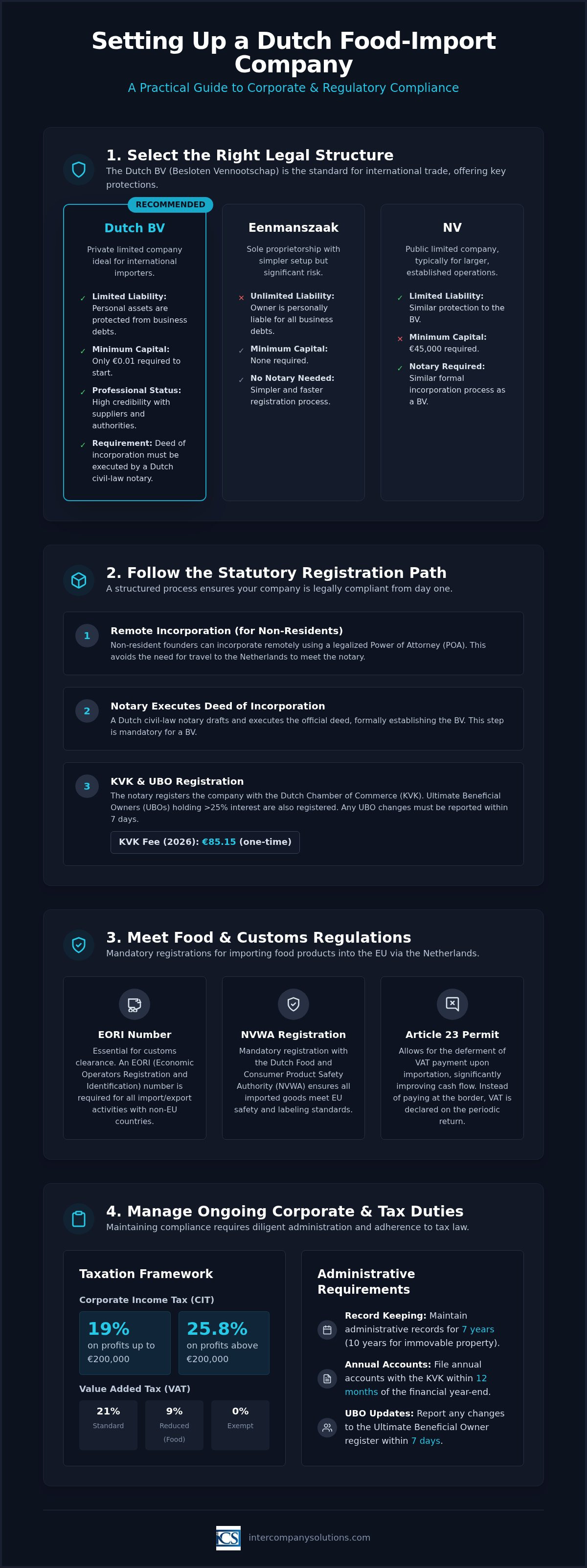
The Besloten Vennootschap (BV) is the most effective legal vehicle for international trade within the Netherlands. It functions as a private limited company where the capital is divided into shares. For those looking to Create: Practical guide for setting up a Dutch food-import company, selecting this structure is the first step toward establishing a professional presence. The BV offers a flexible framework, requiring a minimum share capital of only €0.01. Unlike a sole proprietorship, incorporating a BV requires a Dutch civil-law notary to execute the deed of incorporation and a registered business address within the country.
One of the primary reasons food importers choose the BV is the protection of personal assets. The food industry carries inherent risks, such as product spoilage, contamination, or large-scale recalls. In a BV, the company's liability is limited to its own assets. This means directors and shareholders aren't personally liable for the company's debts unless there's evidence of mismanagement. This legal separation is essential for maintaining financial security while handling perishable goods across international borders.
Advantages of the BV for International Trade
A Dutch BV provides significant tax advantages, specifically through the participation exemption. This rule ensures that dividends and capital gains from qualified subsidiaries aren't taxed at the parent company level, which is ideal for businesses with a global holding structure. Additionally, having a BV registered with the Kamer van Koophandel (KVK) builds immediate credibility with Dutch retailers and European suppliers. Foreign entrepreneurs often manage these entities from abroad. The Netherlands allows for remote management, and the incorporation itself can be handled through a legalized Power of Attorney (POA) route. This ensures that non-resident directors don't need to travel to the Netherlands to meet the notary in person.
Comparison with Other Legal Entities
Choosing the right form is a matter of balancing risk and administrative requirements. An eenmanszaak (sole proprietorship) doesn't require a notary or a minimum capital, but it leaves the owner's personal assets fully exposed to business creditors. Conversely, a Naamloze Vennootschap (NV) is a public company requiring a minimum capital of €45,000; this structure is generally too complex for initial import operations. Most entrepreneurs find that Dutch BV formation services offer the most balanced path for growth. While the BV requires filing annual accounts within 12 months of the year-end and maintaining records for seven years, the benefits of limited liability and professional status outweigh these administrative duties. This choice remains the cornerstone for any Create: Practical guide for setting up a Dutch food-import company.
Statutory Registration with the KVK and Tax Authorities
The formal registration process begins with a Dutch civil-law notary once you have finalized your company structure. This step is mandatory because the notary must draft and execute the deed of incorporation. For international entrepreneurs, the Netherlands provides a streamlined remote incorporation path. Non-EU founders can utilize the legalized Power of Attorney (POA) route, which allows the notary to sign the deed on their behalf. This removes the requirement for physical travel to the Netherlands, making it easier to Create: Practical guide for setting up a Dutch food-import company from your home country.
During the incorporation, you must register the company with the Kamer van Koophandel (KVK). The KVK registration fee is a one-time payment of €85.15 for 2026. Simultaneously, the notary will register the company’s Ultimate Beneficial Owners (UBO) in the UBO register. A UBO is any individual who holds more than 25% of the shares, voting rights, or ownership interest. Any future changes to UBO information must be reported within 7 days to maintain compliance with Dutch anti-money laundering regulations.
Step-by-Step Incorporation Process
The process follows a logical sequence to ensure legal validity. First, you must submit valid identification documents and the legalized POA to your chosen notary. After the notary executes the deed, they handle the registration at the KVK. You will then receive a KVK extract, which serves as the official proof of your business's legal existence. This document is required for opening a business bank account and entering into commercial contracts with food suppliers. For personalized assistance with these filings, you can reach out to our specialist team.
Initial Tax Registrations
Following KVK registration, the company must be registered with the Belastingdienst (Dutch Tax Office). While the KVK often notifies the tax authorities automatically, foreign-owned entities must provide additional information to secure a VAT number. The Belastingdienst requires proof of substance, which often involves demonstrating a physical operational presence. For foreign-owned BVs, the VAT number issuance typically takes 6–8 weeks. This timeline is critical to account for when planning your first shipment of perishable goods. You will also be assigned a tax identification number for Corporate Income Tax (CIT), where the rate is 19% on profits up to €200,000 and 25.8% above that threshold. Since 1 May 2026, the Belastingdienst uses Rabobank as its house bank for all tax-related transactions. Remember that annual accounts must be filed with the KVK within 12 months of the financial year-end, and all business records must be retained for at least 7 years.
Regulatory Compliance with the NVWA
Once your BV is registered at the KVK, you must ensure your operations align with the Netherlands Food and Consumer Product Safety Authority (NVWA). This authority oversees the safety of food and consumer products across the Dutch market. Registration with the NVWA is a mandatory requirement for all importers, as it enables the state to monitor the food chain effectively. To Create: Practical guide for setting up a Dutch food-import company, one must understand that compliance isn't optional; it's a prerequisite for clearing customs.
Your business must adhere to EU Regulation (EC) No 178/2002. This regulation establishes the general principles of food law and mandates strict traceability for all products. You're required to maintain a written food safety plan based on Hazard Analysis and Critical Control Point (HACCP) principles. This plan identifies potential biological, chemical, or physical hazards in your import process and outlines the controls used to prevent them. It's a foundational document that the NVWA may audit at any time.
NVWA Registration and Notification
The registration process varies depending on the nature of your goods. If you intend to import products of animal origin (POAO), you must register as an importer specifically for these categories. This often involves using the Trade Control and Expert System (TRACES), an electronic platform for certification and tracking of animals and animal products entering the EU. For shipments arriving at the Port of Rotterdam, you must arrange for sanitary and phytosanitary (SPS) checks. These inspections verify that the goods meet EU health standards before they're released for distribution. Failure to provide correct electronic notifications via TRACES can lead to significant delays and storage costs at the terminal.
Labeling and Traceability Standards
Imported food must comply with the Dutch Warenwet (Food and Commodities Act) and broader EU consumer information rules. Labels must be accurate, legible, and typically provided in Dutch if the product is intended for the local market. Traceability is managed through a "one step back, one step forward" system. This means you must know exactly who supplied the goods and which customers received them. Under Dutch law, you must retain these administrative records for 7 years. This level of detail is a core component when starting a business in the Netherlands within the food sector. Maintaining precise records ensures that if a safety issue arises, you can execute a targeted recall quickly, protecting both public health and your company's legal standing. This systematic approach is vital for anyone looking to Create: Practical guide for setting up a Dutch food-import company that remains compliant over the long term.
Managing Customs, EORI, and VAT Obligations
Every business involved in the international movement of food products must secure an Economic Operators Registration and Identification (EORI) number. This unique identifier is mandatory for all customs declarations within the European Union. Without it, your shipments will be held at the border, leading to significant storage fees and potential spoilage of perishable goods. To Create: Practical guide for setting up a Dutch food-import company, you must prioritize this registration alongside your KVK filing. You'll also need to classify your inventory using the correct Harmonized System (HS) codes. These codes are the international standard for defining products; they determine the specific import duties and whether your goods require additional sanitary inspections.
The Netherlands applies a reduced VAT rate of 9% to most food products, which is a significant consideration for your pricing strategy. While the standard VAT rate is 21%, the lower rate applies to nearly all essential food items and ingredients. Correct classification ensures you don't overpay at the border or undercharge your Dutch customers. Maintaining accurate records of these classifications is part of your 7 year administrative obligation under Dutch tax law.
Customs Clearance Procedures
Most importers utilize the services of a customs broker to manage the technicalities of import declarations. These specialists ensure that all required documentation, such as commercial invoices, packing lists, and health certificates, is submitted through the proper digital channels. The Dutch customs authority is currently transitioning toward fully digitalized systems for 2026 to increase processing speeds at the Port of Rotterdam. These updates require high data accuracy from the importer. Having your EORI number and HS codes ready before the first shipment arrives prevents logistical bottlenecks that often affect new businesses.
VAT Deferment and Cash Flow
The Article 23 permit is perhaps the most critical tool for managing cash flow in a Dutch food-import business. Under standard EU rules, import VAT is payable at the moment goods enter the country. However, an Article 23 permit allows you to defer this payment. Instead of paying VAT at the border, you report the amount on your periodic VAT return. Because you can typically deduct the same amount as input tax on that same return, the net cash impact is zero. This prevents large amounts of capital from being tied up in tax payments while you wait for a refund from the Belastingdienst.
To qualify for this deferment and manage your tax affairs effectively, you must have a Dutch business bank account. Since 1 May 2026, the Belastingdienst has utilized Rabobank as its house bank for all tax transactions. Securing a local account is also necessary for the VAT application process, which typically takes 6–8 weeks for foreign-owned BVs. This setup ensures that your business remains compliant with the 19% CIT rate on profits up to €200,000 and the 25.8% rate thereafter.
Ongoing Administrative and Accounting Requirements
Establishing the BV is the first phase; maintaining it requires strict adherence to Dutch fiscal deadlines and accounting standards. For 2026, the Corporate Income Tax (CIT) is 19% on profits up to €200,000 and 25.8% for any amount above this threshold. Importers must also monitor the interest deduction cap, which is set at 24.5% of EBITDA for the 2026 fiscal year. These figures are essential for those who use this resource to Create: Practical guide for setting up a Dutch food-import company. All administrative records, including customs declarations and NVWA certificates, must be retained for at least 7 years. If your business owns immovable property, this retention period extends to 10 years.
Your company's financial year usually follows the calendar year, though you can opt for a broken fiscal year during incorporation. Regardless of the chosen cycle, you're required to file annual accounts with the KVK within 12 months of the financial year-end. Failure to meet this deadline can lead to administrative fines and may affect the director's limited liability status. Since 1 May 2026, the Belastingdienst has utilized Rabobank as its house bank for all tax-related transactions, so ensure your payment systems are updated accordingly.
Corporate Tax Compliance
Calculating your taxable profit involves more than just subtracting expenses from revenue. You must account for the participation exemption, which ensures that dividends and capital gains from qualified subsidiaries aren't taxed again at the level of the Dutch holding BV. This is a primary reason why international food traders choose the Netherlands for their regional headquarters. To maintain compliance, it's helpful to engage professional accounting for Dutch BV structures. These specialists ensure that your CIT filings are accurate and that any changes to the UBO registry are reported within the mandatory 7 day window. Remember that any individual holding more than 25% interest is considered a UBO and must be registered to prevent legal complications.
Payroll and Staffing for Importers
As your import operations grow, you may need to hire local staff for logistics or quality control. This requires your BV to register as an employer with the Belastingdienst. Every employee must have a written employment agreement that clearly outlines social security contributions, holiday pay, and working hours. For specialized international roles, you can apply for the 30% tax reimbursement ruling. This allows you to pay 30% of a qualifying employee's salary tax-free to cover the costs of moving to the Netherlands. Utilizing Dutch payroll services ensures that these complex calculations and monthly salary slips are handled correctly. This final operational step completes our Create: Practical guide for setting up a Dutch food-import company, moving your business from a legal registration to a fully functioning trade entity.
Last reviewed: October 2025
Establishing Your Presence in the Dutch Food Market
Launching a food-import operation in the Netherlands requires meticulous attention to both corporate law and safety standards. You've seen how the Dutch BV protects your assets while providing a framework for EU trade. By following the steps in this Create: Practical guide for setting up a Dutch food-import company, you can manage the statutory requirements from abroad using a legalized Power of Attorney. This approach allows you to focus on your supply chain while ensuring every legal detail is handled by specialists.
Success depends on synchronizing your KVK registration with NVWA safety protocols and securing an Article 23 permit for VAT deferment. These administrative foundations ensure your business remains compliant with Dutch tax thresholds while maintaining the necessary seven year record-keeping standard. We facilitate this entire process, offering remote incorporation in 3-5 business days and full support for VAT and EORI applications.
We're here to act as your proactive partner, helping you bridge the gap between local regulations and your global business goals. Your expansion into the European food sector is a significant milestone, and we're committed to ensuring your path to entry is both secure and efficient.
Last reviewed: October 2025
Frequently Asked Questions
Do I need a special license to import food into the Netherlands?
Registration with the Netherlands Food and Consumer Product Safety Authority (NVWA) is mandatory for all food importers. While there is no single "import license," specific categories such as products of animal origin (POAO) require registration in the TRACES system. You must also maintain a written food safety plan based on HACCP principles. This ensures your operations comply with EU Regulation (EC) No 178/2002 regarding traceability and consumer health protection.
Can I register a Dutch food import company remotely without visiting?
You can register a Dutch food-import company remotely through the legalized Power of Attorney (POA) route. This process allows a Dutch civil-law notary to execute the deed of incorporation on your behalf without requiring you to travel to the Netherlands. This method is the standard for non-resident founders and is a core component when you Create: Practical guide for setting up a Dutch food-import company. All authorization documents must be properly legalized.
What is the minimum share capital required for a Dutch food import BV?
The BV minimum capital €0.01 is the legal requirement for incorporating a private limited company. This low threshold provides entrepreneurs with significant flexibility during the initial funding phase. While the capital requirement is minimal, you must still account for other startup costs, such as the KVK registration fee €85.15 (2026, one-time). This structure is ideal for food importers who prefer to allocate their initial capital toward inventory or logistics instead of statutory deposits.
How long does it take to get a VAT and EORI number for a new company?
Obtaining a VAT number for foreign-owned entities typically takes between 6 and 8 weeks. The Dutch Tax Office (Belastingdienst) requires proof of substance and operational presence before issuing the number. Once your VAT registration is active, the application for an EORI number is processed much faster, often within a few business days. It's essential to factor this timeline into your business plan to avoid delays with your first shipment of perishable goods.
What are the Dutch corporate tax rates for food import companies in 2026?
For the 2026 fiscal year, the CIT 19% up to €200,000 and 25.8% above is the applicable corporate tax structure. Importers should also be aware of the interest deduction cap, which is 24.5% of EBITDA in 2025 and remains a critical calculation for 2026. Maintaining accurate records retained 7 years is required to support these filings. Since 1 May 2026, all tax payments are processed through Rabobank, the Belastingdienst house bank.
Is a Dutch bank account mandatory for importing food into the Netherlands?
A Dutch business bank account is not strictly required for the act of incorporation, but it's practically mandatory for tax compliance. The Belastingdienst generally requires a local or SEPA-compliant account to issue a VAT number or an Article 23 permit. Having a local account also simplifies transactions with Dutch customs and logistics partners. Since the Belastingdienst house bank is Rabobank since 1 May 2026, using a Dutch account ensures your tax transactions are processed efficiently.
What are the labeling requirements for food products sold in the Dutch market?
Food products sold on the Dutch market must comply with the Warenwet (Food and Commodities Act) and EU consumer information regulations. Labels must be accurate, legible, and provided in the Dutch language for local consumers. Mandatory information includes the product name, ingredient list, allergen warnings, net quantity, and expiration date. You must also include the name and address of the EU-based importer or manufacturer to ensure full traceability in the event of a recall.
How does the Article 23 VAT deferment permit work for importers?
The Article 23 permit allows importers to defer the payment of VAT from the moment of importation to their periodic VAT return. Instead of paying 9% or 21% VAT at the border, you report the amount as both input and output tax on your return. This creates a neutral cash flow effect, which is vital for high-volume traders. This mechanism is a primary benefit discussed when specialists Create: Practical guide for setting up a Dutch food-import company.
Sources
- ICS Payroll - Dutch payroll services
- KVK - Registering with the Dutch Business Register
- Business.gov.nl - Private limited company (bv)
- Burgerlijk Wetboek Boek 2 (Dutch Civil Code, legal entities)
- Rijksoverheid - Ondernemen
- Belastingdienst - Corporate income tax rates
- Belastingdienst - Payroll taxes (loonheffingen)
- UWV - Employer obligations
- SVB - Social insurance in the Netherlands
- Belastingdienst - VAT (btw) for entrepreneurs
- European Commission - VAT rules and rates
- De Nederlandsche Bank - Supervision
- AFM - Licences and registers
- RVO - Doing business internationally
- Belastingdienst Douane - Customs
- CJEU, Cadbury Schweppes, C-196/04 (ECLI:EU:C:2006:544)
- Hoge Raad, ECLI:NL:HR:2021:1152
- PwC Worldwide Tax Summaries - Netherlands
- ICLG - Corporate Governance Laws and Regulations, Netherlands
Need more information on the Dutch BV company?
Contact an expertReady to start your company in the Netherlands?
| Formation time | Dutch BV formation completed in 3 to 5 business days |
|---|---|
| Process | Fully remote setup with step-by-step guidance |
| Compliance | Expert support for registration, VAT and compliance |
| Aftercare | Accounting, tax and legal support included |
| One partner | All of the above through one trusted formation partner |