

October 19, 2026 · 15 min read
Understanding how to set up a Dutch BV from abroad starts with the notarial process. Non-EU founders can generally use the standard remote route without travelling to the Netherlands: they grant a legalised Power of Attorney, allowing a Dutch notary to execute the deed of incorporation on their behalf. The Dutch Chamber of Commerce (KVK) explains the BV registration process. The notary also reviews the required documents and verifies the founder’s identity.
Before starting, clarify what information to provide, how the deed will be executed and what happens after registration. This guide covers the steps, from preparing shareholder and company details to completing the notarial process and KVK registration. It also explains the follow-on obligations, including UBO registration, tax administration and annual accounts. Requirements may depend on the company’s ownership and activities, so plan the process around those details.
Key Takeaways
- Understand how to set up a Dutch BV from abroad and distinguish company ownership or directorship from living or working in the Netherlands.
- Follow the standard remote process for non-EU founders, from preparing documents and authorising a representative to the notarial deed and KVK registration.
- Compare a BV with other Dutch legal forms and identify which structures require a notary.
- Prepare key identity, company and ownership details, and account for the relevant 2026 capital, registration fee and tax figures.
- Plan for UBO, VAT and annual filing obligations. Formation may take 2-5 days, depending on shareholding complexity.
Table of Contents
- Can You Set Up a Dutch BV from Abroad? The Remote Route Explained
- How the Remote Dutch BV Incorporation Process Works Through a Notary
- Remote Incorporation or Another Legal Form: Compare the Practical Differences
- What to Prepare and Which Dutch BV Obligations Follow Registration
- Complete Your Dutch BV Setup and Plan the First Compliance Steps
Can You Set Up a Dutch BV from Abroad? The Remote Route Explained
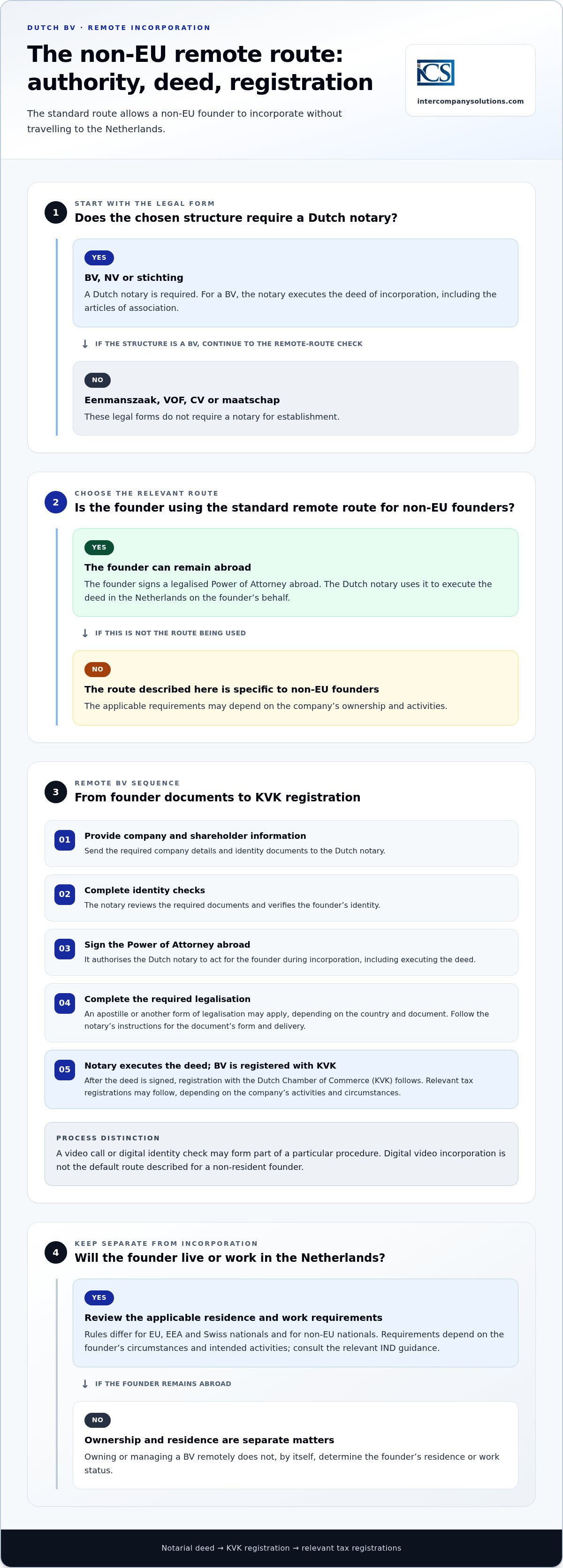
Yes. A foreign founder can establish a Dutch BV without living in the Netherlands, and the standard remote route for non-EU founders does not require travel. A BV, or private limited company, is a Dutch legal form with shares. For a general overview of its characteristics, see Dutch BV (Besloten Vennootschap). Incorporation requires a Dutch notary. Under the standard remote route for non-EU founders, the founder signs a legalised Power of Attorney authorising the notary to execute the deed in the Netherlands.
Consider not only whether you can form the company remotely, but also what you plan to do after incorporation. Company ownership, management, residence in the Netherlands and work performed there are separate matters. Clarifying these points is a useful first step in planning how to set up a Dutch BV from abroad.
What does setting up a Dutch BV from abroad mean?
For a non-EU founder using the standard remote process, “from abroad” means completing incorporation without travelling to the Netherlands. The founder provides the information and identity documents required for the notary’s checks, then signs a Power of Attorney in the country where they are located. The document must be legalised for use in the Dutch notarial process. The notary uses that authority to execute the deed in the Netherlands.
The process moves from preparation and identity checks to the notarial deed, followed by company registration and related administrative steps. Being abroad does not remove the notary’s role or the need to provide accurate information. The Dutch government’s guidance on setting up a private limited company outlines the BV’s formal establishment requirements.
Which founders need to consider residence and immigration rules?
Incorporating a BV does not give its founder permission to live or work in the Netherlands. EU, EEA and Swiss nationals are subject to different residence rules from non-EU nationals. IND guidance explains the residence position for EU, EEA and Swiss citizens and for people who need a Dutch residence permit. A non-EU founder’s requirements depend on their circumstances and intended activities; company ownership alone does not determine them.
Keep these decisions separate: forming or owning the company is a corporate-law matter, while moving to the Netherlands or carrying out work there may involve immigration requirements. If you plan to relocate or work in the Netherlands, review the relevant IND rules for your nationality and situation before making arrangements. If you remain abroad and manage the company remotely, incorporation does not change your residence or work status.
How the Remote Dutch BV Incorporation Process Works Through a Notary
For non-EU founders using the standard remote route, the steps are to provide company and shareholder information, complete identity checks, sign a Power of Attorney, legalise it where required, and send it to the Dutch notary. The notary then executes the deed of incorporation in the Netherlands. After the deed is signed, the BV is registered with the Dutch Chamber of Commerce (KVK), followed by any relevant tax registrations.
This is a notarial process, not simply an online application. A video call or digital identity check may form part of a particular procedure, but digital video incorporation is not the default route for a non-resident founder. The standard non-EU route described here uses an authorised representative and the Dutch notary’s execution of the deed. The Dutch government’s BV incorporation guidance outlines the formal establishment process.
How does the legalised Power of Attorney route work?
The Power of Attorney authorises the Dutch notary to act for the founder during incorporation, including executing the deed on the founder’s behalf. The founder signs the document abroad and completes any required legalisation steps. Whether an apostille or another form of legalisation applies depends on the country and document. Check the Dutch government’s legalisation guidance for the relevant jurisdiction, and follow the notary’s instructions about the document’s form and delivery.
Plan this step early. A signed document that has not been legalised as required may not be ready for the Dutch notarial process. The founder does not travel when using the standard non-EU route. Once the required documents and checks are complete, the notary can proceed in the Netherlands under the authority granted.
What happens when the Dutch notary executes the deed?
The notary formalises the BV by executing its deed of incorporation, which includes the articles of association. The deed establishes the company under Dutch law. KVK registration follows, so allow for the transition between signing and the company appearing in the Business Register. Registration is a separate stage from preparing and legalising the Power of Attorney.
After registration, the company may need further tax registrations, depending on its activities and circumstances. Keep the deed, registration details and supporting records together for administrative and compliance work. These stages provide a practical framework for remote incorporation without confusing document handling with a fully digital process. For help with the documentation and registration sequence, discuss your Dutch BV incorporation.
Remote Incorporation or Another Legal Form: Compare the Practical Differences
The choice of legal form affects how a business is established. For incorporation formalities, the key distinction is whether the structure requires a Dutch notarial deed. A BV, NV and stichting require a notary. An eenmanszaak, VOF, CV and maatschap do not. The Dutch government’s overview of business structures provides context for comparing the available forms.
How does a BV compare with other Dutch legal forms?
This comparison focuses on the notary requirement and the general nature of each form. It does not assess liability, taxation or suitability, which depend on the structure and the circumstances of the business.
| Legal form | General description | Notary required to establish? |
|---|---|---|
| BV | Private limited company | Yes |
| NV | Public limited company | Yes |
| Stichting | Foundation | Yes |
| Eenmanszaak | Sole proprietorship | No |
| VOF | General partnership | No |
| CV | Limited partnership | No |
| Maatschap | Professional partnership | No |
The table clarifies one practical difference: a BV is established through a notary, while the other listed forms do not require a notarial deed for establishment. That distinction alone does not determine which structure fits your business. Consider the planned activities, ownership arrangements and obligations that apply after registration before deciding.
Should you sign remotely or travel to the Netherlands?
For a non-EU founder using the standard remote route, the founder signs a legalised Power of Attorney abroad and authorises the Dutch notary to execute the incorporation deed. The founder does not need to travel for the deed to be executed. Signing in person is another arrangement, but it requires the founder to be present in the Netherlands for the signing. Both routes retain the notary’s role.
Remote signing does not remove the need to prepare the required information or complete identity checks. Digital video incorporation should not be assumed to be the default for non-resident founders. The applicable route depends on the founder’s circumstances and the notarial process. For a founder living outside the Netherlands, the standard non-EU Power of Attorney route allows the deed to be completed without travel.
Use the comparison to separate two decisions: which legal form matches the business, and how to set up a Dutch BV from abroad if a BV is selected. A BV requires a notary; the remote route determines how the founder participates in that process.
What to Prepare and Which Dutch BV Obligations Follow Registration
Preparation involves more than collecting identity documents. The information you provide helps the notary prepare the deed and establish who owns and directs the company. It also gives you a starting point for organising registrations and compliance tasks after incorporation. Use this checklist to prepare the core details before the notarial process begins.
Which information and documents should founders prepare?
- Identification: Prepare the identification documents requested for each founder, shareholder and director. The notary uses them for identity checks.
- Company details: Choose a proposed company name and prepare a clear description of the business activities.
- Ownership and management: Set out who will hold shares, their ownership percentages and who will serve as director. These details inform the deed and help identify the company’s UBOs.
- Notarial information: Provide the details needed for the articles of association and incorporation deed, and respond to the notary’s information requests.
For a non-EU founder using the remote route, the Power of Attorney must be legalised as required. The form of legalisation can depend on the country where it is signed. Check the Dutch government’s document legalisation guidance and follow the notary’s instructions for the relevant jurisdiction.
BV minimum capital €0.01. KVK registration fee €85.15 (2026, one-time). Incorporation costs are only one part of planning; tax treatment and filing duties continue after registration.
Which 2026 compliance deadlines should founders plan for?
Build recurring obligations into the company’s records and calendar from the start. The main requirements include:
- UBO registration: A UBO is generally a person who ultimately owns or controls more than 25% of the company. UBO threshold >25%; UBO changes reported within 7 days. See KVK’s UBO guidance for registration and change reporting.
- Accounting records: Records retained 7 years (10 for immovable property). The Belastingdienst explains business recordkeeping.
- Annual accounts: Annual accounts filed with KVK within 12 months of year-end. Check KVK’s filing guidance for the filing process.
For 2026, CIT 19% up to €200,000 and 25.8% above. VAT rates 21%/9%/0%; the applicable rate depends on the goods or services and the transaction. VAT for foreign-owned entities typically 6-8 weeks. Allow for this period when planning operations. For tax guidance, refer to the Belastingdienst corporate income tax information and its VAT guidance. Belastingdienst house bank is Rabobank since 1 May 2026.
With the documents and obligations mapped out, you can plan how to set up a Dutch BV from abroad and prepare for its ongoing administration.
Complete Your Dutch BV Setup and Plan the First Compliance Steps
Incorporation is the legal starting point, not the end of the setup process. Once the deed has been executed and the BV is registered with the Dutch Chamber of Commerce (KVK), identify the tax registrations that apply and organise the company’s administration. Consider these steps together: the BV’s planned activities inform its tax position, while transaction records provide the basis for accounting and filings.
What happens after KVK registration?
Review the company’s activities to determine whether it needs VAT registration and which VAT treatment applies to its transactions. The Belastingdienst VAT guidance explains the relevant rules. Registration is separate from incorporation, so include it in operational planning rather than assuming it is completed with the KVK entry.
Set up bookkeeping procedures as the BV begins operating. Keep records organised so transactions can be reviewed and information is available for tax returns and other filings. Formation may take 2-5 days, depending on shareholding complexity, but that timeframe does not mean every tax registration or administrative task is completed within the same period.
How can Intercompany Solutions support the setup?
Intercompany Solutions supports foreign entrepreneurs with Dutch BV formation, including legal documentation and KVK registration. The service also covers VAT applications and ongoing accounting and compliance, linking incorporation with the administrative tasks that follow. The registrations required depend on the BV’s activities and circumstances.
Before starting, bring together the planned activities, ownership details and founder information. These details provide a practical basis for the formation process and help identify the next steps for company administration.
Prepare Your Next Steps with Confidence
Before moving forward, decide how the BV will fit into your business plans. Confirm who will own and manage it, which activities it will carry out, and when it needs to begin operating. These decisions help you organise the information required for incorporation and identify the administrative tasks to prepare for launch.
Also decide how the company’s records, tax correspondence and recurring filings will be managed. Assigning responsibility early can clarify the transition from incorporation to day-to-day operations, particularly when founders and decision-makers are based in different countries. A practical plan for how to set up a Dutch BV from abroad should cover both formation and responsibility for what follows.
To discuss your company’s ownership structure, activities and timing, contact Intercompany Solutions.
A clear plan gives you a sound starting point for establishing your company and managing its next steps.
Frequently Asked Questions
Can a foreign founder be both the sole shareholder and director of a Dutch BV?
Yes. A foreign individual can generally hold all the shares and serve as the BV’s director. These are separate roles: the shareholder owns the shares, while the director manages and represents the company. The same person may perform both roles. The notary needs accurate details for the deed and company registration. See the Dutch government’s BV guidance for the establishment requirements.
Does a Dutch BV need a director who lives in the Netherlands?
A Dutch BV does not generally need a director who lives in the Netherlands. A person living abroad may serve as director, subject to the usual appointment and registration requirements. The director’s residence is separate from the company’s Dutch registration. If a director plans to move to the Netherlands or work there, assess their immigration position separately using the IND’s residence guidance.
Does a Dutch BV need a Dutch business address?
Yes, a BV registered in the Netherlands needs a Dutch visiting address for entry in the Business Register. This is a company registration detail, not a requirement for the shareholder or director to live in the country. Keep the address information consistent across the KVK registration and company records, and update the register if the company’s address changes. See KVK registration guidance for address requirements.
Does setting up a Dutch BV automatically mean it must register for VAT?
No. Incorporation alone does not determine whether the BV must register for VAT. The obligation depends on the company’s activities and whether it qualifies as a VAT entrepreneur under Dutch rules. A BV carrying out taxable economic activities may need to charge and report VAT, while the treatment of exempt activities differs. Compare the company’s actual transactions with the Belastingdienst VAT entrepreneur criteria.
Can a non-EU founder own a Dutch BV without a Dutch residence permit?
Yes. A non-EU founder can own shares in a Dutch BV while living outside the Netherlands; ownership itself does not grant Dutch residence or work rights. If you plan to move to the country or work there in person, check the permit rules that apply to your nationality and activities with the IND. Treat company ownership and plans to live or work in the Netherlands as separate considerations.
Last reviewed: October 2026
Sources
- KVK - Registering with the Dutch Business Register
- Business.gov.nl - Private limited company (bv)
- Burgerlijk Wetboek Boek 2 (Dutch Civil Code, legal entities)
- Rijksoverheid - Ondernemen
- Belastingdienst - Corporate income tax rates
- Belastingdienst - VAT (btw) for entrepreneurs
- European Commission - VAT rules and rates
- IND - Highly skilled migrant
- IND - Start-up residence permit
- CJEU, Cadbury Schweppes, C-196/04 (ECLI:EU:C:2006:544)
- Hoge Raad, ECLI:NL:HR:2021:1152
- PwC Worldwide Tax Summaries - Netherlands
- ICLG - Corporate Governance Laws and Regulations, Netherlands
Need more information on the Dutch BV company?
Contact an expertReady to start your company in the Netherlands?
| Formation time | Dutch BV formation completed in 3 to 5 business days |
|---|---|
| Process | Fully remote setup with step-by-step guidance |
| Compliance | Expert support for registration, VAT and compliance |
| Aftercare | Accounting, tax and legal support included |
| One partner | All of the above through one trusted formation partner |