

November 16, 2026 · 17 min read
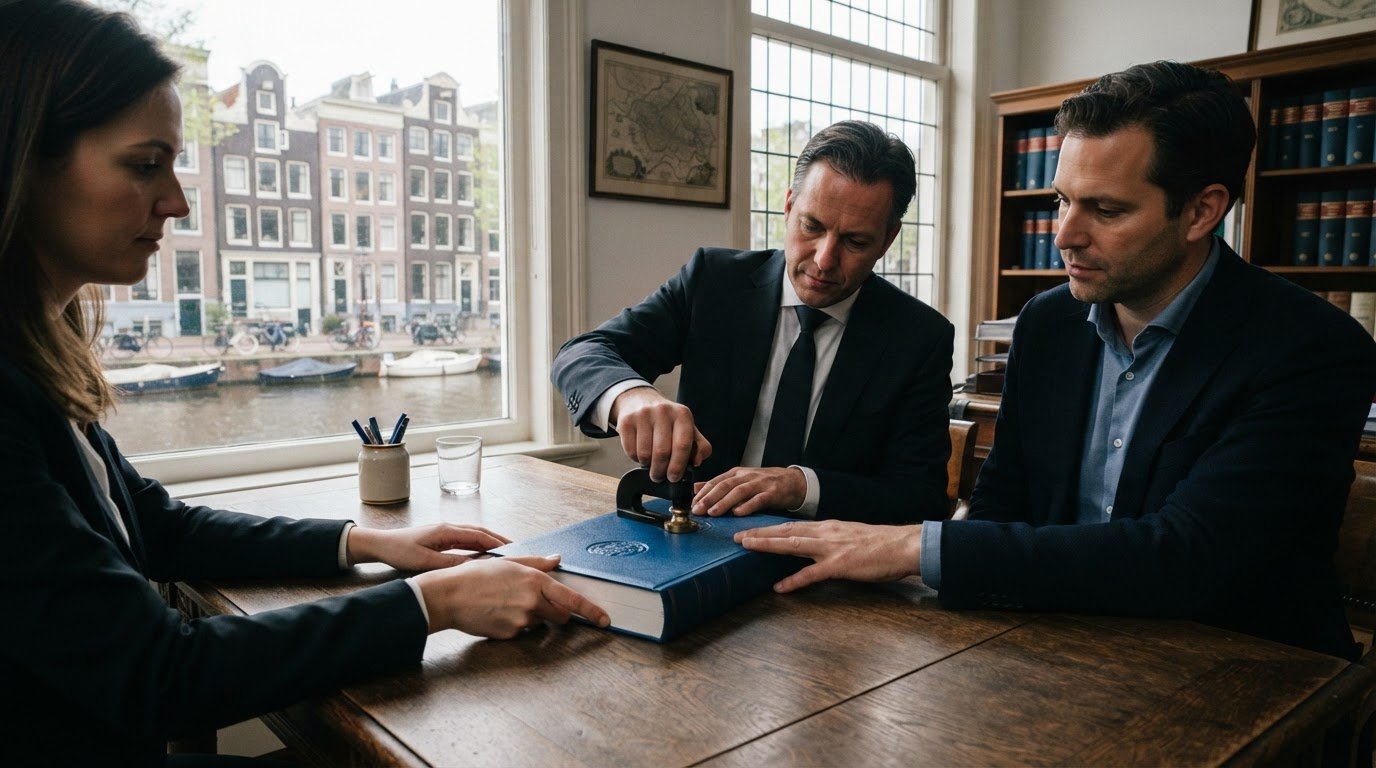
Starting a business in the Netherlands as a foreigner is possible without becoming a Dutch resident or taking on a Dutch partner. You can own a Dutch company fully and manage it from abroad. For a private limited company (BV), formation involves a notarial deed and registration with the Dutch Chamber of Commerce (KVK); the right route depends on whether you plan to operate from abroad or live and work in the Netherlands.
Starting a business in the Netherlands as a foreigner involves more than choosing a legal structure. Your business activities and personal circumstances can affect permits, documents and the remote registration process. This guide covers the main steps, key considerations for non-EU founders planning to live in the Netherlands, and the documents commonly required to establish a Dutch business. It also explains how professional support can coordinate BV formation, registration, VAT applications and ongoing compliance.
Key Takeaways
- You can own and manage a Dutch company from abroad without becoming a Dutch resident or finding a local partner.
- Separate company formation from immigration planning: non-EU and non-EEA founders who intend to live and work in the Netherlands may need a residence permit.
- Prepare the identification and company documents needed for registration, including details for the Dutch business address.
- For a remote BV formation, the notary can execute the deed through a legalized Power of Attorney route, so you don’t need to travel for that step.
- Treat opening a Dutch business bank account as a separate process; non-resident applications depend on the bank and the company profile.
Table of Contents
- How a Professional Provider Can Help Start a Business in the Netherlands as a Foreigner
- Can you register a business in the Netherlands from abroad?
- Residence permits for non-EU and non-EEA entrepreneurs
- Documents required for foreign founders
- Foreign ownership and remote company formation
- Intercompany Solutions
How a Professional Provider Can Help Start a Business in the Netherlands as a Foreigner
Plan your business structure, any required permissions and administration before registering in the Netherlands. Your activities and plans to live or work in the country determine which requirements apply.
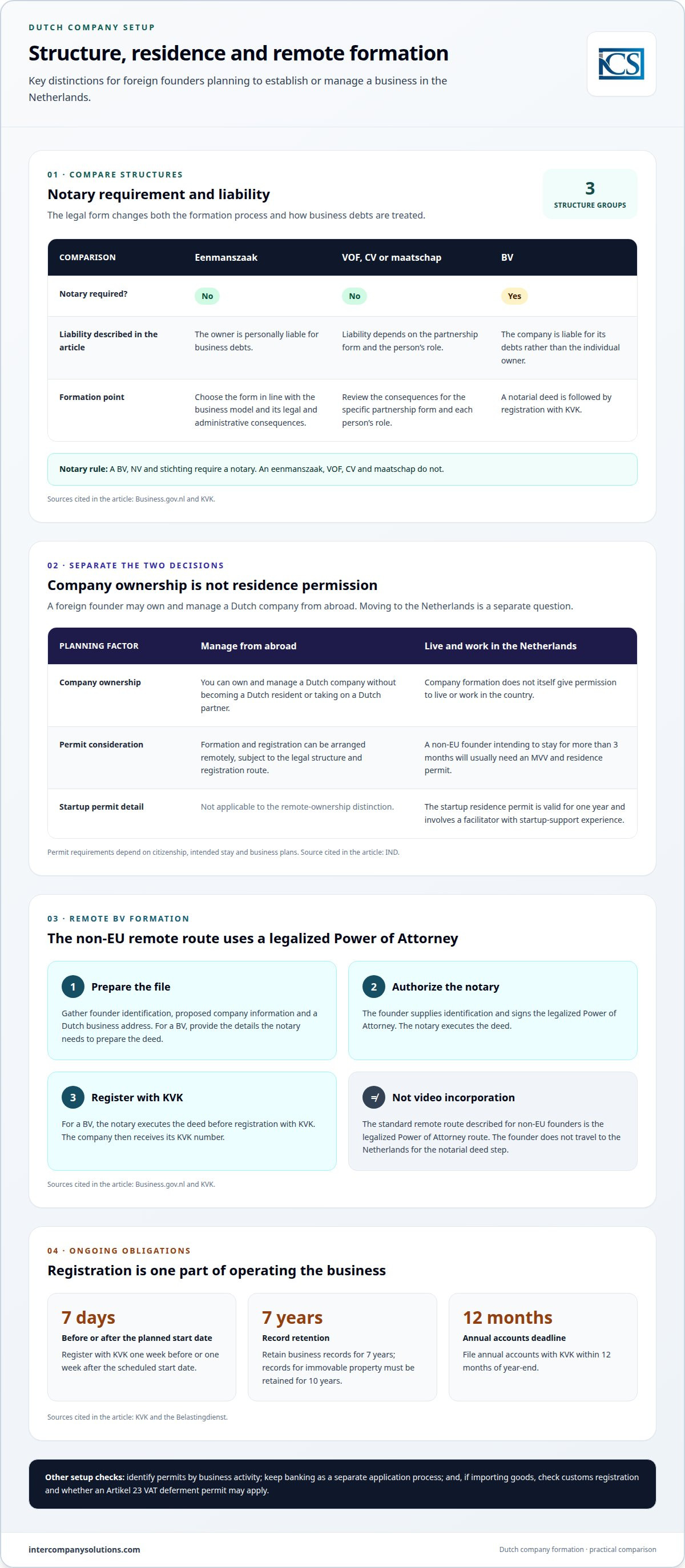
- Choose a structure based on ownership and liability. Use the comparison below to identify the main differences, then align the choice with your business model. According to Business.gov.nl, a BV, NV, and stichting require a notary, while an eenmanszaak, VOF, CV, and maatschap do not.
Structure Notary Liability distinction Eenmanszaak No The owner is personally liable for business debts. VOF, CV, or maatschap No Liability depends on the partnership form and the person’s role. BV Yes The company is liable for its debts rather than the individual owner. According to the KVK, compare each form’s legal and administrative consequences before deciding.
- Separate residence plans from company ownership. A non-EU founder intending to stay in the Netherlands for more than 3 months will usually need an MVV and residence permit. The IND states that the startup residence permit is valid for one year and involves a facilitator with startup-support experience. Company formation does not itself grant permission to live or work in the country.
- Identify permits and insurance by activity. Licences may apply depending on the business sector and activities, according to Business.gov.nl. People who are subject to the Dutch statutory health-insurance system are legally required to have health insurance; the Dutch government explains the standard health insurance system. Distinguish personal health coverage from insurance for business risks.
- Handle banking separately from registration. A non-resident may be able to open a Dutch business bank account without visiting the Netherlands, depending on the bank and company profile. The Business.gov.nl guidance on business bank accounts explains the account-opening process. Bank acceptance is a separate decision from the company’s registration.
- Set up recordkeeping and annual reporting. Dutch businesses must retain records for 7 years (10 for immovable property), according to the Belastingdienst. Businesses must file annual accounts with KVK within 12 months of year-end. The KVK filing guidance covers annual accounts. If the company employs staff, include payroll administration in its ongoing processes.
Can you register a business in the Netherlands from abroad?
Yes. Foreign founders can arrange Dutch company registration remotely, with the process depending on the legal structure and registration route.
Prepare the required documents and coordinate the notarial steps and relevant registrations before the company begins operating.
-
Prepare Registration Documents
Gather the founders’ identification details, proposed company information, and Dutch business address for the registration file. A Dutch business must have a business address in the Netherlands, and a P.O. box is not sufficient, according to Business.gov.nl’s registration guidance. For a BV, provide the information the notary needs to prepare the deed of incorporation. Keep names and company details consistent across documents to reduce corrections.
-
Register with the Chamber of Commerce
Coordinate filing with the Netherlands Chamber of Commerce (KVK) around the planned start date. Businesses must register one week before or one week after their scheduled start date, as stated by the KVK registration guidance. For a BV, the notary executes the deed before registration with KVK; the company then receives its KVK number.
- Arrange remote BV formation. For a non-EU founder, the standard remote route uses a legalized Power of Attorney. The notary executes the deed, so the founder does not travel to the Netherlands for that step. The founder supplies identification and signs the legalized authorization. This formation process is distinct from digital video incorporation; the Business.gov.nl BV guidance outlines the notarial role in establishing this structure.
- Plan customs registrations before importing. Businesses involved in EU trade usually need an EORI number before customs clearance can begin. The Dutch Tax and Customs Administration’s EORI guidance explains the identifier used for customs matters. If the company imports goods, check eligibility for Artikel 23 VAT deferment, which can defer VAT on imported goods under a permit from the Dutch Tax and Customs Administration.
Registration planning should also reflect the company’s actual operations. A business in a Dutch border region may use a private foreign address if it can prove structural and physical business activities in the Netherlands. This exception does not make a P.O. box sufficient, and it applies to that specific border-region situation.
For a coordinated route from documents to KVK registration, discuss your registration arrangements with the team.
Residence permits for non-EU and non-EEA entrepreneurs
Separate the right to own a Dutch company from permission to live or work in the Netherlands. The permit route depends on your citizenship, intended stay, and business plans.
-
Identify Residence and Work Permissions
Decide whether you will manage the company from abroad or move to the Netherlands. Foreign entrepreneurs do not need Dutch residency simply to own a Dutch company. A non-EU citizen planning to stay for more than 3 months will usually need an MVV and a residence permit, according to the IND’s MVV guidance. Keep company registration and immigration applications distinct, because company ownership alone does not grant permission to live or work in the country.
-
Explore Startup Residence Permits
Assess the startup residence permit if you are an eligible entrepreneur from outside the EU and EFTA. The permit is valid for one year, and applicants must work with a facilitator experienced in supporting startups, according to the IND’s startup permit guidance. A founder applying for an MVV to live in the Netherlands and operate a business must have a potential enterprise that promotes a significant Dutch interest. Plan the facilitator relationship as part of the application, not as a substitute for the permit.
- Arrange the application from the right location. A non-EU citizen applying for an MVV and residence permit must make an appointment at a Dutch embassy or consulate in their country of origin or country of continuous residence, according to the IND’s application guidance. Use the same intended activity and business plan consistently across the immigration process. A founder staying abroad to own a Dutch company has a different situation from an entrepreneur relocating to run it.
- Check work permission separately. Non-EU and non-EEA citizens need residence permits to work as employees in the Netherlands, as explained by the IND’s work-permit guidance. Do not treat permission to own shares as permission to perform work in the country. If you will both direct the business and reside in the Netherlands, identify the applicable residence and work route before setting a relocation date. Your role in the company and intended stay are relevant distinctions.
- Match the permit route to your plans. A founder who remains abroad can own and manage a Dutch company without relocating. If you plan to move to the Netherlands to operate the business, you must address residence permission separately. The startup visa route applies to eligible startups working with an experienced facilitator. Set out your business activities, your role and whether you intend to live in the Netherlands. This helps distinguish company formation from immigration requirements.
Documents required for foreign founders
Organize identity, company, and address records before finalizing the registration file. The required documents depend on the company structure and the founder’s circumstances.
A Dutch business needs a Dutch business address, but a bank account may be opened remotely depending on the bank and company profile. A foreign founder may serve as the BV’s director and control it from abroad.
- Prepare current personal and civil-status documents. Collect the founder’s identification details and any civil-status extract needed for Dutch Business Register registration. That extract is valid for 1 month, so its timing matters. If several founders are involved, organize each person’s information in the same format. This helps keep names and personal details consistent across the company file.
- Document the company’s Dutch business address. A Dutch business address is required, and a P.O. box is not sufficient. The address should correspond to the company’s actual business arrangements. A person living in a Dutch border region may use a private foreign address if they can prove structural and physical business activities in the Netherlands. This exception depends on the founder’s location and activities.
- Set out the company and director details clearly. Prepare the proposed company name, ownership details and identity documents for the people involved in formation. A foreign entrepreneur can fully own a Dutch BV and serve as its director while managing the company from abroad. A Dutch founder or local director is not required.
- Treat bank account documents as a separate file. A non-resident may be able to open a Dutch business bank account without visiting the Netherlands. The decision depends on the bank and the company profile, so prepare company and ownership information for the bank’s assessment. Do not confuse opening an account with KVK registration: they are separate processes, and remote account opening is not assured by company registration alone.
- Separate business records from personal residence requirements. If Dutch social-security rules make a person subject to the Dutch health-insurance scheme, they are generally required to take out Dutch basic health insurance. Whether this applies depends on the person’s residence and work circumstances. For a person staying in the Netherlands for more than 4 months, resident status and a citizen service number (BSN) become relevant. A founder operating from another country should distinguish those personal circumstances from the documents used to register the Dutch company.
Foreign ownership and remote company formation
A foreign founder can own and manage a Dutch company without becoming a Dutch resident or adding a local partner. Plan ownership, formation, and any sector-specific screening as separate parts of setting up.
- Decide whether ownership or relocation is your objective. Foreign entrepreneurs do not need Dutch residency to establish a business there, and can own 100% of a Dutch company without a Dutch partner or local shareholder. For example, a founder can remain in their home country while holding all company shares. This separates the decision to invest in a Dutch business from the decision to move there.
- Choose a remote formation route that matches the legal structure. For a BV, a notary must execute the deed of incorporation. A non-EU founder can use a legalized Power of Attorney route, allowing the notary to execute the deed without the founder travelling to the Netherlands. Digital video incorporation is not the default route for non-resident founders. The practical distinction is who signs and where the notarial act takes place.
- Map ownership and management before preparing the formation documents. Record who will own shares and who will act as director, particularly if the founders live in different countries. A foreign entrepreneur can own and manage a Dutch BV from abroad. This does not, by itself, grant permission to live or work in the Netherlands.
- Assess sector screening before committing to a transaction. The Netherlands screens investments in vital providers, sensitive technology, and certain other sectors under the Vifo Act, in force since 1 June 2023. A foreign investment involving one of these activities may require a different review from an ordinary business setup. Identify whether the planned company operates in a potentially screened sector before finalizing ownership or expansion plans.
- Consider whether an existing EU or EEA company should convert. Companies from other EU and EEA states can convert into a Dutch BV or NV through cross-border conversion under rules in force since 1 September 2023. This can be relevant when an existing business wants a Dutch legal form rather than establishing a separate company. Compare that route with new formation based on the entity’s current structure and intended operations.
- Plan employee arrangements separately from share ownership. Owning a company from abroad is different from working as an employee in the Netherlands. Non-EU and non-EEA citizens need a residence permit to work in the Netherlands as employees. If the company plans to hire staff, consider the founder’s ownership role separately from employees’ work and residence requirements.
Intercompany Solutions
Intercompany Solutions supports foreign founders with Dutch BV formation and related company administration. This covers the steps required to establish a Dutch entity and manage its administration. Remote formation takes three to five business days after the required documents are received.
The appropriate starting point depends on your legal structure, planned activities and staffing needs. Consider these factors when assessing the requirements for setting up and running a Dutch business.
Set Your Dutch Business Plans in Motion
Start by defining how the company will operate: who will make decisions, how it will serve customers and which responsibilities need ongoing attention. These choices help shape a practical structure, whether you remain abroad or plan to live in the Netherlands.
For founders starting a business in the Netherlands as a foreigner, professional support can connect formation with ongoing administration. Intercompany Solutions provides support to coordinate company formation and recurring compliance through one provider. Consider this approach if you want these matters handled together.
Set out your intended activities, ownership arrangements and support needs before moving forward. Use the contact link below to discuss your plans.
With a clear plan, you can move ahead with your Dutch business formation and consider what administrative support is appropriate.
Frequently Asked Questions
Common Dutch business forms include the sole proprietorship, VOF, CV, maatschap, BV, NV, stichting and association. A sole proprietorship and partnerships such as a VOF, CV or maatschap do not require a notary. A BV, NV and stichting do. An association can be used to organize social activities rather than focus on profit. Before choosing, decide whether your business needs a legal entity separate from its owners.
Yes, foreign founders can arrange Dutch company formation remotely. For a non-EU founder forming a BV, the usual remote route uses a legalized Power of Attorney, allowing the notary to execute the deed without the founder travelling. Remote formation does not remove the need to provide company and identity documents or arrange a suitable Dutch business address. Banking is a separate process, decided by the bank.
Assess your company’s activities, ownership, and ongoing compliance before it starts trading. Sector-specific permits may apply, and VAT obligations depend on the company’s transactions. For a BV or another entity with legal personality, identify its ultimate beneficial owners: the UBO threshold is >25%, and UBO changes reported within 7 days. Plan who will maintain company records and monitor changes in ownership or management.
Choose a structure based on ownership, liability and how you expect to operate. A sole proprietorship may suit an individual owner, while a VOF or maatschap can suit people working together. A BV has legal personality, and the company is liable for its debts rather than the individual owner. A BV requires a notarial deed; the other structures named here do not.
Yes, a foreigner can own a Dutch company without becoming a Dutch resident. Ownership alone does not establish permission to live or work in the Netherlands. A non-EU citizen intending to stay for more than 3 months will usually need an MVV and residence permit. Non-EU and non-EEA citizens also need residence permits to work as employees in the Netherlands.
Eligible entrepreneurs from outside the EU and EFTA may apply for a Dutch startup residence permit, valid for one year. Applicants must work with a facilitator experienced in supporting startups. A founder applying for an MVV to live in the Netherlands and operate a business must have a potential enterprise that promotes a significant Dutch interest. These routes concern permission to live in the Netherlands, not company ownership alone.
A professional provider coordinates the required formation steps and KVK registration, working with a notary when the chosen structure requires one. For a BV, the notary executes the deed before the company is registered. The registration file can require identification, proof of address, the proposed company name, business activity details, and a Dutch business address. Registration is scheduled around the planned start date.
A sole proprietorship suits an individual owner; a partnership such as a VOF can suit founders operating together. These structures do not require a notary. A BV requires a notarial deed and separates the company’s debts from the owner’s personal liability. Foreign founders can own a Dutch company without a Dutch partner. Consider who will own and operate the business and whether limited liability is important to you.
Sources
- KVK - Registering with the Dutch Business Register
- Business.gov.nl - Private limited company (bv)
- Burgerlijk Wetboek Boek 2 (Dutch Civil Code, legal entities)
- Rijksoverheid - Ondernemen
- ICS Payroll - Dutch payroll services
- Belastingdienst - Payroll taxes (loonheffingen)
- UWV - Employer obligations
- SVB - Social insurance in the Netherlands
- Belastingdienst - VAT (btw) for entrepreneurs
- European Commission - VAT rules and rates
- IND - Highly skilled migrant
- IND - Start-up residence permit
- De Nederlandsche Bank - Supervision
- AFM - Licences and registers
- RVO - Doing business internationally
- Belastingdienst Douane - Customs
- CJEU, Cadbury Schweppes, C-196/04 (ECLI:EU:C:2006:544)
- Hoge Raad, ECLI:NL:HR:2021:1152
- PwC Worldwide Tax Summaries - Netherlands
- ICLG - Corporate Governance Laws and Regulations, Netherlands
Need more information on the Dutch BV company?
Contact an expertReady to start your company in the Netherlands?
| Formation time | Dutch BV formation completed in 3 to 5 business days |
|---|---|
| Process | Fully remote setup with step-by-step guidance |
| Compliance | Expert support for registration, VAT and compliance |
| Aftercare | Accounting, tax and legal support included |
| One partner | All of the above through one trusted formation partner |