


November 23, 2026 · 17 min read
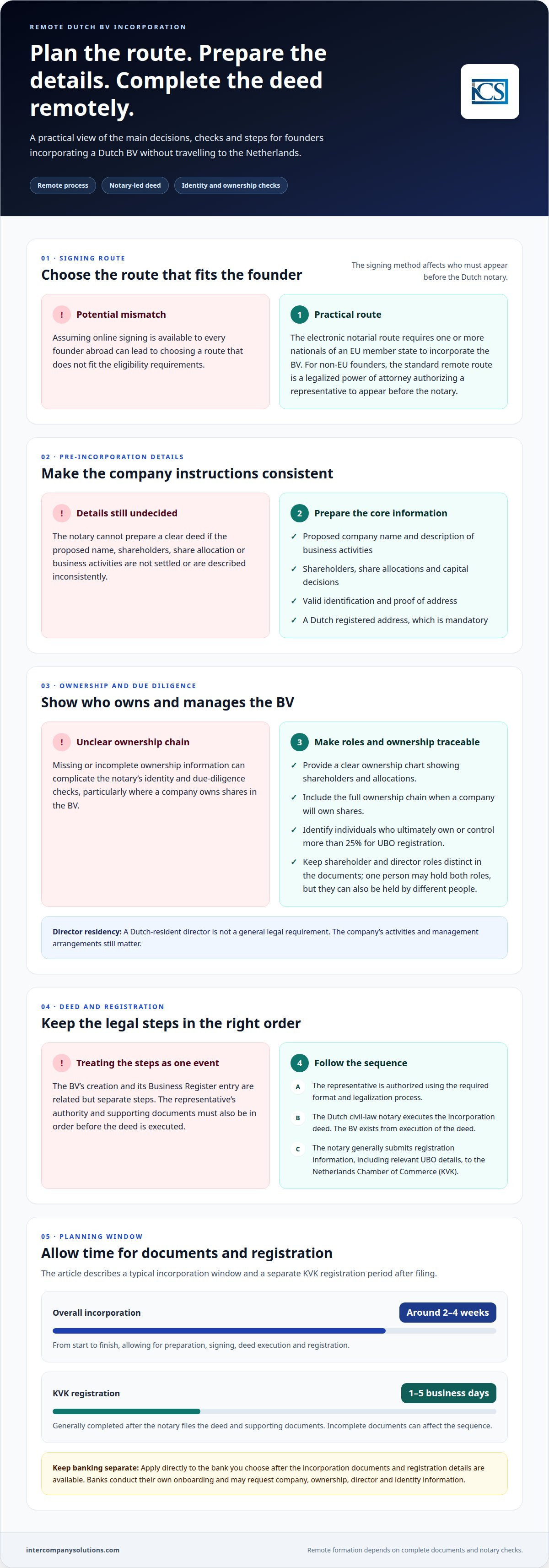
You can register a Dutch BV remotely without travelling to the Netherlands. For non-EU founders, the standard route is to authorize a representative through a legalized power of attorney, allowing a Dutch civil-law notary to execute the incorporation deed. Online signing is not the default for non-resident founders, and the process still involves identity and due-diligence checks.
Before incorporation, decide who will own and manage the BV and what the business will do. You will need to provide a valid ID, proof of address, a proposed company name, and a description of the business activities. Intercompany Solutions coordinates the notary and registration process remotely, so you can complete incorporation without travelling. A Dutch registered address is mandatory.
Key Takeaways
- Non-EU founders can usually complete incorporation without travelling by authorizing a representative through a legalized power of attorney.
- Decide on the BV’s name, shareholders, share allocation and capital before the notary prepares the incorporation deed.
- A Dutch-resident director is not a general legal requirement, but the company’s activities and management arrangements still matter.
- Prepare clear identity and ownership information for the notary’s due-diligence checks, including details of the ultimate beneficial owners.
- Electronic incorporation has specific eligibility and signing requirements, so it should not be assumed to be the route for every non-resident founder.
Table of Contents
- Can a Professional Set Up a Dutch BV Remotely?
- Selecting a BV Name, Ownership Structure and Share Capital with a Formation Professional
- Director residency and company substance
- Dutch notary identity checks and anti-money-laundering due diligence
- Electronic deeds, videoconferencing and language requirements
- Intercompany Solutions: Dutch BV Company Formation
Can a Professional Set Up a Dutch BV Remotely?
Yes. A Dutch BV can be incorporated without the founder travelling when a representative acts under a properly executed power of attorney. The Dutch government’s business information service explains that a BV is established by a civil-law notarial deed.
For non-EU founders, the standard remote route is a legalized power of attorney. Electronic incorporation has narrower eligibility and should not be assumed to suit every founder abroad.
-
Check Eligibility for Electronic Notarization
Choose the signing route before documents are prepared. Under the electronic notarial route, one or more EU member state nationals must incorporate the BV. The eligibility rule appears in Article 2:175a(1) of the Dutch Civil Code. Non-EU founders should generally plan for a legalized power of attorney authorizing a representative to appear before the Dutch notary.
A remote worker should also assess whether a BV suits the business, separately from the signing method. Incorporation can take place remotely, but it does not determine whether the structure suits the worker’s income, activities, or tax position. A professional can consider those details as part of the formation process.
-
Have a Dutch Civil-Law Notary Complete the Incorporation
Authorize the representative using the format and legalization process required for the documents. The Dutch civil-law notary prepares and executes the deed of incorporation, which establishes the BV. The representative’s authority must cover the incorporation actions, and the founder should provide accurate identity and company details for the notary’s checks.
After execution, the notary generally submits registration information to the Netherlands Chamber of Commerce (KVK), including relevant UBO details. The KVK explains the Business Register process, so founders do not normally need to attend KVK in person. The BV exists from execution of its deed; registration is a separate step.
-
Review Setup Costs and Timeline
Separate the statutory registration fee from notary and document-related costs. Notary and other setup costs depend on the deed, ownership arrangements, and documents requiring legalization or translation; request a case-specific breakdown before proceeding.
Allow time for document preparation, signing, deed execution, and registration. A typical Dutch BV incorporation takes around 2-4 weeks from start to finish. The KVK registration process is generally completed within 1-5 business days after the notary files the deed and supporting documents. Incomplete documents can affect the sequence.
- Arrange a bank account separately after incorporation. Intercompany Solutions does not provide bank-account opening assistance. Once the BV’s incorporation documents and registration details are available, apply directly to the bank you choose. Banks conduct their own onboarding and may ask for company, ownership, director, and identity information, so keep these details consistent with the formation documents.
With the stages planned separately, you can arrange remote incorporation while accounting for the notary’s formal role, registration, and bank onboarding.
Selecting a BV Name, Ownership Structure and Share Capital with a Formation Professional
Decide who will own the BV and how its shares will be held before the notary prepares the deed. These decisions define the company’s ownership and structure.
- Prepare a distinctive name for review. Give the formation professional your preferred name and an alternative. The Netherlands Chamber of Commerce (KVK) offers a business name search for an initial check. Consider how the name will represent the company’s activities and appear in its business records. Use the proposed name consistently in formation instructions and registration documents.
A company name does not define its activities or ownership. Make those decisions separately so the incorporation documents reflect the intended business structure.
- Set out each shareholder’s role and shareholding. A Dutch BV can have one or more shareholders, including foreign individuals or companies. The Dutch Civil Code provisions on BVs govern the company’s legal structure and shares. Provide a clear ownership chart showing direct shareholders and their allocations. The UBO threshold applies to individuals who ultimately own or control more than 25% of the company and identifies them for ultimate beneficial owner registration.
If a company will own shares in the BV, include the full ownership chain so the notary can identify the people who ultimately own or control it. Keep ownership and management distinct in the documents: a shareholder can also be a director, but the roles can be held by different people.
- Choose between one BV and a holding structure. Consider how each option fits the company’s planned activities and ownership:
Structure Typical arrangement Point to consider Single BV One company conducts the business and holds its operating assets. A simpler structure may suit a business operating through one entity. Holding structure A holding BV owns shares in an operating BV. Consider separate ownership and operations, retained profits, investments, and a possible sale. A holding BV may qualify for the participation exemption on dividends from its operating BV, subject to conditions. Corporate income tax applies to taxable profits. CIT 19% up to €200,000 and 25.8% above, according to the Belastingdienst corporate tax rates. A holding structure does not automatically reduce tax.
- Confirm share capital and contributions. A BV can be established with minimum capital of €0.01. Founders commonly choose nominal amounts such as €1, €10, €12, €100 or €120. Shares may be paid for in cash or contributed in kind. Tell the formation professional the intended contribution and allocation, so the notary can reflect them in the incorporation documents. Choose capital and share allocation together, rather than deciding either in isolation.
Director residency and company substance
Set out who will manage the BV and describe its planned business activities. Keep these details consistent with the incorporation documents and the company’s administration after formation.
- Appoint at least one director. A Dutch BV must have at least one director, and the Dutch government’s BV guidance explains that a Dutch-resident director is not generally required. A non-resident founder can therefore serve as director, subject to any separate immigration or work rules that apply to that person. The director’s identity and appointment details must match the information prepared for incorporation and registration.
Distinguish the director’s management role from the shareholder’s ownership role. One person can hold both roles, or the BV can have different people in each. For example, a foreign shareholder may own the company while another person manages its daily operations. State each person’s role clearly in the incorporation documents.
- Describe how the BV will operate. Explain the planned activities, who will make business decisions, and how the company will handle its administration. A consulting BV, for example, may document client contracts, invoices, and management decisions as part of its regular records. Keep these arrangements consistent with the activities described during incorporation.
A director’s address alone does not establish a company’s substance. The BV’s actual management, contracts, records, and business activities provide a clearer picture of how it operates. Describe its Dutch presence accurately, and do not claim that an office or local activity exists unless it reflects the company’s real arrangements. A director can live abroad.
- Arrange the Dutch registration address and correspondence process. The KVK’s registration guidance states that a BV needs a registered office in the Netherlands for entry in the Handelsregister. Decide who will receive and handle official correspondence at the registered postal address. The KVK sends the company’s number by letter to that address after Business Register registration.
The KVK number identifies the company in its subsequent business administration. Provide an accurate registered address where correspondence can reach the BV, and keep address and director details consistent across the incorporation documents and registration information.
- Plan ongoing company administration before setting up the BV. Decide who will maintain company records, document important decisions, and monitor the company’s obligations. A director living abroad should have a clear way to receive notices and access company documents. Shareholders should also know how decisions are recorded and where corporate records are kept.
Clear company records help distinguish the BV’s income and activities from the director’s private affairs. For example, record which contracts belong to the BV and which decisions the director made on its behalf. This supports accurate administration without treating a Dutch-resident director as a requirement.
Dutch notary identity checks and anti-money-laundering due diligence
To register a Dutch BV, provide a valid ID, proof of address, a proposed company name, a description of business activities, and details about its shareholders, directors, and ownership. For remote incorporation, the notary reviews the information before executing the deed and may request more details if anything is unclear.
- Prepare consistent identity and company information. Gather each founder’s identity details and the proposed BV’s ownership and management information. Include shareholders’ and directors’ names and roles, the planned business activities, and the ownership chain if another entity will hold shares. This gives the notary a clear picture of the people involved and the company’s structure.
Use the same spelling and personal details on identification documents, incorporation instructions, and any power of attorney. If a name appears differently across records, explain the difference during the formation process rather than leaving it unresolved. Clear, consistent records help the notary review the documents.
- Explain the ownership chain and who is providing instructions. Identify the people who ultimately own or control the BV, including where a company sits between them and the Dutch entity. If a foreign company will be the shareholder, provide its legal name and explain who owns or controls it. The notary needs a clear picture of the company and its participants.
If a representative will act under a power of attorney, include the document authorizing them to do so. The notary needs to verify the representative’s authority as well as the identities of the people involved. Keep the ownership information and formation instructions consistent.
- Respond to the notary’s due-diligence requests. A Dutch civil-law notary verifies identities and reviews information about the proposed company and transaction. Answer questions about the BV’s purpose, ownership, and planned activities directly. If the business model changes during preparation, update the information so the deed reflects the intended company.
The notary’s checks concern identity, ownership, control, and the transaction. They do not determine how future profits will be treated for corporate income tax or whether a particular exemption applies. Provide an accurate description of the BV’s purpose as part of the incorporation process.
- Review the deed and articles before execution. The notary prepares the deed of incorporation, including the BV’s articles of association. Check that the company name, registered details, share structure, and appointment information match the details you provided. Raise any corrections before execution, as the deed establishes the company and sets out its governance arrangements.
Electronic incorporation uses a high-assurance electronic identification method under the eIDAS Regulation. Do not assume an ordinary video call replaces the notary’s identity procedure. Providing the required documents and consistent information helps the notary review the details and prepare the deed.
Electronic deeds, videoconferencing and language requirements
A Dutch BV must have a registered Dutch address to be entered in the Handelsregister. A Dutch-resident director is not required.
After incorporation, the BV must handle tax returns, bookkeeping, UBO updates, and annual accounts. Its tax treatment depends on its activities, taxable profit, and ownership structure.
- Choose the signing route that fits the founders. Electronic notarial incorporation has been available since 1 January 2024, but it is not the default route for non-resident founders. The electronic route is available when one or more EU member state nationals incorporate the BV. Non-EU founders typically use a legalized power of attorney, allowing the Dutch notary to execute the deed without their travel.
For electronic incorporation, the deed may be executed in English. For a standard incorporation, the deed is executed in Dutch. A video call alone does not replace the required identity procedure; electronic identification uses a high-assurance method under the eIDAS Regulation.
- Confirm the Dutch address and UBO details. The BV needs a registered office in the Netherlands for Handelsregister registration. Identify each ultimate beneficial owner using the UBO threshold >25%. If ownership or control changes after registration, the BV must report the UBO changes within 7 days.
Keep the registered address, shareholder details, and articles consistent across the notarial deed and registration information. A founder can live abroad and serve as a director, but the BV still needs a registered Dutch address. The Belastingdienst and other authorities use company details for their respective records.
- Set up tax and accounting administration after registration. The CIT rate is 19% up to €200,000 and 25.8% above. The VAT rates are 21%/9%/0%. The applicable VAT treatment depends on the BV’s goods or services and transaction. Arrange bookkeeping that records income, expenses, invoices, and supporting documents, and retain business records 7 years (10 for immovable property).
File annual accounts with KVK within 12 months of year-end. The BV must also meet its tax filing obligations with the Belastingdienst. If it employs staff, payroll administration becomes relevant; international transactions may also require separate tax analysis.
- Assess transfer-pricing documentation where the BV belongs to a group. Dutch Master File and Local File requirements apply to multinational group entities with at least EUR 50,000,000 in consolidated group revenue in the preceding reporting year. These documents concern transactions between related entities, not every BV with foreign shareholders. Keep intercompany arrangements and supporting records aligned with the group’s actual transactions.
Intercompany Solutions: Dutch BV Company Formation
Intercompany Solutions supports foreign entrepreneurs who want to establish a Dutch BV without travelling to the Netherlands. Its Dutch BV Company Formation service covers the formation process, including registration, VAT applications, and compliance support. The process can suit founders who need help coordinating company details, ownership information, notary requirements, and registration documents. The company states that remote Dutch BV formation can be completed within 3-5 business days, depending on the case and required documents. After incorporation, ongoing administration and tax obligations become part of operating the BV, so plan for those responsibilities alongside formation.
If you are preparing to form a Dutch BV remotely, contact Intercompany Solutions to discuss your formation requirements.
Prepare for the BV’s First Operating Phase
Incorporation begins the company’s operating life. Before proceeding, decide what the BV needs to do after formation: start trading, manage its first contracts, organize bookkeeping, or prepare to hire. A clear order of priorities connects formation decisions with the practical launch.
If you are ready to register a Dutch BV remotely, gather the required documents and decide who will own and manage the company. Then plan how bookkeeping, tax filings, and company records will be handled once the BV is active. Assigning responsibility for these tasks early can make the transition from incorporation to operations more structured.
For ongoing company administration, Intercompany Solutions offers Accounting & Tax Services. This service may be relevant as the company moves into its operating phase.
A considered start gives you a practical basis for developing the BV’s next steps.
Frequently Asked Questions
No. A non-EU founder can stay abroad while Intercompany Solutions coordinates remote incorporation. You provide the required documents and follow the notary’s signing and identity procedures. Incorporation does not include opening a bank account; arrange that directly with your chosen bank, which may have separate onboarding requirements.
Yes. Intercompany Solutions coordinates the incorporation documents, notary process, and KVK registration remotely, so the founder does not need to travel. Opening a BV means establishing the legal entity, not opening a bank account. Provide accurate identity, ownership, and business information, and arrange banking directly with your chosen bank.
Yes. A non-resident individual or foreign company can own 100% of a Dutch BV. Ownership and management are separate roles: a shareholder may also be a director, or the BV may appoint someone else. Where a company owns the shares, the ownership information should identify the individuals who ultimately own or control the structure for UBO registration.
Yes, incorporation can proceed without the founder travelling when the appropriate remote signing route is used. For non-EU founders, this generally involves a legalized power of attorney and a representative before the notary. “Entirely remotely” does not mean every document can be signed online or that a bank account is opened automatically. The notary’s identity and document requirements still apply.
BV minimum capital €0.01, according to KVK. This is the legal minimum, not a recommendation about how much working capital the business needs. The deed records the share capital and the shares issued to each shareholder. For an electronic incorporation deed, only cash may be agreed as consideration for shares, so the contribution method should fit the chosen signing route.
After executing the deed, the notary generally submits the BV’s incorporation and registration details to KVK. KVK sends the company number to the registered postal address and shares company details with the Belastingdienst. The BV receives an RSIN automatically. The Belastingdienst determines whether VAT registration applies and issues VAT numbers when required; Intercompany Solutions includes a VAT number application in its incorporation service.
Prepare a valid ID, proof of address, the proposed company name, a description of the business activities, and ownership information. For a power of attorney, arrange any legalisation required for that document. Apostilles and translations are not universal requirements; the notary’s requirements depend on the document and the country that issued it.
Sources
- KVK - Registering with the Dutch Business Register
- Business.gov.nl - Private limited company (bv)
- Burgerlijk Wetboek Boek 2 (Dutch Civil Code, legal entities)
- Government.nl - Enterprise and innovation
- Belastingdienst - Corporate income tax rates
- ICS Payroll - Dutch payroll services
- Belastingdienst - Payroll taxes (loonheffingen)
- UWV - Employer obligations
- SVB - Social insurance in the Netherlands
- Belastingdienst - VAT (btw) for entrepreneurs
- European Commission - VAT rules and rates
- IND - Highly skilled migrant
- IND - Start-up residence permit
- De Nederlandsche Bank - Supervision
- AFM - Licences and registers
- CJEU, Cadbury Schweppes, C-196/04 (ECLI:EU:C:2006:544)
- Hoge Raad, ECLI:NL:HR:2021:1152
- PwC Worldwide Tax Summaries - Netherlands
- ICLG - Corporate Governance Laws and Regulations, Netherlands
Need more information on the Dutch BV company?
Contact an expertReady to start your company in the Netherlands?
| Formation time | Dutch BV formation completed in 3 to 5 business days |
|---|---|
| Process | Fully remote setup with step-by-step guidance |
| Compliance | Expert support for registration, VAT and compliance |
| Aftercare | Accounting, tax and legal support included |
| One partner | All of the above through one trusted formation partner |