


August 21, 2026 · 17 min read
Securing a corporate bank account often remains the most significant bottleneck in the Dutch company formation process. You likely expect that a physical visit to a traditional high-street bank is a mandatory requirement, only to face months of compliance delays and residency hurdles. Opening a bunq Business Account for a Dutch BV offers a digitized alternative that matches the efficiency of the 3 to 5 business day incorporation timeline. This approach bypasses the need for physical presence while providing the infrastructure necessary for modern financial management.
We provide a technical breakdown of the regulatory requirements, eligibility criteria, and procedural steps for integrating a bunq business account with your new legal entity. This article details the strict mandate that all directors and Ultimate Beneficial Owners (UBOs) must reside within the European Economic Area (EEA). You'll learn how to synchronize your account with Dutch accounting software and manage share capital remotely. By following these specific compliance protocols, you can ensure your corporate IBAN is operational within your first week of business.
Key Takeaways
- Understand the legal requirement for a dedicated corporate account to manage share capital and the mandatory €85.15 KVK registration fee for 2026.
- Verify the specific EEA residency mandates for all directors and UBOs when Opening a bunq Business Account for a Dutch BV.
- Learn how to facilitate remote company formation through the legalized Power of Attorney route to secure your official company excerpt.
- Identify the role of professional secretarial support in managing bank compliance inquiries for non-resident entities.
- Explore the technical integration between bunq sub-accounts and Dutch accounting software to automate VAT filings and financial reporting.
Table of Contents
Statutory Framework for Dutch Corporate Banking
Every Dutch private limited company operates as a separate legal person under the law. This legal personality requires the entity to maintain its own financial records and assets. A dedicated corporate bank account isn't just a tool for convenience; it's a statutory necessity for managing share capital and fulfilling tax obligations. Without a corporate IBAN, a BV cannot effectively interact with the Dutch tax authorities or demonstrate its financial independence from its shareholders.
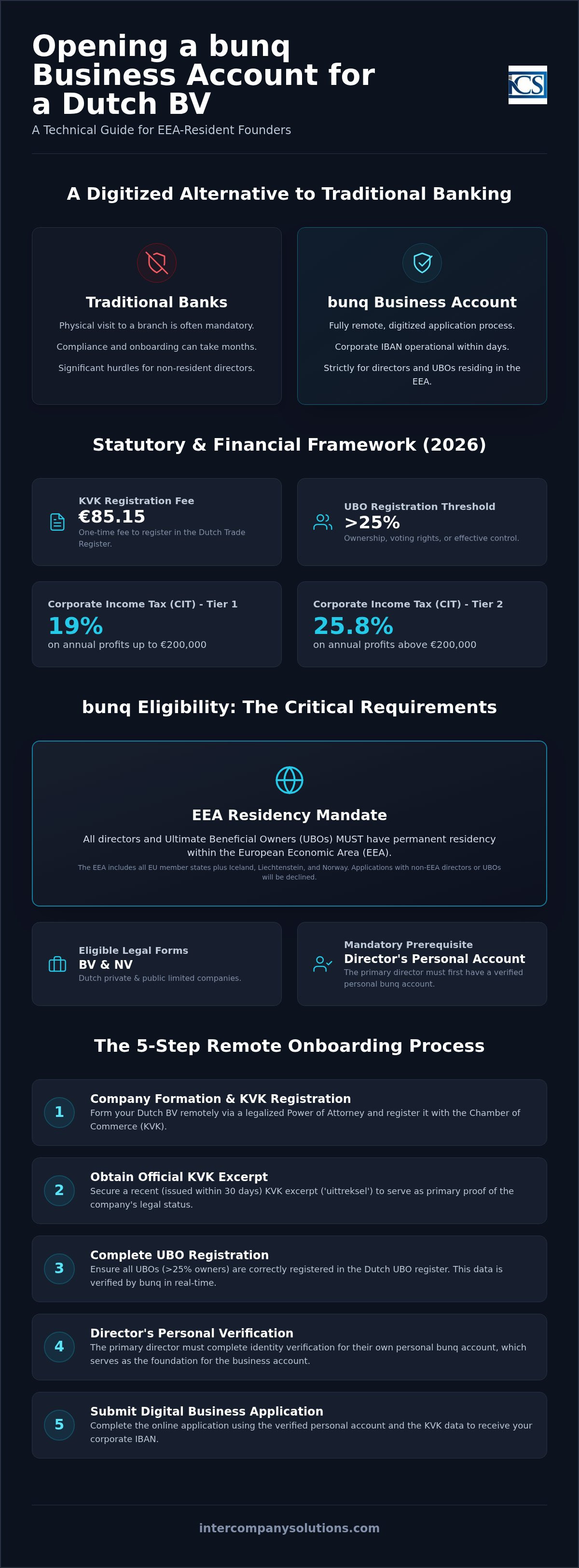
The process begins with the Kamer van Koophandel (KVK). You must register your business in the Trade Register before any banking institution will consider your application. This registration provides the legal foundation for Opening a bunq Business Account for a Dutch BV, as it establishes the company's official existence and its authorized representatives. The table below outlines the primary statutory parameters for 2026:
| Requirement | Statutory Detail (2026) |
|---|---|
| KVK Registration Fee | €85.15 (one-time) |
| CIT Rate (First €200,000) | 19% |
| CIT Rate (Above €200,000) | 25.8% |
| UBO Registration Threshold | >25% ownership or control |
The Role of the KVK Excerpt
The KVK 'uittreksel' or business register excerpt is the primary document used during the onboarding process. Banks require this document to verify that the company is currently active and that the individuals applying for the account have the legal authority to do so. In most cases, you'll need an excerpt that was issued within the last 30 days. This document informs the bank's Know Your Business (KYB) checks by detailing the company's registration number, its statutory seat, and its managing directors. If the data in the KVK registry doesn't match your application, the onboarding process will stall.
Corporate Tax and IBAN Requirements
A corporate IBAN is essential for meeting annual tax liabilities. All Corporate Income Tax (CIT) payments to the Belastingdienst must be traceable to the company's own account. Maintaining a separate business account ensures these payments are processed correctly and that the company's tax records remain transparent. Beyond tax compliance, a dedicated account protects the limited liability of the directors. If you mix personal and corporate funds, you risk losing the legal protection that the BV structure provides. A clear distinction between personal and company assets is required to ensure that creditors cannot easily access your personal wealth in the event of corporate insolvency.
Eligibility Criteria for bunq Business Accounts
bunq limits its business services to specific legal forms registered within the Dutch jurisdiction. The Besloten Vennootschap (BV) and Naamloze Vennootschap (NV) are the primary corporate structures eligible for onboarding. Before initiating the digital application, you must ensure the primary director has already established a verified personal bunq account. This personal verification serves as the foundational identity check for the business entity and is a mandatory prerequisite for Opening a bunq Business Account for a Dutch BV.
The EEA Residency Constraint
The most critical barrier for many international entrepreneurs is the residency requirement. All directors and Ultimate Beneficial Owners (UBOs) must reside permanently within the European Economic Area (EEA). This zone includes all EU member states along with Iceland, Liechtenstein, and Norway. If your company structure includes a director or a shareholder with more than 25% control living outside these borders, the application will likely be declined. Non-EU founders often address this by appointing a resident director or restructuring their board to meet these specific banking standards before applying.
Proof of residency is verified through official government-issued identification and, in some cases, proof of address such as a recent utility bill or rental agreement. Digital banks use automated systems to cross-reference these documents with international databases. It's essential that the residency status of all stakeholders is current and verifiable at the time of the application to avoid immediate rejection.
UBO Registration and Transparency
Transparency is a cornerstone of Dutch financial regulation. You're legally required to register all UBOs in the Dutch UBO register managed by the KVK. bunq verifies this data in real-time against Chamber of Commerce records. A UBO is defined as any individual who owns or controls more than 25% of the company's shares or voting rights. Any discrepancy between your application and the official registry will lead to a request for additional documentation, such as a legalized register of shareholders, or a flat denial of service.
The 2026 Risk Assessment Policy maintained by bunq also excludes certain high-risk industries from onboarding. Activities related to crypto-assets, adult entertainment, weapons manufacturing, or unregulated financial services are generally prohibited. Ensuring your company's SBI code (the Dutch business activity code) accurately reflects a permitted industry is essential for a smooth onboarding experience. If you're unsure if your specific business model qualifies under current regulations, you can consult with our compliance specialists to review your corporate structure. This proactive step is often the difference between a successful application and a lengthy compliance delay when Opening a bunq Business Account for a Dutch BV.
Step-by-Step Application for Foreign Founders
For international entrepreneurs, the preparation for a corporate bank account begins during the legal formation of the company. Remote founders typically utilize the legalized Power of Attorney (PoA) route to establish their entity without traveling to the Netherlands. This process involves signing a PoA in your country of residence, having it legalized by a local notary or via an apostille, and sending it to your Dutch representative. Once the deed of incorporation is signed by a Dutch civil-law notary, the entity is registered with the Kamer van Koophandel (KVK).
The synchronization of these steps is vital for a quick start. By following a structured Netherlands company formation in 3 days, you can obtain your KVK registration number and official company excerpt by the end of the first week. These documents are the primary requirements for Opening a bunq Business Account for a Dutch BV. Once the KVK registry is updated, the company's data becomes visible to bunq's automated KYB systems, allowing the digital application to proceed.
Required Documentation Checklist
The application is handled entirely through the bunq mobile interface. To ensure a smooth review by the compliance team, you must have high-resolution digital copies of the following documents ready for upload:
- A valid international passport or EEA identity card for every director and UBO. Driving licenses are generally not accepted for corporate onboarding.
- The final Articles of Association (Statuten) provided by the notary after incorporation.
- The official KVK excerpt (uittreksel) issued within the last 30 days.
- Proof of the company's registered business address, such as a rental agreement or a recent utility bill in the company's name.
Completing the Identity Verification
Identity verification for directors is performed via biometric scanning within the app. You'll be prompted to take a live photo and a short video to confirm your identity against your uploaded ID. A common pitfall for foreign founders is document legibility. Glare from a camera flash or low-light conditions can cause the automated system to reject the scan, leading to manual reviews and delays. Always use natural, indirect light and ensure all four corners of the document are visible in the frame.
In 2026, the expected response time for corporate compliance reviews ranges from one to five business days. If your corporate structure is straightforward and all UBOs are EEA residents, the approval is often at the faster end of this spectrum. However, if the compliance team requires clarification on your business activities or the source of your share capital, they will contact you via the in-app chat. Responding promptly to these inquiries is the most effective way to expedite Opening a bunq Business Account for a Dutch BV.
Managing Compliance for Non-Resident Entities
While Opening a bunq Business Account for a Dutch BV is a digital process, the bank's adherence to Dutch Anti-Money Laundering (AML) laws is absolute. Non-EU entrepreneurs often assume that a digital-first bank bypasses local residency requirements. However, the requirement for all directors and Ultimate Beneficial Owners (UBOs) to reside within the EEA remains a strict gatekeeper in 2026. This means if any individual with more than 25% ownership or control lives outside the European Economic Area, the application won't meet the bank's current risk appetite. Entrepreneurs must ensure their corporate structure is compliant with these residency mandates before initiating the process.
There's a common misconception that remote banking implies a lack of oversight. In reality, the Dutch financial system requires a "local nexus," meaning the company must have a legitimate reason to operate in the Netherlands. This is established through your registered business address and your KVK registration. While you don't need to be physically present for a branch meeting, your BV must maintain a transparent link to the Dutch economy to satisfy modern AML requirements. This includes adhering to the 7-year record retention period for all corporate and financial documents, as mandated by Dutch tax law.
The Role of Secretarial Support
Expert secretarial support serves as a proactive facilitator during the onboarding phase. Compliance officers frequently issue specific inquiries regarding the nature of international transactions or the source of initial share capital. Utilizing professional secretarial services ensures these queries are handled with the procedural accuracy expected by Dutch regulators. This support includes maintaining the KVK registry data to ensure it perfectly aligns with the information provided to the bank. Any administrative discrepancy between the Chamber of Commerce records and the bank application can lead to immediate rejection or account suspension. Professional support packages can often bridge the communication gap between the founder and the bank’s compliance department.
AML and KYC Protocols in 2026
AML and Know Your Customer (KYC) protocols have become increasingly automated through the use of real-time data feeds. bunq's systems perform continuous audits by cross-referencing your account activity with the Dutch Trade Register and international sanctions lists. Proactive disclosure of intended business activities is the most effective way to prevent automated account freezes. If your BV engages in high-value cross-border trade, providing the bank with supporting documentation before transactions occur demonstrates professional transparency. This approach satisfies the bank’s requirement for a local nexus and proves that the company’s operations are legitimate and manageable within the Dutch financial system.
Last reviewed: October 2026
Operational Integration: Accounting and Tax Synergy
Effective financial management requires more than just a place to store capital. Synchronizing your bank with accounting for Dutch BV software ensures that every transaction is categorized according to Dutch GAAP or IFRS standards. This automation replaces manual data entry with secure, direct API feeds. By linking your banking data to your bookkeeping platform, you create a real-time overview of your company's fiscal health, which is essential for making informed scaling decisions.
Modern Dutch banking allows for the segregation of funds through sub-accounts. Each sub-account comes with its own unique IBAN, allowing you to set aside funds for specific liabilities like Corporate Income Tax (CIT) or future investments. This structural organization prevents the accidental use of tax reserves for operational expenses. For entrepreneurs managing international trade, these sub-accounts can be held in multiple currencies. This feature enables you to receive payments in USD or GBP and hold them until exchange rates are favorable, effectively mitigating local currency risk without the need for complex hedging instruments.
Automated Bookkeeping Workflows
Real-time transaction data significantly reduces annual reporting costs by minimizing the hours your accountant spends on manual reconciliation. Linking corporate cards to employee expense management systems allows for instant VAT reclamation on business purchases. You must also adhere to strict statutory retention periods. Dutch law requires you to maintain all financial records for at least 7 years. However, if your BV deals with immovable property, this requirement extends to a 10-year retention period. Digital banking logs facilitate this compliance by providing a permanent, searchable audit trail of every euro that enters or leaves the entity.
VAT and EORI Integration
Integration extends directly to your tax filings with the Belastingdienst. Your corporate account is the primary tool for paying quarterly VAT (BTW) returns, which are generally calculated at the 21% standard rate or the 9% reduced rate. Automated feeds can calculate these liabilities as transactions occur, ensuring you're never surprised by a tax bill at the end of the quarter. For BVs involved in the import or export of goods, your bank account details are a prerequisite for EORI number applications. This identification number is mandatory for all customs interactions within the European Union.
If you're managing complex cross-border transactions, you can consult with ICS consultants to optimize your financial workflows. Ensuring that your banking setup, VAT registration, and EORI applications are synchronized is vital for maintaining operational continuity. This holistic approach transforms a simple banking tool into a comprehensive financial management system that supports long-term compliance and growth.
Streamlining Your Dutch Corporate Operations
Establishing a legal presence in the Netherlands requires a precise alignment between your corporate structure and banking requirements. Opening a bunq Business Account for a Dutch BV is most efficient when you've already secured your KVK registration and ensured that all directors meet the EEA residency mandates. By integrating your banking with automated accounting workflows, you satisfy the statutory 7-year record retention rule while maintaining real-time control over your VAT liabilities and share capital. This digital-first approach provides the global mobility modern entrepreneurs require without sacrificing regulatory integrity.
Our team facilitates the entire incorporation process remotely via the legalized Power of Attorney route, ensuring your entity is ready for onboarding within 3 to 5 business days. We provide a 100% satisfaction guarantee on our compliance and formation services, with a 24-hour response time for all initial consultations. We act as your proactive partner to bridge the gap between local Dutch regulations and your international business goals.
We look forward to supporting your international growth and ensuring your Dutch venture starts on a secure financial foundation.
Last reviewed: October 2026
Frequently Asked Questions
Can a non-EU resident open a bunq business account for a Dutch BV?
A non-EU resident can open an account provided they maintain permanent residency within the European Economic Area (EEA). bunq requires all directors and Ultimate Beneficial Owners to live in an EEA member state. Non-EU founders living outside this zone generally cannot meet the bank's current onboarding criteria. In such cases, appointing a resident director or restructuring the board is necessary to satisfy the bank's risk assessment and residency protocols.
What are the minimum UBO requirements for a bunq business account in 2026?
An Ultimate Beneficial Owner (UBO) is defined as any individual holding more than 25% of the shares, voting rights, or ownership interest in the BV. For 2026, bunq mandates that every registered UBO must reside within the EEA. This data is verified against the Dutch UBO register at the KVK. Any individual exceeding the 25% threshold who resides outside the EEA will cause the application for Opening a bunq Business Account for a Dutch BV to be rejected.
How long does it take to activate a bunq IBAN after BV incorporation?
Once your BV is registered with the KVK and you have the official excerpt, the bank's review typically takes between one and five business days. Because bunq uses an automated Know Your Business (KYB) process, the timeline depends on the clarity of your documentation and the complexity of your corporate structure. Providing a high-resolution scan of your Articles of Association and a recent KVK excerpt helps ensure your corporate IBAN is active within the same week as your incorporation.
Is a physical office required in the Netherlands to open a bunq account?
A physical office is not a mandatory requirement for bunq, but your BV must have a registered business address in the Netherlands. This address serves as the company’s statutory seat and is recorded in the KVK Trade Register. While traditional banks often demand a local physical presence, bunq’s digital-first model accepts companies with a registered address provided they demonstrate a legitimate local nexus and meet all EEA residency requirements for directors.
What are the fees for a bunq business account for a Dutch entity?
For a Dutch BV, bunq offers three distinct tiers as of August 2026. The Core Business plan costs €7.99 per month, the Pro Business plan is €13.99, and the Elite Business plan is €23.99. The "Free" tier is strictly reserved for sole proprietors (Eenmanszaak) and is not available for corporate entities. Additional costs apply for SEPA transactions exceeding the monthly allowance of 250 in the Pro and Elite plans, which are charged at €0.13 each.
Can I manage multiple trade names under one bunq business account?
You can manage multiple trade names (handelsnamen) by utilizing bunq’s sub-account feature. Each sub-account can be assigned a unique IBAN, allowing you to segregate finances for different business activities or brands registered under the same BV. This structure simplifies accounting and ensures that transactions for different trade names are clearly distinguished. You must ensure that all trade names are officially registered with the KVK to remain compliant with the bank’s internal auditing standards.
Does bunq support international SWIFT payments for Dutch BVs?
bunq supports international payments through both the SEPA network for Euro transactions and the SWIFT network for other major currencies. Opening a bunq Business Account for a Dutch BV allows you to send and receive funds globally, often utilizing partnerships with specialized payment providers to reduce exchange fees. It's important to proactively disclose high-value international transfers to the compliance department to prevent automated flags, especially when dealing with jurisdictions outside the European Union.
What happens if my UBO resides outside the EEA?
If a UBO with more than 25% ownership resides outside the EEA, the application will be denied. bunq’s current policy is strict regarding the residency of all influential stakeholders to comply with their risk management framework. Founders in this situation must either reduce the non-EEA individual's ownership below the 25% threshold or appoint an EEA-resident director with sufficient executive control. Failure to meet this residency gatekeeper is the most common reason for application failure for international entrepreneurs.
Sources
- KVK - Registering with the Dutch Business Register
- Business.gov.nl - Private limited company (bv)
- Burgerlijk Wetboek Boek 2 (Dutch Civil Code, legal entities)
- Rijksoverheid - Ondernemen
- Belastingdienst - Corporate income tax rates
- CJEU, Cadbury Schweppes, C-196/04 (ECLI:EU:C:2006:544)
- Hoge Raad, ECLI:NL:HR:2021:1152
- PwC Worldwide Tax Summaries - Netherlands
- ICLG - Corporate Governance Laws and Regulations, Netherlands
Need more information on the Dutch BV company?
Contact an expertReady to start your company in the Netherlands?
| Formation time | Dutch BV formation completed in 3 to 5 business days |
|---|---|
| Process | Fully remote setup with step-by-step guidance |
| Compliance | Expert support for registration, VAT and compliance |
| Aftercare | Accounting, tax and legal support included |
| One partner | All of the above through one trusted formation partner |