


September 26, 2026 · 15 min read
The first decision when you hire employees in Netherlands is who will employ them. Establishing a Dutch entity is one option. Payroll support or an Employer of Record (EOR) arrangement may also be relevant, depending on your business and the role. Decide on the structure first so you can identify which employment, payroll, and work authorization requirements to check.
It’s understandable to focus first on permits for an international hire or the cost of local payroll. Those questions matter, but the applicable rules depend on factors such as the employee’s nationality and your hiring structure. A clear plan helps you assess both before agreeing on a start date or employment terms.
This 2026 guide explains the main hiring routes, how to approach work authorization, and employer obligations to consider, including contracts, payroll, and workplace requirements. It also sets out practical next steps and points you to Dutch authorities such as the IND and UWV for current requirements. Use it to identify a suitable route and the questions to resolve before hiring.
Key Takeaways
- Before you hire employees in Netherlands, compare direct employment, establishing a Dutch entity, and an intermediary arrangement against your business plans and the worker’s situation.
- Identify which employment agreement, payroll, social security, pension, and sick-leave matters apply to your arrangement.
- Check the worker’s nationality early. EU/EEA and Swiss nationals have different work authorization considerations from third-country nationals.
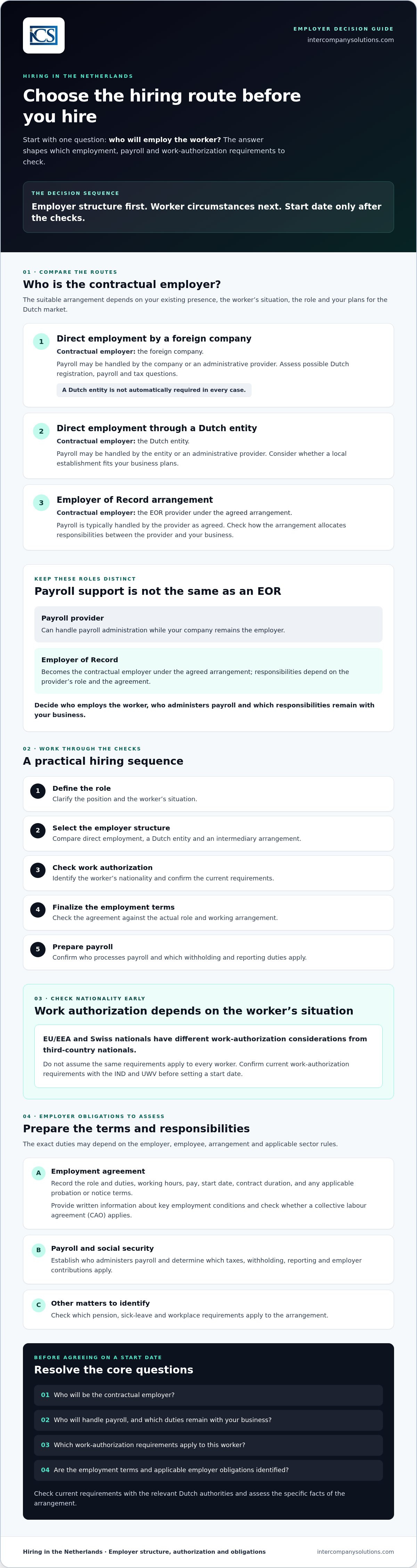
- Follow a clear hiring sequence: define the role, select an employer structure, check authorization, finalize the contract, and prepare payroll.
- Confirm current work authorization requirements with the IND and UWV before setting a start date.
Table of Contents
- Hiring employees in the Netherlands: choose the right route first
- Dutch employment agreements and employer duties explained
- Work permits for hiring foreign employees in the Netherlands
- A practical hiring process: from role definition to first payroll
- Choose a compliant hiring setup and plan your next steps
How to hire employees in Netherlands: choose the right route first
Start by deciding who will employ the worker. A business can assess direct employment through a foreign company, hiring through a Dutch entity, or an intermediary arrangement such as an Employer of Record (EOR). The suitable route depends on your existing presence, the worker’s status, the role, and your plans for the Dutch market.
Separate the employer decision from payroll administration. A payroll provider can handle administrative tasks without becoming the worker’s employer. Under an EOR arrangement, the provider is the contractual employer under the agreed structure, while your business’s responsibilities depend on its role and the agreement.
| Route | Contractual employer | Payroll administration | Assess before choosing |
|---|---|---|---|
| Direct employment by a foreign company | The foreign company | Handled by the company or an administrative provider | Whether the arrangement raises Dutch registration, payroll, or tax questions. |
| Direct employment through a Dutch entity | The Dutch entity | Handled by the entity or an administrative provider | Whether local establishment fits the company’s business plans. |
| Employer of Record arrangement | The EOR provider under the agreed arrangement | Typically handled by the provider as agreed | How the contract allocates responsibilities between the provider and your business. |
Can a foreign company hire someone in the Netherlands directly?
A foreign company may be able to employ someone directly, but the answer depends on its legal and operational circumstances. A Dutch entity is not automatically required in every case, and it should not be assumed unnecessary without reviewing the facts. Assess possible Dutch registration, payroll, and tax implications with the Dutch Tax Administration and relevant professional advisers. If you are considering local establishment, see this guide to starting a business in the Netherlands.
Direct employment, payroll support, or Employer of Record
With direct employment, your company remains the employer even if a provider processes payroll. An EOR instead becomes the contractual employer under the agreed arrangement. Don’t choose between these options based on administrative convenience alone. Clarify who employs the worker, who manages payroll, and which responsibilities remain with your business. For a closer comparison of payroll administration options, review the proposed arrangement and seek guidance for your specific circumstances.
Dutch employment agreements and employer duties explained
If you plan to hire employees in Netherlands, set out the employment terms clearly and identify who is responsible for each employer obligation. A written agreement helps both parties understand the arrangement, but it does not replace checking which statutory information must be provided or which sector rules apply.
What should a Dutch employment agreement cover?
Record the agreed role, duties, working hours, pay, start date, contract duration, and any applicable probation or notice terms. This is a practical starting point, not an exhaustive legal checklist. Dutch employers must provide employees with written information about key employment conditions. Check the current requirements in the Dutch government guidance on employment contracts. Also verify whether a collective labour agreement (CAO) applies, as it may set additional terms.
Before signing, check that the document matches the actual working arrangement. If the role or hours change, for example, review whether the contract and payroll information need updating. The employer’s responsibilities can also depend on the employee’s circumstances and the terms agreed.
Which payroll and social obligations should employers plan for?
Establish how payroll will be administered and determine which taxes and social insurance contributions apply. If your business is responsible for Dutch payroll, confirm its withholding and reporting duties with the Dutch Tax Administration’s payroll tax guidance. The exact treatment may depend on the employer, employee, and arrangement.
- Payroll and social security: Confirm who processes payroll and handles applicable withholding and employer contributions. Outsourcing payroll administration does not, by itself, transfer the employment relationship.
- Pension: Check whether a sector pension scheme or another pension arrangement applies. Requirements can depend on the employer’s sector and the employee’s position. Consult government guidance on pension schemes.
- Sick leave: Employers generally have a continued-pay obligation when an employee is ill. The Dutch government describes the applicable rules, including the period and minimum payment requirements, in its sick-leave payment guidance.
These duties are not identical for every hire. Check the worker’s contract, any applicable CAO, and the employer arrangement before setting up payroll. For a closer look at administration options, review the Dutch payroll services overview. If you need to assess how these obligations apply to your planned setup, you can discuss your hiring situation with a specialist.
Work permits for hiring foreign employees in the Netherlands
Work authorization depends first on the employee’s nationality. EU, EEA, and Swiss nationals generally don’t need a Dutch work permit. For someone who is not a national of one of these countries, the employer must establish which authorization route applies before the person starts work. The role and the employee’s circumstances matter, so don’t assume one permit type covers every international hire.
Do EU, EEA, and Swiss nationals need a Dutch work permit?
As a general rule, employees who are citizens of an EU or EEA country or Switzerland can work in the Netherlands without a work permit. Verify the worker’s nationality and check current guidance from UWV on work permits before confirming the hiring arrangements. This general rule concerns work authorization. It does not determine whether other requirements apply to the employee or employer.
What should employers check before hiring a non-EU national?
For a third-country national, meaning someone who isn’t an EU, EEA, or Swiss national, identify the relevant work and residence authorization requirements before work begins. Depending on the case, the employer may need to apply for authorization or meet conditions linked to the employee’s permit. Check the IND’s work residence permit guidance and UWV’s current work-permit information rather than relying on a general description of a permit route.
Use this practical sequence before agreeing on a start date:
- Confirm nationality and current status. Ask which citizenship or residence status the employee will rely on, then verify the implications through official guidance.
- Describe the role accurately. Duties and employment arrangements can affect which route should be assessed. Make sure the application or permit conditions match the actual job.
- Check who must take action. Confirm whether the employer, employee, or both must complete steps, and whether an application or approval is required before work starts.
- Keep the start date conditional. Don’t treat a submitted application as confirmation that work can begin. Check the decision and any stated conditions with the relevant authority.
A highly skilled migrant permit may be an option for some non-EU hires, but it isn’t a universal route. The employer and employee must meet the applicable IND conditions, including any requirements related to the employer’s status and the role. Verify eligibility directly with the IND’s highly skilled migrant guidance before relying on this route.
For businesses planning to hire employees in Netherlands, document the employee’s nationality, role, proposed start date, and employer structure. Then confirm the applicable requirements with UWV or IND. This helps distinguish work authorization checks from separate payroll and employment obligations.
A practical hiring process: from role definition to first payroll
Use a documented workflow to track decisions, confirmations, and tasks before the employee’s first payment. Assign an owner to each step, particularly when the employing entity, the candidate’s status, or payroll responsibilities affect what must be checked.
What should an employer prepare before making an offer?
Prepare the role description, proposed terms, employing entity, candidate’s nationality and known work status, and intended start date. Use these details to identify questions that need confirmation from the relevant authority or adviser. Don’t treat a submitted application or an assumed processing period as approval. Verify any applicable conditions before confirming when work can begin.
How should employers prepare payroll and ongoing administration?
Before the first payment, establish who will operate payroll and handle the applicable filings. If you are considering a Dutch entity, assess formation and employment planning together. This Dutch company formation guide outlines the local establishment process.
- Define the role and terms. Document the duties, work location, hours, proposed remuneration, and contract type. Check whether the actual arrangement raises employment or sector-specific questions.
- Confirm the employing structure. Record which entity or intermediary will be the contractual employer. If a foreign company will employ directly, assess whether its activities raise Dutch registration, tax, or payroll questions.
- Complete candidate-specific checks. Confirm the candidate’s nationality and current work status. Where authorization may be required, verify the applicable route and conditions with the IND or UWV before work begins.
- Finalize the written terms. Ensure the employment agreement reflects the role and the parties’ arrangement. Check whether a collective labour agreement or pension arrangement needs to be considered.
- Prepare first payroll. Set up the information and process needed for payroll, applicable withholding, social security, and any relevant pension administration. Decide how absences and changes to employment details will be recorded.
- Maintain records and review duties. Keep employment and payroll documentation organized, and assign responsibility for ongoing updates and filings. For tax records, the required standard is: records retained 7 years (10 for immovable property). Confirm the recordkeeping requirements for your circumstances with the Dutch Tax Administration.
Before the start date, review the workflow to confirm that responsibilities are assigned, required checks are complete, and payroll is ready. Keep the process active after onboarding by recording relevant changes and checking ongoing obligations against current official guidance.
Choose a compliant hiring setup and plan your next steps
The right structure depends on how long you expect to employ the person, whether your business plans to establish a presence in the Netherlands, and who can manage employment and payroll administration. Before you hire employees in Netherlands, confirm who will be the contractual employer. Then assess the obligations attached to that arrangement and the candidate’s circumstances.
| Route to assess | May suit a business that | Key point to confirm |
|---|---|---|
| Direct employment by a foreign company | Has a foreign employing entity and is assessing a hire in the Netherlands. | Whether Dutch registration, tax, payroll, or other employer requirements apply. |
| Direct employment through a Dutch entity | Plans to develop an ongoing business presence in the Netherlands. | That the entity is ready to employ the worker and administer applicable obligations. |
| Employer of Record arrangement | Is considering an intermediary as the contractual employer. | Which responsibilities belong to the provider and which remain with your business. |
Payroll support is a separate administrative consideration: a provider may process payroll tasks without becoming the contractual employer. Intercompany Solutions offers payroll support for Dutch entities and international employers, alongside Dutch BV company formation and accounting and tax services. Review the proposed arrangement carefully, especially if employment, immigration, and cross-border tax questions overlap. Work authorization depends on the worker’s nationality and status, while employer duties depend on the employing structure and specific working arrangement. Verify current requirements with the relevant Dutch authorities, including the IND, UWV, and Dutch Tax Administration.
What information should you bring to an initial consultation?
Prepare a concise summary so the proposed route can be assessed against the facts. Include:
- The employer’s country and whether it already has a Dutch entity.
- The proposed role, work location, expected duration, and intended start date.
- The candidate’s nationality and known work or residence status.
- Any existing Dutch payroll arrangements and who currently handles administration.
- Your preference for direct employment or an intermediary arrangement, if you have one.
Use this information to identify which points need confirmation before making an offer or setting a start date. An initial consultation with Intercompany Solutions can help you clarify which questions to take to payroll, tax, employment, or immigration specialists, without assuming that one hiring route fits every case.
Choose the right hiring path and move forward
A clear hiring plan starts with identifying the contractual employer, then checking the requirements that apply to that structure and the worker. Direct employment through a foreign or Dutch entity and an intermediary arrangement each involve different responsibilities. Work authorization also depends on the candidate’s nationality and status, so confirm the relevant requirements before agreeing on a start date.
As you prepare to hire employees in Netherlands, bring together the key details: your company’s country, the role, the candidate’s nationality, intended start date, and any existing Dutch entity or payroll arrangements. This gives you a practical basis for assessing the employment, authorization, and administration questions that still need an answer.
Intercompany Solutions has assisted more than 1,000 foreign entrepreneurs with company formation. Its payroll support can include employment contracts and payroll administration, offering one option to assess for ongoing administration needs.
With the relevant facts in hand, you can assess your options and take the next step with greater clarity.
Frequently Asked Questions
Can a foreign company hire employees in the Netherlands without setting up a Dutch BV?
In some situations, a foreign company can employ someone in the Netherlands without forming a Dutch BV, but it should first assess whether Dutch registration, payroll, or tax obligations apply. The answer depends on the employer’s activities and the specific employment arrangement. Check the Dutch Tax Administration’s payroll guidance and seek advice on the facts before making an offer or setting a start date.
Do EU citizens need a work permit to work in the Netherlands?
EU citizens generally don’t need a Dutch work permit. EEA and Swiss nationals are also generally treated differently from third-country nationals for work authorization. Confirm the candidate’s nationality and check current UWV work-permit guidance for the specific situation. This general rule concerns permission to work. It does not resolve other employment, tax, or registration requirements that may apply to the employee or employer.
Do non-EU employees need a work permit in the Netherlands?
Some non-EU employees need work authorization before starting work in the Netherlands. The required route depends on the employee’s circumstances and the role, so don’t assume a single permit type applies to every hire. Employers should confirm the requirements and any conditions before setting a start date. Check the UWV employer guidance and the IND’s work and residence permit information.
What must a Dutch employment agreement include?
A Dutch employment agreement should record the terms agreed by the employer and employee, including the role, start date, working hours, pay, and contract duration. Employers must also provide written information about key employment conditions. The applicable terms may depend on the arrangement and whether a collective labour agreement applies. Check the Dutch government’s employment contract guidance and ensure the written terms reflect the actual working relationship.
Who pays payroll taxes when a company hires an employee in the Netherlands?
The employer generally handles applicable payroll withholding and remits payroll taxes to the Dutch Tax Administration. The specific taxes and contributions depend on the employer, employee, and arrangement. A payroll provider may process administration without becoming the employer. For an Employer of Record arrangement, clarify which party is the contractual employer and how payroll tasks are allocated. Consult the Tax Administration’s payroll tax guidance for the relevant requirements.
Can an international employer use an Employer of Record in the Netherlands?
An international employer may consider an Employer of Record (EOR) arrangement, where the provider is the worker’s contractual employer under the agreed structure. Review the agreement to understand each party’s responsibilities. Using an EOR doesn’t automatically resolve every employment, tax, or work authorization issue for the international business. Confirm the arrangement’s implications and check permit requirements with the IND or UWV, as relevant.
Sources
- ICS Payroll - Dutch payroll services
- KVK - Registering with the Dutch Business Register
- Business.gov.nl - Private limited company (bv)
- Burgerlijk Wetboek Boek 2 (Dutch Civil Code, legal entities)
- Rijksoverheid - Ondernemen
- Belastingdienst - Payroll taxes (loonheffingen)
- UWV - Employer obligations
- SVB - Social insurance in the Netherlands
- IND - Highly skilled migrant
- IND - Start-up residence permit
- CJEU, Cadbury Schweppes, C-196/04 (ECLI:EU:C:2006:544)
- Hoge Raad, ECLI:NL:HR:2021:1152
- PwC Worldwide Tax Summaries - Netherlands
- ICLG - Corporate Governance Laws and Regulations, Netherlands
Need more information on the Dutch BV company?
Contact an expertReady to start your company in the Netherlands?
| Formation time | Dutch BV formation completed in 3 to 5 business days |
|---|---|
| Process | Fully remote setup with step-by-step guidance |
| Compliance | Expert support for registration, VAT and compliance |
| Aftercare | Accounting, tax and legal support included |
| One partner | All of the above through one trusted formation partner |